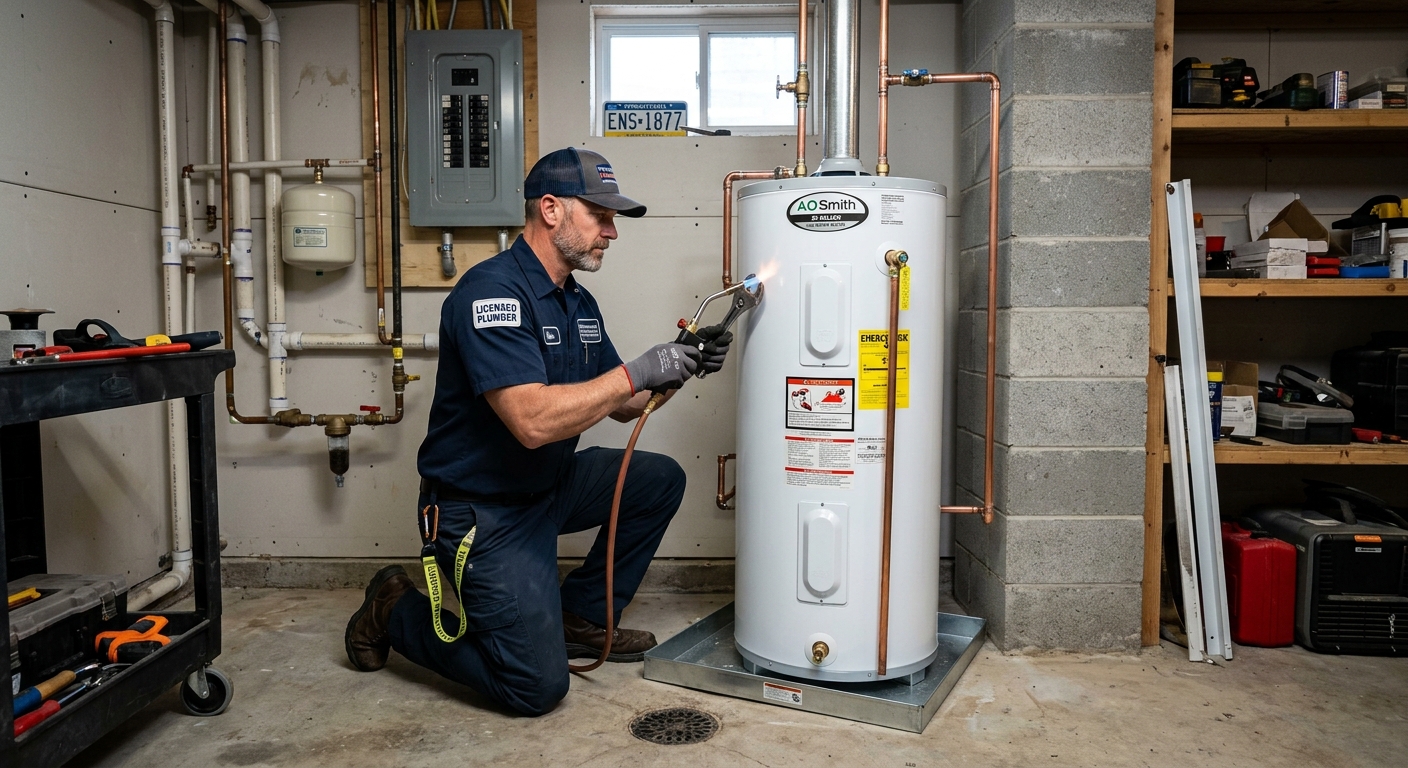
Plumbing costs in Thornbury — 2026
In Thornbury, where 74.9% of homes are single-family and nearly 22% were built before 1980 (U.S. Census Bureau, ACS 2024), plumbing repairs often come down to the age and original materials used in your system. Old galvanized pipes and 1945–1975 construction patterns—like those in nearby Upper Darby and Lansdowne—tend to drive up the risk (and cost) of both leaks and ongoing maintenance as those materials reach the end of their life. In a newer home, you might just be on your first water heater. But in a mid-century twin or rowhouse, you may be on your third, with old supply or drain lines finally giving up.
The most important thing to know is that the same repair can cost more when it’s an emergency—think pipe bursts at midnight—versus a planned, scheduled job. Diagnostic fees or overtime rates almost always apply after hours. Below are real price bands for core plumbing services in Thornbury. What you pay depends heavily on pipe access (finished basements or tight crawlspaces cost more) and what materials you have in your walls.
| Service |
Scope |
Emergency rate |
Standard rate |
| Emergency repair — burst pipe |
locate, open, repair section, restore service |
$700–$1,350 |
$400–$1,350 |
| Water heater replacement (gas, 40–50 gal) |
remove old, install, test, haul away |
$2,100–$3,200 |
$1,350–$3,200 |
| Drain cleaning — main line |
augering or hydro-jet, camera if needed |
$350–$800 |
$200–$500 |
| Sewer line spot repair |
excavate or reline a failed section |
$2,300–$13,500 |
$2,300–$13,500 |
| Whole-house repipe |
replace supply lines throughout, patch and finish |
|
$4,000–$9,600 |
| Water service line replacement |
street to house, excavation and restoration |
|
$6,200–$13,500 |
Estimates for a typical Thornbury home. Access difficulty and pipe material move these figures more than anything else.
Sewer line problems in Thornbury
In Delaware County—including Thornbury—the homeowner typically owns and is responsible for the entire sewer lateral running from their house to the municipal main, even when it extends under the street. This comes as a surprise to many, but it’s the source of the majority of disputes and insurance claims when backups or failures occur.
Common symptoms start mild and grow severe: slow drainage at a single fixture (usually closest to the exit point), then multiple slow drains, gurgling toilets when other fixtures are used, and finally water backing up at the lowest point—often the basement floor drain or lower-level tub. When you start to see multiple fixtures involved, the issue is rarely just a clog and more often a break, belly, or root intrusion in the lateral itself.
The gold standard for diagnostics is a sewer camera inspection before any talk of excavation. Older homes in the area commonly have clay tile or cast iron laterals—clay invites root intrusion at each joint, and cast iron can scale shut or corrode through. Pipe “bellies” (sags) and joint offsets turn up in homes of any era and may cause chronic problems. Spot repairs can be done by open-cut replacement or, where feasible, trenchless relining. Both have their place, but you should never approve a dig or relining quote without actually seeing the camera footage and getting a copy on a thumb drive or cloud link.
For homeowners in Thornbury’s more rural corners, where septic systems are common in outer townships like Edgmont—not the norm in most built-up areas—the issues shift. Here, regular pumping is the main defense; a slow drain might be a sign your tank is overfull or the drainfield is failing, which is a different specialist from a sewer repair.
Plumbing systems in Thornbury homes
Thornbury’s housing stock—where 21.8% was built before 1980 (U.S. Census Bureau, ACS 2024)—shapes what you can expect behind the walls. Many homes echo the postwar wave of construction seen throughout Delaware County, particularly the 1945–1975 rowhouses and twins of Upper Darby and Lansdowne. In these, you are likely to find original galvanized steel supply lines (now well past their prime), cast iron or vitrified clay drains, and sewer laterals that can include clay tile—always a target for roots and shifting.
If your home is newer, copper or even PEX (cross-linked polyethylene) may be present, and the service line (the water pipe running from street to house) is usually copper or plastic, possibly even original. Builder-grade fixtures last, but not forever: 20–30 years is common on water heaters, and much less with hard water. Whether your water heater is being replaced for the first or third time generally depends on the construction era, not just luck. In older homes, that water heater may be on its third or fourth go-round. Sewer backups or pressure issues? Know that the era sets your risk: the older the home, the more likely materials inside are due for wholesale replacement rather than spot repair.
Newer Thornbury homes rarely face lead service line issues but may have original polybutylene supply—the notorious blue or gray tubing—which is now a prime candidate for full replacement regardless of visible trouble.
Hardness, treatment and fixture life in Thornbury
Public water in Thornbury is supplied by Aqua Pennsylvania, Inc., covering most Delaware County municipalities. Residents can request the annual water quality report directly from Aqua, which will detail hardness and any treatment chemicals used. Most Thornbury homes are on public supply, which tends to be moderately hard—enough to shorten the life of water heaters and build up scale on fixtures over the years. That said, you won’t see the roof-eating or green stain “aggressive water” issues sometimes found in very soft municipal systems, so copper pinholing is relatively rare.
If you’re considering a water softener, do the math: a point-of-entry softener will run several hundred to a couple thousand plus ongoing salt costs, and most homeowners in Thornbury replace fixtures for looks long before scale truly wrecks them. For most, regular tank flushing will get more years out of a heater than a softener ever could. Whole-house filtration is oversold here; unless you’re facing specific taste, odor, or lead risks, a kitchen-point filter is usually enough.
If your Thornbury home is one of the few on a private well, the rules change. There’s no published report—you must test annually for bacteria and every few years for metals. Responsible local plumbers won’t suggest expensive treatment up front; they’ll walk you through options only if the lab finds a real contaminant.
Spot repairs or whole-house repipe?
If you’ve had two or more leaks on your supply lines in three years, especially in galvanized or polybutylene pipe, you’re past the “bad luck” stage—replacement starts to make more sense than another patch. Other clear signals include pressure drops at multiple fixtures, discolored water right after turning on a faucet, corrosion visible at exposed joints, and chronic pinhole leaks. These are the hallmarks of pipe systems that have aged out, a scenario common in Thornbury and its Delaware County neighbors built in the postwar era.
For decision-making: Copper is higher cost but familiar, with a proven lifespan. PEX is less expensive, flexible for tight retrofits, and code-approved. The crucial overlooked cost is finish work. In Thornbury’s older plaster-wall homes, patching and repainting can rival the plumbing work itself, especially on a full repipe. Sometimes a partial repipe—a new trunk line plus isolated spot repairs—makes financial sense if only part of the system is at risk. But with multiple failures on the same pipe material, it’s time to budget for a full replacement. Many local jobs stem from converting those 1945–1975 twins and rowhomes out of galvanized and cast iron, with prices reflecting both plumbing and wall repair.
| Situation |
Recommendation |
Cost |
Reasoning |
| One leak, accessible, modern pipe |
Spot repair |
$400–$1,350 |
Localized failure, no pattern; least disruption |
| Two or more leaks in 3 years |
Partial repipe |
$4,000–$6,400 |
Pattern indicates system-wide risk; fixes likely trouble sections |
| Galvanized supply, pressure loss |
Full repipe |
$4,000–$9,600 |
Systemic corrosion and diameter loss; continued repairs uneconomical |
| Polybutylene anywhere in the house |
Full repipe |
$4,000–$9,600 |
Material now known for failure; insurers may refuse coverage |
| Cast iron drain with root intrusion |
Camera, then reline or replace |
$2,300–$13,500 |
Roots and offsets in mainline usually call for more than cabling |
| Suspected lead service line |
Test, then replace the lateral |
$6,200–$13,500 |
Health concern; replacement often offset by utility grants |
Detection methods and what they cost
The cheapest leak detection method is in your hands: shut off every fixture, don’t run any water, then check the water meter (usually in the basement near your main shutoff). If the dial or digital readout moves over several minutes, you have a supply-side leak somewhere—no cost at all to run this test in Thornbury homes serviced by Aqua Pennsylvania.
Professional methods jump up the cost. Acoustic listening—using sensitive mics to pick up leak sounds in walls or slabs—can range from $400–$1,350 depending on time and setup. Thermal imaging, where hot or cold lines are mapped by temperature differences, is used for in-wall leaks but is not foolproof. Gas tracing (injecting harmless gas and sensing its escape) is reserved for the hardest-to-find leaks, especially under slabs or driveways, and is on the higher end of the price range. Direct slab leak localization, relying on combinations of the above, can cost as much as a minor emergency repair.
Where you have plumbing buried in a slab, a leak can manifest not as a visible drip but a higher water bill, unexplained moisture, or warm spots on the floor. Leaks inside finished walls are harder—the right plumber will find it before cutting, not after. In Thornbury, with many homes on basements rather than slabs, most hidden leaks aren’t truly invisible: look for wall stains, foundation dampness, or an unexplained meter spin before calling anyone in for advanced detection.
Verifying a Thornbury plumber's credentials
Pennsylvania licenses plumbers at the municipal—not state—level, which is critical for Thornbury homeowners to know. There is no statewide plumbing license here. That means the plumber you hire must hold the right credential in Thornbury’s local jurisdiction, not just in a neighboring city—Philadelphia and Pittsburgh run their own exams and lists but these do not apply in Delaware County. Always ask which municipality issued the credential and confirm it covers your address.
All contractors working on jobs over $500 must be registered as Home Improvement Contractors (HIC) with the Pennsylvania Office of Attorney General. This is the state’s consumer check for contracts: you can confirm registration at hic.attorneygeneral.gov. When it comes to workers' compensation insurance, Pennsylvania requires all employers to carry it (including plumbers), and homeowners can check valid insurance certificates directly in the state system at wcais.pa.gov.
Permitting varies by municipality. In Upper Darby, new or relocated plumbing lines or fixtures nearly always require a building permit and inspection by the local code office; smaller repairs, such as swapping a faucet or fixing a toilet fill valve, run without permits in places like Media. The authoritative residential code is the Pennsylvania Uniform Construction Code, enforced locally. Always ask your plumber what permits apply and who performs the inspections before the job starts. No permit? No inspection? Walk away.
Frequently asked questions — plumbing in Thornbury
Do I need to drain outdoor spigots in Thornbury?
Every Thornbury homeowner should drain and winterize their outdoor spigots each fall. Delaware County’s 30-inch frost depth and 14 °F winter design temperature mean outdoor faucets and supply lines can freeze and burst if left pressurized—even in a mild winter. For houses with older, non-frost-free sillcocks built before the 1980s, this step is not optional. Draining and shutting off the supply indoors (with the bleeder left cracked to release pressure) prevents one of the most common winter emergencies. A frozen burst outside line can lead to an emergency repair bill of $700–$1,350. Fifteen minutes in October can save you that headache and expense every time.
What does discoloured water on first draw mean?
Discoloured or rusty water appearing first thing in the morning or after a period of non-use usually points to an issue with your home’s supply lines—especially if your Thornbury house predates 1980 and still has galvanized plumbing. The rust or mineral particles settle overnight, then wash out when you turn on the tap. This is a classic warning that your pipes may be corroded or scaling shut. If it’s affecting all fixtures and not just one, a full or partial repipe is likely in order, falling in the $4,000–$9,600 range for most Thornbury homes. In isolated fixtures, sometimes the problem is just in the faucet itself, which is a much smaller fix, but persistent whole-house discolouration is a sign the system is reaching the end of its reliable life.
What does repiping a house cost in Thornbury?
Repiping a whole house in Thornbury costs $4,000–$9,600 as of 2026, depending on the size of the house, the thickness of old walls (plaster will mean more finish work), and whether copper or PEX is used. If your home falls into the average-size, 1950s–1970s-built stock common in Delaware County, expect to be nearer the mid-to-upper end if you’re choosing copper, or lower-to-mid for PEX. The cost includes new supply piping, patching walls and ceilings, and cleanup. If you only need a partial repipe—maybe because only the main risers or a basement trunk line is failing—you can knock this down toward the low end. Always get the scope of finish work spelled out in writing, because patching can double the total in older homes.
How do I verify a plumber's licence and insurance?
In Thornbury, the right credential to check is the municipal license for plumbing—there's no Pennsylvania state plumbing board or universal state license in this trade. Always ask your plumber where they’re registered, and confirm that license covers the township where your home is located. For all contracts over $500, the plumber must also have an active Pennsylvania Home Improvement Contractor (HIC) registration. You can check this free at hic.attorneygeneral.gov. For insurance, request to see their certificate of liability and workers’ compensation coverage; verifying workers’ comp is as simple as looking them up at wcais.pa.gov. Insist on seeing these before letting anyone open a wall—full legal compliance protects you if anything goes wrong, especially on jobs over $400–$1,350.
How hard is the water in Thornbury?
Most Thornbury homes get water from Aqua Pennsylvania, Inc., which supplies municipally treated water that’s moderately hard. This means you’ll notice white mineral spots on fixtures and may have to flush your water heater more often, but you’re unlikely to see the worst corrosion or pinhole issues. Annual water quality reports (available on request from Aqua) detail the exact hardness by neighborhood and are a reliable resource if you’re deciding whether to add a water softener. The economics of full-house softening here are debatable; most homeowners don’t save more than they spend, while basic maintenance (like draining your water heater) and optional point-of-use filters offer the best bang for your buck. If buildup ever wrecks your heater, replacing it runs $1,350–$3,200.
Who owns the sewer lateral, me or the city?
In Thornbury and the rest of Delaware County, homeowners are responsible for the entire sewer lateral—the buried line running from the house all the way to the main out in the street. If a tree root, collapse, or offset joint causes a blockage or backup, you’re on the hook for repairs, not the township. This is a critical reason to get a camera inspection before you buy a home, and never let anyone sell you on excavation or relining without seeing the footage yourself. Sewer line spot repairs in Thornbury typically run $2,300–$13,500, so knowing that ownership line before you start can save you a costly, time-consuming argument with the utility or municipality after the fact.
Repair or replace a leaking water heater?
In Thornbury, the age and type of your water heater matter most. If it’s more than 8–10 years old and leaking from the bottom, replacement is almost always the right call; tank failure isn’t worth patching. For newer units with drips at valves or connections, a repair in the $400–$1,350 range could add years of service. Remember, Delaware County’s moderately hard water can shorten heater life, so even a tank that’s not visibly corroded may already be scaling up inside. Factor in the age, efficiency, and cost of ongoing repairs. When in doubt, ask your plumber about the heater’s serial number date and compare repair costs to the replacement band of $1,350–$3,200. For the oldest tanks, replacement wins every time.
What counts as a plumbing emergency?
Any leak or backup that risks property damage or health in your Thornbury home is an emergency by local standards. This includes an active supply leak (water pouring or pooling), total sewer backups, burst pipes, or a failed water heater spraying uncontrolled water. These situations can rack up hundreds or thousands in damages every hour you delay. Emergency repair rates reflect the urgency: expect costs from $700–$1,350 for a burst pipe fix, mostly driven by after-hours labor and the need to restore critical services quickly. If the problem can wait without danger—like a slow drip into a tub or a stubborn clog in a secondary bathroom—it’s better and much cheaper to schedule standard service the next business day.
Why do plumbers charge a diagnostic fee?
In Thornbury and across Delaware County, most plumbers charge a diagnostic or service fee to cover the cost of travel, time, and skill in pinpointing your issue. Diagnosis isn’t just looking at a drip—it often means using camera scopes, meters, or opening inaccessible areas. This is especially true for hidden leaks, drainage problems, or anything that requires testing. The fee typically applies toward your repair cost (for example, a fee in the $200–$500 range is common for main line drain inspection), but it ensures the tech’s time is accounted for even if you decide not to move forward. Some companies waive this fee if you approve repairs on the spot, but always ask ahead to avoid surprises on the invoice.