Emmaus plumbing prices by job type — 2026
Emmaus homeowners face a wide range of plumbing costs, heavily influenced by when your house was built and what materials were used. With 79.3% of local homes built before 1980 and a 66.0% homeownership rate (U.S. Census Bureau, ACS 2024), a large portion of Emmaus housing stock is aging and carries pipes and fixtures near end of life. In South Whitehall and Upper Macungie—where tract housing from the post‑1950 boom remains common—upgrades such as copper-to-PEX repipes and fixture modernization are frequent jobs, and prices shift accordingly.
One key driver of price is whether your need is an emergency (like a burst pipe at night) or planned work (like a water heater replacement scheduled weeks out). Emergency rates cover after-hours labor and the scramble to get specialized parts or trades on site, which will nearly always raise your cost.
Older homes often have supply pipes in galvanized steel or early copper, and the drain lines might be cast iron or even clay tile. When a pipe fails, that often means a quicker call to a plumber, often at emergency rates if the leak is actively damaging drywall or flooding the basement. In contrast, planned jobs like a water heater replacement or a full repipe can be scheduled within standard work hours, which helps contain costs. Still, Emmaus pricing is shaped more by pipe access and material than anything else—even in the same neighborhood.
| Service |
Scope |
Emergency rate |
Standard rate |
| Emergency repair — burst pipe |
locate, open, repair section, restore service |
$600–$1,200 |
$350–$1,200 |
| Water heater replacement (gas, 40–50 gal) |
remove old, install, test, haul away |
$1,900–$2,800 |
$1,200–$2,800 |
| Drain cleaning — main line |
augering or hydro-jet, camera if needed |
$350–$800 |
$200–$500 |
| Sewer line spot repair |
excavate or reline a failed section |
$2,000–$12,000 |
$2,000–$12,000 |
| Whole-house repipe |
replace supply lines throughout, patch and finish |
|
$3,500–$8,600 |
| Water service line replacement |
street to house, excavation and restoration |
|
$5,500–$12,000 |
Estimates for a typical Emmaus home. Access difficulty and pipe material move these figures more than anything else.
Plumbing systems in Emmaus homes
The story of your plumbing follows the decade your house was put up. With 79.3% of Emmaus homes built before 1980 (U.S. Census Bureau, ACS 2024), you’re likely dealing with a mix: older homes will have galvanized steel or early copper water lines, cast iron or clay drains, and sometimes clay tile sewer laterals. These materials were state of the art in their day but come with predictable aging: galvanized steel narrows with corrosion, and cast iron drains crack or develop pinholes over time. Clay tile sewer laterals tend to leak at joints where tree roots can enter.
If your home was built in the big post-1950 suburban expansion—think South Whitehall or Upper Macungie—the original plumbing might still be copper supply with cast iron drains, but as repipe work has become common, you could find sections of PEX or even leftover stretches of polybutylene (in houses from the late ‘70s to mid-‘90s). Polybutylene is notorious for sudden failure at fittings, and most insurers want it replaced.
Emmaus homes of this vintage are often now on their second or third water heater. It’s rare to find an original tank that has lasted more than 12–15 years. If your attic or crawlspace is stuffed with builder-grade fixtures, expect early copper or even some PVC in places that have seen remodeling.
What looks like “newer” doesn’t mean risk-free. For example, PEX piping can fail from improper installation or damaged fittings, and even mid-1980s construction may have problematic polybutylene if the house fell into that product’s lifespan. So, if you’re not sure what you have, a visual check of accessible pipes (color, connection type, any obvious corrosion) is a smart place to start before planning any upgrades or repairs.
The leak you can hear but can't see
If you suspect a hidden leak—maybe your water bills spiked or you hear the faint hiss of running water—there’s a simple test you can do before calling a plumber. Shut off every faucet, appliance, and fixture, then check your water meter; if the dial or digital indicator keeps moving, you have a supply-side leak somewhere between the meter and the last fixture.
Once you know a leak exists, plumbing pros use a set of targeted tools to find it fast. Acoustic listening maps out pipe runs and pinpoints leaks by amplifying sound; most non-destructive and often included in a service charge. Thermal imaging picks up temperature changes caused by water behind walls or floors, especially helpful with hot water line leaks. For the tough cases—slab leaks or leaks seen only in an isolated area—tracer gas (safe, nonstaining, but a premium option) may be used. Spot location with these tools in Emmaus generally falls in the $350–$1,200 range if opening walls or floors isn’t required.
Slab leaks (water lines run under the concrete floor) are trickier—detection without guesswork is possible with good equipment. Likewise, a leak inside a wall cavity should be located by sound or imaging before a single hole is cut. Irrigation line leaks are found by isolating zones and using thermal or acoustic testing to reveal the break.
If you call a plumber who wants to immediately cut open ceilings or walls before trying to locate the problem, ask for a second opinion. In Emmaus, opening up before locating is backwards: you want the exact spot, not exploratory demolition billed as leak detection.
Water heater replacement decisions
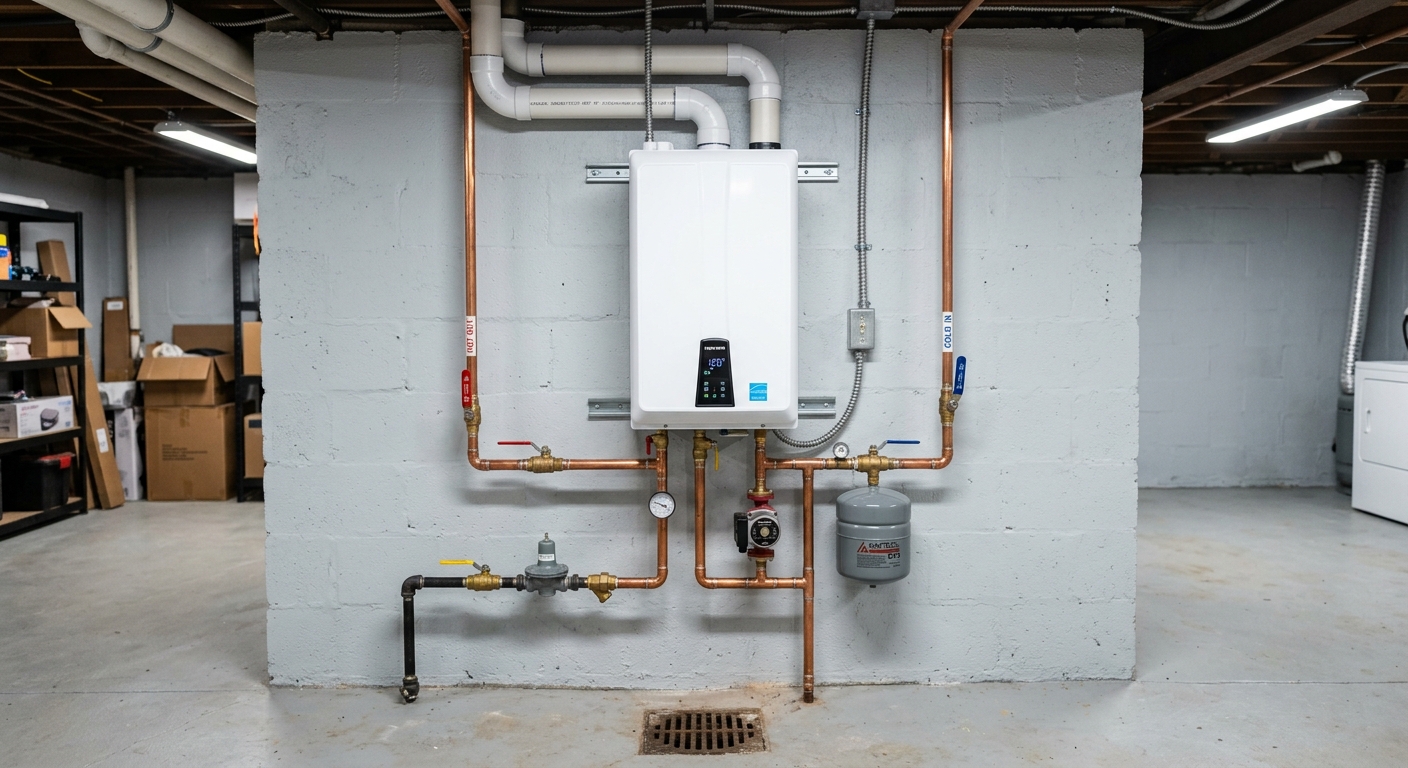
Replacing a water heater in Emmaus is rarely about just the sticker price or the fuel source—you have to match the equipment to both your home and your usage patterns. Gas tank models are the norm in many local homes, especially older houses with pre-existing venting and gas service. They’re the cheapest to install, but have the shortest lifespan and lose energy to standby heat all day. Expect $1,200–$2,800 installed, with replacement every 8–12 years.
Tankless heaters—nearly always gas in our area—promise endless hot water, but the install is pricier because of venting and often a gas line upgrade. If your home doesn’t already have a big enough line, be prepared for some extra cost. Service life jumps to 18–25 years, and running costs are lower because you heat only what you use. Still, for many Emmaus families, the extra spend up front doesn’t pay back in real world savings unless you have high hot water demand.
Heat pump water heaters need lots of air to work efficiently and draw heat from the room, cooling the space they’re in and generating noticeable noise. In a finished basement, this can be a nonstarter. They’re cheapest to run, and in a tightly sealed home without easy gas access, they can be a good choice. However, not every space makes sense for this technology.
Always size a water heater by its first-hour rating (the gallons of hot water it can deliver at peak use), not just the tank size. Expansion tanks are code for new installs, and a drain pan is a must when the heater sits on anything finished. Most failures are from tank leaks, not the controls—so if your heater is 10+ years old and not performing, expect to need a replacement rather than a repair.
| Type |
Installed cost |
Service life |
Operating cost |
Best when |
| Gas tank, 40–50 gal |
$1,200–$2,800 |
8–12 yrs |
moderate |
Existing gas & vent, average hot water demand |
| Electric tank, 40–50 gal |
$1,200–$1,900 |
10–15 yrs |
high |
No gas service, moderate use, easy swap |
| Gas tankless |
$1,900–$2,800 |
18–25 yrs |
low-moderate |
High demand, willing to pay more for space/efficiency |
| Heat pump water heater |
$1,900–$2,800 |
13–15 yrs |
lowest |
Plenty of air, little/no gas, concern about energy cost |
Pipe materials in Emmaus homes and how they fail
If you want to estimate your plumbing’s remaining life or risk of failure, start with when your Emmaus home was built. In the post‑1950 suburban tract housing of South Whitehall and Upper Macungie, copper became common for supply lines, but you can still find sections of galvanized steel in earlier homes. Galvanized steel (pre-1960) looks silvery gray, takes a magnet, and threads together at joints; it fails by corroding from the inside out, first losing pressure, then eventually leaking.
Copper (1950s–present) is reddish and nonmagnetic; connections are soldered. It generally lasts 50–70 years except where pitted by acidic or aggressive water, where pinhole leaks can develop. Polybutylene (late 1970s–mid-1990s) is dull gray or blue, usually marked at fittings; it fails unpredictably, often by blowouts at joints, and insurance companies often insist on full replacement.
PEX (2000s–present), now Emmaus’s standard, is flexible plastic, often red, blue, or white, with crimped or cinch ring connections. It holds up well but is vulnerable to improper installation (especially exposure to sunlight before install or poor support at fittings).
Drains follow a similar evolution. Pre-1975, cast iron (heavy, dark gray, joined by clamps or lead) was the default, lasting 50–75 years. Clay tile sewer laterals (pre-1980) are brittle and tan or reddish, prone to root penetration at the joints. After the 1970s, PVC and ABS took over, offering longer life but with a risk of joint separation in poor installs.
A scratch test (galvanized will reveal shiny steel, copper will remain copper-red) plus check of fitting style and pipe color will usually reveal material. If you know your build year, you can estimate runway: anything pre-1970 likely needs careful inspection and possible budgeting for future replacement.
| Material |
Typical era |
Failure mode |
Service life |
| Galvanized steel supply |
pre-1960 |
internal corrosion, pressure loss |
40–60 yrs |
| Copper supply |
1950s–present |
pinhole leaks, joint failure |
50–70 yrs |
| Polybutylene supply |
late 1970s–1995 |
fitting failure, sudden bursts |
unreliable |
| PEX supply |
2000s–present |
fitting or UV degradation |
40–50 yrs |
| Cast iron drain |
pre-1975 |
corrosion, cracking, scale |
50–75 yrs |
| Clay tile sewer lateral |
pre-1980 |
root intrusion at joints, offset |
50–60 yrs |
| PVC / ABS drain |
1970s–present |
joint separation, crushing |
50+ yrs |
How to find a good plumber in Emmaus
Emmaus requires special attention when hiring a plumber. Plumbing in Lehigh County—including Emmaus—is licensed and permitted at the municipal level via offices like the City of Allentown Building Office. So, always verify that any contractor holds a valid trade license for work in your specific municipality; being registered elsewhere may not be enough.
Check two key things: HIC registration (required for all contracts over $500 in Pennsylvania, verify at hic.attorneygeneral.gov) and an insurance certificate naming your property and current policy period. Workers’ compensation coverage is mandatory for all employers in Emmaus and can be checked via WCAIS (wcais.pa.gov). For emergency jobs, ask if the plumber is using their own crew or subcontractors—this impacts warranty and insurance. Clarify how emergency rates work, since the markups for after-hours work can be substantial.
- Verify HIC registration number at hic.attorneygeneral.gov.
- Ask whether the plumber is licensed specifically to work in Emmaus or your municipality.
- Request a certificate of insurance naming your property address.
- Check workers’ compensation status at wcais.pa.gov.
- Clarify if the plumber uses employees or subcontractors.
- Review all job quotes for clear explanation of labor and material rates.
- Require written contracts for any work over $500, per state law.
- Ask how emergency dispatch and after-hours pricing is calculated and presented.
- For repipes or sewer replacements, require video camera documentation or pressure test results before approving big jobs.
- Review references from nearby Emmaus homeowners or neighbors.
- Check for reputation: saturated local market means you have options—don’t rush.
- Be wary of anyone pushing major work on a first visit without diagnostic backup.
Red flags: In a dense urban-suburban market like Lehigh County, high-pressure sales, refusal to document findings, or quotes for a massive repipe or sewer replacement with no camera footage or leak test should send you looking elsewhere.
Who is allowed to do plumbing work in Pennsylvania
Pennsylvania does not issue a statewide plumbing license—plumbing is licensed municipally. In Lehigh County, that means even a fully qualified plumber in one area may have zero credentials a few blocks away. For Emmaus, the key authority is the City of Allentown Building Office, which requires its own plumbing trade license for work performed locally. So don't just ask, “Are you licensed?”—ask, “Are you licensed for this municipality?”
For work over $500, any contractor must hold a Pennsylvania HIC registration, which you can check at hic.attorneygeneral.gov. Insurance and workers’ compensation coverage are mandatory and verifiable through their respective systems. If your job is in Emmaus, only sign with a plumber who provides a certificate naming your property from the insurer, and check their workers’ comp at wcais.pa.gov.
Permits are required for most plumbing alterations and water heater replacements in Allentown and other Lehigh County municipalities. Very minor like-for-like fixture repairs inside your home usually don’t need a permit. Building inspectors—municipally based or through third-party UCC offices—handle inspections before work is finalized. Before approving a contract, confirm the permits will be pulled in your name and that your contractor is legal to perform the work under municipal and state frameworks.
Don’t get talked into any project over $500 without a written contract, which is required by the Home Improvement Consumer Protection Act. And know your right to cancel within 3 business days. A reputable Emmaus plumber will expect your questions and have every credential ready to show.
Frequently asked questions — plumbing in Emmaus
Why do plumbers charge a diagnostic fee?
In Emmaus and throughout Lehigh County, most plumbers charge a diagnostic fee—sometimes called a trip or service charge—because even a simple assessment takes time, travel, and tools. These fees usually range within the lower end of an emergency repair charge—figure a minimum part of the $350–$1,200 range. Many homes here, over 79% built before 1980 (U.S. Census Bureau, ACS 2024), have hard-to-access basements or aged systems not covered by basic warranties. If a plumber spends an hour diagnosing a hidden leak or using a camera to find a clogged drain, that still costs resources—regardless of whether you go ahead with the repair. Sometimes, plumbers will waive the fee if you buy the repair then and there, but not always. It's better to pay for a real assessment than to guess and get stuck with a big surprise down the line.
How long should a water heater last in Emmaus?
In Emmaus, most water heaters last roughly 8–12 years for a gas tank model and up to 15 years for electric, which matches the average for homes of this era. Given that nearly four out of five Emmaus homes were built before 1980, it’s quite likely your home is already on its second or third heater. Many failures are due to tank corrosion, not failed controls. Models cost $1,200–$2,800 to replace, depending on whether it’s an emergency swap or a planned install. If your heater is pushing 10 years, keep an eye out for rusty water, visible leaks, or trouble maintaining temperature—these are signs it’s time to budget for replacement. Upgrading before total failure can avoid the emergency premium and let you choose the best fit.
Is a sewer line replacement covered by homeowner's insurance?
In Emmaus, as elsewhere in Pennsylvania, most standard homeowner's insurance policies do not cover the replacement of a sewer line due to normal wear and tear or aging—problems that are common with the pre-1980 clay tile and cast iron laterals found here. They will sometimes cover sudden accidental damage, like a collapse caused by a vehicle or a direct water main break, but not old pipes letting in roots or corroding. Sewer line spot repair typically runs from $2,000–$12,000, so it's worth reviewing your policy’s exclusions closely. Some homeowners buy supplemental “service line” coverage for an added fee. If you’re seeing slow drains, backups, or wet spots in your yard, get a camera inspection (with footage), so repairs are based on proof—not just guesswork.
Is a tankless water heater worth it in Emmaus?
Tankless water heaters can be worth it for Emmaus families with high hot water demand, especially if you’re already planning to upgrade venting or your gas supply. Installation often costs $1,900–$2,800 and can require new gas lines or vent work—expenses that catch many by surprise. If your hot water use is sporadic or your current gas line is undersized, you may not see savings over a quality tank unit. The biggest benefit is endless hot water and less wasted space, with a longer lifespan (18–25 years) than most tanks. But for the average Emmaus homeowner with modest hot water needs and an existing tank setup, the traditional style often makes more financial sense.
Do I need to drain outdoor spigots in Emmaus?
Absolutely—freezing conditions in Emmaus are enough to burst supply lines, especially with the 36-inch frost depth common to our area. Even so-called “frost-free” spigots can split if a hose is left attached. Fixing a burst pipe due to a frozen sillcock or buried supply line can easily hit the $600–$1,200 range for an emergency. Every fall, shut off the indoor valve (if present), drain the line, and leave the spigot open for air expansion. A few minutes here can save a big repair bill in peak winter or a flooded finished basement.
What does drain cleaning cost in Emmaus?
Drain cleaning for a main line in Emmaus typically runs $200–$800, depending on access, severity of blockage, and whether you need standard augering or a full hydro-jet plus camera confirmation. The lower end of the range covers routine snaking or augering—fairly common in homes with cast iron or clay drains built before 1980. If roots have invaded the lateral or the clog is deep, expect to pay at the high end, especially if camera inspection is needed. Any quote over the top of this range should come with clear footage and a written explanation before you approve costly repair work.
What do I do about a burst pipe right now?
If you have a burst pipe in Emmaus, your first action is to shut off the main water valve to stop further flooding—this is usually found in the basement near the front wall where the water line enters. Then, call a plumber who can respond quickly—expect an emergency repair in the $600–$1,200 range for after-hours or urgent dispatch. Before any wall is opened, ask what diagnostics will be performed to limit collateral damage. In an older home, the fastest access may not be the tidiest, so clear the area if possible to speed up the process. Once service is restored, work with your plumber to review pipe material and remaining life to avoid repeat events.
Can I do my own plumbing work in Emmaus?
You can legally do very minor, like-for-like fixture repairs inside your dwelling in Emmaus without a permit. Examples include changing a faucet or toilet flapper. Anything involving pipe alteration, water heater replacement, or moving fixtures requires a permit from your local municipal or UCC office, and must pass an inspection. Local code is enforced at the municipal level, so always check with the building office for the current process. If you do work without permits, especially anything over $500, you forfeit protection under the Home Improvement Consumer Protection Act and risk fines or denial of insurance claims if something goes wrong.
Which utility supplies water to Emmaus?
Emmaus is primarily served by the Lehigh County Authority, which oversees water utility under the City of Allentown concession. If you’re unsure about your service line material or need details on the ongoing lead service line inventory and replacement program, contact the Authority directly for current guidance. Water service line replacement, when required, typically runs $5,500–$12,000 in Emmaus, covering excavation, new piping, and restoration. If you own a home built before 1980, you may get a notice regarding future replacement or the need for improved service line documentation.