What plumbers charge in Center
Center, like the rest of Beaver County, has unique plumbing costs tied directly to the era and construction of its homes. With 63.1% of homes built before 1980 and a homeownership rate nearing 80% (U.S. Census Bureau, ACS 2024), most Center houses were constructed during Beaver County’s postwar housing boom—meaning you'll often encounter slab-on-grade foundations and aging galvanized pipes. Galvanized lines tend to corrode and can eventually clog, turning what seems like a small job into a bigger project. In these homes, older pipes are the biggest factor driving both problem type and repair cost.
In Center, the same plumbing job almost always carries a split price: emergency calls cost more than scheduled work. That’s because after-hours dispatch, immediate response, and overtime labor all factor into the total. The difference isn’t small—a burst pipe fixed on a Sunday night will nearly always hit the upper end of the scale, while the same pipe can cost much less if you can turn off the water and wait until business hours. Here’s a look at typical plumbing costs in Center:
| Service |
Scope |
Emergency rate |
Standard rate |
| Emergency repair — burst pipe |
locate, open, repair section, restore service |
$600–$1,250 |
$375–$1,250 |
| Water heater replacement (gas, 40–50 gal) |
remove old, install, test, haul away |
$2,000–$2,900 |
$1,250–$2,900 |
| Drain cleaning — main line |
augering or hydro-jet, camera if needed |
$350–$800 |
$200–$500 |
| Sewer line spot repair |
excavate or reline a failed section |
$2,100–$12,500 |
$2,100–$12,500 |
| Whole-house repipe |
replace supply lines throughout, patch and finish |
|
$3,600–$8,800 |
| Water service line replacement |
street to house, excavation and restoration |
|
$5,700–$12,500 |
Estimates for a typical Center home. Access difficulty and pipe material move these figures more than anything else.
Water quality and what it does to your pipes
For homeowners in Center, water is supplied in many neighborhoods by the Beaver Falls Municipal Authority, which is required to publish an annual water quality report—a document you can (and should) request to know exactly what’s in your water. Hard water, common in southwestern Pennsylvania, leads to scale inside water heaters and fixtures, cutting their lifespan. If your water heater seems to fail on the short side of its expected life, buildup is often the culprit.
Aggressive or acidic water is another concern, as it can eat through copper over time—resulting in the pinhole leaks some Center residents find lurking in older plumbing. While a water softener can combat scale, the cost of installing a unit and keeping it supplied doesn’t always pay back here unless you notice rapid buildup or spotty fixtures. For most Center homes, the economics are simple: if your fixtures and appliances are failing well before their time, it’s worth looking at treatment. Otherwise, put your money elsewhere.
Filtration is another question—whole-house units are good for taste and sediment, but rarely needed for health if you’re on public water. If taste or discoloration bothers you, a point-of-use system at the kitchen tap is usually enough. In the rural reaches of Beaver County, private wells demand periodic professional testing since nobody publishes a report on those; if your property runs on well water, keep up with annual checks for bacteria and minerals.
Bottom line for Center: Don’t spend on oversized systems unless you have a specific, documented problem.
Comparing plumbing estimates in Center
Plumbers in Center typically offer two kinds of billing: flat rate and time-and-materials. Flat rate means you get an all-in price up front—the contractor takes the risk if it runs long or a part breaks, and you get certainty. Time-and-materials, on the other hand, means you’re billed for actual hours and parts. For simple repairs, time-and-materials can save money; for tricky or unpredictable jobs, costs can balloon quickly. Neither model is a scam, but the most common problem is not knowing which you agreed to, especially during the stress of an emergency.
Most Center-area plumbers will charge a diagnostic fee—think of this as the cost for a professional to thoroughly inspect, test, and produce a quote. Sometimes this fee gets credited toward the job; sometimes it doesn’t, so always ask. Your estimate should spell out the full scope: what’s getting opened, what gets put back together, and whether any drywall or flooring repairs are included. Permits can be required, especially for water or sewer line work. Restoration (putting walls, floors, or landscaping back together) should be clearly listed as included or excluded, so you know what's on you after the plumber leaves. Labor warranties are often separate from the fixture or part warranty; make sure both are explained. Lastly, any after-hours premium or emergency rates should be stated before work begins.
| Line item |
What to look for |
Red flag if… |
| Billing model |
flat rate or hourly, stated up front |
unstated |
| Diagnostic fee |
amount, and whether it credits |
vague |
| Scope |
what is opened, repaired and restored |
price with no scope |
| Restoration |
drywall and finish explicitly in or out |
silent |
| Permit |
included and priced |
'not needed' |
| Parts |
brand and model for fixtures |
'standard fixture' |
| Warranty |
labour period stated separately |
parts only |
When to call now and when to wait until Monday
In Center, the difference between emergency and scheduled plumbing work comes down to timing and urgency—after-hours service always costs more. Emergency calls include not just the plumber’s premium for nighttime or weekend response, but a trip charge, overtime pay, and the push to diagnose and repair quickly, often with whatever parts are on the truck. The net result is that an emergency fix for a burst pipe will run closer to $600–$1,250, versus $375–$1,250 if you can wait.
A true plumbing emergency is anything actively flooding your house, a complete loss of all water, sewage backing up into living space, or any kind of gas smell—these can’t wait. But plenty of issues can be safely managed until business hours: a slow drip under the sink, one slow drain when the rest of the house is fine, a toilet that runs but isn’t overflowing, or a water heater that’s leaking only at a steady trickle. In these cases, shutting off the water buys you time and money.
Every homeowner in Center should know how to shut off water at the main—find the main shutoff, usually right after the meter in your basement, crawlspace, or utility room. Individual fixture shutoffs are typically below sinks and behind toilets; turn these clockwise to close. Mastering this basic step often turns an expensive emergency into a routine call. If you’re not sure where your shutoff is, ask your plumber on the next service visit—they’ll show you for free if you ask.
Water heater replacement decisions
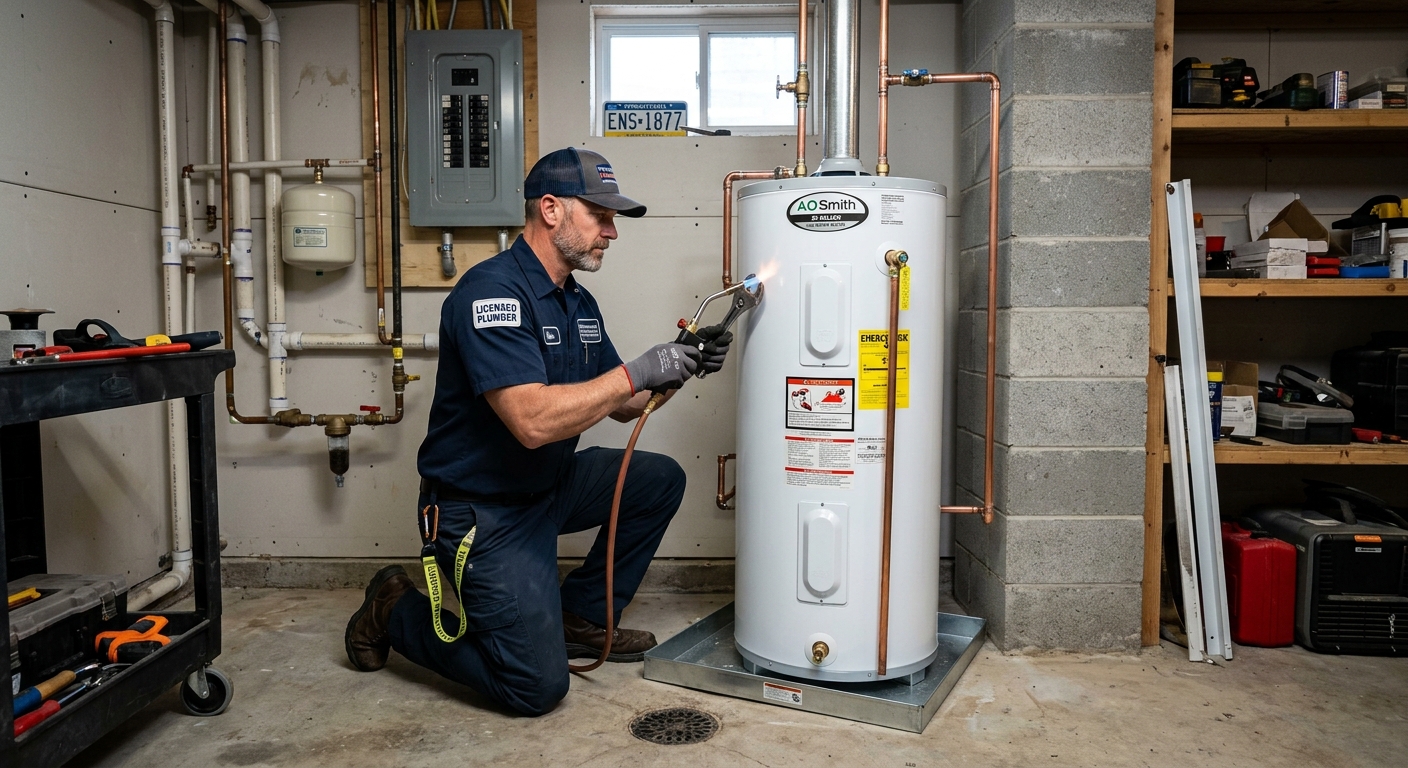
Replacing your water heater in Center isn’t a one-size-fits-all call—it depends on your priorities, the house, and your willingness to pay upfront for savings down the line. Traditional tank units (gas or electric) are cheapest to install, but suffer standby energy loss and have the shortest lifespans. Tankless (on-demand) water heaters offer endless hot water and lower running costs, but require more money upfront and often need upgrades for gas supply lines or vents—costs that can surprise you if not clearly discussed in the estimate. Heat pump water heaters are the lowest to operate and last longer than tanks, but require about as much space as a refrigerator, work best in a warm spot like an unfinished basement, and are loud enough that you wouldn’t want one in a finished room.
In Center, most homes have natural gas available, making gas tank and tankless options viable. Sizing here is about first-hour rating—how much hot water the heater delivers in an hour—rather than just tank size. Old water heaters usually fail because the tank itself corrodes out, not due to controls or elements. Installing a new heater should also include a proper expansion tank (to handle pressure spikes), and a drain pan with a real pipe to a floor drain to manage small leaks before they become floods.
| Type |
Installed cost |
Service life |
Operating cost |
Best when |
| Gas tank, 40–50 gal |
$1,250–$2,900 |
8–12 yrs |
moderate |
gas is easy to reach; budget matters |
| Electric tank, 40–50 gal |
$1,250–$2,000 |
10–15 yrs |
high |
no gas; only replacement needed |
| Gas tankless |
$2,000–$2,900 |
18–25 yrs |
low-moderate |
long-term, unlimited hot water |
| Heat pump water heater |
$2,000–$2,900 |
13–15 yrs |
lowest |
large, open unfinished area; high electric |
Finding a hidden leak in Center
If you suspect a hidden leak in your Center home, the first thing to do costs nothing: make sure all faucets and appliances are fully off, then check your water meter. If the dial is still spinning, that’s a clear sign you’ve got a supply-side leak. This simple meter test is free, fast, and can narrow down whether you need a plumber at all.
If you do call a professional, Center plumbers use a range of methods: acoustic listening (hearing water moving inside the wall or floor), thermal imaging (spotting heat loss from hot water pipes leaking under slabs or in walls), and tracer gas for tough-to-find leaks. Slab leaks—common in the postwar slab-on-grade homes—are often pinpointed with these tools before a hammer touches concrete. Hidden irrigation or yard line leaks are usually found with a combination of pressure testing and tracer gas. Expect to pay for this expertise, but don’t accept a plumber who wants to start opening up walls or flooring without first locating the leak—they’re guessing, and that’s not how it should be done in any Center home.
Who is allowed to do plumbing work in Pennsylvania
In Pennsylvania, there is no statewide plumbing license—plumbers are licensed at the municipal level, not by the Commonwealth. That means a plumber who is properly licensed to work in one city or township may have no standing to pull permits or guarantee code compliance in the next. In Center Township, you should ask directly, “Are you licensed to work here?” instead of just “Are you licensed?” since the jurisdiction is everything.
Permits for plumbing work also depend on the municipality. For example, in Aliquippa, you’ll need a plumbing permit for any new or replacement water or sewer service line. In Beaver Falls, straightforward replacement of interior fixtures usually does not require a city plumbing permit—making some routine jobs faster and less paperwork-heavy. Inspections are conducted by local township or city code enforcement offices. Always insist on seeing your contractor’s Home Improvement Contractor (HIC) registration—verify it at hic.attorneygeneral.gov—since Pennsylvania requires this for jobs over $500. Also confirm their workers’ compensation coverage through WCAIS (wcais.pa.gov). If your home was built before 1978, make sure the company is EPA Lead RRP certified; you can check this at certifiedrenovatorsearch.epa.gov.
Bottom line: hire a plumber who’s qualified and registered for your exact location, and always get a written contract (required by law for jobs over $500).
Frequently asked questions — plumbing in Center
Why do plumbers charge a diagnostic fee?
Plumbers in Center typically charge a diagnostic fee to cover the cost of driving out, inspecting the problem, and using professional tools to pinpoint issues—especially in homes with slab foundations and older pipework. Think of it like a doctor's copay: it pays for time and expertise, whether or not you go ahead with the repair. Many Center plumbers offer to credit this fee toward your repair bill, so be sure to ask if it’s applicable. Diagnostic fees in the area can range between $50–$150 for standard visits, though that’s wrapped into an overall job price when you go forward. If your quote doesn’t break out a diagnostic fee or is vague about whether it’s credited, ask for details before signing. Spending a small amount upfront can prevent bigger surprises or unnecessary work inside your Center home.
Can I do my own plumbing work in Center?
In much of Beaver County, including Center, there’s no statewide plumbing license, and homeowner work is a gray area between municipal codes and real safety risks. Some townships let owners replace fixtures themselves, but Center’s postwar homes with slab foundations and older galvanized lines mean that a simple mistake can quickly get expensive. Always check with your local code enforcement office before starting—some projects require permits and inspections. For any work over $500, Pennsylvania law also requires a written contract if you hire it out, and proper HIC registration for the contractor. For DIY jobs, skip anything gas or main water/sewer lines unless you’re qualified. It’s not about saving on labor—it's about knowing when your insurance or local code won’t have your back if something fails.
How much does a water heater replacement cost in Center?
Replacing a water heater in Center depends mostly on tank size, fuel source, and whether the job is scheduled or an emergency. For a standard 40–50 gallon gas unit, expect to pay $1,250–$2,900 installed, with the most common total right around $2,000. Emergency replacements run higher, especially after hours. The cost covers removal of the old heater, installation, testing, and haul away. If you need new venting or gas line upgrades—common in the dominant 1945–1970 Center homes—expect to be at the higher end. Always demand an itemized quote, ask about expansion tanks and drain pans, and consider tankless only if you’re ready for higher upfront costs.
Are tree roots a common sewer problem in Center?
Tree roots are a frequent problem in older Center neighborhoods, especially in postwar houses with original clay or cast iron pipes from the boom era. As pipes age and joints weaken, roots squeeze into gaps, causing blockages and even pipe collapse. Homes with large trees in the yard are most vulnerable. Clearing a main line blockage by hydro-jet or auger usually costs $200–$800 in Center, depending on access and time. If a camera finds roots have broken the line, spot repairs can run even higher—sometimes pushing into $2,100–$12,500. Early intervention prevents the worst outcomes, so don’t wait for sewage backup before calling.
Is a sewer line replacement covered by homeowner's insurance?
In Center, as in most of Pennsylvania, standard homeowner’s insurance usually does not cover routine wear-and-tear or failure of a buried sewer line. Coverage may exist for sudden, accidental damage—for example, if a tree falls and crushes the pipe—but not for slow root intrusion, corrosion, or pipe collapse from age. Replacement costs for a sewer line in Center run between $5,700–$12,500, depending on length and access. Some insurance carriers offer optional buried utility endorsements; check with your agent about that before a problem appears. When in doubt, ask your plumber to provide video documentation, which can help your claim if you think it’s worth pursuing.
How do I find a hidden water leak?
Hidden water leaks are common in Center’s older houses, especially with galvanized or corroded copper lines. The first step you can take is the water meter test: turn off all water-using fixtures and appliances, then watch your meter for any movement—if the dial spins, you have a supply-side leak. If that test confirms a problem, Center plumbers can use tools like acoustic listening equipment, thermal cameras, and sometimes tracer gas to pinpoint the exact spot. This approach avoids tearing up walls or concrete slabs blindly. Professional leak detection typically starts at $375 in our area and goes up for slab leaks. Always ask your plumber to explain their detection plan before they start opening finishes.
What counts as a plumbing emergency?
A plumbing emergency in Center is any problem you can’t contain or postpone: active flooding, no water to any fixture, sewage backing up, or the smell of gas should trigger an immediate call—don’t wait until Monday. Emergency repairs for a burst pipe or active leak often run between $600–$1,250 here due to after-hours rates. Conversely, slow drips, jammed shutoffs, or a single stubborn drain are rarely emergencies and can be safely scheduled. If you know how to shut off water at the main or to a specific fixture, you’ll save both anxiety and money. The right triage can convert a pricey emergency call to a normal Monday appointment in Center.
Should I leave a faucet dripping in cold weather?
In Center’s freeze-prone winters, a slow drip can help prevent pipes from freezing, especially in older, uninsulated lines running through crawlspaces or over cold slabs—both common in our postwar housing stock. While you don’t need every faucet running, leaving a trickle on the most exposed pipe can make a big difference. That being said, repeated dripping will raise your water bill and won’t solve underlying insulation problems. If your pipes have already frozen or split, repair costs can run $375–$1,250 for a burst pipe. For long-term peace of mind, consider pipe insulation and heat tape where accessible rather than relying on the drip trick every year.
Repair or replace a leaking water heater?
When your water heater leaks in Center, the right answer comes down to where the water is coming from and the age of your tank. Leaks from the valves or piping can often be fixed for a few hundred dollars, but if the tank itself is dripping or rusting, replacement is the only safe solution—repairs won’t buy much time, and floods get expensive fast. Expect to pay $1,250–$2,900 for a standard tank replacement installed, depending on type and whether you catch it before hours. If your unit is under 8 years old and the leak is minor, a repair might be worth quoting; otherwise, save your money and go straight to replacement for Center homes.