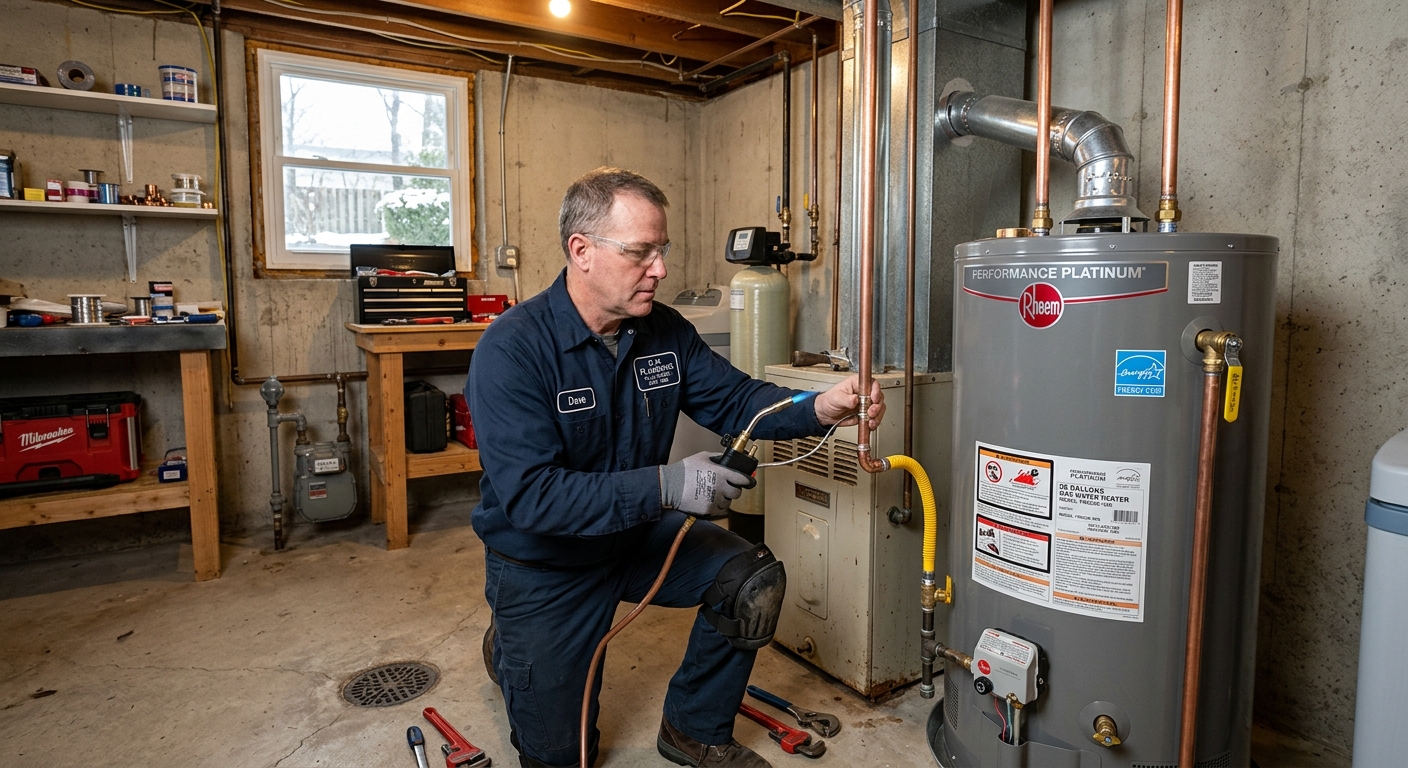
What plumbers charge in Lower Makefield
In Lower Makefield, plumbing costs are shaped by both home age and the urgency of the job. With 87.7% homeownership and many houses built before 1980 (42.0%), it’s common to encounter older plumbing systems, especially in neighborhoods developed during the post-1950 housing surge like Levittown in Falls Township. These homes often feature undersized copper and galvanized pipes, which have shorter service lives and are more prone to leaks, corrosion, and low water pressure. Emergency repairs on old piping tend to cost more, not just for materials but also because of the time and care needed to safely access and repair fragile lines.
For any given job in Lower Makefield, expect to see the emergency rate if you need service right now—for example, if a pipe bursts on a weekend or water is actively flooding. This premium covers not just the urgent dispatch, but the need to diagnose and fix a problem on the spot, often after hours. Standard rates apply to jobs scheduled during normal business hours, and if you can safely wait, you’ll save. The urgency is a bigger driver of price than the actual work in many cases; a scheduled water heater replacement can run $1,500–$3,500, but an off-hour job with special piping access can top $3,500. The table below outlines what to expect for most common services:
| Service |
Scope |
Emergency rate |
Standard rate |
| Emergency repair — burst pipe |
locate, open, repair section, restore service |
$750–$1,500 |
$450–$1,500 |
| Water heater replacement (gas, 40–50 gal) |
remove old, install, test, haul away |
$2,400–$3,500 |
$1,500–$3,500 |
| Drain cleaning — main line |
augering or hydro-jet, camera if needed |
$350–$800 |
$200–$500 |
| Sewer line spot repair |
excavate or reline a failed section |
$2,500–$15,000 |
$2,500–$15,000 |
| Whole-house repipe |
replace supply lines throughout, patch and finish |
|
$4,400–$10,500 |
| Water service line replacement |
street to house, excavation and restoration |
|
$7,000–$15,000 |
Estimates for a typical Lower Makefield home. Access difficulty and pipe material move these figures more than anything else.
Who is allowed to do plumbing work in Pennsylvania
Pennsylvania does not have a statewide plumbing license; licensing is handled by individual municipalities. That means a plumber credentialed in one area may hold no official status in the neighboring township. In practical terms, if you’re hiring for work in Lower Makefield, the critical question is not “are you licensed” but “are you approved to work in this municipality?” This is especially important because local code offices—not the state—enforce the Pennsylvania Uniform Construction Code (UCC), which is based on the International Residential Code. If a plumber isn’t familiar with Lower Makefield’s or the surrounding township’s processes, you could get unexpected (and expensive) permit issues or failed inspections.
In the Bucks County area, municipalities such as Bensalem Township require a plumbing permit for any work that alters water or sewer piping layout or fixture count. Minor like-for-like fixture swaps may not need a permit in some townships, such as Falls Township, but if you’re touching water or sewer service lines, it’s practically guaranteed you’ll need a permit and inspection. You can always check eligibility by confirming HIC (Home Improvement Contractor) registration with the Pennsylvania Office of Attorney General at hic.attorneygeneral.gov. For work contracted over $500, a written contract is required, and contractors must have valid workers’ compensation insurance, which can be verified through the WCAIS system at wcais.pa.gov. If your home was built before 1978 and work will disturb painted surfaces, the EPA Lead RRP rule applies—make sure your contractor is on the certified list at certifiedrenovatorsearch.epa.gov.
Water quality and what it does to your pipes
Most Lower Makefield homes get water from the Bucks County Water & Sewer Authority, which reports public water quality yearly. You can (and should) request that annual report if you are noticing frequent fixture clogs, odd tastes, or scaling. The local water is considered moderately hard, which means minerals will slowly accumulate inside water heaters and on the insides of pipes and fixtures. This scaling shortens the usable life of water heaters and can mean frequent repairs, especially as older galvanized or copper pipes roughen with age. In some cases, aggressive water chemistry can lead to pinhole leaks in copper—something seen regularly in post-1950 homes in the area.
If you’re considering a water softener, know that while it can reduce mineral scale, it may not pay off for every home in Lower Makefield. A typical softener installation will not reverse existing buildup, and the extra cost in salt, water, and maintenance sometimes outweighs the slow benefits. Whole-house filtration, unless you have clear evidence of persistent water quality issues (from your utility report), often falls in the “nice to have, not need to have” category. Point-of-use filters at the kitchen sink or refrigerator are usually enough for most local needs and far more cost-effective. If your home uses a private well or septic system (more common in the northern townships), you’ll need to arrange private lab testing since nobody publishes a report for private wells, and recommendations on treatment equipment should be based solely on actual test results. If someone tries to sell you expensive systems without a test or a specific problem, be wary.
Emergency rates versus scheduled work in Lower Makefield
When a plumbing issue strikes in Lower Makefield, the difference between emergency service and scheduled work isn’t just about convenience—it’s about cost. Emergency rates apply when a plumber has to drop everything, dispatch quickly (sometimes after hours or on weekends), and work under the clock’s pressure. That emergency premium covers overtime labor, fast response, a travel and diagnosis fee, and the need to solve the immediate problem before full investigation. Scheduled (standard) work, by contrast, allows for better planning, routine labor costs, and often a more thorough finish, at a lower cost.
What should you treat as an emergency? True emergencies include active flooding (burst pipe spraying or gushing), total water loss to the house, sewage backed up into living space, or anything that smells of gas—those situations put your property or safety at direct risk and merit the emergency rate of $750–$1,500 for a burst pipe as typical. On the other hand, a slow drip under a sink, a sluggish drain, or a toilet that won’t stop running can almost always wait until business hours and save you hundreds.
Knowing how to use your water shutoffs is the best tool a homeowner in Lower Makefield can have. There’s usually a main shutoff near where water enters through the foundation—close it clockwise to cut all water supply. Most fixtures also have their own valves under the sink or behind the toilet. Shutting these buys time to turn an emergency bill into a standard service call, or lets you sleep easy until help arrives.
Pipe materials in Lower Makefield homes and how they fail
The post-1950 building boom, especially in Levittown within Falls Township, left Lower Makefield and surrounding Bucks County homes with a patchwork of plumbing materials. Each type has its own strengths, weak points, and service window, and knowing what’s in your walls can signal how soon you’ll be looking at repairs or full repiping.
Galvanized steel pipes (common up to 1960) corrode from inside, narrowing their bore and slowly robbing your home of water pressure before leaks appear. These are recognized by a gray, dull color and magnetic threads. If you scratch the surface, it stays silver-gray. Copper came into wide use in the 1950s and is usually reddish and non-magnetic; joints are soldered, not threaded. While copper is reliable, our local water chemistry sometimes causes pinhole leaks after decades. Polybutylene, installed from the late 1970s through 1995, is bluish-gray plastic and fails unpredictably at fittings—it’s widely considered uninsurable elsewhere and has a short track record here as well. PEX, used since the 2000s, is flexible plastic (often red, blue, or white) and typically has crimped metal fittings.
On the drain side, cast iron pipes (pre-1975) last 50 to 75 years but eventually crack or clog with scale. Clay tile sewer laterals (pre-1980) let in roots at the joints. Modern PVC or ABS is white or black plastic with glued joints and tends to hold up well unless crushed or poorly installed. Aging mains and drains from the big build-out era mean that many Lower Makefield homes are right at the point where pipes start giving out.
| Material |
Typical era |
Failure mode |
Service life |
| Galvanized steel supply |
pre-1960 |
internal corrosion, pressure loss |
40–60 yrs |
| Copper supply |
1950s–present |
pinhole leaks, joint failure |
50–70 yrs |
| Polybutylene supply |
late 1970s–1995 |
fitting failure, sudden bursts |
unreliable |
| PEX supply |
2000s–present |
fitting or UV degradation |
40–50 yrs |
| Cast iron drain |
pre-1975 |
corrosion, cracking, scale |
50–75 yrs |
| Clay tile sewer lateral |
pre-1980 |
root intrusion at joints, offset |
50–60 yrs |
| PVC / ABS drain |
1970s–present |
joint separation, crushing |
50+ yrs |
Flat rate versus time and materials
In Lower Makefield, plumbers usually bid jobs using either a flat rate or a time-and-materials model. A flat rate gives you a set price before work starts, with all labor and parts (plus an allowance for surprises) rolled in. This buys certainty, especially for typical repairs or replacements. On time-and-materials, you’re billed for the actual hours worked plus the precise cost of parts. This can be cheaper for a very simple job, but open-ended when access or scope turn out worse than the estimate. Neither is inherently bad—the critical thing is knowing which approach your contractor is using and confirming it in writing.
Good quotes in Lower Makefield are detailed. They list a diagnostic fee (and if it will be credited to the repair), spell out the exact work and what restoration is included, specify permit handling and costs, call out brand/model of any fixtures, and explicitly state the labor and parts warranty (typically at least a year on labor). Watch for silent or vague quotes, or language that excludes cleanup or patching. If after-hours rates might kick in, demand to see those numbers up front.
| Line item |
What to look for |
Red flag if… |
| Billing model |
flat rate or hourly, stated up front |
unstated |
| Diagnostic fee |
amount, and whether it credits |
vague |
| Scope |
what is opened, repaired and restored |
price with no scope |
| Restoration |
drywall and finish explicitly in or out |
silent |
| Permit |
included and priced |
'not needed' |
| Parts |
brand and model for fixtures |
'standard fixture' |
| Warranty |
labour period stated separately |
parts only |
Finding a hidden leak in Lower Makefield
If you suspect a hidden leak in your Lower Makefield home, start by doing a simple test: shut off all faucets and appliances that use water, then watch your water meter (usually inside where the main service enters the house). If the flow indicator dial is moving, there’s a supply-side leak somewhere.
Professional plumbers have several ways to pinpoint hidden leaks. Acoustic listening equipment picks up the sound of water escaping under floors or inside walls (often in the $350–$800 range for inspection and basic repair if it’s obvious). Thermal imaging uses heat-sensing cameras to flag cold, wet spots behind walls or floors, helpful for slab leaks. Tracer gas, which is rarely needed but effective in hard-to-diagnose cases, introduces harmless gas into lines—sensitive detectors show where it escapes. Locating a leak under a concrete slab or out in the yard tends to drive cost higher, but the right tools mean you only open what you must. Plumbing pros should always locate first, open walls or dig only as the last step. If you’re told demolition must happen first, get a second opinion.
For leaks in wall cavities, an experienced plumber uses moisture meters and inspection cameras. Hidden irrigation supply leaks are best found with pressure testing and careful elimination. Again, finding before opening saves time, money, and mess—especially in occupied homes.
Frequently asked questions — plumbing in Lower Makefield
What counts as a plumbing emergency?
In Lower Makefield, a true plumbing emergency is anything that threatens immediate property damage or health risk. Examples include a burst pipe actively flooding your home (especially in older galvanized or copper lines, which are common locally), total loss of water to the house, sewage backing up into sinks or tubs, or any gas smell. These problems justify emergency rates, which run $750–$1,500 for burst pipe repairs depending on access and material. A slow drip, one toilet not working, or a minor leak at a shutoff valve is almost never an emergency—you can usually shut off the affected fixture and wait for a standard rate visit. Knowing your shutoffs and acting quickly can turn a potential emergency into a routine call.
Is a water softener worth it in Lower Makefield?
Water in Lower Makefield is considered moderately hard, but it’s far from the worst in Pennsylvania. Mineral buildup can shorten water heater and fixture life over decades, but most residents find it manageable. A water softener’s real benefit is reducing scale, which helps if you have sensitive skin or want to maximize appliance lifespan. However, installation and maintenance (salt, extra water) means the savings rarely outweigh the costs unless you have a very large home or significant scaling. Point-of-use filters can address taste and minor spotting for much less. Expect a whole-house softener system to run several thousand dollars installed, compared to most water heater replacements at $1,500–$3,500. For most Lower Makefield homes, softeners are a personal choice, not a must-have.
How much does a water heater replacement cost in Lower Makefield?
For a typical 40–50 gallon gas water heater replacement in Lower Makefield, expect a price band of $1,500–$3,500. The final bill depends on access (basement or attic, tight spaces are harder), any necessary updates to piping or venting, and haul-away of the old unit. Older homes—common here—may need a shutoff upgrade or backflow protection to pass inspection, which can push the top end higher. Emergency same-day replacements climb toward the higher end of that price range. Always get a detailed quote, make sure the plumber includes permit and inspection, and check for a labor warranty distinct from the manufacturer’s parts warranty.
Do I need a permit for plumbing work in Lower Makefield?
Permit requirements in Lower Makefield and surrounding Bucks County townships depend on the type of work. In Bensalem Township, any project altering your water or sewer piping layout or fixture count requires a local permit and inspection. Like-for-like fixture swaps, such as replacing a faucet or showerhead in Falls Township, may not need a separate permit. When in doubt, check with your township’s code office. Always verify that your plumber is registered as a Home Improvement Contractor with the Pennsylvania Attorney General at hic.attorneygeneral.gov and has insurance through the WCAIS system (wcais.pa.gov). Permit costs are usually built into a plumber’s estimate, which might be bundled with labor—around $450–$1,500 for jobs like pipe repairs.
How much does a plumber cost in Lower Makefield?
Plumber rates in Lower Makefield cover a wide range. A standard, scheduled service call—like a minor pipe or shutoff valve repair—typically runs $450–$1,500, with smaller jobs falling at the lower end. Emergency service (nights, weekends, or a flood situation) jumps to $750–$1,500 or higher. Drain cleaning can run $200–$500 for normal work; big sewer spot repairs start at $2,500. Whole-house repipes, needed in many older homes here, cost $4,400–$10,500. Always ask how the estimate is structured (flat rate or time and materials) and make sure it covers all restoration or patching, especially in older homes where some hidden surprises are possible.
Is my water line lead?
Bucks County Water & Sewer Authority reports about 2,000 known or suspected lead service lines countywide, mostly in older neighborhoods. If your Lower Makefield home was built before 1950, check where the line enters in the basement: a soft, dull gray pipe that can be scratched easily (the scratch turns bright silver) may be lead. Water lines originally installed as galvanized or copper are less likely to be lead, but if your records are unclear, your water quality report or a plumber can verify. Lead service line replacement is a significant job, running $7,000–$15,000 depending on length and restoration needed. If yours is lead, replacement is always the best investment for long-term health.
How deep do water lines need to be buried in Lower Makefield?
In Lower Makefield, the local frost depth is 30 inches, and water service lines are buried deeper than that to avoid freezing. Expect your line to be at least 36 inches below grade, sometimes deeper depending on landscaping and utilities. Replacement involves trenching and full restoration of any lawns or hardscaping disturbed. This work typically falls in the $7,000–$15,000 range due to the depth, local code inspections, and the type of soil or obstructions (older sidewalks, tree roots). Always ask for photos or inspections to prove the proper depth is met; it’s required by the Pennsylvania Uniform Construction Code and enforced by local township code offices.
Is Lower Makefield on combined sewers or septic?
Lower Makefield and Bensalem Township are served by separated sanitary and storm sewers—your home’s wastewater and rainwater are routed to different systems. In contrast, northern Bucks County townships still have pockets where homes are on individual septic systems. If you’re in a single-family home in Lower Makefield and pay the Bucks County Water & Sewer Authority bill, you’re almost certainly connected to public sewer. If you have a septic leach field or aren’t billed for sewer, periodic tank pumping and separate field maintenance will apply. Full sewer spot repairs start around $2,500–$15,000, while septic repairs are a different scope entirely and involve other contractors. Always ensure a plumber inspects your line and confirms which system you’re on before any excavation starts.
Does insurance cover a burst pipe in Lower Makefield?
Most homeowners’ insurance policies in Lower Makefield will cover sudden, accidental water damage from a burst pipe, provided the leak wasn’t the result of long-term neglect (such as a slow drip left for months). Losses from freezing, especially if your home is vacant and heated, are usually included. Your insurance will not cover the repair of the broken section itself, just the resulting water damage, clean-up, and restoration. Burst pipe repairs typically run $750–$1,500. Remember, Pennsylvania’s Home Improvement Consumer Protection Act prohibits waiving your deductible—don’t trust any contractor offering to “cover” that part. Always get multiple quotes and coordinate with your insurer before authorizing major repairs or restoration work.