Plumbing costs in West Manchester — 2026
In West Manchester, most single-family homes were built before 1980, and more than two-thirds of residents here own their homes (U.S. Census Bureau, ACS 2024). This matters because older plumbing systems—especially those from the 1900–1950 era like in neighboring York City—often mean you’re dealing with materials such as galvanized steel that are well past their design life. In these cases, replacing with copper or PEX is often the most economical long-term fix.
Your plumbing cost will depend as much on urgency as on technical complexity. The same repair can land in two different price brackets—if water is actively pouring into your basement or you’re without hot water entirely, expect to pay the emergency rate. Call during standard business hours for a non-urgent fix, and you'll get the regular rate at the lower end of the band. Older homes with trickier access, hidden pipes, or layers of earlier repairs will always cost more—the material itself (copper, steel, PEX) is only part of it. Below, real price bands for common jobs:
| Service |
Scope |
Emergency rate |
Standard rate |
| Emergency repair — burst pipe |
locate, open, repair section, restore service |
$600–$1,150 |
$350–$1,150 |
| Water heater replacement (gas, 40–50 gal) |
remove old, install, test, haul away |
$1,850–$2,700 |
$1,150–$2,700 |
| Drain cleaning — main line |
augering or hydro-jet, camera if needed |
$350–$800 |
$200–$500 |
| Sewer line spot repair |
excavate or reline a failed section |
$1,950–$11,500 |
$1,950–$11,500 |
| Whole-house repipe |
replace supply lines throughout, patch and finish |
|
$3,400–$8,300 |
| Water service line replacement |
street to house, excavation and restoration |
|
$5,400–$11,500 |
Estimates for a typical West Manchester home. Access difficulty and pipe material move these figures more than anything else.
Detection methods and what they cost
The first leak check you can do yourself is the meter test. Shut off every faucet and appliance in the house, make sure nobody is using any water, and watch your water meter. If the little dial is still spinning, there’s a leak somewhere on your supply piping—often under a slab, in a wall, or in a crawlspace.
When it comes to professional leak detection, a good plumber brings more than just a flashlight. Acoustic listening is usually the starting point—special microphones pick up the sound of water escaping under concrete or behind walls. This method typically costs $350–$800, often bundled into the initial service call. For hidden or intermittent leaks, thermal imaging cameras can reveal temperature differences caused by water flow, especially inside insulated walls. Tracer gas (usually a safe, inert gas like nitrogen or hydrogen) is blown through the lines and detected by a sensitive sensor where it escapes—best for the trickiest hidden leaks, and often priced around $350–$800, sometimes higher if extensive searching is needed.
Slab leaks are located by a combination of acoustic and thermal methods because breaking concrete should be the last resort. Underground irrigation leaks are most often found by electronic line tracing and pressure testing. If a plumber’s first inclination is to open your drywall or start cutting without pinpointing the leak, that’s backwards—modern detection reduces both mess and repair time.
Dating your plumbing by what it's made of
In this part of York County, plumbing is pretty much an archaeological record of when the house was built. York City’s housing stock, largely from 1900–1950, drives frequent jobs here swapping out old galvanized lines for copper or PEX. Knowing your material not only predicts what’s likely to go wrong, but also how much life you have left before you face a big repair bill.
You can identify supply pipe material by look and feel. Galvanized steel is dull grey, magnetic, and threaded at joints—scrape a section with a key and you’ll see shiny silver. Copper is reddish and joined with soldered fittings, while PEX (in blue, red, or white) is flexible plastic connected with crimped rings or push fittings. Polybutylene is dull grey or blue, less rigid than metal pipe, and nearly always joined with compression fittings—notorious for sudden splitting (if you see this, it’s time to budget for a repipe). Cast iron drain pipes are heavy and dark, joined at hubs with lead, while clay tile drain lines are often orange-brown and only found underground; PVC and ABS are unmistakable white or black plastics with glued joints.
The era gives away what’s in your walls. Galvanized steel from pre-1960 will be on its last legs if it’s original—expect severe pressure drops and brownish water before an outright leak. Copper from the 1950s on will deliver decades of service if the water chemistry is right, but pinholes do show up in older installs. Cast iron drains start failing from the inside out, usually between 50 and 75 years in. Clay tile sewers, common until 1980, are prime targets for root intrusion at their joints. PVC and PEX are current standard practice, both with long expected life but not immune to failure at fittings.
| Material |
Typical era |
Failure mode |
Service life |
| Galvanized steel supply |
pre-1960 |
internal corrosion, pressure loss |
40–60 yrs |
| Copper supply |
1950s–present |
pinhole leaks, joint failure |
50–70 yrs |
| Polybutylene supply |
late 1970s–1995 |
fitting failure, sudden bursts |
unreliable |
| PEX supply |
2000s–present |
fitting or UV degradation |
40–50 yrs |
| Cast iron drain |
pre-1975 |
corrosion, cracking, scale |
50–75 yrs |
| Clay tile sewer lateral |
pre-1980 |
root intrusion at joints, offset |
50–60 yrs |
| PVC / ABS drain |
1970s–present |
joint separation, crushing |
50+ yrs |
Verifying a West Manchester plumber's credentials
Pennsylvania does not license plumbers at the state level—municipalities handle trade licensing individually. For West Manchester, you should know that a plumber who is licensed in York or another township may not automatically have a trade credential here. Always ask directly: “Are you licensed to work in this township?” Don’t settle for just “licensed” in general.
Spring Garden Township in York County, for example, maintains its own plumbing license. In York City, permits are handled by the Bureau of Permits and Inspections, which requires a plumbing permit for any new or altered system work beyond replacing an existing fixture. If you’re simply swapping out a toilet or faucet at the same location, though, you typically do not need a permit in York City—but changing where plumbing runs or adding a new fixture line does require one. Surrounding townships such as West Manchester handle their own permitting. If a plumber tells you no permit is necessary for major work, get that in writing and verify with local offices.
For all contracts over $500, Pennsylvania law requires the plumber to have Home Improvement Contractor (HIC) registration from the Office of Attorney General, which you can confirm at hic.attorneygeneral.gov. Every employer must carry workers' compensation coverage; you can check compliance through WCAIS (wcais.pa.gov). Insurance for the job should name your property address. No matter what is claimed, ask to see trade registration specific to your location and proof of up-to-date insurance.
Freeze risk and what to do about it
South-central Pennsylvania winter can bring a 12 °F design temperature, 30-inch frost depth, and plenty of freeze-thaw cycling. Pipes most often burst not where they freeze, but between the ice plug and a closed faucet as pressure builds up—so the actual leak may be some distance away from where a pipe iced up. The most vulnerable spots are exterior walls, unheated crawlspaces, garages, hose bibs, and any pipes run through unconditioned attics. Many homes in West Manchester were built before energy codes required better pipe placement, so this risk is real, especially for single-family homes built before 1980.
Here’s how to prevent frozen pipes, ranked by cost and impact: First, insulate exposed supply pipes in unconditioned spaces with foam pipe sleeves. Add heat tape or cable if insulation alone isn’t enough (especially for runs along exterior walls or through crawlspaces). In the coldest stretches, letting a faucet trickle during single-digit nights keeps water moving and relieves pressure buildup. Open cabinet doors to let warmer air circulate around pipes under sinks. Outdoors, always shut off and drain hose bibs before the first hard freeze—most winter floods in basements start here.
If you find a frozen pipe, thaw it slowly with a hair dryer or heat gun. Never use an open flame. Pipe wraps that plug into a standard outlet work too. If a pipe bursts, you’re looking at $350–$1,150 for emergency repairs—prevention, by contrast, usually costs under $100 in materials and a bit of your own time.
Sewer laterals: the pipe you own and can't see
Most homeowners in West Manchester own the sewer lateral all the way from the house to where it joins the public main—often right into beneath the street. This is the root of many surprise repair bills, because when something goes wrong with your lateral, the cost is yours.
Common symptoms of a problem start subtle and get ugly: a single slow drain, then multiple slow drains, gurgling at lower fixtures, and, at its worst, sewage backing up in the basement. Before anyone talks about digging, the first step should always be a camera inspection. This costs a fraction of even a minor excavation and can show root intrusion, bellies (sags where sewage collects), or offsets at the joints.
In York City and other municipalities with separated sanitary and storm sewers, repairs often target old clay tile laterals—these tend to fail where tree roots find their way into joints or where sections shift. Trenchless relining is a less invasive alternative to open-cut replacement, but only if a camera inspection shows the lateral is straight and not fully collapsed. On the other hand, if you’re in one of West Manchester’s neighboring rural townships, septic systems are still common. Problems there are different—a full septic tank needs pumping every 3–5 years, while a failing drainfield means pooling in the yard, not in the basement.
Insist on seeing the camera footage before considering any sewer excavation quote—if a company will not provide one, walk away. Even the worst sewer line spot repair runs $1,950–$11,500, so getting the diagnose right up front matters.
The point where patching stops making sense
For supply piping in West Manchester, here’s the honest bottom line: if you have two or more leaks on the same pipe material in less than three years, repair no longer makes sense. That’s a symptom of system-wide deterioration, not just a fluke. Signs to look for include whole-house pressure drop (not just at one faucet), discolored water on first draw, visible corrosion at pipe joints, or recurring pinhole leaks—a common sight in older copper.
Copper remains a preferred upgrade for durability, but PEX is now the standard for repipes due to lower cost and easier installation—especially when walls must be opened and access is tight. Whole-house repipes always disrupt finishes, and many homeowners forget that the repair cost for drywall and, especially in the older plaster-and-lath homes common to this area, can rival half the plumbing labor. On partial repipes, some older galvanized runs may be left behind for budget reasons, but expect more repairs soon.
Since much of the local housing dates back to York City’s 1900–1950 peak, galvanized supply lines are prime targets for full replacement. Polybutylene is rare, but if present, always merits a full repipe. Clay or cast iron drain issues start with a camera inspection and may go to a spot repair or full lateral replacement if root intrusion or collapse is proven.
| Situation |
Recommendation |
Cost |
Reasoning |
| One leak, accessible, modern pipe |
Spot repair |
$350–$1,150 |
Isolated failure, no evidence of systemic issue |
| Two or more leaks in 3 years |
Partial repipe |
$3,400–$5,600 |
Pattern suggests widespread deterioration |
| Galvanized supply, pressure loss |
Full repipe |
$3,400–$8,300 |
Material is at the end of usable life |
| Polybutylene anywhere in the house |
Full repipe |
$3,400–$8,300 |
Frequent sudden failures, not insurable |
| Cast iron drain with root intrusion |
Camera, then reline or replace |
$1,950–$11,500 |
Must verify with video before breaking ground |
| Suspected lead service line |
Test, then replace the lateral |
$5,400–$11,500 |
Lead lines should be eliminated—document replacement |
Frequently asked questions — plumbing in West Manchester
What counts as a plumbing emergency?
Most West Manchester homeowners aren't sure whether a given issue is urgent enough to call for emergency service. In practical terms, a plumbing emergency means anything causing active water damage (like a burst pipe flooding your basement), a loss of essential service (such as no potable water or total sewer backup), or a leak that can't be isolated with a shut-off valve. Sewer backups, leaks near electrical panels, and no hot water in winter all qualify. Keep in mind: calling for emergency repair in West Manchester typically lands you in the $600–$1,150 range for a burst pipe, compared to the standard rate if you can wait for regular business hours. For a slow drip under a sink with the water valve off, wait until morning and save yourself money.
Do older West Manchester homes have galvanized pipes?
Yes, many homes in West Manchester—especially those built before 1960—are likely to have at least some galvanized steel supply piping. Since 53.3% of the local housing stock went up before 1980 (U.S. Census Bureau, ACS 2024), this is a real concern. Galvanized pipes tend to corrode inside, causing pressure loss and rusty water before they leak outright. Most burst pipe calls I see in older local homes happen on original galvanized lines. If you're considering a home purchase here, or planning to renovate, budget for a full repipe at around $3,400–$8,300 if these are still present.
Is a sewer line replacement covered by homeowner's insurance?
Usually, standard homeowner's insurance in West Manchester (or anywhere in Pennsylvania) does not cover normal wear and tear or tree root intrusion in your sewer lateral. Coverage sometimes kicks in if the pipe is damaged suddenly by a covered peril, but most lateral replacements—especially for old clay tile attacked by roots—are out-of-pocket. Some insurers sell a specific sewer line “endorsement” or offer service line coverage for an added fee; without it, you’re looking at paying $1,950–$11,500 yourself. Always check your policy language before signing any replacement contract.
How do I find a hidden water leak?
If you suspect a hidden leak in your West Manchester home, start with the meter test: shut off every fixture and check your water meter. If it's still spinning, there's a leak. Professional leak detection combines acoustic listening (to pinpoint leaks in walls or under slabs) and thermal imaging (to spot temperature changes from water flow). The diagnostic visit for this service often costs between $350–$800 locally, but can save you from tearing open finished walls unnecessarily. Some leaks are as simple as a dripping valve, but for anything hidden, bring in a plumber with the right detection tools—the guess-and-check approach costs far more in repairs.
Why do plumbers charge a diagnostic fee?
In West Manchester and throughout Pennsylvania, a diagnostic fee pays for two things: the time and expertise to correctly find the root cause (not just the symptom), and the use of specialized tools—like acoustic listening equipment or camera scopes—especially on hidden leaks or clogs. This up-front charge, which typically falls into the $350–$800 category if detection is complex, ensures the real problem is solved with the first repair. Often, if you approve the proposed work, part or all of the diagnostic fee will be credited toward your total bill. Always ask how fees will be applied before work starts.
Repair or replace a leaking water heater?
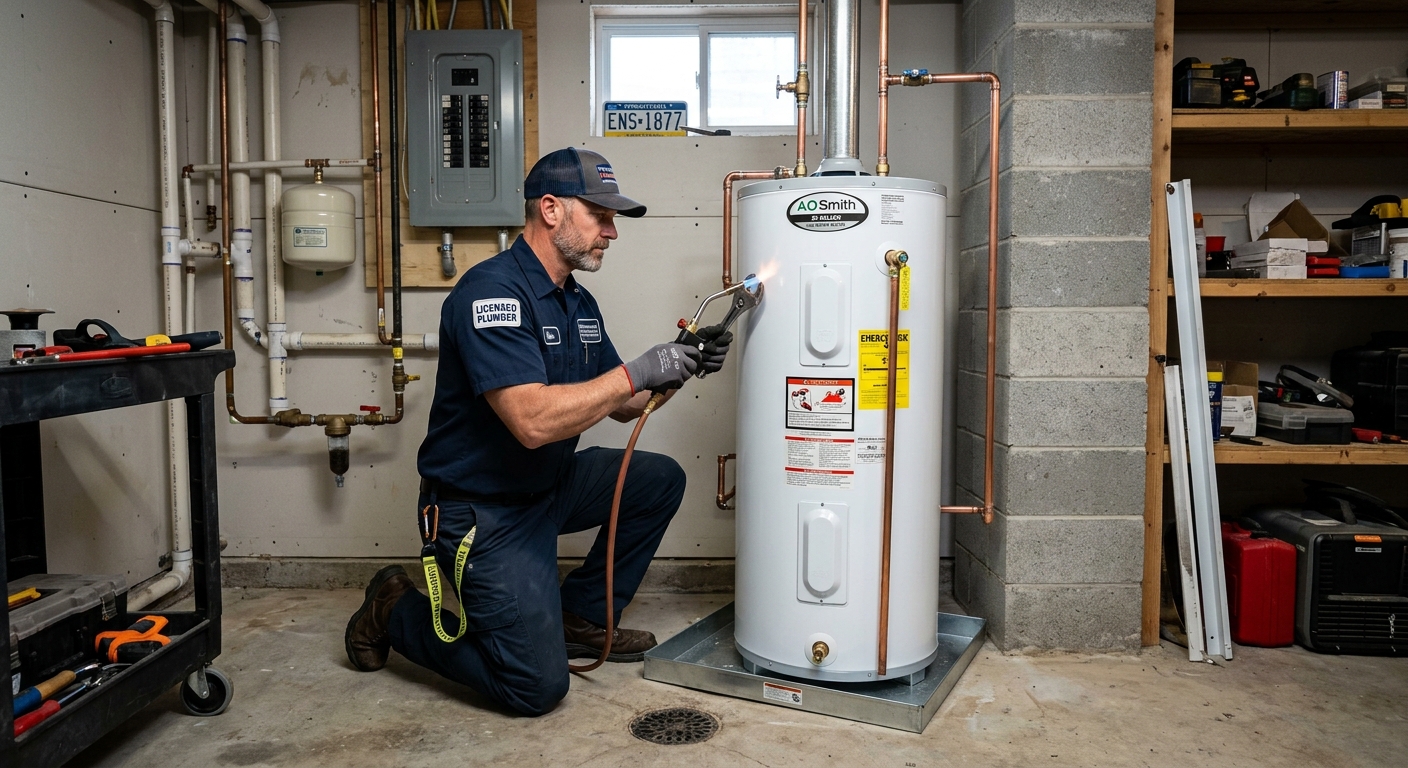
For West Manchester homeowners, the decision depends on both age and problem type. A tank water heater over 10 years old with a leaking tank is almost always due for replacement—repairs are usually futile and can end up costing more. If the leak is at a fitting or valve on a newer unit, a repair may be reasonable. Local water heater replacement, complete with removal and haul-away, runs $1,150–$2,700. For anything nearing the end of its design life, invest in a new one; repairs on an old tank are usually wasted money.
Do I need a permit for plumbing work in West Manchester?
For most major plumbing work in West Manchester, a permit is needed. Simple same-location replacements of fixtures like toilets or faucets usually do not require one, but anything involving new pipe runs or system changes does. Permitting is handled by each municipality, and permits are enforced locally—York City uses the Bureau of Permits and Inspections, while townships like West Manchester have their own offices. Always confirm permit requirements before starting work. For full system alterations or sewer work, this is required, and the inspector will confirm code compliance before the job is approved. Plumbing contractors must also be registered under Pennsylvania’s Home Improvement Contractor rules for jobs over $500.
How deep do water lines need to be buried in West Manchester?
In southern York County, including West Manchester, water lines must be buried below the local frost depth to prevent freezing. The required depth is at least 30 inches, based on the recorded frost depth and regional code. If your supply line is buried shallower than this (not uncommon in certain old homes), there's a real risk of freezing in hard winters—which leads to burst lines and expensive repairs in the $350–$1,150 range for a single fix, or more if the main is damaged. When replacing or adding a water service line, always confirm with your local permit office and utility—the wrong depth is asking for trouble.
How much does sewer line repair cost in West Manchester?
Sewer line repair is a big-ticket item for West Manchester homeowners, especially with older clay tile laterals in pre-1980 houses. Spot repairs (where just a section is excavated or relined) typically run $1,950–$11,500 depending on depth, access, and how much must be replaced. Most common issues are tree root intrusion or collapsed joints, which are diagnosed by sewer camera before any digging. Full lateral replacement—often needed if multiple failures are found—can approach the upper end of this range. Never agree to a repair without first seeing the camera inspection video and a written scope of work.