Plumbing costs in Mount Joy — 2026
Mount Joy homeowners face a wide range of plumbing costs, and your bill often depends less on what’s broken than on when you pick up the phone. Routine work scheduled in advance always comes in cheaper than emergency repairs. For example, stopping a leak in the middle of the night will draw an emergency rate, while a planned replacement or repair scheduled during normal business hours can often come in at half the cost or less.
With 76.3% of Mount Joy’s 3,145 owner households (U.S. Census Bureau, ACS 2024) in single-family homes, you’re likely dealing with original plumbing dating back to mid-century or older. Lancaster city’s nearby housing stock is dominated by pre-1940 row and twin homes, meaning frequent upgrades from galvanized to copper or PEX. Construction era matters: older pipe materials are more failure-prone and costlier to fix, especially in an emergency. Restoring water service to an older pipe, or tying into period materials, will often take more time, extra fittings, and skill—reflected in the higher end of the price bands below.
| Service |
Scope |
Emergency rate |
Standard rate |
| Emergency repair — burst pipe |
locate, open, repair section, restore service |
$650–$1,250 |
$375–$1,250 |
| Water heater replacement (gas, 40–50 gal) |
remove old, install, test, haul away |
$2,000–$3,000 |
$1,250–$3,000 |
| Drain cleaning — main line |
augering or hydro-jet, camera if needed |
$350–$800 |
$200–$500 |
| Sewer line spot repair |
excavate or reline a failed section |
$2,100–$12,500 |
$2,100–$12,500 |
| Whole-house repipe |
replace supply lines throughout, patch and finish |
— |
$3,700–$9,000 |
| Water service line replacement |
street to house, excavation and restoration |
— |
$5,800–$12,500 |
Estimates for a typical Mount Joy home. Access difficulty and pipe material move these figures more than anything else.
Who is allowed to do plumbing work in Pennsylvania
Plumbing in Pennsylvania is licensed at the municipal level, not statewide. Unlike some states that run a central plumbing registry or licensing board, Pennsylvania’s Uniform Construction Code (UCC) sets the building standard, but each municipality enforces and handles its own credentials. That means a plumber licensed in Lancaster city can work within city limits, but that same license may not be accepted in a neighboring township like Mount Joy unless specifically approved. The practical takeaway: when hiring, ask, “Are you licensed for plumbing work in this township?” Not every plumber can say yes, even if they’re well-known just a few miles away.
Permits are also locally enforced. In Lancaster city, for example, any plumbing work that physically alters, expands, or adds value to a property requires a related plumbing or building permit. Minor same-fixture repairs—such as swapping out a faucet cartridge or repairing a toilet—generally can proceed without a formal permit. Inspection of permitted work is handled by the local municipal codes or zoning office, or by Pennsylvania Department of Labor & Industry in places that opt out.
For contracts over $500, Pennsylvania law requires that plumbers hold a Home Improvement Contractor (HIC) registration issued by the state Office of Attorney General. Homeowners can verify contractor HIC registration at hic.attorneygeneral.gov. Always ask for proof of workers' compensation, which you can check against the state’s WCAIS system (wcais.pa.gov), to ensure coverage for anyone working on your property.
What construction era means for your pipes
Mount Joy housing ranges widely by age, but with 30.6% of homes built before 1980 (U.S. Census Bureau, ACS 2024), era is a good predictor of plumbing troubles. If your home dates to before 1970, the supply lines are likely galvanized steel or even cast iron, both prone to interior buildup and corrosion. Original drain piping in these homes will often include cast iron or clay tile, which get brittle and allow tree roots to invade at the joints. Sewer laterals are commonly clay pipe—which is why main line blockages in older Mount Joy neighborhoods often turn up roots or collapsed spots.
The water service line, especially in homes built before 1980, could be lead, galvanized, or a mix, and may be included in the ongoing multi-year inventory and replacement programs in cities like Lancaster. In homes from the 1980s and newer, you’ll see more copper and, in the last couple of decades, PEX for supply runs. Drains may be PVC. These materials resist corrosion, but even plastic piping is vulnerable to poor installation, shifting soil, or high water pressure.
Water heaters in pre-1980 homes are rarely original—most are on their second or third tank by now. In 1990s and later construction, you’re likely nearing the end of a water heater’s first 8–15 year service life, and original builder-grade fixtures may be due for replacement more for reliability than outright failure.
Winter pipe failures in south-central Pennsylvania
Mount Joy and the surrounding south-central Pennsylvania region face pronounced freeze-thaw cycles, with a local frost depth of 30 inches and winter design temperatures down to 12°F. In these conditions, outside walls, crawlspaces, attached garages, and any pipes run through unconditioned attic spaces are at high risk for freezing. The actual burst usually happens not at the frozen spot but somewhere between the ice blockage and a closed faucet—hydrostatic pressure builds until the line splits, and only reveals itself when things warm up or a faucet is opened.
High-risk areas are: pipes routed through exterior walls; unheated crawlspaces; garages with utility sinks or washers; hose bibs left pressurized in winter; and, in some split-level Mount Joy homes, attic plumbing. The best prevention, in order of cost: insulate exposed supply lines, install quality heat tape (with thermostat), let faucets trickle during severe cold snaps, open under-sink cabinet doors overnight, and always shut off and drain outdoor hose spigots before the first freeze.
If your pipes do freeze, never use an open flame. Safe thawing tools include a hair dryer, portable heater (keeping space clear), or a dedicated pipe-thawing machine. The aftermath of a burst pipe, especially if service needs to be opened and repaired on emergency rates, can cost $650–$1,250 or more—not including water damage repairs. Spending a little on insulation or heat tape is almost always the most cost-effective path for Mount Joy homeowners.
What urgency costs you
When it comes to plumbing, an emergency is as much a matter of timing as of what failed. Emergency rates exist because fast response demands overtime labor, on-call staff, and travel time. You’ll pay a premium for nights, weekends, and holidays, as well as for the risk that careful diagnosis is sacrificed for speed: the goal is stop the damage and restore function, sometimes at the expense of later finish work.
In Mount Joy, true emergencies are anything involving active flooding (a burst supply line, water pouring in), total loss of water service, sewage backing up into the lowest drain, or any potential gas leak (you smell gas or rotten eggs near a water heater). These should be handled at the emergency rate without delay. Call for help if you’re facing these.
Less urgent: one slow drain, a running toilet, a slow leak captured in a bucket, or loss of hot water with no immediate risk to property. These can almost always wait until regular business hours for service, potentially saving hundreds. For example, repairing a burst pipe on emergency rates may run $650–$1,250, while the same work scheduled as a standard repair is often $375–$1,250.
The single most important emergency skill: know how to shut off your main water valve (often right where the water service enters your basement) and at individual fixtures. This converts many “emergencies” to contained, manageable problems you can schedule at standard rates.
Camera inspection, relining and replacement
Most Mount Joy homeowners don’t realize it, but the sewer lateral—the pipe from your house to the main out at the street—is typically your responsibility. That includes any segment running under sidewalks or even into the street itself, depending on local rules.
Symptoms start with slow drainage at one fixture, escalate to backups at the lowest fixture, and may include gurgling or water standing in floor drains. If you notice two or more drains slowing down at once, or toilets gurgling when another drain runs, your main sewer line is a likely suspect. Before anyone quotes a dig, demand a camera inspection. Modern drain cameras show in real time what’s going on: root masses intruding through clay tile joints, “bellies” (sags that collect water), offsets, or full collapses. In older areas of Lancaster County, root intrusion where clay pipes meet is especially common.
Mount Joy and nearby townships have a mix of municipal sewer and private septic systems, especially on exurban and agricultural lots. If you’re on septic, slow drains or backups may mean your septic tank needs pumping (every 3–5 years) or your drainfield is failing—problems with very different fixes and costs than a blocked sewer lateral.
When repair is needed, choices are open-cut trench (complete replacement) or trenchless relining in certain conditions. In either case, always ask to see the camera footage—never accept a quote for a major excavation based on guesswork.
Water heater replacement decisions
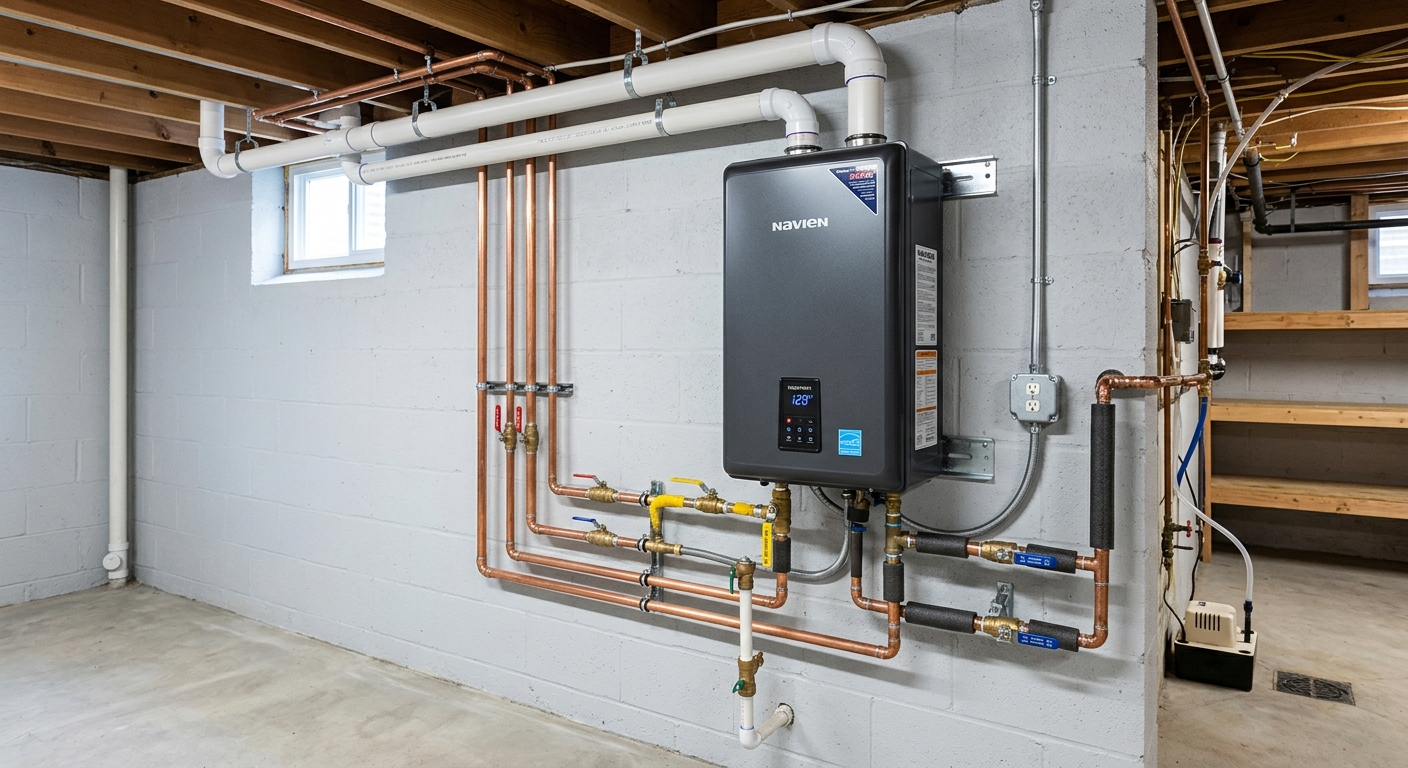
Choosing the right water heater for your Mount Joy home should balance upfront cost, operating cost, expected life, and how much disruption you’re willing to tolerate. Standard tank models are the lowest initial cost but also the shortest-lived, usually serving eight to fifteen years before the tank rusts through. The tankless (on-demand) models deliver endless hot water but need a substantial gas line and revamped venting—surprises for many buyers, since these upgrades are extra line items atop the base unit cost. Electric tanks are simple and reliable, but cost more to run long-term.
Heat pump water heaters are the lowest to operate by a substantial margin, but only work well in larger spaces with mild temperatures (not a freezing basement). They make noise and cool the area around them, so they aren’t for every finished basement or closet install.
If you have natural gas, a standard tank or tankless can be most practical; if not, heat pump units are worth a close look, especially if your electric rate is reasonable. Don’t size just by tank gallons—use the “first-hour rating,” which measures how much hot water your home can draw in 60 minutes. Every professional install in Mount Joy should include a pan and drain for tank models, and typically an expansion tank if your supply has a pressure regulator.
| Type |
Installed cost |
Service life |
Operating cost |
Best when |
| Gas tank, 40–50 gal |
$1,250–$3,000 |
8–12 yrs |
moderate |
Gas available, lowest install budget, simple swap |
| Electric tank, 40–50 gal |
$1,250–$2,000 |
10–15 yrs |
high |
No gas service, easy option, space isn’t tight |
| Gas tankless |
$2,000–$3,000 |
18–25 yrs |
low-moderate |
Homes using lots of hot water, space tight, can add gas line/vent |
| Heat pump water heater |
$2,000–$3,000 |
13–15 yrs |
lowest |
Electric only, mild/large space, want lowest bills |
Frequently asked questions — plumbing in Mount Joy
What do I do about a burst pipe right now?
If you discover a burst pipe in your Mount Joy home, the first step is to shut off your main water supply valve immediately—typically located where the water service enters your basement. Then, open a faucet in the basement or at the lowest point to drain down water and relieve pressure. If the break is on a branch pipe, shut off the nearest fixture valve. Once the flow has stopped, mop up and document any water before calling your plumber. Emergency repairs here run from $650–$1,250. Quick action limits both water damage and repair costs, and makes it safer to wait for a standard-hours fix if the problem is contained. In cold weather, also check for other frozen spots so you don’t fix one leak only to find more as things thaw.
What does emergency plumbing cost in Mount Joy?
Emergency plumbing rates are higher in Mount Joy because of the immediate response, after-hours labor, and time-sensitive travel. For an active burst pipe or major leak, you’re looking at anywhere from $650–$1,250 just for the emergency visit and repair. Even smaller jobs like main line drain clogs, if addressed outside regular business hours, can be $350–$800. To control these costs, shut off the main water, contain any leaking, and only call for emergency help if you’re dealing with ongoing flooding or loss of all service—otherwise, you can often wait for a standard rate appointment.
Do I need a permit for plumbing work in Mount Joy?
Permitting requirements in Mount Joy are local: in nearby Lancaster city, you need a plumbing or building permit for any work that alters, expands, or upgrades your plumbing system. Simple swaps like a faucet or toilet part generally don’t need permits. Any significant upgrade—new water heaters, repiping, or moving fixtures—will almost always require a permit and inspection by the local office. If you’re hiring a plumber, check that they’re HIC registered with the Pennsylvania Office of Attorney General for jobs over $500, and make sure their workers’ compensation is current and verifiable on WCAIS. Planning ahead avoids penalties and ensures everything passes final sign-off.
How much does a water heater replacement cost in Mount Joy?
For a standard gas water heater replacement (40–50 gallons), expect to pay $1,250–$3,000 in Mount Joy. This price usually includes removing the old tank, installing the new one, necessary valves or pans, and hauling out the old unit. Tankless models and heat pump water heaters fall into the upper range. More complicated jobs—like upgrading the gas line or relocating the unit—can push costs toward the high end. If your old water heater lasted more than 12 years, you likely got your money’s worth, but do not wait for a sudden failure, especially in homes built before 1980.
How do I prevent frozen pipes in Mount Joy?
Mount Joy winters expose pipes to plenty of freeze-thaw cycling. The best prevention, before the cold fully hits, is to insulate pipes in unheated spaces and install heat tape where exterior walls can’t be avoided. Remember to shut off and drain all outdoor hose bibs before the first hard freeze. If a deep freeze is coming, open cabinet doors under sinks along outside walls and let a trickle run overnight. Repairs after a burst can cost $650–$1,250, so a few hours spent insulating is a smart investment. Never use open flames to thaw frozen pipes—stick with hair dryers, space heaters, or professional pipe-thawing equipment.
How do I find a hidden water leak?
Hidden leaks in Mount Joy homes show up as unexplained puddles, damp drywall, musty odors, or high water bills. The first step is to check every visible pipe, valve, and connection—especially in basements and crawlspaces where older galvanized or copper pipes are used. If you can’t see water but suspect a leak, shut off all fixtures and watch your water meter—if the dial keeps spinning, there’s a leak somewhere on your supply line. Professional plumbers often use acoustic detectors or moisture meters to pinpoint hidden leaks. Repair costs start at $375–$1,250, depending on access and pipe material. Address leaks quickly in older homes to prevent costly wall and flooring damage.
Does insurance cover a burst pipe in Mount Joy?
Most homeowners’ insurance policies in Mount Joy do cover sudden water damage from a burst pipe, provided you’ve maintained heat in the home and did not neglect obvious repairs. Damage to walls, floors, and personal property is typically included; the repair to the actual section of pipe itself is often not. Always photograph the damage, save receipts, and call your provider quickly. Emergency repairs can cost $650–$1,250 just to get the leak stopped, with restoration billed separately. Note that Pennsylvania law prohibits plumbers from waiving your insurance deductible. For older Mount Joy homes, prompt reporting and good documentation make the claim process smoother.
Are tree roots a common sewer problem in Mount Joy?
Yes, especially in homes with clay sewer lines, which are frequent in the pre-1980 houses found in Mount Joy and Lancaster city. Tree roots enter through minor cracks or gaps between clay tile sections, eventually causing slow drains, backups, or total blockages. Camera inspections (typically factored into spot repair jobs of $2,100–$12,500) clearly show root intrusion or collapsed tile. If you have recurring slow drains and mature trees in your yard, regular camera checks and root-clearing auger services can prevent full line failure. Don’t let anyone sell a major sewer dig without reviewing the video evidence first.
Should I repipe my Mount Joy home or keep repairing?
If you own a Mount Joy home with galvanized or aging copper, and repairs are becoming annual, it’s time to weigh the math. Repeated emergency repairs at $375–$1,250 each add up quickly, especially after flooring or drywall patching. A whole-house repipe—costing $3,700–$9,000—is a big investment but usually means twenty years or more of reliability and better water pressure. If the piping is original and frequent leaks are ruining floors or making you nervous about water quality, replacement makes sense. For newer homes with isolated leaks, spot repairs are usually the way to go for now.