Plumbing costs in Bedford — 2026
Bedford homeowners face plumbing costs shaped by the age and construction era of their houses. With 58.7% of homes built before 1980 and a high homeownership rate of 86.7% (U.S. Census Bureau, ACS 2024), most plumbing calls here involve older materials, especially galvanized pipes and early copper or cast iron. In these properties, the risk of hidden corrosion, pinhole leaks, and outright failure is much higher than in newer homes, driving both the frequency and price of repairs. The large stock of pre-1940 farmhouses and small borough homes in Bedford County explains the steady drumbeat of updates for aging supply lines and outdated water heaters. Construction era isn’t just trivia: it predicts what kind of pipes are inside—and pipe material sets expectations for failures, replacement frequency, and what the plumber’s bill will look like.
The same job is priced very differently depending on whether it’s an emergency callout (after hours, water running, or urgent threat to property) versus a planned visit. Travel surcharges also come into play because Bedford County sits between major metro plumbing markets. If you’re responding to a burst pipe at midnight, expect the upper end of the band. If your water heater is failing but not flooding, scheduling standard service saves substantial money.
| Service | Scope | Emergency rate | Standard rate |
| Emergency repair — burst pipe |
locate, open, repair section, restore service |
$600–$1,150 |
$350–$1,150 |
| Water heater replacement (gas, 40–50 gal) |
remove old, install, test, haul away |
$1,850–$2,700 |
$1,150–$2,700 |
| Drain cleaning — main line |
augering or hydro-jet, camera if needed |
$350–$800 |
$200–$500 |
| Sewer line spot repair |
excavate or reline a failed section |
$1,950–$11,500 |
$1,950–$11,500 |
| Whole-house repipe |
replace supply lines throughout, patch and finish |
|
$3,400–$8,300 |
| Water service line replacement |
street to house, excavation and restoration |
|
$5,400–$11,500 |
Estimates for a typical Bedford home. Access difficulty and pipe material move these figures more than anything else.
Finding a hidden leak in Bedford
If you suspect a hidden plumbing leak in your Bedford home, you can run the same test any plumber will start with—free of charge. Turn off every fixture and appliance using water, then check your main water meter (if you’re served by Bedford Borough Water Authority). A moving dial or creeping digital readout with everything off signals a supply-side leak, whether it’s under a slab, inside a wall cavity, or buried in the yard.
When a leak is not obvious, professionals rely on several targeted tools. Acoustic listening devices are used first, letting a plumber "hear" water escaping under floors or inside walls. Thermal imaging cameras can reveal colder areas where water is evaporating—a particular help when tracing a slow leak in plastered walls. For the most elusive leaks, especially under slabs, tracer gas (a safe, inert gas pressurized in the pipe and tracked by detectors) can pinpoint the break’s location. Expect professional leak detection to cost roughly the same as a standard diagnostic visit or up to the emergency repair base, typically $350–$1,150 depending on time and complexity.
Specific problems demand different approaches. Slab leaks are found by combining acoustic and thermal imaging before any floor is opened. Leaks in wall cavities are located with moisture meters, spot infrared, and careful inspection. Exterior lines, such as buried irrigation or water service pipes, may require electronic locators. If a plumber’s first move is to start opening walls without confirmation, get a second opinion—good diagnosis always comes before destructive work in Bedford’s tight housing stock.
Choosing a water heater in Bedford
For Bedford homeowners, water heater choices come down to tank, tankless, or heat pump models. Conventional tanks are the lowest-cost option up front, with installation running $1,150–$2,700 for common 40–50 gallon gas units. They’re simple, widely available, and cheap to repair—but they waste a fair amount of energy keeping water hot even when no one’s home, and most only last 8–12 years.
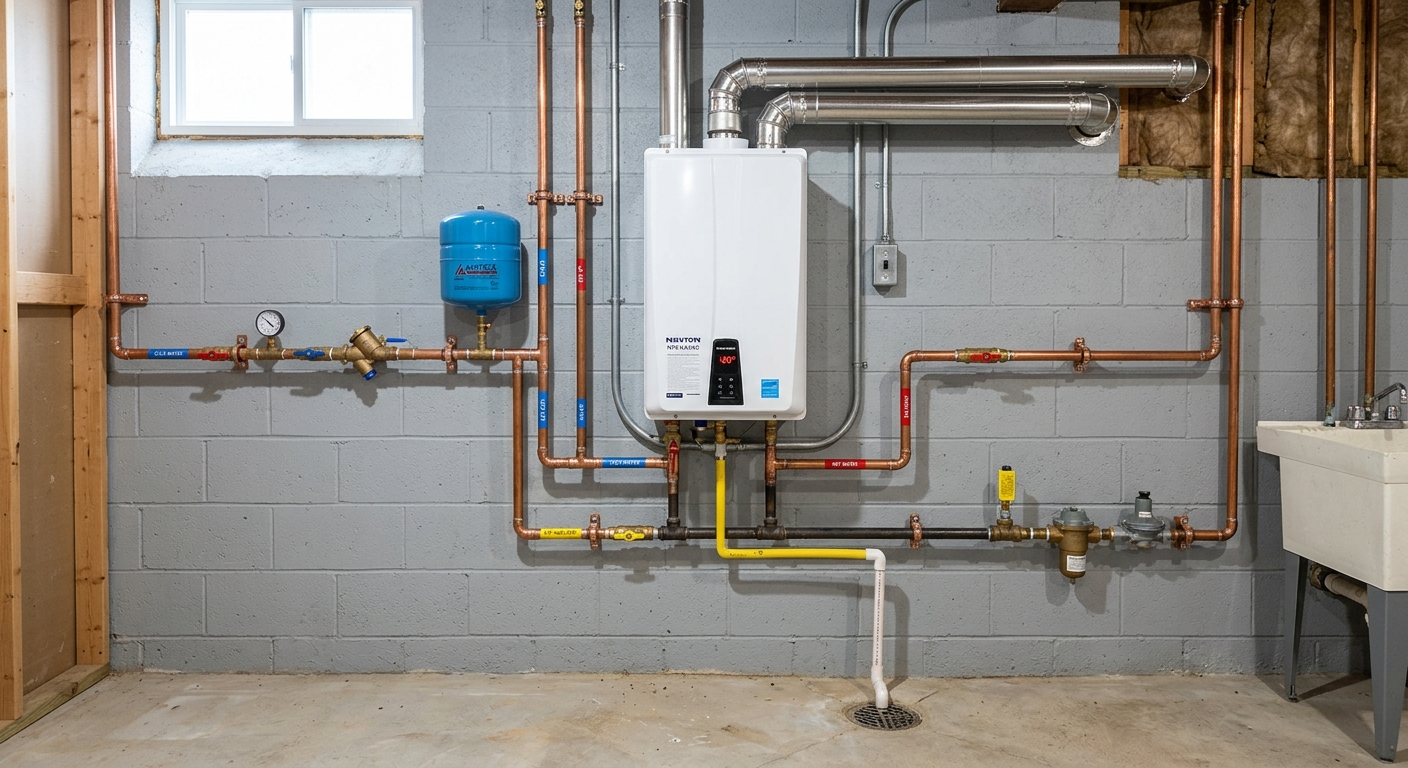
Tankless (on-demand) gas models offer endless hot water without standby heat loss and can last up to 25 years, but install costs are higher—usually $1,850–$2,700. Many older Bedford homes need a new, larger gas line and modern venting for tankless. These extras drive up the project’s total cost, and if the quoted price seems low, check whether those upgrades are included. Unless you have high, constant hot water demand, the payback is often longer here than homeowners expect.
Heat pump water heaters have the lowest running costs and are attractive where electricity is less expensive or gas access is limited. They must sit in a warm space with good air volume—a chilly Bedford basement may limit efficiency. They also cool and dehumidify the room, which is a downside if your heater sits in a finished basement or laundry area. Noise is another consideration, especially with bedrooms nearby. Expect to pay $1,850–$2,700 installed.
Sizing for any model should be based on first-hour rating (how much hot water it can deliver in peak use), not just the tank size. Always check for an expansion tank and install a drain pan and floor drain in older homes prone to leaks—the tank usually fails before controls or electronics.
| Type | Installed cost | Service life | Operating cost | Best when |
| Gas tank, 40–50 gal |
$1,150–$2,700 |
8–12 yrs |
moderate |
Existing gas, fast replacement, limited space |
| Electric tank, 40–50 gal |
$1,150–$1,850 |
10–15 yrs |
high |
No gas, low upfront budget |
| Gas tankless |
$1,850–$2,700 |
18–25 yrs |
low-moderate |
Endless hot water, space tight |
| Heat pump water heater |
$1,850–$2,700 |
13–15 yrs |
lowest |
Plenty of space, moderate temps, reduces cooling load |
What construction era means for your pipes
In Bedford County, with 58.7% of homes built before 1980, your plumbing system’s age is written into your house’s bones. Most pre-1940 houses in the borough and townships have galvanized steel for supply lines, typically paired with cast iron or even clay for main drains and laterals. Galvanized pipe corrodes from the inside, leading to falling water pressure and eventual pinhole leaks. Clay tile sewer lines are prone to shifting and root intrusion, especially in the older farmhouses on mature lots. If you have a prewar home, odds are high you’re on your second or third water heater and original service lines are overdue for evaluation.
Newer homes—those built after 1980—shifted toward copper or early PEX for supply and PVC for drains. While these materials last longer and are less prone to sudden failure, they bring their own issues: copper still develops pinhole leaks after decades of acidic water, and early plastics have had recall cycles. Water heaters in these homes are often nearing the end of their first installed life.
No matter your home’s era, materials set the list of concerns. Older stock means corrosion, hidden leaks, and recurring repairs. Newer construction trades those for builder-grade fixtures, potential for plastic supply failures, and fewer surprises in drains—but “new” stock here can still mean 40 years old, which is hardly risk free in Bedford’s tough climate and ground conditions.
Spot repairs or whole-house repipe?
In Bedford County, it’s tempting to patch a leak and hope for the best. For a single, accessible leak on copper or PEX, a spot repair (typically $350–$1,150) is all you need. But two or more leaks in the same system within three years on old galvanized or problematic polybutylene is a clear signal—this is system failure, not just bad luck. Water pressure dropping in more than one fixture, brown water on the first morning draw, or visible rust around joints means you’re either chasing leaks or ready for a repipe.
Homeowners often forget the hidden cost: wall and ceiling repairs. Older Bedford homes have thick plaster walls; patching after a repipe can run as much as the plumbing labor itself. When comparing copper and PEX for replacements, PEX is usually less invasive and lower in cost, but copper may still be required in some visible areas or where local officials prefer it for repair durability.
In a housing market full of pre-1940 farmhouses and small borough homes, updating aged galvanized piping is often a necessity rather than a luxury. Don’t spend money patching known problem materials—treat repeated leaks as a system in decline.
| Situation | Recommendation | Cost | Reasoning |
| One leak, accessible, modern pipe |
Spot repair |
$350–$1,150 |
Isolated issue, longest life left in material |
| Two or more leaks in 3 years |
Partial repipe |
$3,400–$5,600 |
Pattern shows systemic failure |
| Galvanized supply, pressure loss |
Full repipe |
$3,400–$8,300 |
Galvanized corroded, flow restriction |
| Polybutylene anywhere in the house |
Full repipe |
$3,400–$8,300 |
Documented risk of failure, insurance issues |
| Cast iron drain with root intrusion |
Camera, then reline or replace |
$1,950–$11,500 |
Damage shown, restoration method follows |
| Suspected lead service line |
Test, then replace the lateral |
$5,400–$11,500 |
Remove lead exposure, restore safe water |
Who is allowed to do plumbing work in Pennsylvania
Pennsylvania does not issue a statewide plumbing license. Instead, all licensing—and the qualifications to pull permits and perform plumbing work—are controlled municipally. This means that a plumber authorized to work in one borough or city may not be recognized in the next township unless they have satisfied local requirements. For Bedford County, this is a practical point: always ask not just "are you licensed," but "are you allowed to work here?"
In Bedford Borough, building and plumbing permits are issued through the Borough Office with inspections handled by third-party code officials. Most minor fixture replacements in Bedford Township—like new faucets or toilets—don’t require a permit, but adding or relocating fixtures does. If you are spending more than $500 on a plumbing contract, the Home Improvement Contractor (HIC) registration from the Pennsylvania Office of Attorney General is required, and you can verify that number at hic.attorneygeneral.gov. Every contractor employing workers (which includes plumbing companies) must carry workers’ compensation insurance; those policies can be checked through the state’s WCAIS system (wcais.pa.gov).
For projects in older, pre-1978 homes, federal rules about lead-safe practices (EPA Lead RRP Rule) also apply. If your plumber suggests waiving your homeowner’s insurance deductible or working “under the table,” they are not operating within the state’s required legal framework or consumer protection laws.
Camera inspection, relining and replacement
In Bedford County, you own the sanitary sewer lateral from the foundation all the way to the main—even when it runs under public sidewalk or right up to the street. This responsibility leads to surprises when a backup reveals tree roots or a collapse out by the curb. Symptoms start subtle: a single slow drain, then gurgling in the lowest fixtures, eventually multiple fixtures clogging or backing up. When more than one drain is slow or you get a backup at the lowest point (usually the basement utility sink or floor drain), don’t guess—have the line inspected by camera before authorizing any digging.
Camera inspection reveals exactly where problems lie—root invasion, collapsed or offset clay tiles (common in Bedford’s older housing), or sags (bellies) that catch solids. Only after documenting the issue should you consider excavation or lining. In most cases, spot repairs of the faulty section are possible, but widespread root intrusion or collapse usually mean relining or full replacement. Open-cut excavation is still needed for severe offsets or when the pipe is deeply buried, while trenchless lining restores runs with fewer driveway or yard disturbances.
Many homes outside Bedford Borough use private septic systems. Here, a “sewer backup” could be as simple as a full tank or as costly as a failed drainfield. For septic, regular pumping is essential, and true drainfield failure often requires soil testing and replacement well beyond sewer line repair cost bands.
Whatever promises are made, never agree to sewer excavation in Bedford County without reviewing the camera footage yourself. It’s your best protection in a market with both old pipes and rural service costs.
Frequently asked questions — plumbing in Bedford
Why do plumbers charge a diagnostic fee?
Diagnostic fees cover the plumber’s time and expertise to assess the problem—including travel, especially important in a rural county like Bedford. When you call about an active leak, slow drain, or mystery moisture, a trained tech brings thousands of dollars in tools to your home and applies years of experience to pinpoint the fault. These costs aren’t rolled into the price of repairs unless you approve the work. Most Bedford plumbers apply that diagnostic fee toward the repair if you hire them, so it’s not typically an extra expense if you proceed. For example, locating a leak or confirming a failed water heater can run $350–$1,150 if additional testing is needed, but the transparency helps avoid surprise billing and ensures you’re not paying for unnecessary repairs.
Do older Bedford homes have galvanized pipes?
Yes—with Bedford County’s large stock of pre-1940 farmhouses and borough homes, galvanized steel supply piping is common, especially in houses built before 1960. This material corrodes from the inside out under the high mineral content and long heating season the local water system sees. Over time, this leads to dirty, low-pressure water and repeated pinhole leaks. Spot repairs are possible and cost $350–$1,150 for the accessible sections, but repeated issues across a galvanized system signal the need for a full repipe. If you’re not sure what you have, exposed basement or utility room piping is a good tell—galvanized is a dull gray and magnetic, copper is reddish and non-magnetic.
Who inspects plumbing work in Bedford?
In Bedford Borough, any building or plumbing permit project is inspected by third-party code officials assigned through the Borough Office. Their role is to ensure compliance with the Pennsylvania Uniform Construction Code, which includes plumbing standards based on the International Residential Code. Minor fixture swaps in Bedford Township may not require a permit or inspection, but new or relocated plumbing almost always does. The inspector checks everything from proper pipe sizing to correct venting and safe materials. If you hire a contractor, you can verify both the company’s state HIC registration (for contracts over $500) and workers’ compensation status before work starts.
What do I do about a burst pipe right now?
First, shut off your home’s main water supply and open a faucet to relieve pressure. If you don’t know where the shutoff is, check the basement or near the pressure tank if you’re on a well. Once the flow is stopped, call a plumber for emergency repair—this is where the upper pricing band applies. In Bedford, expect your emergency repair bill for a burst pipe to fall between $600–$1,150 depending on location and after-hours surcharges. Take photos for your insurance, and don’t bother pulling out wet plaster or drywall unless the plumber tells you it’s needed for access. Fast action contains costs and damage.
Should I repipe my Bedford home or keep repairing?
Repipe if you’ve seen two or more leaks in as many years on old galvanized or polybutylene pipe, or if your water pressure is visibly dropping throughout the house. In Bedford County’s older homes, continual repairs can quickly eclipse the cost of a partial or whole-house repipe—currently $3,400–$8,300 depending on home size and finish repairs. Once your system starts failing, the next leak is only a question of when, not if. If repairs are just at a fixture or new pipe, patching makes sense, but otherwise put your money toward replacement for peace of mind.
Do I need to drain outdoor spigots in Bedford?
Absolutely. With an average winter design temperature of 2 °F and frost depth reaching 36 inches, Bedford homes are at high risk for burst exterior pipes if hoses and bibs are not fully drained and shut off before the first hard freeze. Damage from a frozen outdoor spigot can run from a simple repair ($350–$1,150) to a much higher bill if the burst pipe isn’t caught early. Shut the water supply to exterior lines, open the spigot to drain out any water, and ideally use frost-free sillcocks for added protection.
Is my water line lead?
If your Bedford home was built before 1940, it’s possible the original water service line used lead. In later years, lead was phased out but copper or galvanized sometimes connect to older lead lines underground. A professional test and camera inspection can confirm, and full replacement (excavating from street to house) is in the $5,400–$11,500 range. The health risk isn’t worth delaying—if you see bulbous fittings or soft, dull piping where the line enters the house, ask for a lead test before next repair.
How much does sewer line repair cost in Bedford?
For homes connected to Bedford Borough’s sanitary sewer, main-line spot repairs or relining runs $1,950–$11,500. Where only a small segment is damaged—say by root intrusion or a collapsed clay tile—a precision repair keeps your yard intact. Full replacement, especially under driveways or the street, lands at the upper end. For outlying township homes on septic, “sewer repair” often means tank pumping and line cleaning ($350–$800 for drain clearing) but drainfield replacement is a different and costlier project. Always ask to see the camera inspection footage before approving major excavation.
Does insurance cover a burst pipe in Bedford?
Most homeowners insurance policies in Pennsylvania—including Bedford—cover sudden and accidental water damage from burst pipes, provided you maintained heat during the winter and took reasonable preventive steps. That includes draining exterior lines and shutting off water when away in subfreezing temps. While the insurance may pay for water cleanup, drywall, and repairs, it typically does not cover the actual pipe replacement itself, just the damage the water causes. Keep receipts for the plumber—emergency burst pipe repairs average $600–$1,150—and photograph all affected rooms. Know that waiving or “covering” your deductible isn’t legal here, regardless of what any contractor says.