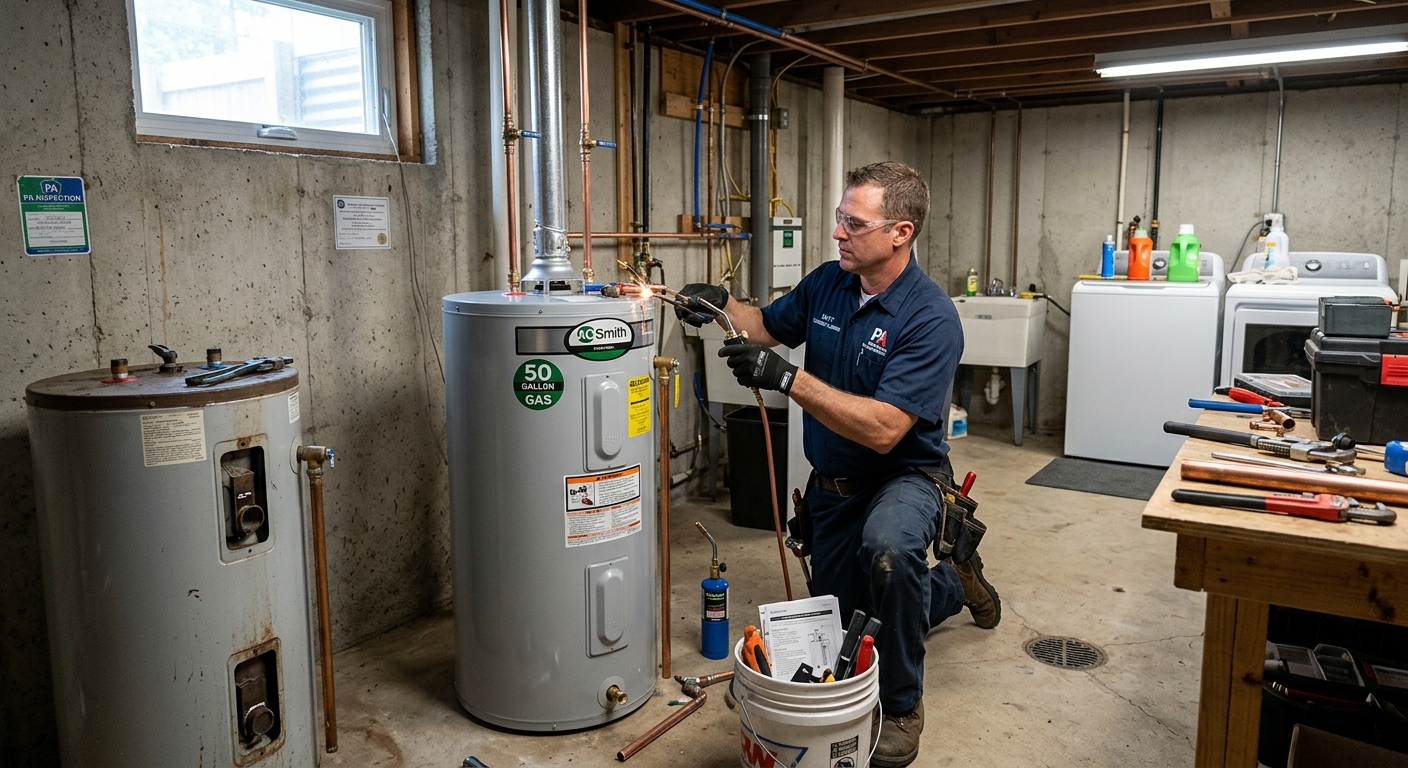
Paradise plumbing prices by job type — 2026
In Paradise, plumbing costs are closely tied to when you call and what your house is made of. Many homes here date before 1980, and that age means galvanized steel and cast iron are still present in a lot of supply and drain lines. Since 55% of homes here are pre-1980 (U.S. Census Bureau, ACS 2024), the odds are better than even that, sooner or later, you’ll be dealing with materials that aren't used in newer construction. When these old pipes leak or clog, two prices appear: one for emergency calls—nights, weekends, water pouring onto the floor—and another for work that can be scheduled. For emergency repairs, expect premium rates due to fast dispatch and after-hours labour. Whole-home repipes, often needed in Paradise’s prewar row and twin homes, are driven by the combination of failing galvanized lines and the high cost of repeated spot repairs. Paradise is mostly single-family, which usually means longer runs and greater restoration work after pipes are replaced. Overall, what you’ll pay for a plumber here depends more on existing pipe material and access—think finished plaster walls in an old house—than on the type of repair itself.
| Service |
Scope |
Emergency rate |
Standard rate |
| Emergency repair — burst pipe |
locate, open, repair section, restore service |
$600–$1,250 |
$375–$1,250 |
| Water heater replacement (gas, 40–50 gal) |
remove old, install, test, haul away |
$2,000–$2,900 |
$1,250–$2,900 |
| Drain cleaning — main line |
augering or hydro-jet, camera if needed |
$350–$800 |
$200–$500 |
| Sewer line spot repair |
excavate or reline a failed section |
$2,100–$12,500 |
$2,100–$12,500 |
| Whole-house repipe |
replace supply lines throughout, patch and finish |
|
$3,600–$8,800 |
| Water service line replacement |
street to house, excavation and restoration |
|
$5,700–$12,500 |
Estimates for a typical Paradise home. Access difficulty and pipe material move these figures more than anything else.
Is your water line lead? How to find out
Lancaster city has reported thousands of potential lead service lines and has an ongoing replacement and inventory program. As a homeowner in Paradise, your property may be served by the City of Lancaster Water Bureau or a township water authority, so your first step is knowing who serves your address. Even if your water is municipally supplied, you own the section of line running from the curb to your house—the most common location for legacy lead pipe.
The utility typically owns the main in the street and sometimes part of the service to the curb stop; the rest is in your hands. While replacement programs primarily address the utility’s side, many leave the homeowner’s portion up to you. Partial replacements are common, but these can actually increase short-term lead exposure by disturbing protective mineral buildup inside old pipes—something Paradise’s pre-1940 homes are uniquely at risk for due to their original infrastructure.
To check if your line is lead, go to your basement or where the pipe enters the house. Use a key or coin to gently scratch the pipe’s surface: a dull gray, soft metal that a magnet does not stick to often means lead. If the pipe is copper, it will have a reddish tint; galvanized steel is dark gray and the magnet will attach. For more certainty, check the City of Lancaster Water Bureau’s published inventory to see if your property is flagged, or call your utility directly—do not assume you’re covered by a replacement program.
If you do discover a lead service line, replacement typically runs $5,700–$12,500 for the homeowner’s side, depending on access and restoration. Sometimes the issue can be piecemeal (just the lateral), but expect the full range. If you’re looking at a full whole-house repipe due to mixed metals or persistent leaks, that runs $3,600–$8,800.
Licensing and permits for plumbing work in Paradise
In Pennsylvania, there is no statewide plumbing license. Licensing, if it exists, is municipal. In Lancaster County, the City of Lancaster and nearby townships each run their own code or zoning offices. This means a plumber qualified for work in one municipality may not meet requirements in the next. The right question is not whether a plumber is “licensed,” but whether they can pull a permit and do plumbing work specifically where your house sits in Paradise.
Any work in Lancaster city that alters, expands, or adds value—like a repipe or water heater replacement—requires a plumbing or building permit. Minor same-fixture repairs (think faucet cartridge or toilet fill valve) generally don’t need one, but anything beyond that will. Inspections for permitted work are handled by the local municipality or, if the township opted out, by the PA Department of Labor & Industry. Always ask to see permit paperwork before work starts.
On insurance: Pennsylvania mandates all employers carry workers’ compensation, which you can verify through the Worker’s Compensation Automation and Integration System (WCAIS) at wcais.pa.gov. Contractors bidding jobs over $500 must be registered with the Home Improvement Contractor program, and you should verify at hic.attorneygeneral.gov. Always get a written contract—and remember you have three business days to cancel under the Home Improvement Consumer Protection Act.
The point where patching stops making sense
In Paradise, especially in Lancaster city’s older row and twin homes, many homeowners face the same pattern: a leak patched here, a drip fixed there, but soon another pinhole appears. If you’ve had two or more leaks on the same pipe material in three years, that’s not just bad luck—it’s systemic failure common with old galvanized lines or aging copper. Other warning signs include low water pressure everywhere (not just one sink), discolored water when you first turn on the tap, visible corrosion at joints, and a patchwork of old and new repairs. When these crop up, a whole-house repipe isn’t just sensible, it’s often cheaper than repeated spot fixes—remember, the older housing stock here means more work patching plaster and drywall, often adding as much to the repair bill as the plumbing itself. Copper is durable and preferred for long runs, but PEX is common for quick installs and tight spaces in Paradise’s older layouts. Full vs. partial repipe decisions often come down to access and budget.
| Situation |
Recommendation |
Cost |
Reasoning |
| One leak, accessible, modern pipe |
Spot repair |
$375–$1,250 |
No sign of systemic failure; patch holds value. |
| Two or more leaks in 3 years |
Partial repipe |
$3,600–$5,900 |
Repeating failures signal underlying corrosion. |
| Galvanized supply, pressure loss |
Full repipe |
$3,600–$8,800 |
Interior scale and rust choke flow; patching is futile. |
| Polybutylene anywhere in the house |
Full repipe |
$3,600–$8,800 |
Material is failure-prone and often uninsurable. |
| Cast iron drain with root intrusion |
Camera, then reline or replace |
$2,100–$12,500 |
Roots signal large cracks; lining or replacement is the fix. |
| Suspected lead service line |
Test, then replace the lateral |
$5,700–$12,500 |
Health hazard; partial replacement can worsen risk. |
Sewer laterals: the pipe you own and can't see
In Paradise, you’re on the hook for the section of sewer pipe (the lateral) from your house all the way to the main in the street. That’s true in Lancaster city, and it’s a source of confusion and surprise costs when something goes wrong. Most problems start small—a single slow drain, then multiple drains slow at once, gurgling sounds from toilets, and, at worst, raw sewage backing up into the basement or first-floor tub. When more than one drain backs up, the blockage is almost always in your main line or lateral.
For Lancaster city, the system is all public sewer, while in the surrounding townships, you’ll still find septic tanks on exurban properties. Septic problems differ—maintenance means pumping the tank every 3–5 years, and drainfield failures show as lush patches of grass or pooling water outdoors, not indoor backups.
For public sewer, always insist on a camera inspection before entertaining any quote that involves digging. Especially in older Paradise homes with clay tile or cast iron, roots will find almost any joint, and old pipes often settle, causing bellies or offsets that can trap waste and water. Relining is sometimes possible, but truly collapsed or broken pipes need open-trench replacement. Costs range widely—spot repairs or trenchless can be $2,100–$12,500.
Never trust a sewer excavation quote without seeing the camera footage yourself. It’s the only real evidence of what’s actually wrong, and what needs to be replaced versus relined or even just cleaned.
Winter pipe failures in south-central Pennsylvania
Paradise sits in a region where the winter design temperature is 12°F and local code calls for a 30-inch frost depth. With the freeze-thaw swings of south-central Pennsylvania, the classic burst pipe scenario plays out the same way: water freezes and blocks a section of pipe, then pressure builds between the blockage and the next closed valve, leading the pipe to split—often far from where the freeze actually formed.
The most vulnerable locations in Paradise homes are pipes in exterior walls—especially those without insulation—unheated crawlspaces, unfinished basements, hoses left attached outside, and even attics that don’t get the benefit of regular heating. Water lines running through the garage or to a rarely-used utility sink are frequent victims too.
Prevention is always cheaper than repair—insulating pipes costs relatively little, heat tape can be installed in colder sections, and letting a faucet trickle during single-digit cold snaps keeps water moving. Open under-sink cabinet doors to get heat onto wall pipes, and always shut off and drain outdoor spigots before the first hard freeze in the fall.
If something does freeze and burst, repairs for a straightforward section run $375–$1,250, assuming access is good. Thaw pipes using a hair dryer, heat lamp, or specialty heat gun—never use an open flame. The damage bill rises fast if a crawlspace or wall must be opened.
What urgency costs you
In Paradise, plumbing rates change sharply the moment an emergency call comes in. Emergency rates include an after-hours trip charge, extra labor expense for overtime, and a premium for diagnosing and opening up under serious time pressure—especially if a leak is ongoing or water is pouring out. Standard rate jobs can be scheduled when access is easier and parts can be ordered without a rush. With the age of homes here, the difference between a $600–$1,250 emergency repair bill and a $375–$1,250 planned fix can easily be hundreds of dollars—just for calling at the wrong time.
True plumbing emergencies are: an active flood (pipe burst and water running), no water at all (failed main supply), sewage backing up inside the house, or a gas odor near an appliance—anything where immediate damage or health risk is possible. What’s not an emergency? A slow drip from a shutoff valve, a sluggish drain (as long as you have one working toilet and one sink), or even a running toilet—these all can wait and save you a bundle by handling them on a regular schedule.
If water is pouring out, shut off the main—usually located where the water line enters the house, often near the front wall or basement. For specific fixtures, look for shutoffs under sinks or behind toilets. Knowing this single step often turns a disaster into a fix that can wait for business hours, keeping the bill in the range you expect.
Frequently asked questions — plumbing in Paradise
How much does sewer line repair cost in Paradise?
Sewer line repairs in Paradise, especially within Lancaster city, usually mean working with old clay or cast iron lines that run from your home to the street. Camera inspection is the gold standard for diagnosis. For a spot repair—typically fixing one failed section—the cost runs $2,100–$12,500 depending on how deep the line is and where the break occurs. Older homes may require more extensive excavation or even full line replacement if the original pipe is badly deteriorated. These prices reflect current conditions in 2026 and include restoration after the work is finished. Always get a copy of the inspection video before a trench is dug.
Should I reline or replace my sewer line?
For many Paradise homeowners with older laterals, trenchless relining is possible if the pipe hasn’t totally collapsed. It’s less invasive (no tearing up your whole yard) and usually faster. Relining or “cured-in-place” repairs are effective for cracks, small holes, and limited root intrusion, and in 2026, they fall in the $2,100–$12,500 range depending on length and pipe depth. But if your pipe has truly collapsed, shifted out of alignment, or choked with roots throughout, full replacement—costing about the same band—is the safer, longer-lasting fix. Make this decision based on camera inspection findings, not a guess.
Are tree roots a common sewer problem in Paradise?
Absolutely—especially if your house connects to the public sewer on older main lines, which is common in Paradise and Lancaster city. Many pre-1980 homes still have clay tile or cast iron sewer laterals; these are prime targets for root intrusion as joints weaken with age. Telltale signs include multiple slow drains and “gurgling” sounds. Cutting the roots buys time, but if the problem comes back or the camera shows major root infiltration, full repair or relining (costing $2,100–$12,500) may be needed. Rural homes on septic aren’t immune, but the threat is highest where old trees and old pipes meet.
What do I do about a burst pipe right now?
First, don’t panic. The most important thing is to shut off the main water supply—typically found near your basement wall or crawlspace where the water line enters from the street or well. Turn the handle clockwise until it stops. For leaks at individual sinks or toilets, use the fixture shutoff. Mop up any standing water to protect floors and valuables, and then call a plumber. Emergency repairs after hours in Paradise range from $600–$1,250, but if you can safely stop the flow, you may be able to wait and book a standard service at $375–$1,250. Never try to patch a burst with glue or tape—professional repair is the only real option.
Do I need to drain outdoor spigots in Paradise?
Yes, this is crucial in south-central Pennsylvania. Our frost depth is 30 inches, and the winter design temperature is 12°F. Not draining and shutting off your outside spigots before the first hard freeze is a common cause of burst pipes—especially in exposed basement areas next to exterior walls. The repair for a split line from a frozen spigot entry can cost you $375–$1,250 once restoration is factored in. Always shut the valve inside and open the outside spigot to let remaining water drain out, and, if possible, install a frost-proof sillcock for extra protection.
Who inspects plumbing work in Paradise?
In Paradise, inspections are handled by the local township or municipal office. Within Lancaster city, the Bureau of Building Code Administration is responsible. Surrounding townships each have their own code offices—so always confirm with your contractor that they’re permitted to work in your specific neighborhood. For jobs requiring a permit (anything beyond basic repairs), an inspector will visit to check for code compliance as required by the Pennsylvania Uniform Construction Code, which in this region is based on the IRC. Jobs over $500 must have a written contract and be performed by a contractor registered with the Pennsylvania Office of Attorney General.
How do I tell what my pipes are made of?
In Paradise, especially with so many homes built before 1980, you may find a mix of copper, galvanized steel, lead, or even older plastics. To check, look where the pipe enters your basement or crawlspace. Lead pipes are a soft gray, and a magnet will not stick; copper has a reddish-brown color; galvanized steel is gray and magnetic; and PEX is plastic, usually white, blue, or red. If you suspect you have lead service, a full replacement costs $5,700–$12,500 for the lateral. For peace of mind, a plumber can run a proper identification and camera inspection of inaccessible lines.
Does insurance cover a burst pipe in Paradise?
Most standard homeowner’s policies in Paradise do cover sudden and accidental burst pipes—as long as you maintained your system (kept heat on, drained outdoor faucets before freezing weather, etc.). Damage to walls, floors, and belongings is usually insured, but the cost to repair or replace the failed pipe itself (typically $375–$1,250) may be capped. Coverage can be denied if freezing happened because heat was off or known problems were ignored. Always photograph the damage, document the repair, and call your agent before cleanup starts. Read your specific policy to avoid surprises.
How much does a water heater replacement cost in Paradise?
For a standard 40–50 gallon gas water heater in Paradise (the most common type), total replacement—including old unit removal, new installation, testing, and haul-away—runs $1,250–$2,900 as of 2026. Expect prices at the higher end if access is tight, your venting or gas line needs rework, or you choose a high-efficiency model. Many older homes have tighter basements or unique layouts that add labor and cost. Always ensure your plumber pulls the right permit and checks local code requirements before swapping out your tank.