Plumbing costs in O'Hara — 2026
Most homeowners in O'Hara, where nearly 70.3% of homes were built before 1980 and 78.7% are single-family properties (U.S. Census Bureau, ACS 2024), will see different pricing for the same plumbing job depending on whether it’s a late-night emergency or scheduled ahead. This is especially true here, because much of the local housing stock dates to the 1900–1950 era—years that saw galvanized and cast-iron piping go in, and now, those pipes are reaching or past end of life. The older the system, the greater the chance pipes will need more invasive repair and restoration, which drives costs higher for emergencies.
Emergency “stop the flood” repairs always run higher, since a plumber must respond fast, work overtime, and sometimes open up finished spaces with no time for planning. By contrast, a scheduled job lets you shop for quotes and allows the plumber to plan the work, restoring everything neatly and sometimes saving on finish work.
The cost of plumbing work in O'Hara depends most on how hard the system is to reach and what material the pipe is made from. Repairs and replacements in older homes, with tight framing and thick plaster, are always more than in open utility spaces.
| Service |
Scope |
Emergency rate |
Standard rate |
| Emergency repair — burst pipe |
locate, open, repair section, restore service |
$650–$1,300 |
$375–$1,300 |
| Water heater replacement (gas, 40–50 gal) |
remove old, install, test, haul away |
$2,100–$3,100 |
$1,300–$3,100 |
| Drain cleaning — main line |
augering or hydro-jet, camera if needed |
$350–$800 |
$200–$500 |
| Sewer line spot repair |
excavate or reline a failed section |
$2,200–$13,000 |
$2,200–$13,000 |
| Whole-house repipe |
replace supply lines throughout, patch and finish |
|
$3,900–$9,400 |
| Water service line replacement |
street to house, excavation and restoration |
|
$6,100–$13,000 |
Estimates for a typical O'Hara home. Access difficulty and pipe material move these figures more than anything else.
Tank, tankless or heat pump water heater?
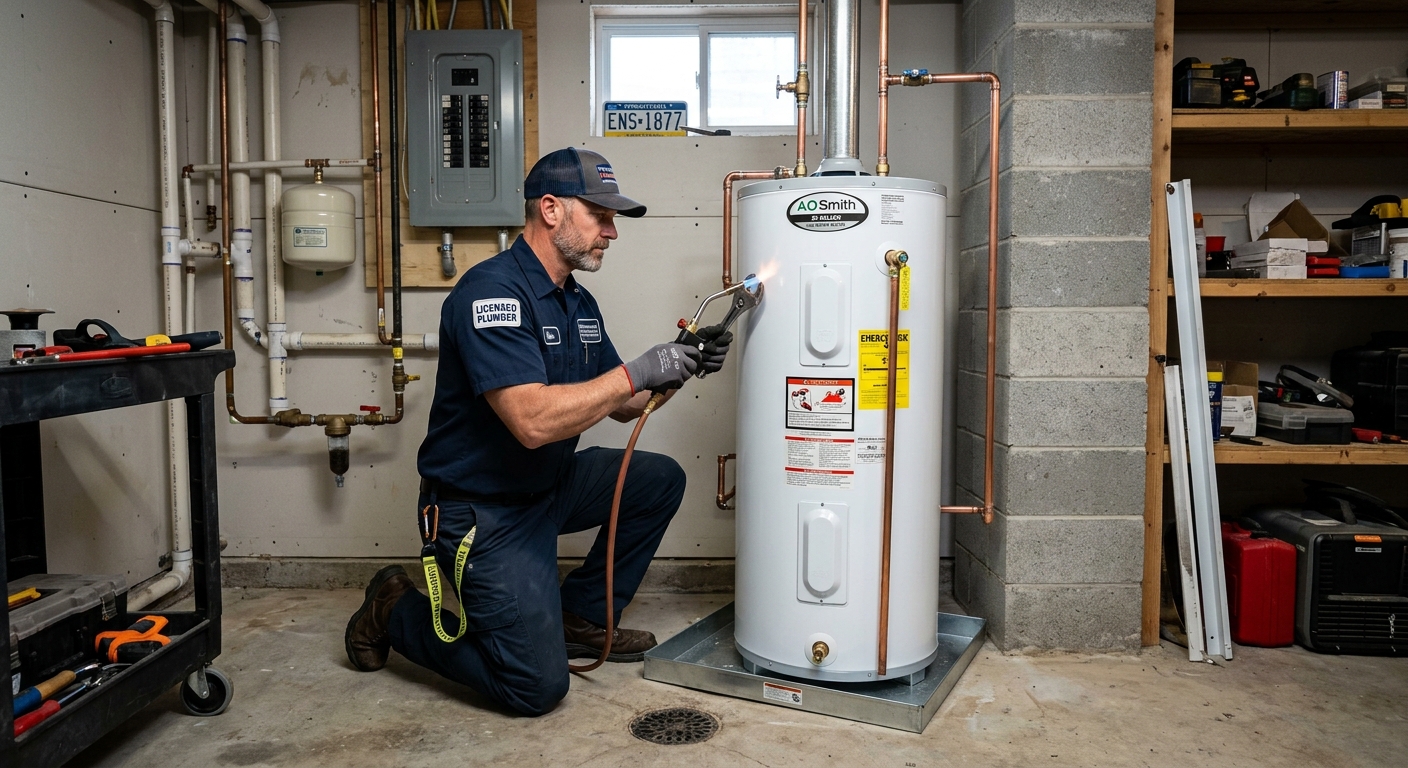
In O'Hara, most homes built before 1980 started with basic tank-style water heaters—easy to install, familiar to every plumber, and with replacement costs that stay in the lower range. Tanks are the lowest cost upfront, but they lose heat even when you’re not using hot water (standby losses), and 8–12 years is about the best you can expect before the tank corrodes and leaks. Replacement in this area usually means swapping out a unit that’s failed at the tank, not the electronics or burner—those rarely go first.
Tankless (on-demand) water heaters appeal to many for endless hot water and superior efficiency, but installation is not just a simple swap. Gas models here often trigger the need for a bigger gas line and new venting, which are expensive surprises in O'Hara’s older homes with limited chase space. The up-front investment can be double or more than a tank, and unless you need endless showers or a very compact footprint, the payback isn’t always there.
Heat pump water heaters are efficient and have the lowest running costs, but need a warm, unconditioned space with enough air volume—most O'Hara basements qualify. They cool and dehumidify their surroundings, which can be annoying in a finished lower level. Noise is also worth considering, as some units are louder than you’d want below bedrooms or in living space.
Pick your size by “first-hour rating”—how much hot water the heater can deliver in peak use. Make sure a new install includes an expansion tank, pan, and a working drain where codes require. In older O'Hara homes, tank failure is almost always sudden, and not the controls, making planned replacement a smarter call than waiting for a flood.
| Type |
Installed cost |
Service life |
Operating cost |
Best when |
| Gas tank, 40–50 gal |
$1,300–$3,100 |
8–12 yrs |
moderate |
most replacements; low cost |
| Electric tank, 40–50 gal |
$1,300–$2,100 |
10–15 yrs |
high |
where gas is unavailable |
| Gas tankless |
$2,100–$3,100 |
18–25 yrs |
low-moderate |
high demand, endless hot water needed |
| Heat pump water heater |
$2,100–$3,100 |
13–15 yrs |
lowest |
unconditioned space, high efficiency |
Spot repairs or whole-house repipe?
In O'Hara, especially in homes built before 1980, decisions about repairing pipes come down to frequency and pipe type. If you’ve had two or more leaks in the same material over three years, the problem isn’t bad luck—it’s a warning that the whole system is aging out. Classic signs for replacement include weak pressure everywhere (not just one sink), water that runs brown or cloudy at first draw, flaking or rust at pipe joints, and multiple tiny leaks (“pinholes”) on older galvanized or copper lines. Spot fixes can hide the root trouble, especially where Pittsburgh-era pipes have corroded from the inside out.
Repipe jobs usually mean a choice between copper and PEX. Modern copper is long-lasting but costly in both material and labor—especially hard on thick plaster and lath common in O'Hara’s earlier blocks. PEX handles cold better, resists scale, and is quicker to run, lowering installation costs. Don’t forget: the expense isn’t just the new pipe, but patching all those precisely cut access holes afterward. Plaster, not drywall, makes restoration a real cost for older homes.
Much of Pittsburgh’s housing stock dates 1900–1950, increasing replacement work for aging galvanized and cast-iron piping. In these homes, sooner or later, a full repipe is usually cheaper in the long run than patching for years—and risking water damage or lead exposure from legacy materials.
| Situation |
Recommendation |
Cost |
Reasoning |
| One leak, accessible, modern pipe |
Spot repair |
$375–$1,300 |
single location, healthy system |
| Two or more leaks in 3 years |
Partial repipe |
$3,900–$6,300 |
pattern signals widespread failure |
| Galvanized supply, pressure loss |
Full repipe |
$3,900–$9,400 |
rust, scale restricts flow |
| Polybutylene anywhere in the house |
Full repipe |
$3,900–$9,400 |
failure-prone material |
| Cast iron drain with root intrusion |
Camera, then reline or replace |
$2,200–$13,000 |
line likely failed, needs imaging |
| Suspected lead service line |
Test, then replace the lateral |
$6,100–$13,000 |
health risk, utility may help |
Plumbing systems in O'Hara homes
With 70.3% of O'Hara’s homes built before 1980, there’s a strong likelihood you have veteran plumbing systems under the floors. Supply lines in these houses are often galvanized steel, copper, or even lead—each with their own issues. Galvanized corrodes inside until pressure drops and brown water signals scaling. Copper is durable, but older installs may leak as joints deteriorate. Lead, which predates World War II, is now a health concern and on the local replacement lists.
Drainage in homes from 1900–1950 typically runs through cast iron or clay tile. Both can last a century, but roots and shifting clay and shale subgrade in Allegheny County show up eventually as cracks, offsets, and blockages, often exposed by sewer camera inspection. Beyond the 1970s, some homes saw polybutylene supply or PVC pipe, both signs of transitional eras. For water service lines—the buried pipe from street to basement—lead and galvanized turn up in the oldest stock, while copper or plastic is more likely in any postwar build.
If your home is from 1960–1980, you may be dealing with the first replacement cycle: builder-grade fixtures wearing out at the same time and original water heaters nearing the end of their first (or second) lifetime. Newer does not mean maintenance-free—sometimes it just reshuffles the list of what fails first.
Vetting a plumber in Allegheny County
Homeowners in O'Hara need to confirm their plumber holds all legally required credentials for this municipality—since Pennsylvania does not issue statewide plumbing licenses and code enforcement here is municipal. First, verify Home Improvement Contractor registration for jobs over $500 at hic.attorneygeneral.gov. If work is in Pittsburgh or nearby, confirm the plumber’s Allegheny County Health Department license, since not every local is qualified outside their municipality. Always get an insurance certificate naming your address and confirm workers’ compensation via the WCAIS system (wcais.pa.gov).
Ask whether the company uses their own trained crews or subs out labor, and if emergency pricing is stated before work begins. With so many contractors in the saturated Pittsburgh metro market, double-check camera footage for drain and sewer jobs and demand pressure tests for repipes; big quotes require big proof.
- Home Improvement Contractor registration checked at hic.attorneygeneral.gov
- Municipal or Allegheny County Health Department plumbing license for your specific job
- Up-to-date, address-specific insurance certificate (liability and property)
- Workers’ compensation status verified at wcais.pa.gov
- Written contract as required by law for all jobs over $500
- Contract discloses emergency/after-hours rates up front
- Proof of who performs the work—crews or subcontractors
- No waiving of homeowner’s insurance deduction (illegal in PA)
- Camera inspection for any quoted sewer or major drain repair
- Pressure test documentation provided for any repiping quote
- Scope of restoration work defined (drywall, finishes)
- EPA Lead RRP certification for work in pre-1978 homes if disturbance is possible
Red flags: Any plumber unwilling to share license, registration, or insurance details is a risk. In a dense contractor market, never accept a recommendation for expensive repipe or sewer work without video or test proof—up-selling is common when proof and price don’t match.
Verifying a O'Hara plumber's credentials
Plumbing licensing in Pennsylvania is not handled at the state level. Instead, it is managed municipally, which means a plumber licensed in Pittsburgh or another Allegheny County municipality may not automatically be licensed to work in O'Hara or your particular township. The right question for a homeowner is not just “are you licensed,” but “are you licensed to do plumbing work here?” For work in Pittsburgh and certain adjacent municipalities, plumbing permits and licenses are regulated by the Allegheny County Health Department Plumbing Program, which operates its own registry of journeyman and master plumbers for these areas.
For plumbing work in O'Hara, always ask if your plumber can provide proof of proper licensing for your specific municipality. Never assume any valid credential gives statewide coverage—municipal borders matter. Most new or altered plumbing systems require an Allegheny County Health Department plumbing permit; this includes main water and sewer line work and whole-house repipes. Minor fix-ups like faucet replacements are usually exempt from permit requirements in Allegheny County.
Before the job, ask for a certificate of insurance naming your address and confirm workers' compensation coverage using the WCAIS portal (wcais.pa.gov)—both are mandatory for any company with employees in Pennsylvania. This is the surest way to protect yourself from both code violations and on-property accidents. Any claim from a plumber about “state licensing” is a signal to dig deeper and check the specifics—they may be thinking of another trade or jurisdiction.
What a plumbing quote should contain
O'Hara homeowners should know that plumbing quotes come in two shapes: flat rate and time-and-materials. Flat rate gives you a final price for defined work, building in some risk for the plumber—they eat the overages. Time-and-materials (T&M) can be cheaper when things go smoothly, but costs climb fast if the job gets complicated. Neither approach is a scam; the issue is not knowing which you agreed to up front.
Look for a diagnostic fee: Does it credit toward the job, or is it extra? Honest contractors state the scope—what gets opened up, what’s fixed, and what’s restored. The quote should include whether permits are needed (and their price), if restoration like drywall is included, and spell out the manufacturer for any fixtures. Check the warranty for labor and parts as separate lines. If after-hours rates might apply, the written quote should highlight them.
| Line item |
What to look for |
Red flag if… |
| Billing model |
flat rate or hourly, stated up front |
unstated |
| Diagnostic fee |
amount, and whether it credits |
vague |
| Scope |
what is opened, repaired and restored |
price with no scope |
| Restoration |
drywall and finish explicitly in or out |
silent |
| Permit |
included and priced |
'not needed' |
| Parts |
brand and model for fixtures |
'standard fixture' |
| Warranty |
labour period stated separately |
parts only |
Frequently asked questions — plumbing in O'Hara
What does emergency plumbing cost in O'Hara?
In O'Hara, the cost for emergency plumbing—such as a burst pipe at night or a major leak you can’t shut off—typically falls between $650–$1,300 for a callout. The exact number depends on how much demo is needed to reach the problem and how much water needs shut-off or restoration. Most homes in O'Hara were built before 1980, so older piping and tight crawlspaces can add to labor time (and cost) compared to newer areas. You'll pay a premium for after-hours or holidays, and the emergency fee covers the fact that a plumber is dropping everything to solve your problem. Always ask up front if the quoted price is flat rate or just the initial fee, and whether restoration is included.
Who pays to replace a lead service line in O'Hara?
Homeowners in O'Hara are usually responsible for the cost of replacing the water service line from the street to the house, even when it's made of lead. With the Pittsburgh Water and Sewer Authority actively replacing thousands of lead lines in Allegheny County, some areas see utility cost sharing, but on your side of the property line, the bill is yours—typically $6,100–$13,000. It’s wise to check if there are any utility programs or city-led initiatives open to your address before proceeding, as these may offset some costs. In most cases, testing and confirming a lead line starts the process, and replacement is not just about compliance, but health.
Should I leave a faucet dripping in cold weather?
For O'Hara residents, with local frost depth set at 36 inches and very real risk of pipe freeze-thaw, allowing a slow drip from a faucet on the coldest nights can help prevent freezing in vulnerable lines. This advice is best applied to older homes with exposed or poorly insulated sections of pipe, especially in basements or crawl spaces with drafts—a real concern here with so many pre-1980 homes. The cost of running a trickle of water overnight is trivial compared to the bill for a burst pipe emergency, which averages $650–$1,300. If your pipes freeze anyway, don’t use an open flame to thaw them, and call a local plumber for help.
Is a tankless water heater worth it in O'Hara?
A tankless water heater can make sense for O'Hara households with high hot water demand or limited space, but it’s not always worth the added cost. Installation runs from $2,100–$3,100, and in the area’s older homes, added costs for venting or upgrading the gas line are common. For many families, a standard tank is more cost effective over a 10–12 year window, unless you value endless hot water for back-to-back showers. If your goal is long-term efficiency and you’re prepared for upfront expense and the quirks of older home retrofits, tankless is a solid choice—otherwise, wait until your current tank fails before switching.
What causes low water pressure in O'Hara homes?
In O'Hara, one of the top causes of low water pressure is internal corrosion on old galvanized pipes—a direct result of the area’s high percentage of pre-1980 homes. Minerals and scale build up in steel pipes, shrinking them from the inside and reducing flow throughout the house. Pressure issues can also signal a failing pressure-reducing valve, a closed main shutoff, or blockages at the meter. Sometimes, it’s as simple as old supply lines in need of a full or partial repipe, which can cost $3,900–$9,400. Always ask a plumber to diagnose visually and with a pressure test before you commit to major work.
What do I do if sewage is backing up?
If sewage is backing up in your O'Hara home, stop running water immediately and call a local plumber who can respond fast. Blockages in older clay or cast iron lines are common in houses built before 1980, and main line issues may affect every drain at once. Professional drain cleaning (hydro-jetting or augering, plus a camera inspection) typically costs $200–$800 for a standard job, but severe blockages or broken lines could run much higher. Don’t use chemical drain openers, as they can worsen pipe damage, especially in older systems. Camera footage is key—don’t authorize a full dig or replacement without it.
Why do plumbers charge a diagnostic fee?
A diagnostic fee covers the travel time and expertise a plumber uses to identify your problem, even if no repair is made that day. In O'Hara, where older homes hide many plumbing surprises behind thick plaster or finished basements, finding the real source of a leak or backup is real work. The fee, which may run $375–$1,300 for emergencies, offsets the costs of tools, travel, and lost time if you opt not to have the work performed. Many reputable plumbers credit the diagnostic fee toward the repair if you go ahead, so always ask up front how this is handled in the quote.
How do I verify a plumber's licence and insurance?
For O'Hara and Allegheny County, check Home Improvement Contractor registration at hic.attorneygeneral.gov for jobs over $500, and ask to see a valid Allegheny County Health Department plumber's license if you’re within Pittsburgh or nearby. Always get a copy of their insurance certificate naming your property, and verify workers’ compensation coverage using WCAIS (wcais.pa.gov). This protects you from unlicensed work and liability if someone’s hurt on your job. Never accept a quote for major work—such as a whole-house repipe at $3,900–$9,400—without seeing these credentials.
Do older O'Hara homes have galvanized pipes?
Yes, many O'Hara homes built between 1900 and 1950 likely have galvanized steel supply pipes, as these were standard when much of Pittsburgh’s housing stock was constructed. Over decades, these pipes corrode and restrict flow, showing up as falling pressure and rusty water, and driving the need for full house repipe, which costs from $3,900–$9,400. If you suspect you have galvanized pipes—check for gray, magnetic pipes at your meter—plan for eventual replacement, especially if you’ve had more than one leak or spot corrosion.