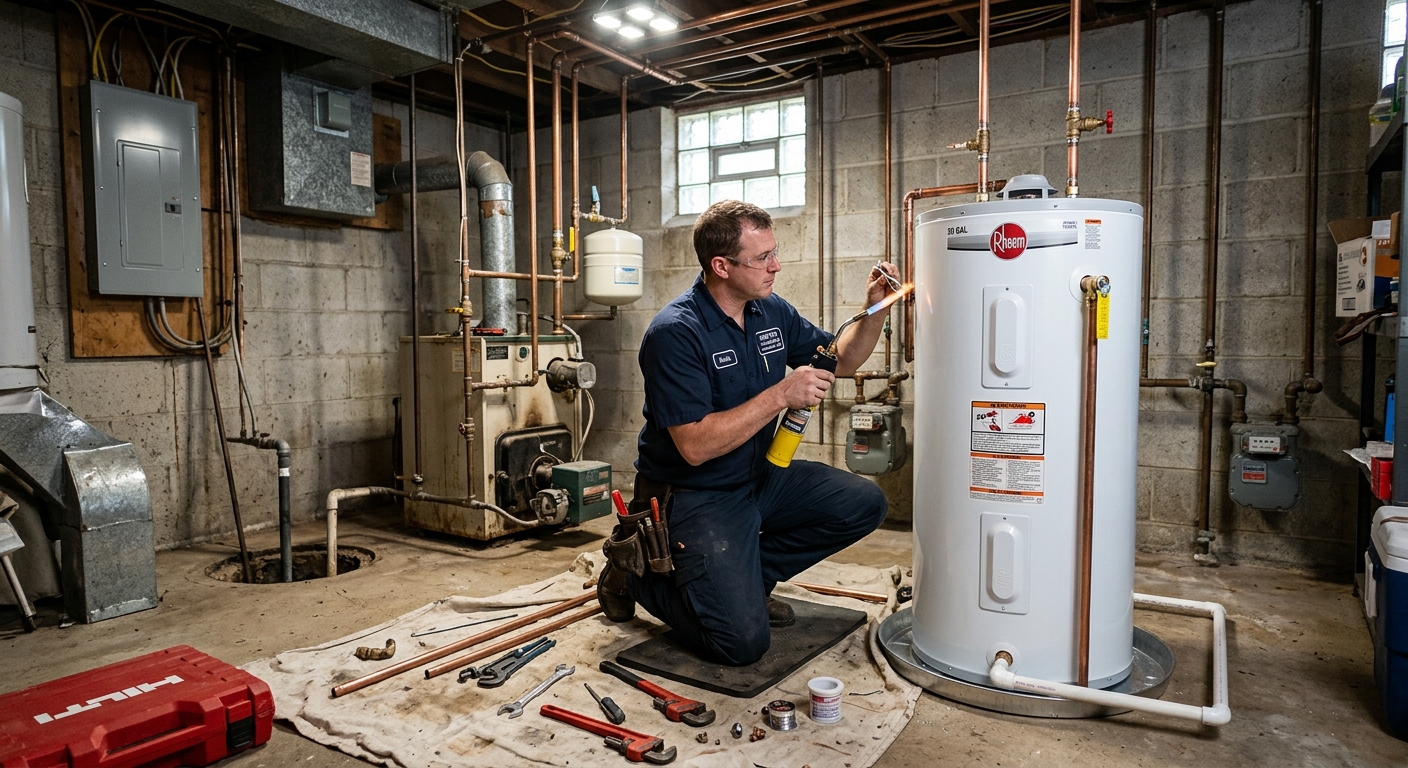
Plumbing costs in Elizabethtown — 2026
Elizabethtown homeowner bills for plumbing work are shaped by two big things: whether the call is an emergency and the era the house was built. With roughly 67.9% of homes built before 1980 (U.S. Census Bureau, ACS 2024), our supply lines often start as galvanized pipe, which means more corrosion and a higher chance you'll face a full repipe, not just a quick repair. That’s especially true in older neighborhoods, which see frequent galvanized-to-copper or PEX replacement work—similar to what’s happening throughout Lancaster city’s pre‑1940 row and twin home stock.
The price for the same plumbing job in Elizabethtown can differ by hundreds depending on whether it’s a middle-of-the-night emergency or a planned project. A burst pipe, for example, runs $600–$1,150 as an emergency, but could be as low as $325–$1,150 if handled during regular hours. That gap carries through water heater swaps—because rapid-response crews and overtime cost more. For unpredictable breakdowns (think: sudden leaks or water heaters that quit without warning), you will pay the emergency rate. For jobs you can schedule in advance, you’re in the standard band.
| Service |
Scope |
Emergency rate |
Standard rate |
| Emergency repair — burst pipe |
locate, open, repair section, restore service |
$600–$1,150 |
$325–$1,150 |
| Water heater replacement (gas, 40–50 gal) |
remove old, install, test, haul away |
$1,850–$2,700 |
$1,150–$2,700 |
| Drain cleaning — main line |
augering or hydro-jet, camera if needed |
$350–$800 |
$200–$500 |
| Sewer line spot repair |
excavate or reline a failed section |
$1,900–$11,500 |
$1,900–$11,500 |
| Whole-house repipe |
replace supply lines throughout, patch and finish |
|
$3,400–$8,200 |
| Water service line replacement |
street to house, excavation and restoration |
|
$5,300–$11,500 |
Estimates for a typical Elizabethtown home. Access difficulty and pipe material move these figures more than anything else.
Choosing a plumbing contractor
Pennsylvania does not issue a statewide plumbing license—plumbing is licensed (or sometimes not) at the municipal level, so a contractor from one area may not be allowed to pull permits in another. Before you sign anything over $500, check for a valid Home Improvement Contractor (HIC) registration at hic.attorneygeneral.gov, and request a certificate of insurance that lists your property. Ask to see proof of workers’ compensation coverage—required by law and verifiable via WCAIS (wcais.pa.gov). Always get emergency pricing up front, and ask whether the company uses its own employees or subs out the work; in Lancaster County, this can affect both speed and accountability.
- Check for HIC registration (hic.attorneygeneral.gov)
- Verify the company is authorized in your municipality—not just the county
- Request a current certificate of insurance naming your address
- See workers’ compensation documentation for all employees on site
- Ask about who pulls permits, and verify it’s signed in the contractor’s name
- Ask if the crew are employees or subcontractors
- Clarify rates for after-hours or emergency response
- Get written estimates, especially for jobs over $500 (as required by law)
- Confirm there’s a clear warranty policy, and get it in writing
- Ask to see camera footage for sewer/drain replacements or repairs
- Request proof of compliance with the EPA Lead RRP rule for homes built before 1978
- Decline any quote based solely on "visual estimate" for major pipe work—insist on proof
Red flags: In a market as spread out as Lancaster County—with its mix of older urban and far-flung rural customers—you will find some out-of-area and traveling crews. The biggest red flag on major jobs is a contractor recommending a full sewer or repipe job without providing camera footage or a pressure test as justification.
The leak you can hear but can't see
Before calling a plumber for a hidden leak, try the free test every Elizabethtown homeowner can do: shut off every faucet and water-using appliance, then check your water meter. If the indicator dial still spins, you have a leak somewhere in the supply piping, not just a dripping faucet.
Professional leak detection starts at the $325–$1,150 range for an initial investigation and can go up if advanced techniques are needed. Acoustic listening devices pick up the sound of water moving through pipe or a slab—good for pinpointing leaks in walls or under floors. Thermal imaging cameras visualize temperature changes from leaking pipes. Tracer gas gets used for truly tough-to-locate leaks—non-toxic gas is injected, and detectors sniff out where it escapes. Slab leak detection generally runs at the higher end because it requires more specialized tools.
If you have water pooling but no visible source—like behind a wall, inside a ceiling cavity, or under concrete—these tools make finding the leak possible with minimal drilling or demolition. A professional plumber in Elizabethtown should never open up your wall or break tile "just to look" before these locating methods are done. For outside irrigation or invisible lawn leaks, acoustic or tracer gas works even when lines aren’t easy to trace. Good detection saves time, mess, and your money.
Plumbing systems in Elizabethtown homes
In Elizabethtown, where nearly 68% of homes date from before 1980 (U.S. Census Bureau, ACS 2024), it’s realistic to expect original supply lines to be galvanized steel or early-generation copper, and waste pipes to be a mix of cast iron, clay tile, and in some lower-cost postwar blocks, even Orangeburg (bituminized fiber). In these homes, the main water line from the street may be lead, and inside lines corrode or clog with rust after decades—one reason that galvanized-to-copper or PEX replacement is so common in Lancaster city and surrounding towns. Most older homes have had at least one water heater replacement, and a 50-year-old waste stack or 80-year-old supply pipes have almost always been patched or partially replaced.
For neighborhoods built in the 1980s through the early 2000s—some of Elizabethtown’s outer developments—supply pipes are typically copper or early PEX, with builder-grade fixtures and, occasionally, polybutylene or CPVC in the right vintage. Water heaters in these homes are often nearing the end of their first or possibly second life. Drains tend to be plastic (ABS or PVC), and while leaks are less likely than in older stock, original materials can still fail. Regardless of era, plenty of homes here now face replacement needs: pipes and water heaters do not last forever, and your inspection list just changes with the age.
Spot repairs or whole-house repipe?
If you’ve had two or more leaks on the same type of pipe within three years, it’s not just bad luck—that’s the point where repair costs start stacking up past what a proactive partial or whole-house repipe might cost. For Elizabethtown homes, especially those built before 1980 with galvanized, polybutylene, or old copper, look for global signs: noticeable pressure drop across every fixture, rusty water on first draw, chronic pinhole leaks, or obvious corrosion at joints are red flags for replacement, not more spot repairs.
Whole-house repiping usually means swapping galvanized for copper or PEX. PEX is popular for cost and easier installation in tight old basements common throughout the Lancaster area, including pre‑1940 homes. Copper costs more but outlasts plastics. However, don’t forget the hidden cost—patching drywall and, in older homes, plaster. Sometimes the finish work that follows the piping can cost as much as the plumbing itself, especially in houses with historic details.
You might be tempted by the “partial repipe” pitch, but in aging galvanized systems or polybutylene, a patch seldom buys more than a few years of peace. That trend—frequent galvanized-to-copper or PEX repipes—isn’t marketing; it’s what the old housing stock here actually requires.
| Situation |
Recommendation |
Cost |
Reasoning |
| One leak, accessible, modern pipe |
Spot repair |
$325–$1,150 |
Damage is isolated; material not at end of service life |
| Two or more leaks in 3 years |
Partial repipe |
$3,400–$5,500 |
Pattern suggests underlying material failure |
| Galvanized supply, pressure loss |
Full repipe |
$3,400–$8,200 |
Clogged, corroded lines risk more failures soon |
| Polybutylene anywhere in the house |
Full repipe |
$3,400–$8,200 |
Known failure-prone; insurance issues may follow |
| Cast iron drain with root intrusion |
Camera, then reline or replace |
$1,900–$11,500 |
Root growth and corrosion mean patching won't last |
| Suspected lead service line |
Test, then replace the lateral |
$5,300–$11,500 |
Health risk and city programs urge full replacement |
Sewer line problems in Elizabethtown
For Elizabethtown homeowners, you own the sewer lateral from your house all the way out to where it joins the city main—a point that usually extends past your property line, sometimes even into the street. This is the main source of disputes over who pays for repairs. Recognizing problems early is key: one slow drain is likely inside the house, but if multiple fixtures are sluggish, or you hear gurgling and see water backing up in the lowest-lying tub or floor drain, the problem is often in the lateral.
Any plumber telling you to dig up your yard without showing you a camera inspection should be shown the door. A proper diagnosis—costing $200–$500 for a standard camera job—lets you see the blockage, collapse, or intrusion (roots are common in older clay tile lines here). Frequent causes in this area are root intrusion at joints, “bellies” (sags that collect debris), or offset pipes. For many Elizabethtown homes with pre-1980 lines, expect to see original vitrified clay or sometimes Orangeburg, both failure-prone.
Remedies range from open-cut replacement to trenchless relining (when pipe condition allows), but always base scope and price on camera proof. Septic systems are also common in outlying agricultural parcels—if you’re on a septic tank, have it pumped every 3–5 years and keep an eye out for soggy lawns or foul odors as possible signs the drainfield is failing. Never accept a sewer excavation quote without camera footage in hand.
Verifying a Elizabethtown plumber's credentials
In Pennsylvania, plumbing is not licensed state-wide. Requirements are set instead by each individual municipality. That means a plumber working in Lancaster city may have no standing to do permitted work in Elizabethtown or any surrounding township. The question to ask isn’t “are you licensed,” but instead “are you licensed to pull permits here in Elizabethtown?” For jobs over $500, state law requires a written contract (Home Improvement Consumer Protection Act).
In Lancaster County, code enforcement is handled by the City of Lancaster Bureau of Building Code Administration, with all township offices enforcing residential code based on the Pennsylvania Uniform Construction Code (which itself is based on the IRC). In Lancaster city, permits are needed for any work that physically alters, expands, or adds value—so that covers most replumbing, sewer, and water line projects. Minor same-fixture repairs (think faucet cartridges or toilet seals) do not require a separate plumbing permit.
Before any major project, you should always see the contractor’s HIC registration (verify at hic.attorneygeneral.gov), a current certificate of insurance listing your address, and proof of workers’ compensation (verify via WCAIS, the state system named in the law). For homes built before 1978, confirmation of EPA Lead RRP compliance is required. Never let work start without these checks, because a permit pulled by someone not authorized here can leave you with an uninspected—or even illegal—job.
Frequently asked questions — plumbing in Elizabethtown
Who owns the sewer lateral, me or the city?
In Elizabethtown and throughout Lancaster County, the homeowner owns the sewer lateral all the way from the foundation to where it connects with the city’s main line—often running beneath the curb, sidewalk, or even part of the street. The city only maintains the public main, not the line from your house to the tap. If your line needs repair or replacement, you are responsible for all work and costs. Sewer spot repairs here can run from $1,900–$11,500 depending on the extent and depth of the issue, excavation needed, and surface restoration (like replacing sidewalk or landscaping). Always ask to see camera inspection footage of your actual line before authorizing repair—never rely on a guess or generic statement about “old pipes.” Knowing where your responsibility begins is important to avoid prolonged disputes and unnecessary expenses.
Should I reline or replace my sewer line?
For Elizabethtown homes, the right solution depends on pipe condition, material, and where the issue is located. Relining is a trenchless option—often called “cured-in-place pipe”—that creates a new lining inside an old pipe, best suited for clay or cast iron laterals with root intrusion or minor cracks, but not if the pipe is totally collapsed or offset. Traditional open-cut replacement is still required for pipes that have “bellied,” lost their slope, or broken entirely. The cost for either can start around $1,900–$11,500. Before making a decision, demand a camera inspection (which usually costs $200–$500) so you see exactly what’s happening under your yard. Relining avoids digging and is often less disruptive, but isn't right for every failure—and no one-size-fits-all answer works for Lancaster County’s variety of pipe types and soil conditions.
Does Pennsylvania license plumbers at the state level?
No—there is no statewide plumbing license in Pennsylvania. Instead, licensing falls to individual cities or townships. For example, Lancaster city examines and licenses plumbers for work within its boundaries; the same goes for Pittsburgh and Philadelphia. Elizabethtown and surrounding townships may have different requirements. So hiring someone “licensed in PA” isn’t enough—you need a plumber licensed to pull permits in your specific municipality. Before work starts, especially for jobs over $500, check the company’s Home Improvement Contractor (HIC) registration at hic.attorneygeneral.gov, and make sure they are authorized in Elizabethtown or your township for the type of work required. This difference often confuses homeowners, so ask directly before you sign a contract.
Are tree roots a common sewer problem in Elizabethtown?
Yes, they are. Many Elizabethtown homes—especially those built before 1980—still have original clay tile or cast iron laterals. These older pipes are prone to root intrusion as joints age, shift, or develop tiny cracks, creating a path for root growth and blockages. This is a leading cause of backups and expensive repairs in our region. The fix can range from root cutting (a temporary solution) to trenchless relining or full replacement, which runs $1,900–$11,500 for a typical spot repair in this area. Prevention is possible: regular camera inspections and annual augering—especially if you have known shallow-rooted trees near the sewer line—can save substantial headaches (and money) down the road.
What causes low water pressure in Elizabethtown homes?
Low water pressure here most often points to aging infrastructure—usually galvanized steel or corroded copper pipes found in the two-thirds of Elizabethtown homes built before 1980. Mineral and rust buildup constrict flow, and in some cases, you’ll see brown or discolored water at the tap. Less often, it could be a failing pressure regulator, a partially closed main shutoff, or a leaking water service line bleeding off pressure underground. A whole-house repipe for these issues (copper or PEX) generally ranges from $3,400–$8,200. For isolated low pressure at a single fixture, check for plugged aerators or shutoffs first—don’t jump to worst-case scenarios until the basics are ruled out.
What does drain cleaning cost in Elizabethtown?
In Elizabethtown, drain cleaning pricing depends on the urgency and the length or difficulty of your main line. For a regular, scheduled job on a single main drain, expect to pay $200–$500. If it’s an emergency after hours or a major blockage, the price could rise to $350–$800—especially if the plumber uses a hydro-jetter or needs to run a camera for diagnosis. Smaller jobs, like snaking a sink or tub, cost less. Many homeowners try chemical cleaners first, but for clogged main lines or repeated backups, professional cleaning is safer for your pipes and often less expensive in the long run.
Do I need to drain outdoor spigots in Elizabethtown?
Yes, absolutely. Elizabethtown winters bring repeated freeze-thaw cycles, with winter temperatures dipping to 12°F and a frost depth of 30 inches. Outdoor faucets (hose bibs) and lines that aren’t winterized are at high risk of bursting—an emergency repair will run $325–$1,150. To avoid this, turn off the water supply to exterior spigots from inside the basement, drain the remaining water, and leave the outdoor valve open slightly. In older Elizabethtown homes, look for “frost-free” models if you’re replacing a leaking one; these are specifically designed for our climate. Prevention is a ten-minute fall chore—much cheaper than burst pipe repairs.
What counts as a plumbing emergency?
Any water event that damages property or leaves you without vital services qualifies as an emergency. In Elizabethtown, typical plumbing emergencies include active leaks (burst pipe, gushing fitting), overflowing toilets with sewage, water heater failures that cause flooding, or loss of the main water or sewer service. Emergency repairs run higher—generally $600–$1,150 for burst pipes and up if after hours or on weekends. If you can safely shut off the water and wait until business hours, you’ll pay less. Never ignore leaks in ceilings or behind walls; fast action keeps damage—and expense—down.
What does repiping a house cost in Elizabethtown?
Repiping an entire Elizabethtown house typically costs between $3,400–$8,200, depending on size, access, and whether you choose copper or PEX for the supply lines. Older homes with plaster walls and tight crawlspaces often run on the higher end due to extra labor for wall and ceiling patchwork after the pipes are replaced. You’ll see the highest costs if you have extensive finished or historic interior surfaces, as restoration can rival the plumbing labor itself. If you’ve had multiple pipe leaks in two or three years or see pressure loss across the house, a repipe is often more cost-effective than years of recurring spot repairs.