Newberry plumbing prices by job type — 2026
Most Newberry homeowners can expect two different price tags for the same plumbing job, depending on whether they need help in the middle of a crisis or can wait for a scheduled visit. With a 92.4% homeownership rate and more than 43% of the housing stock built before 1980 (U.S. Census Bureau, ACS 2024), much of Newberry’s plumbing follows the pattern seen in York City: frequent projects replacing old galvanized supply lines with copper or PEX due to age and corrosion. This construction era means materials drive both the type and price of repairs. Emergency calls, especially for older homes where shutoffs may be corroded or buried, routinely bring a higher rate, not only for the time but for the urgency and diagnosis in less-than-ideal circumstances.
Here’s what you can expect to pay for common plumbing jobs in Newberry, with clear differences between emergency and scheduled work:
| Service |
Scope |
Emergency rate |
Standard rate |
| Emergency repair — burst pipe |
locate, open, repair section, restore service |
$600–$1,250 |
$375–$1,250 |
| Water heater replacement (gas, 40–50 gal) |
remove old, install, test, haul away |
$1,950–$2,900 |
$1,250–$2,900 |
| Drain cleaning — main line |
augering or hydro-jet, camera if needed |
$350–$800 |
$200–$500 |
| Sewer line spot repair |
excavate or reline a failed section |
$2,100–$12,500 |
$2,100–$12,500 |
| Whole-house repipe |
replace supply lines throughout, patch and finish |
$4,500–$8,800 |
$3,600–$8,800 |
| Water service line replacement |
street to house, excavation and restoration |
$7,000–$12,500 |
$5,700–$12,500 |
Estimates for a typical Newberry home. Access difficulty and pipe material move these figures more than anything else.
When to call now and when to wait until Monday
In Newberry, the difference between an emergency plumbing rate and a standard rate is all about immediacy. Emergency service means someone is rolling a truck outside of normal hours—often nights, weekends, or holidays. What you’re paying for is not just the fix, but rapid dispatch, overtime labor, and fast troubleshooting under pressure. Expect a typical emergency repair to fall in the $600–$1,250 range, while waiting for business hours can drop that same job to $375–$1,250.
True emergencies include:
- Active flooding from a burst pipe or failed water heater
- No water throughout the house
- Raw sewage backing up into drains or tubs
- Smell of gas near a water heater or furnace (leave the house and call the utility)
Most other issues—like a slow drip under the sink, a single slow drain, a running toilet, or water heater pilot going out—can safely wait until standard business hours. These kinds of repairs aren’t likely to worsen dramatically overnight.
If you’re unsure, the most valuable skill is knowing how to shut off water. Every Newberry home should have a main shutoff, usually at the point where the water line enters the basement. Turn the valve clockwise to shut off. Individual fixtures (toilets, sinks) also have their own shutoffs just below. Stopping the water flow turns many emergencies into simple repairs at a lower cost when the work is scheduled.
Service line material and drinking water in Newberry
Newberry’s public water comes from the York Water Company, the region’s primary supplier. Importantly, the York Water Company has reported full lead service line replacement for its York City system after carefully inventorying historic connections. However, not every home in outlying parts of York County is covered by these efforts, and each property owner is still responsible for the portion of the service line running from the curb stop or property line into their home.
This split means that while the utility may own and maintain the main line up to your property, everything from that point to your meter is homeowner territory—including responsibility and cost for repairs or replacement. Replacing just the utility side is common, but a partial replacement can disturb built-up scale and increase lead in water for a short time, sometimes creating a temporary spike.
Homeowners in Newberry should check the York Water Company’s published service line inventory—often posted on their website or available by direct request—to confirm the material for both sides of their service. If you are unsure or outside York City limits, contact the York Water Company directly to verify your own line’s material, as there may not be a formal replacement cost-share in place outside the city system.
To identify your own line, find where the pipe enters the house and perform a scratch and magnet test: lead is soft, silvery, and non-magnetic. If you do need to replace your side, a typical water service line replacement in Newberry will run $5,700–$12,500. If galvanized or lead pipe runs inside the home, a full house repipe using copper or PEX will fall in the $3,600–$8,800 range. Don’t assume total replacement is needed without confirming the material and its condition first—it could save you thousands.
Water heater replacement decisions
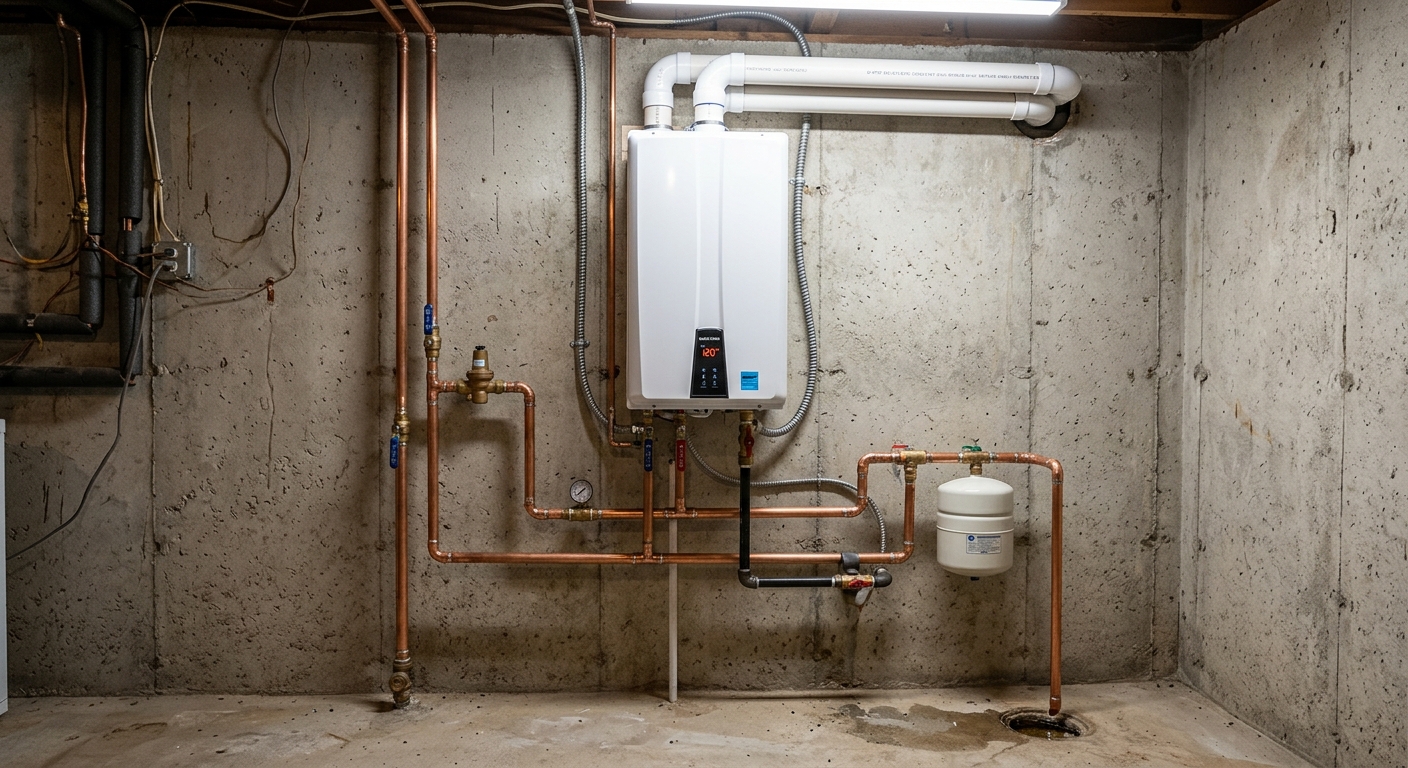
For Newberry homeowners, the “best” water heater always comes down to installation cost, long-term savings, and how your home is set up. Most older homes in Newberry use gas or electric tank water heaters: cheapest to install (generally $1,250–$2,900 for a 40–50 gallon gas model), but with the shortest lifespan and the highest standby losses because hot water is always sitting in the tank.
Tankless gas units offer endless hot water and save energy by heating only as you use it, but their install cost is higher ($1,950–$2,900). The real catch is that many older homes need a larger gas pipe or new venting for code compliance—a cost missed in many quotes. Heat pump (hybrid) water heaters are the cheapest to run, but need 700–1,000 cubic feet of warm, unfinished space and can noticeably cool the room they’re in, which is only a benefit in the summer. They’re louder than a typical fridge, so less ideal if your basement is finished living space.
Rather than picking by tank size, check the First Hour Rating—how much hot water it can deliver during peak use. If your system’s expansion tank is missing or water heater is on the floor, adding a thermal expansion tank and a drain pan is worth the small extra cost. Most water heater failures start as a leak from the tank, not a control or burner problem.
| Type |
Installed cost |
Service life |
Operating cost |
Best when |
| Gas tank, 40–50 gal |
$1,250–$2,900 |
8–12 yrs |
moderate |
existing gas plus vent, large families |
| Electric tank, 40–50 gal |
$1,250–$1,950 |
10–15 yrs |
high |
no gas available, lowest upfront |
| Gas tankless |
$1,950–$2,900 |
18–25 yrs |
low-moderate |
endless hot water, high demand |
| Heat pump water heater |
$1,950–$2,900 |
13–15 yrs |
lowest |
big unfinished, warm basement, no gas |
Hardness, treatment and fixture life in Newberry
The York Water Company supplies most of Newberry’s public water, and they release an annual water quality report. You can request the latest version for free; it details hardness, iron, and other levels that affect everything from water heater lifespan to faucet performance.
Newberry’s water is typically described as moderately hard. Hardness shortens the life of water heaters and fixtures through scale buildup, meaning you may see popping sounds or less hot water output as sediment collects. Hardness can be addressed with a softener, but installation and ongoing salt/recharge costs mean most homes with moderate hardness do not see enough payback to justify the expense unless you’re chasing specific issues like white spotting or shortened appliance life.
For drinking water, a point-of-use filter at the kitchen tap is usually plenty—whole-house systems add ongoing cost and maintenance without much added benefit unless you have strong odors or visibly stained fixtures. Aggressive (soft, corrosive) water is less common and would show up as copper pinhole leaks, though it’s always wise to check. Don’t buy expensive equipment unless you have a clear water quality need—ask for the York Water Company’s data, and consider a plumber’s honest opinion about what’s really necessary.
Plumbing systems in Newberry homes
With over 43% of Newberry homes built before 1980, plumbing varies house by house. Many older homes mirror York City’s 1900–1950 patterns: galvanized steel supply lines (prone to rust and low flow), cast iron or clay tile drain lines, and copper or galvanized water service lines. If your house was built in that era, it may have experienced at least one round of repiping, often moving from galvanized to copper, or more recently, to PEX. By now, most water heaters are on their second or third replacement cycle—few original tanks have lasted this long.
This older stock means higher odds of hidden corrosion and the occasional floor drain or sewer lateral made from vitrified clay, which is more susceptible to ongoing root intrusion and spot failures. Expect water heater and major fixture replacements to become more routine as weak links reveal themselves.
In newer, post-1980 subdivisions—less common in Newberry—you may see original builder-grade fixtures, copper or even polybutylene (in the right window) supply piping, and PVC drains. Original water heaters in these homes are nearing end-of-life, but fewer surprises should surface if good shutoffs and up-to-date materials are on site. Newer homes cut down on emergencies, but none are immune to the need for rework eventually.
Who is allowed to do plumbing work in Pennsylvania
Pennsylvania does not license plumbers at the state level—there is no statewide trade license for plumbing. Instead, licensing is handled by municipalities. This matters for Newberry homeowners because a plumber licensed to work in one city may not hold any credential in the next township. For Spring Garden Township, there’s a separate plumbing license registration on top of general state requirements. Always ask your plumber: “Are you licensed here, for this municipality?”
The Pennsylvania Uniform Construction Code (UCC), based on the International Residential Code, sets the standards across the state, but inspection and permits are enforced locally or by the state Department of Labor & Industry if a municipality has opted out. In York City, for example, any new or altered plumbing system work beyond fixture replacement needs a permit and will be inspected by the city’s Bureau of Permits and Inspections. Same-location replacement of an existing sink or toilet commonly doesn’t need a permit, streamlining smaller jobs.
For homeowner assurance, Pennsylvania requires Home Improvement Contractor (HIC) registration from the Office of Attorney General for contracts over $500. You can check a contractor’s status at hic.attorneygeneral.gov. Employers must carry workers’ compensation insurance, and you can verify coverage via WCAIS (wcais.pa.gov). Written contracts are mandatory for jobs above $500, and you have the right to cancel within 3 business days under the Home Improvement Consumer Protection Act.
Frequently asked questions — plumbing in Newberry
What counts as a plumbing emergency?
Emergencies in Newberry include any active flooding, no water at all, or sewage backing up into the house. These events can damage your property or make your home unsafe very quickly. If you come home to water spraying from a burst pipe or a water heater letting go, or if you notice a foul smell and sewage emerging from floor drains or tubs, that’s an emergency. Some less-obvious cases include no hot water for homes with only one shower, or any gas smell near a water heater—leave the house and contact the gas utility. Emergency service comes at a premium, often $600–$1,250 for a burst pipe repair compared to a lower rate if scheduled. Anything leaking slowly or only affecting one fixture can usually wait until normal business hours to save money.
Is a water softener worth it in Newberry?
For most Newberry households on public water, a softener is rarely a must. York Water Company’s water is moderately hard, so you might see white mineral buildup or shortened water heater life, but the annual cost of buying, installing, and maintaining a softener often rival the savings—unless you’re seeing constant fixture replacement or must-have spotless dishes. For hatch-mark savings, a new water heater comes in around $1,250–$2,900; a softener generally won’t pay for itself by extending tank life alone. Consider softeners if your water test comes back with hardness much above average or if you have sensitive skin or hair. If you’re on a private well, test your water annually and treat based on actual results, not sales pitches.
Should I leave a faucet dripping in cold weather?
In Newberry, winters bring enough freeze-thaw cycles that uninsulated pipes—especially near foundation walls or in crawl spaces—are at risk. Leaving a faucet dripping may help prevent freezing, but only if the exposed section is vulnerable and you can’t insulate it properly. Dripping every faucet is overkill for most Newberry homes. Find your main shutoff so you can quickly stop water if a pipe does burst. A frozen and burst pipe that goes unnoticed can lead to an emergency repair in the $600–$1,250 range, while preventative insulation costs less if you have access. Prioritize heat and insulation, and use the drip method only as a backup for the coldest, windiest nights.
What does drain cleaning cost in Newberry?
Main line drain cleaning in Newberry generally ranges from $200–$500 for a standard (scheduled) call to $350–$800 if you need someone after hours. Drain cleaning usually involves augering or, for stubborn clogs like grease or roots, hydro-jetting. Camera inspection might be included or added for a moderate extra charge if the problem isn’t resolved. If you notice all drains are slow or water backs up in the lowest fixtures during showers or laundry, your main line should be checked soon, but unless sewage is coming back in, you can usually schedule rather than pay the emergency premium. Avoid overused chemicals, which rarely solve the main issue and can damage pipes.
How much does sewer line repair cost in Newberry?
Sewer line spot repairs in Newberry fall within a wide band: $2,100–$12,500. The biggest factors are access and how much pipe needs replacement or relining. If you have an older home with clay or cast iron laterals typical for the area, root intrusion and settling are common sources of failure. Most straightforward “spot” repairs—digging up and fixing a short failed section—hit the lower end, but major blockages, collapse under driveways, or deeper runs push costs up quickly. Because sewer lines often run under lawns, gardens, or pavement, restoration doubles the price when sensitive landscaping or concrete is involved. Always get a camera inspection first.
How hard is the water in Newberry?
Newberry’s water, supplied mostly by the York Water Company, rates as moderately hard according to their annual water quality reports. This means you may see some mineral buildup on faucets, kettle elements, or bathtubs. For most families, it’s not hard enough to damage pipes outright, but can shorten water heater life. Depending on your preference for spotless dishes or how much you value extending appliance life, a softener could help, but many homes defer this expense. A new water heater is $1,250–$2,900, and a softener only makes sense if the mineral buildup is truly disruptive.
Am I responsible for the water line under the street?
Not in most cases. For Newberry and York City, the York Water Company is responsible for the public portion of the water service line up to your property line or curb stop; the section from the property line into your house is the homeowner’s responsibility. If you need to replace that run, especially if it’s old galvanized or lead, the cost for a water service line replacement is typically $5,700–$12,500. Always confirm ownership split with the utility before starting work, and check their published service line inventory or ask for written documentation about which portion you’re required to maintain.
Who inspects plumbing work in Newberry?
In Newberry and throughout York County, plumbing permits and inspections are managed at the municipal level. For example, if your home is within York City, the Bureau of Permits and Inspections will handle all code-required inspection and permit review for any new or altered plumbing system project (anything bigger than a fixture swap). Townships like Springettsbury do their own inspections. Homeowners can verify a contractor’s HIC registration at hic.attorneygeneral.gov, and workers’ compensation coverage at wcais.pa.gov. Contractors should provide a written contract for jobs over $500, and both you and the inspector should see permits and sign-offs before closing up any walls.
Why do all my drains drain slowly at once?
If every drain in your Newberry home is running slow—tubs, showers, sinks, even toilets—it’s almost always a main drain issue. In older homes, root intrusion into clay or cast iron lines, or a soft clog from grease or wipes, can restrict as much as 90% of the line before anything fully backs up. Most main line issues can be cleared using augering or hydro-jetting, which costs $200–$500 if scheduled during normal hours. If waste starts backing up into lower drains or basement fixtures, or you notice sewer smells, call sooner. If it's just one fixture, the problem is local, but if it’s the whole house, it’s time to look below the floor.