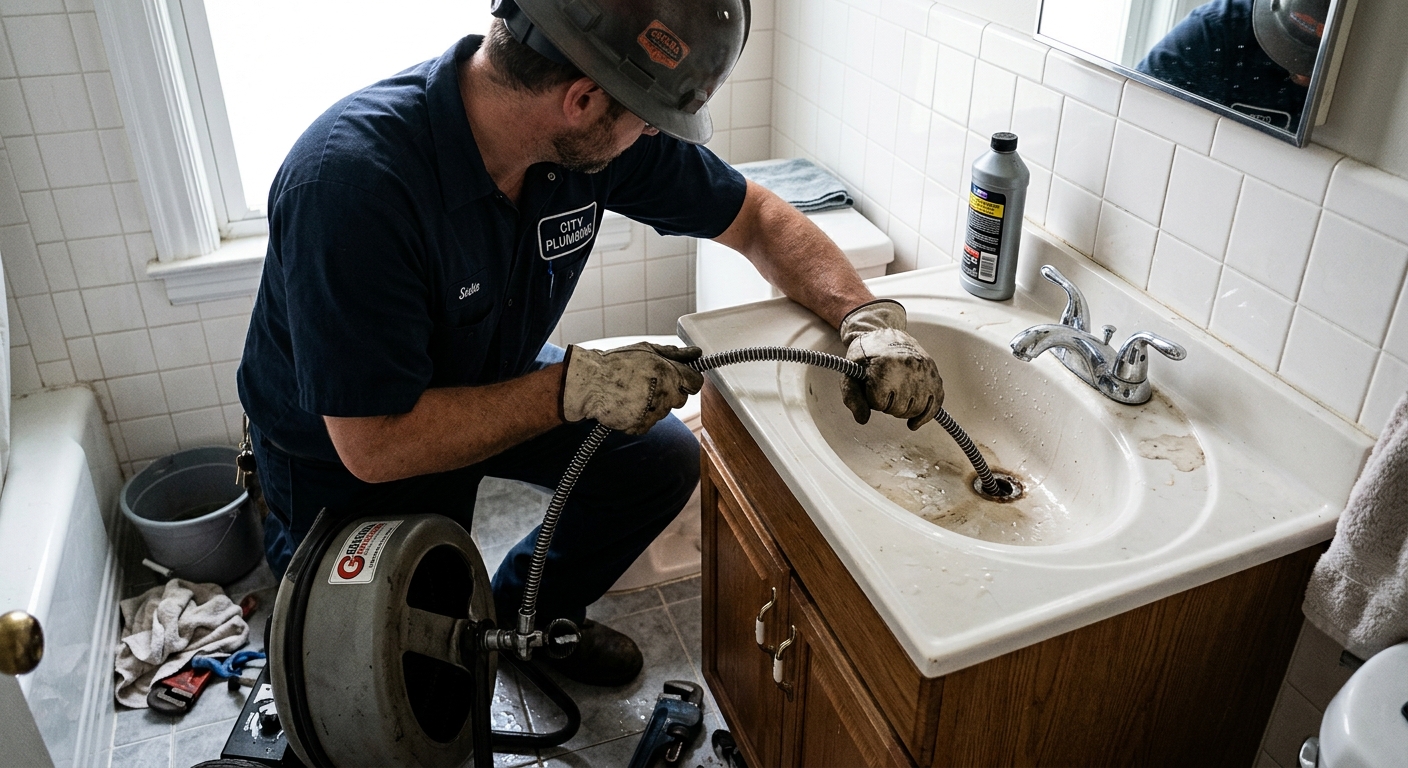
What plumbers charge in Ross
In Ross, with 76.0% homeownership and over three-quarters of homes built before 1980 (U.S. Census Bureau, ACS 2024), plumbing costs often reflect the reality of aging pipe—especially galvanized and cast iron. Much of Pittsburgh’s housing stock dates 1900–1950, so failures tied to corrosion, mineral buildup, and joint separation are common. The construction era usually pins down both the type of pipe you have and what eventually goes wrong, whether it’s a slow leak from rusted galvanized or a sudden break in a brittle cast iron drain.
Emergency repairs cost more, sometimes much more, than scheduled work. Sympathy aside, any plumber in Ross or the broader Allegheny County market will quote based on when you call—and whether water’s still running onto the floor. Routine jobs like water heater replacement carry a straightforward price, but those numbers change if you’re facing an immediate leak and need an after-hours dispatch.
| Service |
Scope |
Emergency rate |
Standard rate |
| Emergency repair — burst pipe |
locate, open, repair section, restore service |
$600–$1,250 |
$350–$1,250 |
| Water heater replacement (gas, 40–50 gal) |
remove old, install, test, haul away |
$1,950–$2,900 |
$1,250–$2,900 |
| Drain cleaning — main line |
augering or hydro-jet, camera if needed |
$350–$800 |
$200–$500 |
| Sewer line spot repair |
excavate or reline a failed section |
$2,000–$12,500 |
$2,000–$12,500 |
| Whole-house repipe |
replace supply lines throughout, patch and finish |
|
$3,600–$8,700 |
| Water service line replacement |
street to house, excavation and restoration |
|
$5,600–$12,500 |
Estimates for a typical Ross home. Access difficulty and pipe material move these figures more than anything else.
How to find a good plumber in Ross
Ross sits within Allegheny County’s bustling plumbing market, so finding a reputable contractor takes more than scrolling reviews. Licensing for plumbers in Ross is municipal, not statewide—meaning you must confirm your plumber is licensed where your property sits, not just in the next township. Start by asking for a copy of their Allegheny County Health Department license for plumbing work within your municipality. Insurance is mandatory—ask for a certificate naming your address and check workers’ compensation coverage at wcais.pa.gov. For contracts over $500, Pennsylvania law demands Home Improvement Contractor (HIC) registration. You can verify this at hic.attorneygeneral.gov. Honest companies will also clarify if they use in-house staff or subcontract, and will give you upfront rates for after-hours emergencies, not just “time and material.”
- Verify municipal plumbing license (Allegheny County Health Department)
- Check active HIC registration with Pennsylvania Office of Attorney General
- Ask for certificate of insurance that lists your address
- Confirm workers’ comp at wcais.pa.gov
- Require a written contract for jobs over $500 as per HICPA
- Obtain all emergency pricing and minimums in writing before work begins
- Ask if work crews are direct employees or subcontractors
- Confirm pulling of any needed plumbing permits for new/altered systems
- Get a detailed scope of work and parts list—no “allowances” only
- Be wary of vague or bundled invoices after the fact
- Demand before-and-after photos and, for sewers, a copy of camera footage
- Require a pressure test for any repipe or water service job
Ross’s dense contractor market means high competition—and some overselling. The biggest two red flags: any plumber who pitches a major repipe or sewer job without offering camera proof and a pressure/leak test, and anyone unwilling to put emergency pricing in writing upfront. Walk away if you see either.
Lead service lines in Ross
Pittsburgh Water and Sewer Authority supplies water to much of central Allegheny County, including Ross, and has identified and is replacing thousands of lead service lines in the county. With these lines, there are always two sides involved: the portion owned by the utility (usually under the street) and the homeowner’s side (from the curb to your house). Replacement programs typically cover only one; you’re responsible for the house-side unless specifically told otherwise. Partial replacement—a new copper line spliced into an old lead line—can be worse than doing nothing in the short term, since disturbing the pipe shakes loose scale that had been holding lead back. If you live in an older home, especially pre-1950, your lateral is at risk.
To check, locate the pipe where water enters your home. A scratch test (use a coin) reveals if it’s dull gray and soft (lead), while a magnet will not stick to lead. If uncertain, ask your plumber or contact the utility. Pittsburgh Water and Sewer Authority maintains a public inventory online—always check your address or call directly for current status and any potential cost-sharing programs. Until you know, don’t assume you’re covered.
If you need to replace the line between the street and your house, expect a contractor quote in the $5,600–$12,500 range. Where a full repipe is needed inside, that can run from $3,600–$8,700 and is often sensible if you already have galvanized or lead pipe showing failures elsewhere.
Verifying a Ross plumber's credentials
In Pennsylvania, plumbing work is not licensed at the state level—the rules are set municipally. In Ross and most of Allegheny County, the Allegheny County Health Department administers its own journeyman and master plumber licensing program; a plumber licensed in one city may have zero standing in the next township. That means the question is not just “Are you licensed?” but “Are you licensed here in Ross?” Always verify that your plumber’s license matches the jurisdiction of your property, not merely the county at large or the City of Pittsburgh.
Any new or altered plumbing system in Ross Township or nearby municipalities demands a plumbing permit, which is issued and inspected by the Allegheny County Health Department. Minor work—like replacing a faucet—generally does not require a permit, but check if you’re unsure. For bigger jobs, always confirm that your plumber will pull the required permit and schedule the inspection.
Written contracts are mandatory in Pennsylvania for projects over $500. Use hic.attorneygeneral.gov to verify HIC registration. For proof of insurance and workers’ compensation, confirm coverage at wcais.pa.gov, and make sure certificates list your job site or address by name. These steps are what protect you from liability—not just a business card or a verbal assurance.
Detection methods and what they cost
Before calling anyone, you can do a simple meter test: shut off every fixture in the house, then check your water meter. If the small dial or “leak indicator” still spins, you have a supply-side leak. That’s free to check and worth trying first.
Professionally, local plumbers use acoustic listening devices (often $200–$400), thermal imaging cameras ($250–$450), and tracer gas (helium or nitrogen, $350–$600) to track down tough leaks. For slab leaks—rare, but possible in some foundations—sensors narrow it to a spot before a jackhammer ever comes out. Leaks in wall cavities are found with acoustic or thermal tools. Hidden irrigation or yard lines use both listening and ground-penetrating approaches. Opening walls or breaking floors should always come after pinpointing with less invasive tools. If someone wants to open up before attempting to locate, you’re getting billed for trial and error instead of actual detection.
In most Ross homes, detection cost is a fraction of repair—especially compared to emergency water damage rates. Always insist on clear diagnostics before approving any invasive work.
Winter pipe failures in southwestern Pennsylvania
With a frost depth of 36 inches and a winter design temperature of 8 °F, Ross homes are well within the freeze-thaw hazard zone. The hilly Allegheny County terrain and heavy clay soil can frost-heave pipes, while uninsulated lines near exterior walls, crawlspaces, attics, or garages are at highest risk. The classic failure isn’t right at the ice: water freezes, creating a plug; pressure then builds between the frozen spot and a closed fixture, and the pipe bursts at its weakest point—often several feet away.
Common weak links in Ross are hose bibs and pipes in crawlspaces or unconditioned garage ceilings. The best prevention, ranked by cost, starts with insulating exposed pipes ($50–$300 for a plumber, much less DIY), applying heat tape ($100–$450 installed), letting a cold water faucet drip on the worst nights, opening cabinet doors to share indoor heat with plumbing runs, and shutting off/draining outdoor spigots before the first hard freeze of the season. All are far cheaper than an emergency repair, which in Ross falls in the $350–$1,250 band for a burst pipe, depending on access and timing.
To thaw a frozen pipe safely, use a portable heater or a hair dryer—never an open flame. Open the affected faucet first. Moving water helps clear the ice, and slow, controlled thawing lowers the risk of new leaks developing as the pipe warms. Prevention always beats cleanup costs.
What's in the water here
Pittsburgh Water and Sewer Authority, which supplies Ross, publishes an annual water quality report—freely available and worth requesting. Most Ross homes see moderate water hardness, leading to long-term scale buildup inside water heaters and fixtures. That buildup shortens the life of heaters and restricts flow in older pipes. Water here can also be slightly aggressive, which explains why pinhole leaks show up in older copper supply lines and why proactive replacement is common in pre-1980 homes.
Softeners help if you have severe hardness, but with city water, most Ross homeowners won’t recover the cost of major equipment unless the build-up is extreme. For scale alone, routine flushes and anode replacement in water heaters often do more than a $1,500 softener. Whole-house filtration usually isn’t needed unless you have odor or color issues; point-of-use units (kitchen or ice maker) cover taste and lead without the whole-house cost. Don’t be upsold on equipment just because it’s offered. If you’re on the public supply, start by reading the utility’s water quality report before buying anything big.
Frequently asked questions — plumbing in Ross
Why do all my drains drain slowly at once?
When every drain in your Ross home is running slow, it’s a sign of a main drain restriction—or a complete blockage—instead of isolated fixture issues. With Ross’s older housing stock, tree roots in cast iron, settled pipes, or years of build-up are frequent culprits. If you’re on a combined or older sewer lateral, these problems are common. The solution might just be a main line cleaning—often in the $200–$500 band for a scheduled job in Ross. Don’t jump to worst-case (replacement) until the line has been properly cleaned and a camera inspection run all the way to the street. Sometimes a flush and a simple fix handle the cause. If the plumber can’t show you a camera feed, get a second opinion before authorizing major work.
Is a sewer line replacement covered by homeowner's insurance?
In Ross and across Pennsylvania, most standard homeowner’s policies do not cover damage to or replacement of the underground sewer line outside your foundation—unless the coverage was added with a special rider. Breaks due to age, roots, or ground shift (common with clay and shale soils in Allegheny County) are usually excluded. Insurance may pay for water damage cleanup inside the house, but not the repair of the pipe itself. Out-of-pocket, a spot sewer repair typically runs $2,000–$12,500 in Ross, and full replacement costs more. Shop coverage for “service line protection” if you want insurance for that risk.
What do I do if a pipe is frozen but not burst?
If you catch a frozen pipe before it bursts, act fast to avoid extensive damage—a real risk in Ross with extended winter cold. First, open the closest faucet on the line to relieve pressure. Then gently warm the pipe using a hair dryer, portable space heater, or heat tape, working toward the frozen spot. Never use an open flame, as it’s a fire hazard and can weaken the pipe. Once water flows, inspect carefully for leaks as the pipe thaws. If you’re not comfortable, or if a joint starts to drip, call a pro; expect the emergency visit to run in the $350–$1,250 range if repairs are needed. Prevention next time: insulate and fix drafty areas now, before deep winter sets in.
What does repiping a house cost in Ross?
Repiping in Ross—common with so many pre-1980 homes—ranges from $3,600–$8,700 depending on house size, material chosen (PEX or copper), and how much patching is needed. The older the home and the tougher the access (plaster, finished basements, or tight crawlspaces), the higher in that band you’ll fall. Most modern repipes use PEX to control labor costs and avoid future corrosion, but some homeowners prefer copper for resale. Always get camera evidence and a pressure test; don’t agree to repipe if the problem could be solved by spot repair or cleaning instead.
Should I wait until business hours to call?
If water is running onto the floor or pouring from a ceiling, don’t wait—shut off the main and call immediately. In Ross, emergency rates for burst pipes or active leaks fall in the $600–$1,250 band. For anything less urgent—a slow drip or a fixture issue—schedule during normal hours and save hundreds. After-hours dispatch costs more simply because every local plumber is stretched thinner, not because the work is different. Unless delay risks property damage, it almost always pays to wait until mornings or weekdays for standard rate service.
Is trenchless sewer repair reliable?
Trenchless sewer repairs—like pipe bursting or lining—are established and widely used in Allegheny County, including Ross. When done by a reputable local contractor and with a camera inspection before and after, trenchless methods can last as long or longer than conventional excavation. Costs for spot repairs are in the $2,000–$12,500 range, depending on access and methods. The biggest risk isn’t the technology, but poor diagnostics or skipping a camera check, leaving roots or bellies that keep causing problems. Always insist on a video that documents both ends of the “no-dig” line, not just the invoice.
What does drain cleaning cost in Ross?
For a main line cleaning in Ross, expect a standard visit in the $200–$500 range if scheduled, or $350–$800 for an emergency. The price covers a mechanical auger (snake), and sometimes includes a follow-up with a hydro-jet or camera if the blockage is especially stubborn. If you’re quoted thousands for a simple backup, get a second opinion. In almost every Ross house, a real clog responds to one visit—repeated “cleanings” back to back indicate it’s time for a camera inspection to check for root growth or collapsed pipe, not just charging for the same work twice.
Which utility supplies water to Ross?
Pittsburgh Water and Sewer Authority is the primary utility delivering water to homes in Ross and central Allegheny County. If you’re curious about your water’s source, its quality, or any current lead service line initiatives, their public annual report lays out all required testing results and ongoing infrastructure work. For most local residents, the Authority manages both supply and public-side water main replacements. If you’re facing a replacement of your own water service line, contractors typically quote in the $5,600–$12,500 range for the full run from street to foundation in Ross homes.
Do I need a permit for plumbing work in Ross?
Most new or altered plumbing work in Ross Township does require a permit, issued by the Allegheny County Health Department Plumbing Program. This includes repipes, water heater installations, and almost any job beyond faucet and fixture swaps. Permits ensure that your work is inspected to current code, which in Pennsylvania is based on the Uniform Construction Code (UCC) but enforced by local authorities. Be sure your plumber is licensed in Ross, not just the city next door, and that a permit is clearly pulled before starting. Permitting and inspection does factor into job pricing; for example, a legally permitted water heater change runs $1,250–$2,900 for a standard 40–50 gal gas unit in Ross.