Plumbing costs in Upper Macungie — 2026
Upper Macungie’s suburban mix of post-1950 tract homes means most residents face plumbing expenses linked to copper or PEX—what's in your walls matters just as much as what fails. With a homeowner rate of 78.7% and 57.5% of properties being single-family homes (U.S. Census Bureau, ACS 2024), repair and upgrade needs are consistent across the area, particularly as these houses hit key ages for supply line replacement and fixture modernization.
In Upper Macungie, the price tag for the same job splits sharply depending on whether you’re calling in a plumbing emergency or booking standard work. An active leak or burst pipe comes with urgent response and rapid repair, so labor rates and diagnostic charges are higher. By contrast, if you can schedule ahead, you save on the same scope of work. This is true not just for repairs, but for water heater replacements and drain emergencies, with the cost of immediate service landing at the higher end.
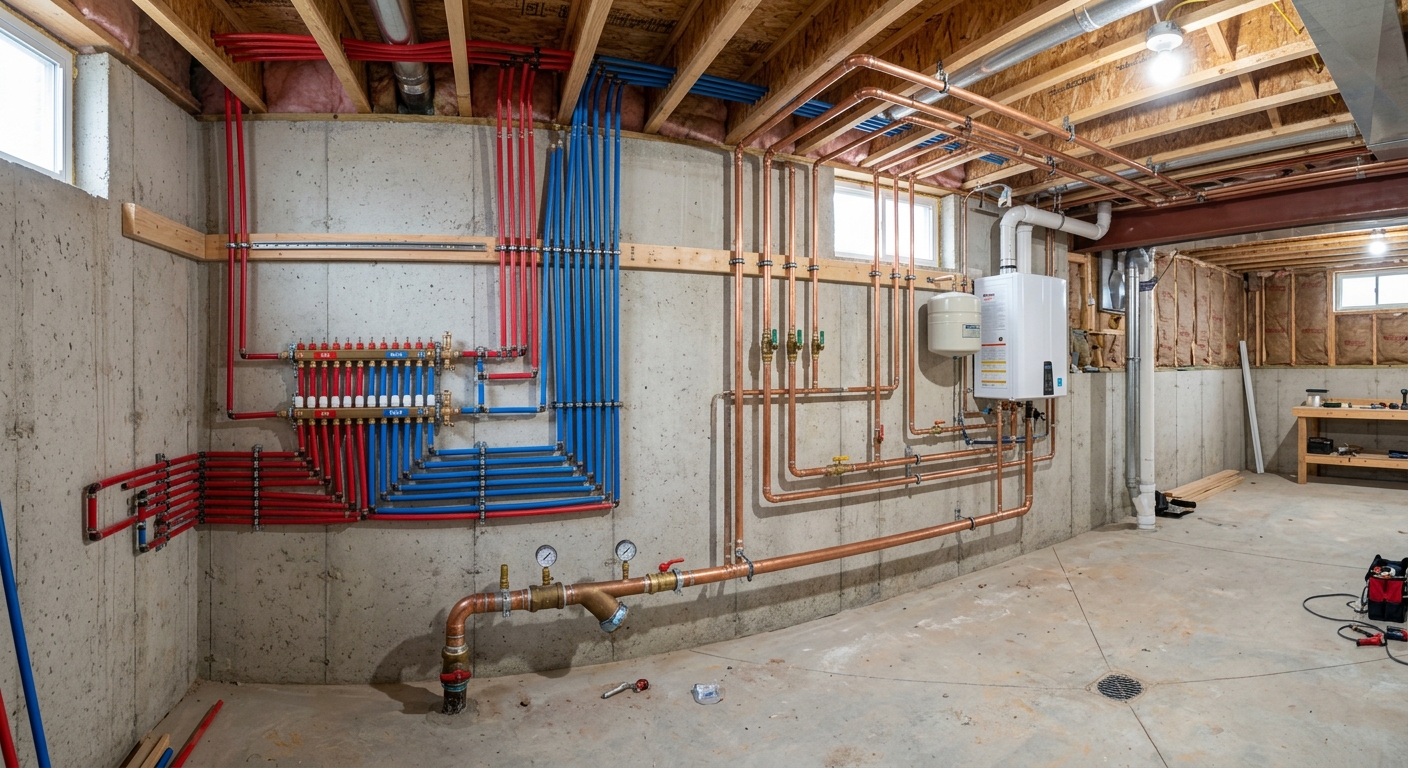
Access and pipe material move the price. Copper-to-PEX repiping remains common as original pipes age, and supply lines placed deep in finished walls or under slabs are simply harder to access. This, and not your ZIP code, is what pushes bills up or down.
| Service |
Scope |
Emergency rate |
Standard rate |
| Emergency repair — burst pipe |
locate, open, repair section, restore service |
$650–$1,300 |
$375–$1,300 |
| Water heater replacement (gas, 40–50 gal) |
remove old, install, test, haul away |
$2,100–$3,100 |
$1,300–$3,100 |
| Drain cleaning — main line |
augering or hydro-jet, camera if needed |
$350–$800 |
$200–$500 |
| Sewer line spot repair |
excavate or reline a failed section |
$2,200–$13,000 |
$2,200–$13,000 |
| Whole-house repipe |
replace supply lines throughout, patch and finish |
$4,900–$9,400 |
$3,900–$9,400 |
| Water service line replacement |
street to house, excavation and restoration |
$8,100–$13,000 |
$6,100–$13,000 |
Estimates for a typical Upper Macungie home. Access difficulty and pipe material move these figures more than anything else.
Who is allowed to do plumbing work in Pennsylvania
In Pennsylvania, plumbing is licensed and enforced at the municipal level, not statewide. This means there’s no single state plumbing license; instead, cities and townships decide who is qualified to do plumbing within their boundaries. In Lehigh County, including Upper Macungie, the City of Allentown Building Office requires its own plumbing trade license—in addition to Pennsylvania’s required Home Improvement Contractor (HIC) registration for any job over $500. A plumber licensed and registered in Allentown may hold no credential in Upper Macungie Township if not specifically approved there. When hiring, always clarify that the plumber is licensed for your municipality, not just anywhere in Pennsylvania.
Permits are generally required for plumbing alterations and for water heater replacements across Lehigh County’s municipalities, including Upper Macungie. Routine like-for-like repairs inside your unit—such as changing a faucet—generally don’t trigger a permit requirement, but upgrading pipework or fixtures will. Inspections are carried out by municipal or third-party Uniform Construction Code (UCC) offices, ensuring conformity with the Pennsylvania Uniform Construction Code (UCC), which is based on the International Residential Code (IRC).
Before hiring, you should verify the contractor holds valid HIC registration at hic.attorneygeneral.gov, and that workers’ compensation coverage is active and matches the property address—checkable at wcais.pa.gov. Insurance certificates should clearly name your property. For projects over $500, Pennsylvania law requires a written contract and grants you a three-day right of cancellation.
Vetting a plumber in Lehigh County
Hiring a plumber in Lehigh County—including Upper Macungie—means checking against both municipal and state-level requirements. Because plumbing licensing here is handled municipally, a credential from another city (like Allentown) isn’t necessarily valid in your township. Start by confirming municipal licensing with the City of Allentown Building Office or your local township office. Next, any job over $500 must be backed by a Home Improvement Contractor (HIC) registration from the Pennsylvania Office of Attorney General, and you can confirm this at hic.attorneygeneral.gov.
Ask for proof of workers’ compensation coverage matching your address; state law demands private or self-insured coverage for all employees, checkable via wcais.pa.gov. Make sure insurance is current and specifically names your property. It’s also wise to ask if the company uses its own licensed crews or outsources to day labor—consistency in staff matters for code compliance and workmanship.
All emergency services should publish a clear disclosure of rates—flat fees, after-hours surcharges, and minimums. In this market, avoid any company that quotes a full repipe or sewer line replacement without showing camera footage or producing a water pressure test to justify the recommendation. The local trade market remains dense, so you have the ability to be selective.
- Confirm license is valid for Upper Macungie/your municipality, not just Lehigh County or PA
- Verify HIC registration: hic.attorneygeneral.gov
- Request insurance naming your property address
- Check workers' compensation at wcais.pa.gov
- Ask if work is subcontracted or completed by directly employed teams
- Require written contract for jobs over $500
- Clarify emergency, after-hours or weekend rates in advance
- Get camera footage and/or pressure test results before approving repipes or sewer replacements
- Insist on permit documentation for water heater or major plumbing changes
- Review local trade office or municipal complaint history if available
- Ask for references from recent Upper Macungie jobs
- Avoid high-pressure pitches or offers to waive insurance deductibles (illegal in PA)
Red flags: In Upper Macungie’s urban-suburban market, walk away from any one-call "diagnosis" of catastrophic failure without video, pressure testing, or documentation, especially for big-ticket repipe or sewer projects.
Service line material and drinking water in Upper Macungie
Upper Macungie is served primarily by the Lehigh County Authority under the City of Allentown concession, who have reported an ongoing lead service line inventory and replacement program. However, the utility’s detailed counts have not been published, and homeowners should not assume if their particular house is on a replacement list.
The water service line is split: the utility owns the section in the street, but homeowners are responsible from the curb shutoff or meter to the point where the line enters the house. Most programs, if available, only cover the public section; replacement of the homeowner's portion is almost always out-of-pocket. Upgrading the entire run is best—partial replacement can actually increase temporary lead levels for several months by disturbing accumulated scale.
To check your home’s service line material, inspect the pipe where it enters your basement with a scratch and magnet test. Lead is soft and easily scratched with a coin and is not magnetic; copper is reddish and non-magnetic; galvanized steel is gray and magnetic. If you find a lead line or an old galvanized pipe, full replacement (street-to-house) typically runs $6,100–$13,000 for the home side. Spot sewer repairs, which sometimes go hand-in-hand, fall between $2,200–$13,000 depending on depth and length.
The Lehigh County Authority’s website is the best starting point for checking the published service line inventory. If you don’t find direct information for your address, call and ask whether financial support or cost-sharing applies before hiring anyone for replacement. Don’t assume coverage—clarify your responsibility.
Freeze risk and what to do about it
Upper Macungie homeowners face a genuine risk of frozen pipes. The area’s 36-inch minimum frost depth and winter design temperature of 4°F, along with frequent severe cold snaps and the occasional high snow load, mean pipes in poorly insulated areas are vulnerable each season.
A pipe doesn’t actually burst where it freezes. Instead, when ice blocks one end, pressure builds up between the blockage and the closed tap further down the line. Eventually, the pipe cracks in the unblocked section, and that’s when the flood happens—often in a finished wall or ceiling.
The most at-risk spots include supply lines in exterior walls, unheated crawlspaces, attached garages, hose bibs, and pipes laid above the insulation in attics. Preventing a disaster is about reducing those risks:
- Insulate all pipes in unheated spaces
- Apply electric heat tape to exposed lines running through exterior walls
- Let a cold-water faucet barely trickle overnight during deep freezes
- Open vanity or cabinet doors to let warm air in
- Before the first hard freeze, shut off and bleed outdoor spigots
If a pipe does freeze but hasn’t burst, use a hair dryer, warm towels, or a space heater (with supervision) to thaw it gently—never an open flame or torch. If a pipe bursts, the cost to locate and repair starts at $650–$1,300 for emergency service. Prevention is far cheaper than cleanup.
Hardness, treatment and fixture life in Upper Macungie
Residents of Upper Macungie drawing from a public supply via the Lehigh County Authority can request the latest water quality report at any time. Hardness—meaning dissolved calcium and magnesium—varies by area, but locally sourced municipal water commonly contains enough mineral to leave scale deposits in heaters and fixtures, gradually shortening their service life.
Scale buildup inside a water heater increases energy usage and can cut its functional lifespan, often necessitating replacement at the lower end of the typical $1,300–$3,100 local cost range. Minor pitting inside copper piping due to aggressive water is possible but isn’t a crisis in Upper Macungie.
A whole-house softener will reduce scaling and can extend appliance life, but the payback depends on how hard your water is. For many homes along the Lehigh County Authority system, a softener is a comfort choice, not a necessity. Be skeptical about add-on filters or chemical treatments—sometimes the best value is a single point-of-use kitchen filter, not a whole-house system.
If you own a home with a private well and septic, there’s no utility report—test for hardness, iron, coliform, and pH every couple of years. Budget for routine maintenance, not expensive surprise fixes.
Pipe materials in Upper Macungie homes and how they fail
Upper Macungie’s post-1950s subdivisions and similar era housing in South Whitehall made copper piping the default for decades, with PEX taking over since the 2000s. A few older homes (especially pre-1960) may have lingering galvanized steel, and those built or replumbed in the 1980s and 1990s sometimes show up with polybutylene—a material infamous for sudden fitting failures and denied insurance claims.
Drain lines follow a similar archaeological pattern: cast iron in older or higher-end homes, clay tile laterals underground before the switch to PVC in the 1970s. Galvanized steel corrodes from inside out, slowly strangling water flow before it finally leaks, which is why you’ll notice pressure drops first. Copper is long-lived unless local water chemistry creates pinholes, but repairs are straightforward. Polybutylene can look fine until it catastrophically fails at a fitting, making its legacy brief and risky. PEX flex tubing is current practice for new work and is reliable when protected from sunlight.
Homeowners can identify their pipes: a gray magnetic pipe with threaded joints is galvanized steel; a reddish, non-magnetic pipe, typically soldered, is copper; blue, gray, or black flexible lines are either PEX or polybutylene—look for visible manufacturer stamps and fitting types. Cast iron drains are black and heavy, often joined with big steel bands, while clay tile is reddish-brown, found under lawns.
If your house was built in the 1950s–1970s, your original supply and drain lines are probably near the end of their service life. Homeowners in Upper Macungie now frequently choose copper-to-PEX repiping to modernize and avoid future leaks, as aging pipes lead to recurring repairs and water quality complaints.
| Material |
Typical era |
Failure mode |
Service life |
| Galvanized steel supply |
pre-1960 |
internal corrosion, pressure loss |
40–60 yrs |
| Copper supply |
1950s–present |
pinhole leaks, joint failure |
50–70 yrs |
| Polybutylene supply |
late 1970s–1995 |
fitting failure, sudden bursts |
unreliable |
| PEX supply |
2000s–present |
fitting or UV degradation |
40–50 yrs |
| Cast iron drain |
pre-1975 |
corrosion, cracking, scale |
50–75 yrs |
| Clay tile sewer lateral |
pre-1980 |
root intrusion at joints, offset |
50–60 yrs |
| PVC / ABS drain |
1970s–present |
joint separation, crushing |
50+ yrs |
Frequently asked questions — plumbing in Upper Macungie
What does repiping a house cost in Upper Macungie?
For a typical single-family home in Upper Macungie, a whole-house repipe—replacing all supply lines with new PEX or copper—falls in the $3,900–$9,400 range, with most jobs landing near the $6,300 mark. The main factors are access (finished basements versus crawlspaces), the existing pipe material, and whether wall and ceiling patching is needed after the work. Homes built in the 1950s–1970s are most likely now due for replacement, given the service life of original copper or galvanized lines. Phased repiping—handling just bathrooms or the kitchen to start—is possible if you’re managing costs, but a full replacement resolves pressure, leak, and water quality complaints in one go. Always get camera footage or a pressure test if you’re told a full repipe is necessary, and make sure the plumber is licensed for Upper Macungie specifically.
Am I responsible for the water line under the street?
In Upper Macungie and throughout Lehigh County, the homeowner is responsible for the water service line from the property line or curb shutoff to the house—this includes the underground stretch through your yard. The water utility, the Lehigh County Authority, usually owns and maintains the section under the street itself. If a leak or break occurs on your side, you’re responsible for the full cost of replacement, which typically runs $6,100–$13,000 depending on length and depth. Some institutional replacement programs may address the public (street) side, but homeowner participation and costs vary. Always check with the Lehigh County Authority to clarify boundaries and available programs before hiring anyone.
Do older Upper Macungie homes have galvanized pipes?
Yes, if your Upper Macungie home was built before 1960, there’s a good chance it was originally plumbed with galvanized steel supply pipes. Over time, most have been replaced with copper or PEX during renovations, but some remnants may linger, especially in unfinished basements. Galvanized steel corrodes from the inside, first showing up as low water pressure and finally as leaks. If you do have galvanized, you’ll likely need a full repipe soon, which falls in the $3,900–$9,400 bracket, depending on house size and wall finishes. To check, look for gray, magnetic pipes with threaded joints near the meter or water heater.
How much does sewer line repair cost in Upper Macungie?
Sewer line spot repairs in Upper Macungie cost between $2,200–$13,000, with most jobs falling in the $6,100 range for excavation, pipe replacement or relining, and restoring disturbed areas. The price depends on the length of damaged section, depth, and whether there’s landscaping or pavement on top. Older homes with original clay tile or cast iron laterals are at highest risk for root intrusion and cracks. Always demand camera footage before approving a big sewer job—a reputable plumber will show you exactly what needs to be fixed, and how they quantified the problem.
Is trenchless sewer repair reliable?
Trenchless sewer repair—such as pipe bursting or cured-in-place lining—has a solid track record in Upper Macungie when properly applied. It can restore a failing clay or cast iron lateral without the expense and mess of digging up your whole yard or driveway. The cost is comparable to open cut replacement, usually between $2,200–$13,000 depending on the length and method. What matters is that the line is thoroughly cleaned and inspected by camera both before and after; otherwise, unseen defects or bad prep can lead to failures. Not every sewer is a suitable candidate, especially if the pipe is completely collapsed—an honest plumber will tell you.
What causes low water pressure in Upper Macungie homes?
In Upper Macungie, low water pressure is often traced to internal pipe corrosion if you have original galvanized steel supply lines from the pre-1960 era. Other common culprits include partially closed main shutoff valves, old pressure regulators, or mineral scale in water heaters starting to fail at the lower end of the $1,300–$3,100 replacement range. Municipal supply pressure is generally consistent, so pressure drops usually mean something is wrong inside your house or service line. A plumber can quickly check pressure at the main and recommend targeted repairs before a repipe becomes necessary.
What do I do if a pipe is frozen but not burst?
If you suspect a frozen pipe in Upper Macungie but there’s no sign of a leak, act quickly: open the affected faucet (hot and cold), and apply gentle heat to the suspected section. Use a hair dryer, space heater, or warm towels—never an open flame or propane torch, as these are major fire risks. Slowly thawing the pipe relieves pressure and can prevent a break. If the pipe bursts, an emergency repair will cost $650–$1,300 or more, depending on location. Insulate exposed pipes, especially in unheated crawlspaces, attics, or garages, to prevent this from happening again.
Who inspects plumbing work in Upper Macungie?
In Upper Macungie, plumbing work that requires a permit—such as water heater replacement, repiping, or fixture upgrades—is inspected by your municipal or approved third-party Uniform Construction Code (UCC) office. The process ensures the work conforms to the Pennsylvania Uniform Construction Code (UCC), which is based on the International Residential Code (IRC). Some minor repairs inside your dwelling may not need a permit, but for any major project, the plumber should pull a permit and schedule inspection. Expect to see permit paperwork and inspection sign-off before paying the final bill, especially for jobs over $500.
What do I do if sewage is backing up?
Sewage backing up in a drain or basement floor is a main-line emergency in Upper Macungie. Stop using all water fixtures immediately, and call a local plumber with emergency dispatch capability—expect an emergency drain clearing rate between $350–$800. Don’t try to use store-bought drain openers; they won’t clear a major clog and could create a chemical hazard for the technician. If the problem recurs, insist on a camera inspection to pinpoint the issue, whether it’s roots in a clay lateral or settlement in an old cast iron drain. Camera footage will justify any major repair or replacement recommendation so you’re not buying more than you need.