What plumbers charge in Perkiomen
In Perkiomen, plumbing prices follow a clear trend: expect higher rates for emergencies, and more reasonable costs when you can schedule work during normal hours. That split matters for homeowner decisions here, especially with so many houses built during the 1950s–1970s suburban expansion. If you own one of the area’s 2,744 homes (U.S. Census Bureau, ACS 2024), chances are your plumbing materials trace back to this era—meaning copper, galvanized steel, and cast iron are common, all nearing the end of their expected service lives. Failures drive much of the local demand; that’s why repipes, fixture replacements, and water heater swaps fill the schedules. What you actually pay is determined largely by whether the problem can wait or if it’s a “water on the floor” emergency.
Pipe material and home access have the biggest impact on both cost and repair approach. Emergency service means premium rates—after-hours dispatch, overtime labor, and tougher scheduling. But even routine jobs carry regional nuances: main line drain clearing, for example, may require hydro-jetting for old cast iron pipes rather than just snaking, changing both price and result. The typical Perkiomen homeowner, living in a detached house built before 1980, will see prices in these bands for the most common plumbing services:
| Service |
Scope |
Emergency rate |
Standard rate |
| Emergency repair — burst pipe |
locate, open, repair section, restore service |
$700–$1,450 |
$425–$1,450 |
| Water heater replacement (gas, 40–50 gal) |
remove old, install, test, haul away |
$2,300–$3,300 |
$1,450–$3,300 |
| Drain cleaning — main line |
augering or hydro-jet, camera if needed |
$350–$800 |
$200–$500 |
| Sewer line spot repair |
excavate or reline a failed section |
$2,400–$14,500 |
$2,400–$14,500 |
| Whole-house repipe |
replace supply lines throughout, patch and finish |
$4,200–$10,000 |
$4,200–$10,000 |
| Water service line replacement |
street to house, excavation and restoration |
$6,500–$14,500 |
$6,500–$14,500 |
Estimates for a typical Perkiomen home. Access difficulty and pipe material move these figures more than anything else.
Who is allowed to do plumbing work in Pennsylvania
Pennsylvania does not issue a statewide plumbing license. Instead, plumbing work is regulated at the municipal level. This means a plumber licensed in Philadelphia or Pittsburgh may hold no special credential in Perkiomen, where your local municipal office sets the requirements and does its own inspections. When asking a plumber about licensing, the relevant question is, “Are you licensed to do plumbing work in this township?” not just “Are you licensed?” This policy shapes who can pull permits and pass final inspection.
In Montgomery County, each municipality—including Perkiomen and its neighbors—manages its own permit and inspection process. Permits are required when altering plumbing (replacing, repiping, or adding new systems), installing water heaters, or changing sewer lines. Minor fixture replacements that do not alter the plumbing system—like swapping out a faucet or toilet—typically do not need a permit. After job completion, a municipal inspector—not the plumber—must sign off. You can verify insurance and workers’ compensation using WCAIS and check Home Improvement Contractor (HIC) registration through the Pennsylvania Office of Attorney General’s system at hic.attorneygeneral.gov.
Consumer protection is governed by the Home Improvement Consumer Protection Act (HICPA): for any job over $500, a written contract is required, and you have a three business-day right of cancellation. Never accept a contractor’s offer to “waive your deductible”—it’s explicitly prohibited. With plumbing work in Perkiomen, anyone working without municipal permit approval or insurance isn’t operating above board.
Galvanized, copper, PEX, cast iron
A walk through most Perkiomen homes will reveal plumbing that tracks the typical suburban build-out of the 1950s–1970s. That era strongly predicts what pipes you have, what can go wrong, and what it will cost to fix. Galvanized steel was common in supply lines through the 1950s, replaced by copper from the 1960s onward. Copper is long-lived but can develop pinhole leaks, especially if the water chemistry is aggressive. Polybutylene was used briefly from the late 1970s to mid-1990s and is especially failure-prone—insurance penalties are common, and replacement is almost always advised.
PEX supply lines arrived in the 2000s and are now standard practice. For drains, cast iron was common in pre-1975 homes and is nearing its end of life now, failing by corrosion or cracks. Early sewer laterals may be clay tile, which attract root intrusion. Newer construction and many replacements use PVC or ABS plastic, rated for at least 50 years of service unless crushed or poorly joined. Most failures are age- or chemistry-driven and rarely catastrophic at first—low pressure in old galvanized means corrosion, not just “bad pressure regulation.”
To figure out what you have, try a scratch test on exposed pipe: galvanized steel is gray and magnetic, copper is reddish and bright once scratched, PEX is flexible plastic in multiple colors, and cast iron is thick and heavy for drains. Threaded pipes are galvanized; soldered means copper. For sewer laterals, look for clay (orange-brown, with segment joints) or plastic cleanouts. If your house is from the 1950s–1970s, most pipes are at or near their lifespan now.
| Material |
Typical era |
Failure mode |
Service life |
| Galvanized steel supply |
pre-1960 |
internal corrosion, pressure loss |
40–60 yrs |
| Copper supply |
1950s–present |
pinhole leaks, joint failure |
50–70 yrs |
| Polybutylene supply |
late 1970s–1995 |
fitting failure, sudden bursts |
unreliable |
| PEX supply |
2000s–present |
fitting or UV degradation |
40–50 yrs |
| Cast iron drain |
pre-1975 |
corrosion, cracking, scale |
50–75 yrs |
| Clay tile sewer lateral |
pre-1980 |
root intrusion at joints, offset |
50–60 yrs |
| PVC / ABS drain |
1970s–present |
joint separation, crushing |
50+ yrs |
Tank, tankless or heat pump water heater?
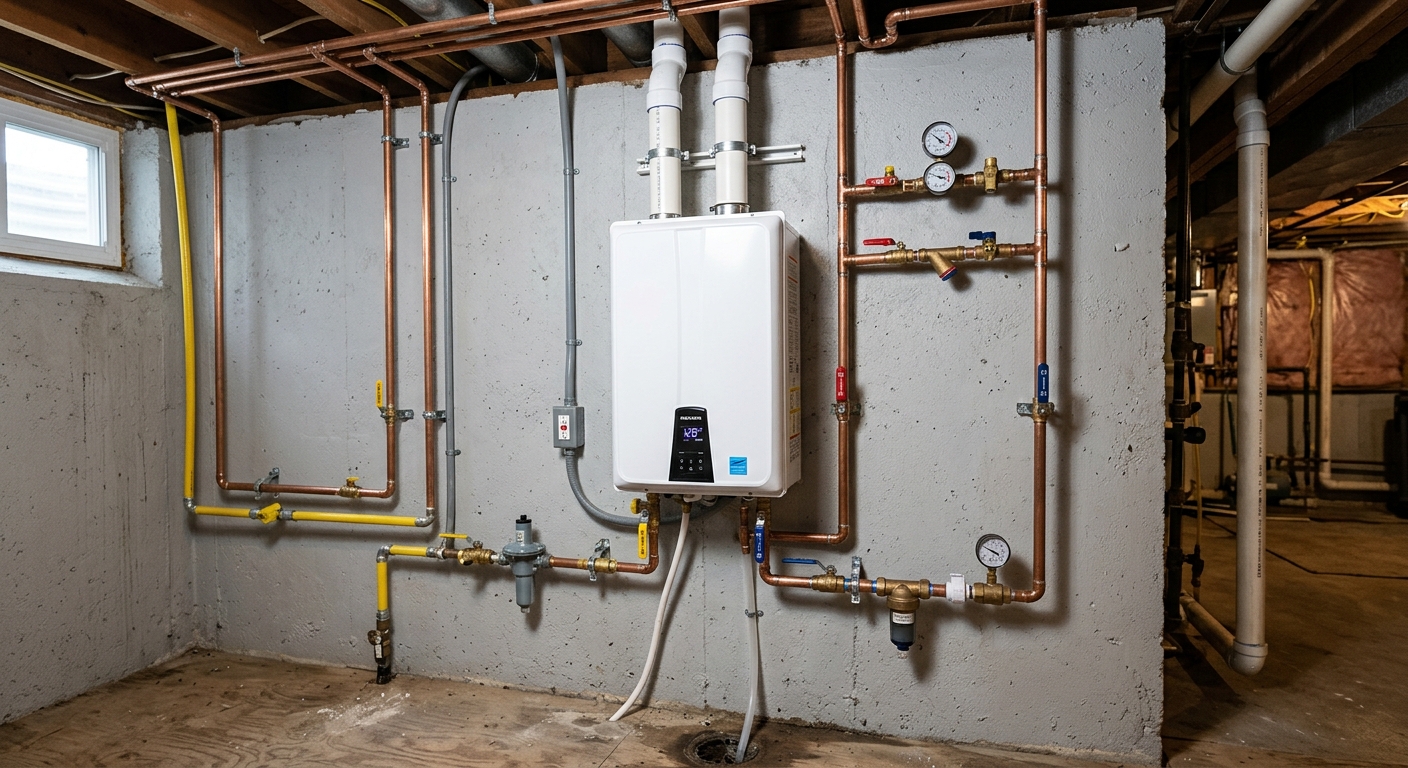
In Perkiomen’s housing stock, most water heaters still use the traditional tank. They’re the cheapest up front and relatively simple to swap, but they do have downsides—higher energy bills due to standby losses and the shortest lifespan of the three types. Tankless water heaters mean you never run out of hot water, but installation costs are higher, and older houses usually need a bigger gas line and new venting, which can make that bid jump. Those extras surprise more people than not. Heat pump water heaters cost the least to operate, but installation requires enough conditioned space to exchange air, and they work best where noise and a slight cooling effect aren’t a nuisance—a finished basement can make them a risky fit unless you have a utility room with a door you can close.
Households built before 1980 (36.3% in Perkiomen, U.S. Census Bureau, ACS 2024) typically have 40–50 gallon tanks. Gas is available throughout the area, but you can convert electric tanks to heat pump models. For any water heater, pay attention to the first-hour rating (how much hot water you’ll actually have on a busy morning) instead of just the tank capacity. Expansion tanks, drain pans, and proper drainage are required by code for new installations—especially important with Pennsylvania’s 30-inch frost depth. Nearly every failure is a tank leak, not a control problem. Routine maintenance keeps you safe, but when a tank fails, replacement is the smart move, not repair.
| Type |
Installed cost |
Service life |
Operating cost |
Best when |
| Gas tank, 40–50 gal |
$1,450–$3,300 |
8–12 yrs |
moderate |
existing gas, fast replacement |
| Electric tank, 40–50 gal |
$1,450–$2,300 |
10–15 yrs |
high |
no gas available, simple swap |
| Gas tankless |
$2,300–$3,300 |
18–25 yrs |
low-moderate |
endless hot water, space gained |
| Heat pump water heater |
$2,300–$3,300 |
13–15 yrs |
lowest |
ample space, focus on efficiency |
Choosing a plumbing contractor
In Perkiomen, hiring right means verifying municipal credentials—not just a general trade license. Every contractor offering plumbing work over $500 must be registered as a Home Improvement Contractor (HIC) with the Pennsylvania Office of Attorney General. But that is just the start: there is no statewide plumbing license, so every township or borough sets its own rules for who can pull permits as a plumber. Ask specifically if they’re authorized to work in your municipality. Confirm that you receive a certificate of insurance for liability and that workers’ compensation is valid; both are checkable at official state websites mentioned earlier.
With a crowded contractor market in Montgomery County, the best establish themselves by transparency. You’ll want to know if the contractor sends their own employees or subs out your door, if emergency pricing is openly discussed, and—especially for major work like a whole-house repipe or a sewer line repair—that recommendations are documented (no good plumber suggests a repipe without at least a pressure test or camera footage to justify it).
- Check HIC registration at hic.attorneygeneral.gov.
- Ask for proof of insurance, with your address named on the certificate.
- Confirm workers’ compensation status using WCAIS.
- Ensure they are authorized to work in your specific township or borough.
- Request the name(s) and qualifications of technicians performing the work.
- Get a clear statement of emergency versus standard pricing before dispatch.
- Ask if the company uses their own team or subs jobs out.
- Require a written contract for all work above $500, per HICPA.
- Expect a start and end date—or at least a clear schedule.
- Demand that sewer replacement or repipe quotes be backed by pressure or camera documentation.
- Restoration work (drywall, finish) should be included or clearly excluded in writing.
- Clarify warranty terms on both labor and parts.
Red flag: in such a dense contractor market, any push for big work (repipe, sewer repair) without evidence, or anyone unwilling to show proper credentials for Perkiomen, is a cue to move on.
Flat rate versus time and materials
Plumbing jobs in Perkiomen are priced in two main ways: flat rate and time-and-materials (T&M). Flat rate means you get a total price upfront. The contractor builds risk into the quote—if the job is easier, you still pay the rate. T&M can be cheaper for straight jobs like swapping a shut-off valve, but if the job is complex or hits snags (think accessing old galvanized pipe behind plaster), costs may mount. The model isn’t a scam in itself; not knowing which you agreed to can create real misunderstandings.
Key lines to check: is there a diagnostic fee, and does it credit toward the work? Is the scope spelled out, or does the quote just name a price without details? Are permit costs and wall/floor restoration included or excluded? Warranty should list parts and labor separately. Emergency or after-hours pricing should never be a surprise; a reputable Perkiomen plumber will state it up front, along with any extra costs for unusual access, slab cuts, or patchwork. If you’re not given this level of detail, be cautious before you sign.
| Line item |
What to look for |
Red flag if… |
| Billing model |
flat rate or hourly, stated up front |
unstated |
| Diagnostic fee |
amount, and whether it credits |
vague |
| Scope |
what is opened, repaired and restored |
price with no scope |
| Restoration |
drywall and finish explicitly in or out |
silent |
| Permit |
included and priced |
'not needed' |
| Parts |
brand and model for fixtures |
'standard fixture' |
| Warranty |
labour period stated separately |
parts only |
Finding a hidden leak in Perkiomen
If you suspect a hidden leak in your Perkiomen home, start with a simple test: turn off all fixtures and appliances in your house, then check your water meter. If the indicator dial keeps spinning, there is almost certainly a supply-side leak. That costs nothing and saves you from guessing at symptoms.
When professional help is needed, plumbers here use a range of detection methods: acoustic listening devices find leaks in pressurized pipes behind walls and under floors, thermal cameras spot hidden dampness, and tracer gas can pinpoint particularly elusive breaches (like under a slab). For supply lines inside walls or ceilings, these non-invasive tests are often enough. Tracer gas and slab leak location are pricier services, but usually fall below the cost of opening finished walls blindly.
If the leak is under a slab—common in some older homes—tracer gas and acoustic methods help pinpoint the location so that only a small area has to be broken. For irrigation lines, specialized listening and pressure tests identify underground leaks. In any case, a plumber who wants to start cutting open walls or floors without first localizing the leak is doing the job backwards and will likely run up your bill without finding the real problem.
Frequently asked questions — plumbing in Perkiomen
Who inspects plumbing work in Perkiomen?
In Perkiomen, plumbing inspections are handled by your local municipal authority—not by a county or the state. Each township or borough in Montgomery County enforces the Pennsylvania Uniform Construction Code (UCC), which is based on the IRC, and sends its own inspectors to sign off on permit-required plumbing work. For example, in Norristown, the Borough of Norristown Code Enforcement Department performs these checks. If you’re planning a whole-house repipe (usually $4,200–$10,000), a permit is required and a municipal inspector, not the plumber, must perform the final approval before walls are closed. Always get confirmation that your contractor is approved to pull permits in your specific municipality.
Should I wait until business hours to call?
If you have an active leak, water on the floor, or a burst pipe in your Perkiomen home, do not wait—call for emergency service. The difference is cost: emergency repair calls generally run $700–$1,450 compared to standard rates, but water damage and mold can drive far higher bills if delayed. For no-hot-water, slow drains, or fixture trouble without flooding, waiting until business hours saves money (and often gets you the regular rate $425–$1,450). In this region, contractors handle dense service calls and usually respond well outside standard hours. Your judgment: safety and water damage risk always override cost savings.
What does emergency plumbing cost in Perkiomen?
Emergency plumbing calls in Perkiomen cost more than scheduled visits because of after-hours labor, mobilization, and the need to restore service quickly. For a burst pipe or active leak, expect to pay $700–$1,450 for a typical job that includes locating the leak, opening a wall or ceiling, performing the repair, and restoring water service. Other emergencies—such as total drain blockages or failed water heaters—fall within similar price bands. The bottom line: if you can safely wait until regular hours, you can save several hundred dollars, but don’t risk property damage over the difference.
Should I leave a faucet dripping in cold weather?
In Perkiomen, with a frost depth of 30 inches and winter lows around 14 °F, it’s a smart move to let a faucet drip overnight during severe cold snaps—especially if your kitchen or bath pipes are on an outside wall or in a poorly insulated area. Moving water is less likely to freeze. However, this is a temporary workaround, not a permanent solution. If you have older galvanized or copper lines near the point of freezing, consistent use of this method might still not protect you from a costly burst (repairing a frozen pipe here is typically $700–$1,450 on emergency call). Long-term, insulate problematic pipes and address drafts.
Is my water line lead?
Aqua Pennsylvania serves most of Perkiomen, and widespread lead service lines were mostly phased out in postwar builds. Still, some older homes—especially from the early 20th century—may have lead goosenecks, solder, or even full lead services. To check, scratch the service line at the point it enters the house: lead is soft, silvery, and non-magnetic. If your home’s water line is lead, replacement is recommended and expected to cost between $6,500–$14,500 depending on distance from the street and restoration work. Ask your plumber for verification before moving ahead.
Does insurance cover a burst pipe in Perkiomen?
Most homeowners insurance policies in Pennsylvania do cover repairs for sudden and accidental water damage from a burst pipe, but only if the property was properly maintained and heated. The coverage is for the damage caused by water—not the plumbing repair itself. So, if a pipe bursts during a freeze and damages drywall or flooring, restoration is typically covered, but the repair (normally $425–$1,450 for the fix in Perkiomen) is on you. Always document the incident and work with contractors familiar with the Home Improvement Consumer Protection Act so claim paperwork lines up.
Is trenchless sewer repair reliable?
Trenchless sewer repair technologies—like pipe bursting or cured-in-place pipelining—are increasingly common in Perkiomen, especially where landscaping or driveways make excavation undesirable. Reliability is high if the existing pipe is relatively sound apart from isolated failures; massive misalignment or total collapse still requires digging. Cost ranges from $2,400–$14,500 depending on length and soil access. Insist on camera footage before and after any trenchless work, and a warranty in writing. For homes built before 1980, clay tile laterals are often prime candidates.
How hard is the water in Perkiomen?
Most homes here draw water from Aqua Pennsylvania, which sources from both surface and groundwater. Perkiomen's water has moderate hardness—enough to cause scale in older water heaters and leave spots on fixtures, but usually not enough to require full-home softening. Tank-type water heaters are especially affected by hardness, which can reduce their service life (generally $1,450–$3,300 for replacement). Annual flushing and periodic valve maintenance help mitigate scale buildup. If you notice excessive scale, have your water tested before investing in a softener.
What does drain cleaning cost in Perkiomen?
Main line drain cleaning in Perkiomen runs between $200–$500 for a standard call (power auger or basic snaking) and up to $350–$800 if you need emergency service or hydro-jetting for old cast iron pipes. Hydro-jetting is more often needed in houses built before 1980 with cast iron systems that collect heavy scale or debris. Camera inspection incurs an extra charge but is often necessary to avoid recurring problems. Always request before-and-after video if you’re paying for the higher-end service.