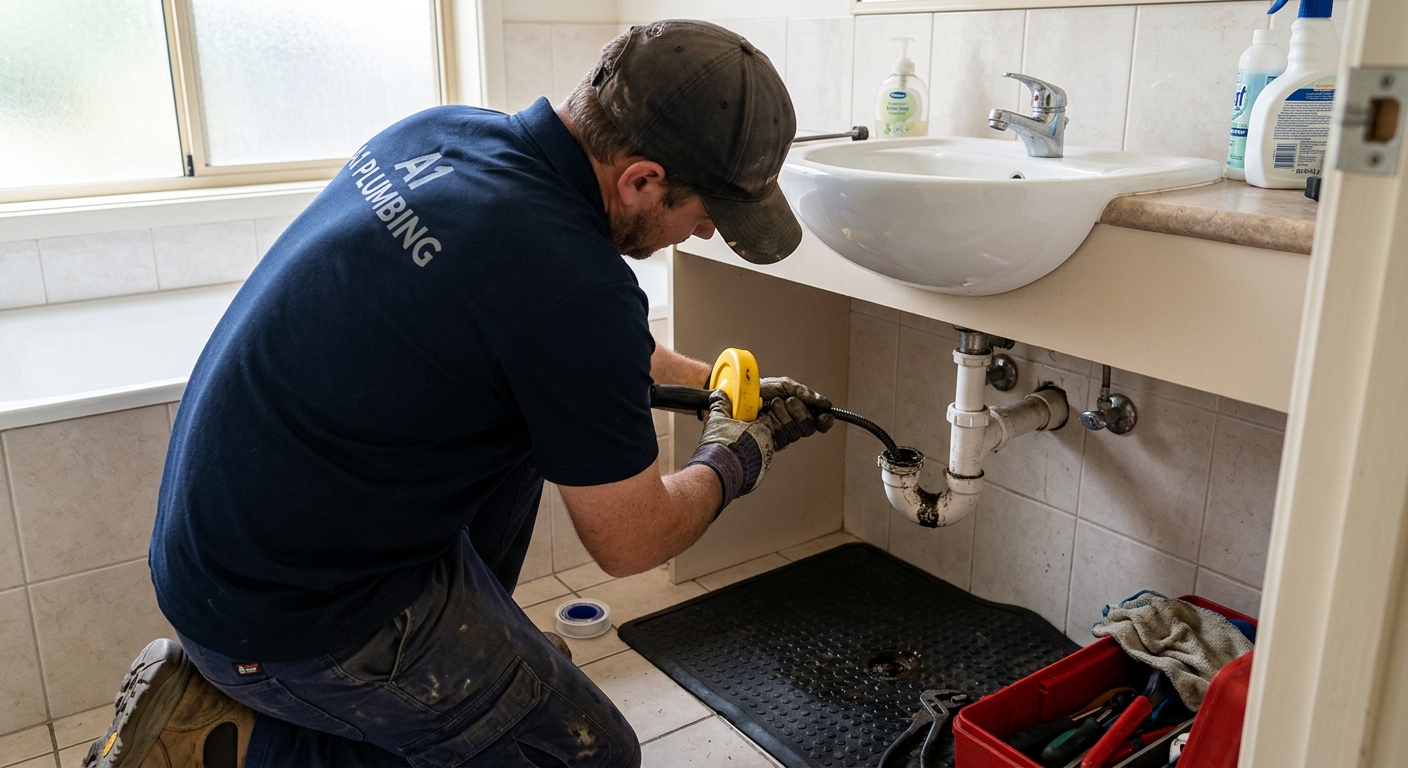
Jefferson Hills plumbing prices by job type — 2026
In Jefferson Hills, your plumbing cost comes down to two main factors: whether the work is booked as an emergency and the era of your home’s construction. Nearly half of local homes were built before 1980 (U.S. Census Bureau, ACS 2024), and many follow the broader Pittsburgh trend of 1900–1950 housing. This matters because older homes are far more likely to have galvanized or cast-iron pipes, which are known for leaks and corrosion as they age. With single-family homes making up 81.0% of Jefferson Hills, most repairs involve full access rather than apartment-style complications, but old pipe materials push the higher end of any price band.
Across all local jobs—whether it’s a quick repair or new plumbing—a call on an emergency basis will cost more than a planned visit. Emergency rates reflect not just after-hours labor but also the difficulty matching old piping, cutting plaster, and restoring water service quickly. Large jobs like sewer line repairs or whole-house repipes are rarely true emergencies (unless you’ve had a backup or complete failure), but burst pipe repairs and water heaters can’t always wait. The table below gives price bands for typical Jefferson Hills homes, but actual quotes will vary based on access, finish, and—most importantly—whether the piping is original or updated copper/PEX.
| Service |
Scope |
Emergency rate |
Standard rate |
| Emergency repair — burst pipe |
locate, open, repair section, restore service |
$650–$1,300 |
$375–$1,300 |
| Water heater replacement (gas, 40–50 gal) |
remove old, install, test, haul away |
$2,100–$3,100 |
$1,300–$3,100 |
| Drain cleaning — main line |
augering or hydro-jet, camera if needed |
$350–$800 |
$200–$500 |
| Sewer line spot repair |
excavate or reline a failed section |
$2,200–$13,000 |
$2,200–$13,000 |
| Whole-house repipe |
replace supply lines throughout, patch and finish |
— |
$3,800–$9,300 |
| Water service line replacement |
street to house, excavation and restoration |
— |
$6,000–$13,000 |
Estimates for a typical Jefferson Hills home. Access difficulty and pipe material move these figures more than anything else.
Tank, tankless or heat pump water heater?
For Jefferson Hills homeowners, the choice between tank, tankless, or heat pump water heaters is about more than install price. It comes down to your home’s setup, household size, and what counts as a “win” in your basement or utility room.
Traditional tank heaters (gas or electric) are the cheapest to install, with predictable repairs and a shorter expected life. The downside is “standby loss”—you’re paying to keep water hot around the clock, even when no one’s running a tap. In older homes, tanks are almost always easier to swap because the footprint matches what’s already there.
Tankless (on-demand) heaters take up less space and offer endless hot water, but in this market, nearly every gas tankless install requires heavier gas piping and a new vent system. This extra work can be a surprise, pushing your bill closer to the top of the band. Unless your household runs back-to-back showers and dishwashers, the savings rarely offset the install cost in a typical 3–4 person Jefferson Hills house.
Heat pump water heaters are the cheapest to run but only make sense if you have enough space and don’t mind the unit cooling your basement while it runs. Sound level matters—if your basement is finished space, the fan can bother you. Sizing is about the “first-hour rating”—how much hot water it can deliver in that crucial period, not just tank capacity. And with Allegheny County’s mix of older and new construction, most replacements will require an expansion tank and a proper drain pan to meet today’s code. In nearly all local water heater failures, it’s the tank leaking—not the controls—that ends its life.
| Type |
Installed cost |
Service life |
Operating cost |
Best when |
| Gas tank, 40–50 gal |
$1,300–$3,100 |
8–12 yrs |
moderate |
Existing gas, standard basement or utility room |
| Electric tank, 40–50 gal |
$1,300–$2,100 |
10–15 yrs |
high |
No gas service, lowest upfront cost |
| Gas tankless |
$2,100–$3,100 |
18–25 yrs |
low-moderate |
High hot water demand, budget for extra install work |
| Heat pump water heater |
$2,100–$3,100 |
13–15 yrs |
lowest |
Large, unfinished basement, no need for gas |
Finding a hidden leak in Jefferson Hills
If you suspect a hidden leak in your Jefferson Hills home, start with a simple test: shut off all fixtures—no running toilets, washing machines, or taps—then check your water meter. If the small dial or sweep hand moves, there’s a leak somewhere between the meter and your fixtures, almost always on the supply side and your responsibility to fix. This costs you nothing and often rules out a false alarm caused by a dripping faucet or running toilet.
When you call in a plumber, common leak detection methods include acoustic listening (where sensitive microphones pinpoint the sound of water), thermal imaging to spot unnatural temperature changes behind walls, and tracer gas for the hardest-to-find supply line leaks. Full leak locating for a slab or wall cavity typically costs in the $375–$1,300 range if part of a repair, or less if detection only. If you’re dealing with a hidden irrigation line leak or a slab leak (more common in homes with concrete floors), the approach combines water shutoff testing with these high-tech tools. Opening walls or flooring should be the last step: a professional plumber will always locate as precisely as possible before cutting. If your plumber wants to start demolition instead of diagnosis, get a second opinion.
Verifying a Jefferson Hills plumber's credentials
Pennsylvania has no statewide plumbing license, and all requirements come down to the local municipality. In Allegheny County—including Pittsburgh and its surrounding communities—plumbing permits and licenses are administered by the Allegheny County Health Department Plumbing Program. This means a plumber licensed to work in the City of Pittsburgh may not be legal to work in Jefferson Hills without the correct county credential.
The right question is not, “Are you licensed?” but “Are you licensed and permitted to work in Jefferson Hills?” For new or altered plumbing systems—including water heater replacements, whole house repipes, and major alterations—most Allegheny County municipalities require an Allegheny County Health Department plumbing permit. Minor fixture replacements, such as changing a faucet, typically do not need a permit in this area.
Every contractor working in your home for more than $500 must be registered as a Home Improvement Contractor (HIC) with the Pennsylvania Office of Attorney General. Always verify at hic.attorneygeneral.gov. Insurance and workers’ compensation must also be confirmed—Pennsylvania requires all employers to carry workers’ comp, which you can check through the WCAIS system at wcais.pa.gov. If the plumber cannot show an insurance certificate naming your address, move on. Lead safety is an added concern for work on homes built before 1978; companies must comply with the EPA Lead RRP Rule.
Vetting a plumber in Allegheny County
Before you hire a plumber in Jefferson Hills—or anywhere in Allegheny County—take time to verify the basics. Because plumbing licensing is handled locally, ensure the plumber holds a current Allegheny County Health Department credential if the job is more than a simple fixture swap. Confirm HIC registration status at hic.attorneygeneral.gov and review their insurance certificate, making sure your property’s address is listed for coverage. Every employer in Pennsylvania must carry workers’ compensation, which you can confirm with the WCAIS registry at wcais.pa.gov.
Ask if the company uses its own licensed employees or subs out the work—union and non-union crews are both common in our saturated Pittsburgh metro area. Demand written disclosure of after-hours or emergency rates, and never hire anyone who hesitates to provide this up front. In this market, beware the company pushing expensive repiping or sewer work without providing camera footage or a pressure test for proof—jumping to replacements is more common where competition is high.
- Check Allegheny County Health Department plumbing license (if required for your job)
- Verify HIC registration at hic.attorneygeneral.gov
- Confirm active workers’ compensation via wcais.pa.gov
- Obtain a certificate of insurance with your address named
- Ask if repair crews are direct hires or subcontracted labor
- Request written emergency and after-hours pricing
- Require camera footage before any sewer replacement quote
- Do not accept a repipe quote without evidence of multiple active leaks
- Check lead safety certification for pre-1978 homes
- Read contract terms—Pennsylvania mandates written estimates over $500
- Expect a 3-business-day right of cancellation for jobs over $500
- Never sign anything offering to waive your insurance deductible—it’s prohibited
Red flags in Allegheny County’s crowded market include high-pressure sales, no camera footage to justify drain or sewer work, and companies eager to cut walls before finding the leak.
The point where patching stops making sense
In Jefferson Hills—especially for homes built between 1900 and 1950—the original pipes have likely given more than their fair share of service. When you see two or more leaks in three years on the same piping material, that’s a pattern, not bad luck. At that point, repeated repairs cost almost as much as replacing the line, and you’re not buying peace of mind.
The main signals it’s time to stop patching: falling pressure across the whole house (not just one faucet), brown or discolored water on first draw, visible corrosion or green/white buildup at exposed joints, and repeated pinhole leaks. If you see these, especially with galvanized or cast-iron piping, your dollars are better spent on a planned repipe than another patch. Jefferson Hills homes with original galvanized supply or cast iron drains are textbook candidates for this, given local housing history. Don’t forget—after the pipes are replaced, you’ll still need to budget for drywall or plaster repairs. In older homes, restoring plaster can cost as much as the plumbing labor itself.
| Situation |
Recommendation |
Cost |
Reasoning |
| One leak, accessible, modern pipe |
Spot repair |
$375–$1,300 |
Single event; the piping is still reliable overall |
| Two or more leaks in 3 years |
Partial repipe |
$3,800–$6,300 |
Emerging pattern; start planning for replacement in sections |
| Galvanized supply, pressure loss |
Full repipe |
$3,800–$9,300 |
Original material has reached end of useful life |
| Polybutylene anywhere in the house |
Full repipe |
$3,800–$9,300 |
Material is a known failure risk, not fixable by spot repairs |
| Cast iron drain with root intrusion |
Camera, then reline or replace |
$2,200–$13,000 |
Ongoing root problems, sectional or full drain replacement needed |
| Suspected lead service line |
Test, then replace the lateral |
$6,000–$13,000 |
Safety risk; area utility is actively replacing these lines |
Sewer laterals: the pipe you own and can't see
No matter who operates the main sewer in Jefferson Hills, the connection from your house to the street (the sewer lateral) is your responsibility. This includes the line running under your yard—even if it crosses under a municipal sidewalk or street. Many homeowners aren’t aware until something backs up, but repairs or replacements here are always on the property owner.
Early signs of trouble start small—one slow drain, then perhaps gurgling or water at the lowest fixture—and escalate to widespread slowdowns, or sewage backup in a basement shower or floor drain. When these symptoms appear, a camera inspection should always come before any excavation quote. Root intrusion is common in older, clay-tile pipes, which are typical in Allegheny County’s housing stock from 1900–1950. Other issues include “bellies” (sags) that hold wastewater, or pipe sections shifting from repeated freeze-thaw in our clay and shale soil.
Repair options are either open trench (dig and replace the pipe) or trenchless relining (install a new pipe inside the old). Relining is less invasive, but not always possible if the line is fully collapsed or offset. Outlying Allegheny County townships may still use septic systems, which have different failure signs—tank pumping every three years is typical maintenance, while slow or soggy drainfields point to bigger problems.
The bottom line for Jefferson Hills homeowners: never accept a costly sewer dig or replacement quote without first seeing the camera video. In this region, that footage is your only real evidence for what actually needs to be done.
Frequently asked questions — plumbing in Jefferson Hills
Do I need to drain outdoor spigots in Jefferson Hills?
Freezing temperatures are routine in Jefferson Hills, with a winter design temp of 8 °F and a frost depth of 36 inches. Outdoor spigots left full of water can freeze, split, and break pipes inside the foundation—especially in older homes where original sill cocks are set close to the outside wall. Before the first deep freeze, always disconnect garden hoses and drain the spigot. Many newer homes have frost-free hose bibs, but even these should have hoses removed so they can drain properly. If a spigot cracks and floods your basement, you could be facing an emergency repair bill of $375–$1,300—cheaper to prevent than to fix.
Who inspects plumbing work in Jefferson Hills?
In Jefferson Hills, as with most Allegheny County municipalities, plumbing permits and inspections are handled by the Allegheny County Health Department Plumbing Program. This local oversight sets Allegheny apart from the rest of Pennsylvania, which relies on municipal enforcement under the Uniform Construction Code. If your plumber schedules a water heater replacement or major new piping, the county inspector will sign off on the work before walls are closed. This protects homeowners: you know your repipe, sewer repair, or new fixtures meet current standards. For jobs over $500, a written contract is also required under state law.
How much does sewer line repair cost in Jefferson Hills?
The cost to repair a sewer line in Jefferson Hills depends on whether you need a spot fix or a more extensive replacement. Most spot repairs—such as fixing a collapsed or root-filled section—run from $2,200–$13,000, with the typical repair around $6,000. Factors that move the price include how deep the pipe is, whether it runs under your driveway or landscaping, and how much restoration is required after digging. Always insist on a camera inspection before accepting any quote. In older homes with original clay or cast-iron sewer pipes, large repairs are common due to shifting clay/shale and Pittsburgh’s heavy freeze-thaw cycles.
Is trenchless sewer repair reliable?
In most Jefferson Hills homes, trenchless sewer repair—where a liner is inserted into the existing pipe—has an excellent track record when done properly. This method works best if the original pipe is still roughly in place and not completely collapsed. It is often less invasive than traditional trench-and-replace, saving your yard and walks. Upfront, trenchless methods can cost about as much as open excavation—sometimes $2,200–$13,000—but minimize surface disruption. Insist on a camera inspection; the pipe’s condition determines if trenchless is possible. Where there’s major offset or pipe collapse, open cut is often the only option.
Is a sewer line replacement covered by homeowner's insurance?
In Jefferson Hills and across Pennsylvania, standard homeowner’s insurance generally does not cover sewer line replacement due to age or normal wear. Coverage may be available for sudden and accidental events—a collapse from a specific cause such as a tree root or a covered peril like fire. Some insurers, including those serving Allegheny County, offer add-on “sewer and drain” endorsements. These can help with repairs costing from $2,200–$13,000 but are subject to the policy terms and exclusions. Always read the fine print, and don’t count on reimbursement for replacing old, failing clay pipes.
How do I shut off the water to my house?
Every Jefferson Hills home should have a main water shutoff valve where the service line enters, usually in the basement by the foundation wall. Turn the valve clockwise (right) to stop all flow to your fixtures. In older homes, the valve may be a round wheel or a lever. Test it at least once a year: older valves stick, and you don’t want to discover it’s frozen during a midnight emergency. If you can’t shut off the water yourself during a leak, you may need to call for an emergency repair, which often costs $650–$1,300 for a burst pipe fix. Knowing your shutoff saves time and money.
Do older Jefferson Hills homes have galvanized pipes?
Yes. Much of the Pittsburgh area’s housing—including Jefferson Hills—was built before 1950, and galvanized steel was the standard for water supply. These pipes corrode, leading to brown or rusty water and low pressure. If you live in an older home and see these issues, it may be time for a whole-house repipe. Replacing all supply lines can cost $3,800–$9,300, but it’s a lasting fix worth considering after two or more leaks or visible corrosion at joints. Most older owners reach a point where repairs become more frequent and expensive than replacing the whole system.
How much does a water heater replacement cost in Jefferson Hills?
In Jefferson Hills, a standard 40–50 gallon gas water heater replacement—including removal, installation, and testing—typically costs $1,300–$3,100, with most jobs around $2,100. Prices edge up for tankless, heat pump, or if you need a new gas line or venting—common issues in older basements. Your total depends on the location, code-required expansion tanks or pans, and whether the basement is finished (adds to labor and finish work). Always ask for a quote that includes haul-away, shutoff upgrades, and permit fees.
What causes low water pressure in Jefferson Hills homes?
In Jefferson Hills, low water pressure is most often a sign of aging galvanized pipes, mineral buildup, or a partially closed main shutoff. If the whole house is affected, it likely points to original galvanized supply lines—common in pre-1980 housing. Pressure can drop suddenly from a hidden leak, so try the water meter test. If pressure only drops at one fixture, it might be a single clogged aerator or supply stop you can clean yourself. Full-house supply pipe replacement can cost $3,800–$9,300 but will restore good flow for the long term. Always get a professional evaluation before signing up for major work.