What plumbers charge in Salisbury
Salisbury, like much of Lehigh County, has plumbing prices shaped by its post-war suburban growth and older housing stock. With 73.5% of local homes built before 1980 and 80.4% single-family occupancy (U.S. Census Bureau, ACS 2024), most jobs here are in houses with aging pipes, sometimes on their second or third round of major repairs. In South Whitehall and Upper Macungie, post‑1950 tract housing drives copper-to-PEX repiping and modernizations, so plumbing material is closely tied to what needs fixing — and what it’ll cost when it goes wrong.
Almost any job costs more as an emergency call, often because of off-hours labor and the need to work fast with what is on hand rather than scheduling and planning. For example, a burst pipe on a cold winter night can easily cost $650–$1,250 to repair, compared to the wider standard rate range if it can wait for business hours. Routine work (new water heater, sewer repairs, or repiping) generally falls in the mid-to-upper range, especially when navigating old construction or difficult access, while whole-house repipes and water service upgrades tend to be higher ticket items tied directly to labor time and material.
| Service |
Scope |
Emergency rate |
Standard rate |
| Emergency repair — burst pipe |
locate, open, repair section, restore service |
$650–$1,250 |
$375–$1,250 |
| Water heater replacement (gas, 40–50 gal) |
remove old, install, test, haul away |
$2,000–$2,900 |
$1,250–$2,900 |
| Drain cleaning — main line |
augering or hydro-jet, camera if needed |
$350–$800 |
$200–$500 |
| Sewer line spot repair |
excavate or reline a failed section |
$2,100–$12,500 |
$2,100–$12,500 |
| Whole-house repipe |
replace supply lines throughout, patch and finish |
|
$3,700–$8,900 |
| Water service line replacement |
street to house, excavation and restoration |
|
$5,800–$12,500 |
Estimates for a typical Salisbury home. Access difficulty and pipe material move these figures more than anything else.
Camera inspection, relining and replacement
Most Salisbury homeowners are responsible for the sewer lateral—the pipe running from the house to the main in the street. In Lehigh County, including the outer townships, that responsibility generally extends all the way to the city connection, meaning repairs or clogs beneath lawns and driveways fall on you, not the city.
Problem signs follow a course: a single slow drain is typically a local clog. Multiple slow drains or gurgling from toilets and tubs point to a problem further down the line, often toward the sewer lateral. A backup at the lowest level fixture—like a basement floor drain—means the main is obstructed or failing, and riding it out is not an option.
A proper sewer repair starts with a camera inspection. For houses built before 1980 in Salisbury and much of Lehigh County, the lateral is often clay tile, which is notorious for letting roots in at the joints. Other common defects are bellies (low spots trapping waste), offsets (sections pushed out of alignment by settling), and total collapse. Modern plumbers can reline accessible sections (trenchless), or must excavate for spot repairs or full replacements if the problem is severe.
Many township homes in Lehigh County, especially outside Allentown, have septic tanks. If you’re in Salisbury with a septic system, similar symptoms (slow drains, sewage in the yard) may indicate the septic tank needs pumping (every 3–5 years) or the drainfield is failing—a different fix from a city sewer issue.
No matter the cause, never accept a sewer excavation or relining quote in Salisbury without being shown the camera footage. You need to see the break or root mass. Get a copy of that video; it’s your road map for both insurance and any other contractor you speak to.
Finding a hidden leak in Salisbury
If you suspect a hidden leak in Salisbury, start with the simple meter test: shut every faucet and appliance in the house, then check your water meter. If the dial still moves, there’s a supply-side leak somewhere, often behind walls or under slabs. This costs nothing and can rule out a lot before you call anyone.
Plumbers use several methods to pinpoint hidden leaks. Acoustic listening devices amplify the sound of running water inside walls or floors, and typically run from $375–$1,250 when combined with a small spot repair. Thermal cameras find warm spots from hot water leaks behind drywall or under floors; this is especially good for heating lines or a leaking hot line in slab homes. For the truly elusive leak under a slab, tracer gas (an inert gas pumped into the pipe and detected with a sniffer above ground) is the last resort, but rarely needed in most Salisbury homes.
The right approach depends on the situation. A slab leak usually means moisture or cracking in a basement slab or garage floor; wall leaks often show up as stains or bubbling paint before the leak goes undetected for years. Some leaks turn up in irrigation or outside lines, which can be found by isolating shutoffs and running pressure tests. Any plumber who offers to start opening walls or jackhammering floors without localizing the leak hasn’t done the job right—find a pro who explains how they’ll pinpoint it first without unnecessary damage.
Choosing a water heater in Salisbury
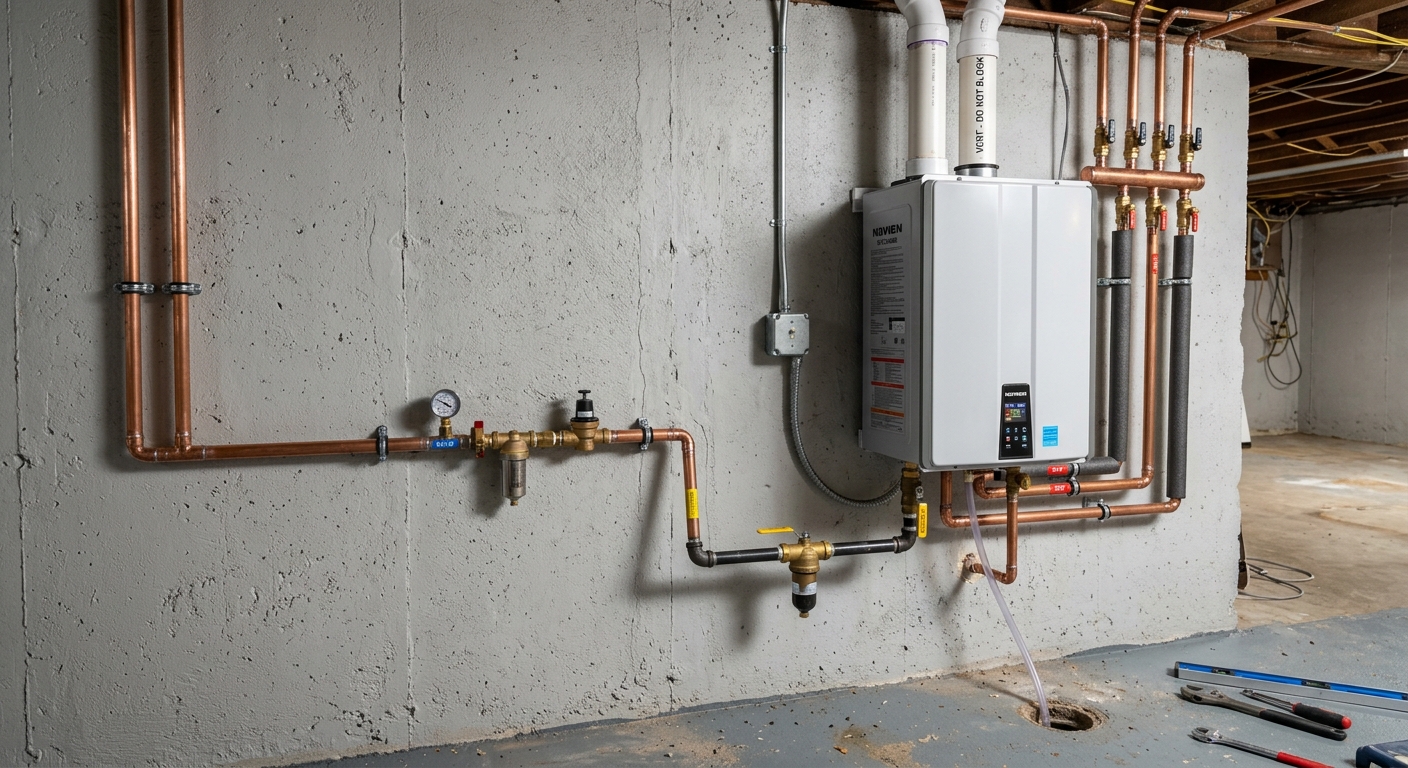
Your water heater options in Salisbury break into three main categories: tank, tankless, and heat pump units. Traditional gas or electric tank heaters are the least expensive to install, with a decent service life (8–15 years), but they do waste energy keeping water hot around the clock. Tankless—mostly gas-fired in this market—give you endless hot water and save on standby losses, but often need significant upgrades: a larger gas line, a special vent, and sometimes electrical work. Those extras are what push costs up for Salisbury homeowners.
Heat pump (hybrid) water heaters are now the cheapest to run by far, using ambient air for heat, but they’re only a good fit if you have a decent amount of warm space. They cool off the area around them and are noisy, a consideration for finished basements common in post-war homes here. Salisbury doesn’t lack for gas, so the choice often comes down to install cost versus running cost, plus space and vent constraints.
Sizing should be based on first-hour rating—the amount of hot water available for showers and laundry at once—not just tank gallons. Salisbury homes with expansion tanks (for modern code) and a pan with drain (especially in finished spaces) will avoid water damage from a heater failure, which is much more often a rusted-out tank than bad controls.
| Type |
Installed cost |
Service life |
Operating cost |
Best when |
| Gas tank, 40–50 gal |
$1,250–$2,900 |
8–12 yrs |
moderate |
Standard setups, adequate vent, affordable install |
| Electric tank, 40–50 gal |
$1,250–$2,000 |
10–15 yrs |
high |
No gas available, quick replacement |
| Gas tankless |
$2,000–$2,900 |
18–25 yrs |
low-moderate |
High demand, long-term savings, space savings |
| Heat pump water heater |
$2,000–$2,900 |
13–15 yrs |
lowest |
Space available, utility savings matter, electric backup |
What construction era means for your pipes
With 73.5% of homes in Salisbury built before 1980, you’re likely dealing with original copper, galvanized steel, or cast iron drain lines if your house is older. Clay tile was the go-to for sewer laterals, and many service lines from this era are either galvanized or copper, meaning leaks from corrosion or root intrusion are simply a matter of time, not bad luck.
South Whitehall and Upper Macungie tract homes built post-1950 typically have copper supply lines (with some early PEX or polybutylene in 1980s-90s builds). These homes see a high volume of repipes, especially when old copper starts pinholing or a remodel opens up the walls. Bathroom and kitchen fixtures from the builder-grade era are now near or past their intended service life, and water heaters—if original—are overdue for replacement.
If your house is a newer build, don’t relax entirely. Polybutylene supply pipe (late 1970s to mid-90s) can fail without warning, and PVC or ABS for drains still need the right support and installation to avoid future separation. Upgrades to PEX in the last two decades usually mean you’re in good shape, but the underlying drains and main lines may still be original and a looming expense.
Galvanized, copper, PEX, cast iron
If you own a home in Salisbury or the surrounding Lehigh County townships, you can often date your plumbing by the pipes themselves. Post‑1950 suburban tract housing in South Whitehall and Upper Macungie is a mix of copper and, in the 1980s to early 1990s, polybutylene, with more PEX entering as repipes peak in recent years. Galvanized steel—silver-gray, magnetic, and joined by threads—shows up in the oldest homes, where you’ll likely notice poor water pressure and brown water before leaks appear. Copper is a smooth, reddish pipe joined by soldered fittings, long-lasting but susceptible to pinhole leaks if the water chemistry is aggressive.
PEX (colored red, blue, or white flexible tubing, usually with crimped or cinched fittings) dominates modern repipes, especially for Salisbury’s mid-century and newer homes. Cast iron drains are heavy, black, and joined by leaded “bell and spigot” fittings; these fail by rusting through or cracking at the joints after 50–75 years. Clay tile sewers—dull brown, segmented, and brittle—are prone to root intrusion at every joint.
To identify your supply lines, do a scratch test on an exposed pipe (like at the meter): shiny silver and magnetic means galvanized; shiny copper color is, naturally, copper. If you see light gray plastic with distinct fittings, that’s polybutylene—the one type you should plan to replace sooner rather than later, as insurers dislike it and failures tend to be sudden.
Use these clues to estimate remaining life. With galvanized, you’re living on borrowed time after 60 years. Copper can last many more decades unless you’ve had leaks. PEX, done right, should be safe for decades. Cast iron and clay drains are near their end after 50–75 years. Knowing your materials lets you budget, not just react.
| Material |
Typical era |
Failure mode |
Service life |
| Galvanized steel supply |
pre-1960 |
internal corrosion, pressure loss |
40–60 yrs |
| Copper supply |
1950s–present |
pinhole leaks, joint failure |
50–70 yrs |
| Polybutylene supply |
late 1970s–1995 |
fitting failure, sudden bursts |
unreliable |
| PEX supply |
2000s–present |
fitting or UV degradation |
40–50 yrs |
| Cast iron drain |
pre-1975 |
corrosion, cracking, scale |
50–75 yrs |
| Clay tile sewer lateral |
pre-1980 |
root intrusion at joints, offset |
50–60 yrs |
| PVC / ABS drain |
1970s–present |
joint separation, crushing |
50+ yrs |
Who is allowed to do plumbing work in Pennsylvania
In Pennsylvania, plumbing licensing is not statewide—it’s controlled at the municipal level. That’s especially important in Lehigh County. The City of Allentown Building Office oversees plumbing trade licensing countywide, but each municipality or its third-party Uniform Construction Code (UCC) office sets its own enforcement. That means a plumber licensed in Allentown isn’t automatically licensed in Salisbury or the next township. Always ask your contractor, "Are you licensed for this municipality?" rather than just "Are you licensed?"
For jobs over $500, Pennsylvania requires Home Improvement Contractor (HIC) registration, verified through the Pennsylvania Office of Attorney General. You can check a contractor’s registration at hic.attorneygeneral.gov. A written contract is required by law over $500, and you have three business days to cancel under the Home Improvement Consumer Protection Act.
Permit rules are clear: in Allentown and most Lehigh municipalities, you need a permit for alterations that affect plumbing or for water heater replacements. For small, like-for-like fixture repairs inside your own unit, permits usually aren’t required. Inspections are handled by the city, the township, or whichever third-party UCC office your area uses.
Always verify workers' compensation coverage, especially since Pennsylvania mandates it for all employers, which you can confirm on WCAIS (wcais.pa.gov). For homes built before 1978, check that your contractor has proper EPA Lead RRP certification if disturbing painted surfaces (certifiedrenovatorsearch.epa.gov).
Frequently asked questions — plumbing in Salisbury
What do I do if a pipe is frozen but not burst?
If you’re in Salisbury during a cold snap and notice a faucet isn’t running but haven’t spotted water damage, it’s likely a frozen pipe—especially in homes with uninsulated plumbing along exterior walls or crawl spaces, which are common in pre-1980 construction (U.S. Census Bureau, ACS 2024). Don’t run a torch or open flames; instead, gently warm the pipe with a hair dryer starting at the faucet moving back. Open cabinets and let warm air circulate. Leave the faucet open—when thawed, water will flow and relieve pressure. If you’re not sure where the pipe is frozen or it’s behind a finished wall, most Salisbury plumbers can locate and safely thaw it for $375–$1,250. If you see any leak or bulge, shut off the main immediately and call for emergency help.
How hard is the water in Salisbury?
Salisbury sits within the Lehigh County Authority service area, where public water is considered moderately hard to hard—though no precise local figures are published, the scale deposits found in fixtures and water heaters are typical of northeastern Pennsylvania. Hard water isn’t a health concern, but it will shorten the life of water heaters and appliances, and can cause scale in pipes, especially in older homes with copper or galvanized supply lines. If you notice frequent element failures in electric heaters or white buildup on faucets, a softener may be helpful. Most homeowners in the area simply replace affected fixtures as needed, with water heater replacements running $1,250–$2,900 in Salisbury.
Should I repipe my Salisbury home or keep repairing?
With 73.5% of Salisbury homes built before 1980, many are well into the range where supply and drain pipes reach the end of their service life. If you’re dealing with galvanized steel, chronic pinhole leaks in copper, or have unreliable polybutylene, repiping is likely to be more cost-effective than repeated repairs—fixing one pinhole rarely stops the next. Whole-house repipes typically fall between $3,700–$8,900 in Salisbury, depending on house size and access. If you’ve only had a single, isolated leak in otherwise good copper lines, a targeted repair makes more sense. Let the history, not just age, of your plumbing guide your decision.
Who owns the sewer lateral, me or the city?
In Salisbury and throughout most Lehigh County municipalities, the homeowner owns the entire sewer lateral from their foundation out to the connection at the main in the street. That means blockages, breaks, or root intrusion under your yard or driveway are your financial responsibility. Most local sewer repairs—from camera inspection to full replacement—are at your expense, with spot repairs ranging from $2,100–$12,500. Always get the problem verified with a camera before approving major work. Only the sewer main itself, usually under the street, falls to the city or utility.
Can I do my own plumbing work in Salisbury?
In Pennsylvania, and specifically in Salisbury, you’re legally allowed to do your own plumbing work in your own home, but only up to what the municipal code allows. For projects that change plumbing lines or major fixtures (like a water heater or moving a sink), you’ll need a permit and to pass inspection, even if you DIY. In Allentown and most Lehigh County townships, a permit is nearly always required for significant plumbing changes or replacements. Simple like-for-like repairs inside your own unit can often be done without a permit, but if you’re not sure, check with the local UCC office. Remember, hiring a contractor for anything over $500 brings with it extra consumer protections and contract requirements.
What counts as a plumbing emergency?
In Salisbury, a plumbing emergency is any active leak or failure that can cause immediate water damage or loss of basic service. This includes a burst supply pipe, a water heater leaking heavily, a sewer backup into the house, or any situation that leaves you without all water or all drainage. Leaks inside a wall or under a floor can escalate quickly, especially in homes with finished basements or expensive flooring. Emergency rates reflect the urgency—with burst pipe repairs usually falling between $650–$1,250 in Salisbury. Clogged drains where you still have at least one working bathroom or kitchen faucet rarely qualify as urgent, unless sewage is backing up.
How much does a plumber cost in Salisbury?
Plumbing costs vary with the job, materials, and especially whether it’s an emergency. In Salisbury, the typical price for an emergency repair like a burst pipe is $650–$1,250. A planned replacement, such as a standard water heater, is often $1,250–$2,900. Drain cleaning and routine repairs for accessible fixtures can be at the lower end, but major work (replacing a sewer lateral, repiping the whole house) will be at the higher end. Take the time to get a detailed, written estimate and avoid paying extra for a rush job if you can wait for standard rates.
What does drain cleaning cost in Salisbury?
Main line drain cleaning in Salisbury, for a clog preventing whole-house drainage, generally costs $350–$800 as an emergency or $200–$500 if you can wait for standard scheduling. Costs rise if your plumber needs to use a camera—often necessary for stubborn recurring clogs in older homes with cast iron or clay tile drains. Light clogs in a single fixture (like a bathroom sink) are less, but main line issues almost always require a professional with proper equipment. Get a clear quote before work starts; upsells for unnecessary jetting are common, but in most Salisbury homes, standard augering does the job.
What causes low water pressure in Salisbury homes?
Low water pressure in Salisbury’s older homes is most often caused by buildup inside galvanized steel pipes or failing pressure regulators, especially in houses built before 1960. Internal corrosion narrows the pipe, reducing pressure long before leaks start. In newer construction, scale in fixtures or issues with the main shutoff can also cause drops in flow, particularly with hard water. Sometimes the problem is traceable to the water service line, which may be old galvanized or kinked copper, and replacing it can restore full pressure—but that is a substantial project, typically running $5,800–$12,500. Get the main line and pressure checked before committing to any major repiping, as fixing a single fitting or valve may solve the problem.