What plumbers charge in Bridgeport
Bridgeport’s plumbing costs are shaped by a mix of older homes and ongoing demand for emergency work. With just under 1,000 owner households and most Bridgeport homes built before 1980 (U.S. Census Bureau, ACS 2024), the typical client is dealing with aging supply lines, older fixtures, and systems that have already seen one or two rounds of replacement. Era predicts everything: if your pipes are original, the odds you’ll face a burst, a repipe, or a failing water heater are much higher — and that’s where costs rise.
Emergency calls always carry a higher rate, no matter the job. If you call for help after hours or with water pouring through a ceiling, you’ll pay more than for the same fix scheduled in advance. The wide price range below captures this split; emergency service includes overtime, faster response, and all the risk of a scene that can get worse if not handled fast. For Bridgeport’s 1950s–1970s stock, whether you’re restoring water service after a leak, replacing a corroded heater, or opening a main drain that’s backing up, the age and configuration of your house have as much effect on price as the job itself.
| Service |
Scope |
Emergency rate |
Standard rate |
| Emergency repair — burst pipe |
locate, open, repair section, restore service |
$600–$1,250 |
$375–$1,250 |
| Water heater replacement (gas, 40–50 gal) |
remove old, install, test, haul away |
$2,000–$2,900 |
$1,250–$2,900 |
| Drain cleaning — main line |
augering or hydro-jet, camera if needed |
$350–$800 |
$200–$500 |
| Sewer line spot repair |
excavate or reline a failed section |
$2,100–$12,500 |
$2,100–$12,500 |
| Whole-house repipe |
replace supply lines throughout, patch and finish |
|
$3,600–$8,800 |
| Water service line replacement |
street to house, excavation and restoration |
|
$5,700–$12,500 |
Estimates for a typical Bridgeport home. Access difficulty and pipe material move these figures more than anything else.
What construction era means for your pipes
If your home in Bridgeport was built before 1980 — as is true for almost 87% of the local stock — your plumbing is likely a patchwork of original and replaced components. The 1950s–1970s wave brought copper supply lines as the standard, often joined to galvanized steel remnants or cast iron drains. Sewer laterals in this era are likely clay tile, which means they’re prone to root intrusion at the joints as the decades pass. Water service lines from the street may still be copper, but lead and galvanized are not unheard of in older Bridgeport sections.
With decades of service, most water heaters in this housing wave aren’t seeing their first replacement — many are close to their third cycle, a nod to the typical 10- to 12-year lifespan under southeastern Pennsylvania’s conditions. You’ll encounter fixtures replaced when styles changed but often tied to aging supply valves that aren’t up to a shutoff or swap without trouble. Drain lines are cast iron in most pre-1975 homes; visible rust “bleeds” at joints or noxious odors signal a breach waiting to happen.
Bridgeport’s pre-1980 homes simply face a different plumbing reality than newer buildings. If you’ve upgraded cosmetic fixtures but not the pipes, odds are good you’ll run into pressure drops, leaks, or failed shutoffs first. Each decade adds risk; most failures can be traced straight to the original builder’s material choices — and the fixes, whether spot repairs or full replacements, follow the same lines as the era’s construction.
Winter pipe failures in southeastern Pennsylvania
Bridgeport winters aren’t as harsh as upstate, but with a frost depth of 30 inches and a winter design temperature of 14 °F, pipes freeze — and burst — every year. The damage doesn’t usually happen where the pipe actually freezes. Instead, ice forms a plug and water trapped between the freeze and a closed fixture has nowhere to go, so pressure spikes and splits the line a few feet away. Most often, you’ll find the break in a wall, ceiling, or floor, not at the exposed spot that iced up.
The most vulnerable spots in Bridgeport homes are uninsulated pipes in exterior walls, garages, unheated crawlspaces, and attics — all more common in your area’s postwar houses. The connection for your outdoor faucets (hose bibbs) is another classic failure point, especially if not winterized early. Prevention is mostly cheap and always less than cleaning up.
- Add pipe insulation to exposed lines, especially in unconditioned spaces.
- Use heat tape for chronic trouble spots.
- On the coldest nights, let a faucet (ideally on an exterior wall) run a slow trickle.
- Open cabinet doors under sinks to let room heat in.
- Always shut off and drain outdoor faucets before the first real freeze.
If a pipe does freeze, use a hair dryer or space heater — never an open flame — aimed at the pipe’s accessible section. Go slow, starting from the open faucet and working back toward the ice. Thawing with a torch is risky, both for burns and potential fire inside the wall cavity.
Compare all this to a burst-pipe emergency call: you’re looking at $600–$1,250 if it floods and you need a plumber right away. A foot of foam or an hour with a space heater isn’t just cheaper, it’s peace of mind when January hits hard.
Dating your plumbing by what it's made of
If you want to know how long your pipes in Bridgeport will last, know what they’re made of — and when they were installed. Almost all stock built in the 1950s–1970s was piped with copper, with earlier homes using galvanized steel. Cast iron is the norm for larger drains, while clay tile was the common choice for buried sewer laterals up to 1980. If your pipes went in later, look for PEX or, in 1980s–90s renovations, polybutylene (which is now a major insurance concern).
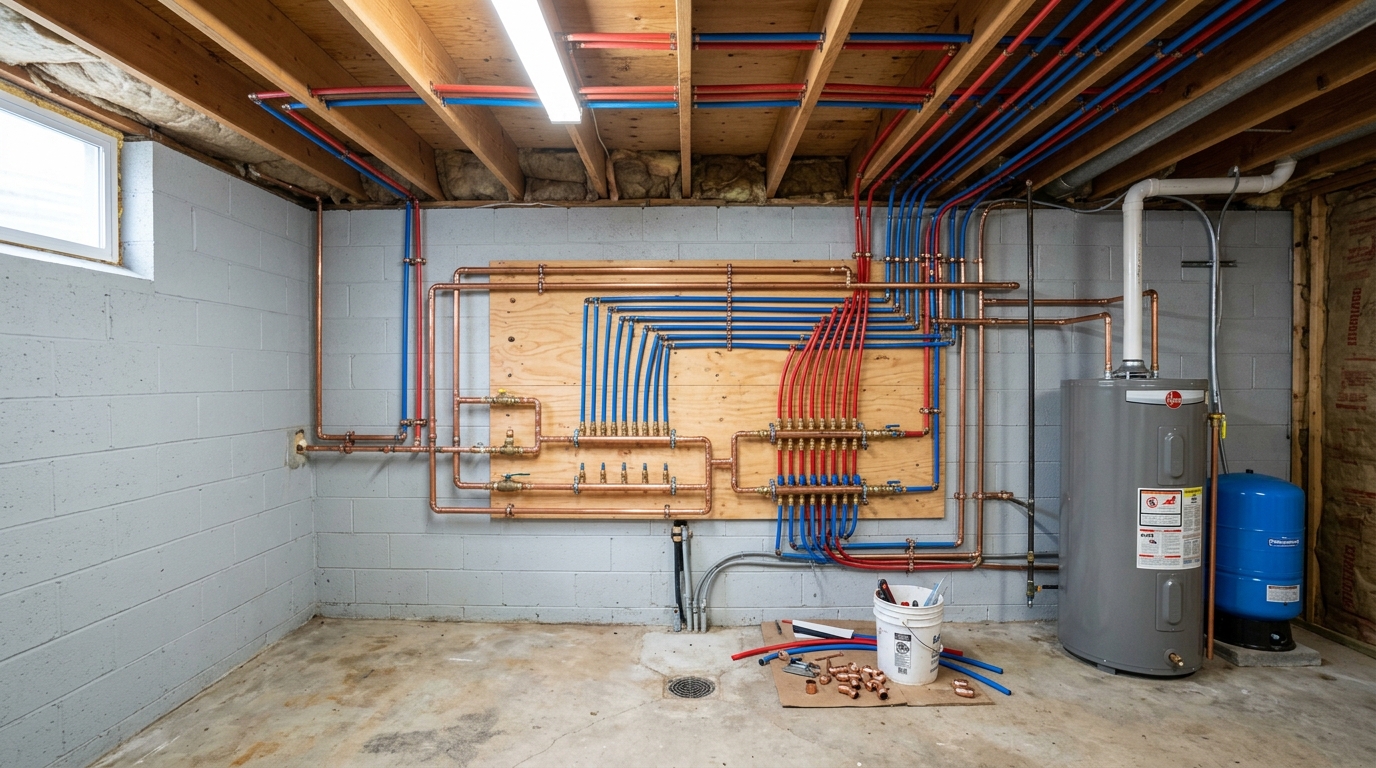
Galvanized steel pipes are gray, magnetic, and produce rust when scratched with a screwdriver. Copper is reddish, soldered at joints, and stays non-magnetic. Polybutylene is soft gray or blue plastic, commonly seen with compression or crimp fittings, while PEX is more flexible and comes in red or blue. You can usually scratch plastic with a fingernail; you can’t scratch copper that way.
Era is destiny: galvanized steel is likely closing in on 60 years — expect pressure loss and hidden corrosion, even if it isn’t leaking yet. Copper has a longer runway but suffers when water chemistry is poor, leading to pinhole leaks from the inside out. Polybutylene, if you have it, is simply worth replacing. Cast iron drains may look fine but can crack or clog from scale at the half-century mark. Clay tile outside the house is on borrowed time, especially near mature trees. Knowing what you have puts you in control: you can budget for targeted repairs now instead of facing everything at once after a failure.
| Material |
Typical era |
Failure mode |
Service life |
| Galvanized steel supply |
pre-1960 |
internal corrosion, pressure loss |
40–60 yrs |
| Copper supply |
1950s–present |
pinhole leaks, joint failure |
50–70 yrs |
| Polybutylene supply |
late 1970s–1995 |
fitting failure, sudden bursts |
unreliable |
| PEX supply |
2000s–present |
fitting or UV degradation |
40–50 yrs |
| Cast iron drain |
pre-1975 |
corrosion, cracking, scale |
50–75 yrs |
| Clay tile sewer lateral |
pre-1980 |
root intrusion at joints, offset |
50–60 yrs |
| PVC / ABS drain |
1970s–present |
joint separation, crushing |
50+ yrs |
Verifying a Bridgeport plumber's credentials
Pennsylvania does not issue statewide plumbing licenses. Instead, plumbing is regulated at the municipal level. This means that a plumber licensed to work in Norristown is not automatically approved to work in Bridgeport — and vice versa. For Bridgeport, always ask if the plumber is licensed in your municipality, not just “licensed in Pennsylvania.” Municipal permit offices handle inspections and credentialing, not a state board.
Any plumbing work beyond swapping a like-for-like fixture — such as a new water heater, system alteration, or entire repipe — requires a permit issued and inspected by your municipality. The inspector ensures the work meets the Pennsylvania Uniform Construction Code (UCC), enforced locally. For Bridgeport, expect that at the end of any permitted project, a municipal inspector will sign off before walls are closed.
If you’re hiring, check for a Home Improvement Contractor registration — required for contracts over $500. You can verify this at hic.attorneygeneral.gov. For employers, workers’ compensation is also mandatory, and can be confirmed at wcais.pa.gov. Any written contract must meet consumer protection requirements, including clear scope and a 3-day right to cancel. Don’t skip these checks; it’s the best protection you have if a job goes sideways.
Water quality and what it does to your pipes
Bridgeport’s public water is provided by Aqua Pennsylvania, and their annual water quality report will tell you exactly what’s coming out of your tap and what, if anything, it might be doing to your plumbing. Hardness is moderate in southeastern Pennsylvania; over years, it will cause scale buildup in water heaters and aerators, shortening appliance and fixture lifespan but rarely posing a health risk. The biggest issue is aggressive water — slightly acidic water can eat copper pipes from the inside, creating pinhole leaks.
Water softeners are commonly offered, but whether one pays back depends on your fixture count and how much you value a spotless shower door. They do add salt, which some people prefer to limit. For most Bridgeport homes, the value is less about plumbing longevity and more about aesthetics and appliance efficiency. A softener won’t save a failing pipe.
Whole-house filtration might make sense if you want to strip chlorine or certain minerals for taste, while point-of-use filters (under-sink or pitcher) handle drinking water at a fraction of the cost. Installation of expensive treatment for Bridgeport public water is usually more about taste than necessity. Request Aqua Pennsylvania’s report before making upgrades and be skeptical: aggressive sales pitches for “necessary” treatment equipment almost always oversell the risk.
What a plumbing quote should contain
Bridgeport plumbers usually quote work as a flat rate or on time-and-materials. Flat rate pricing gives you a fixed cost; you know the bill before work starts, but it’s priced to cover all risks. Time-and-materials can be a better deal for straightforward jobs but carries more risk if complications stack up. It’s not about which is “right” — it’s about knowing and agreeing to the billing model before anyone starts work.
Ask if there is a diagnostic fee and whether it’s credited if you choose to go ahead. Read the scope: a proper quote spells out what’s being opened, repaired, and restored. Did the plumber include permit fees and inspection? If wall, floor, or ceiling repairs are needed after a leak or repipe, is restoration included or left to you? Always get clear warranty language for labor and for the parts or fixtures installed. If the job is after-hours or weekends, the increased rate should be detailed in writing. If you don’t see a line for any of these, ask. In Bridgeport, with older houses and system unknowns, clarity on scope, restoration, and warranty saves major hassle down the line.
| Line item |
What to look for |
Red flag if… |
| Billing model |
flat rate or hourly, stated up front |
unstated |
| Diagnostic fee |
amount, and whether it credits |
vague |
| Scope |
what is opened, repaired and restored |
price with no scope |
| Restoration |
drywall and finish explicitly in or out |
silent |
| Permit |
included and priced |
'not needed' |
| Parts |
brand and model for fixtures |
'standard fixture' |
| Warranty |
labour period stated separately |
parts only |
Frequently asked questions — plumbing in Bridgeport
What does emergency plumbing cost in Bridgeport?
Emergency plumbing calls in Bridgeport generally run between $600–$1,250 for a typical burst pipe or active leak, with the higher end for calls at night or over a weekend. These figures reflect the true cost of fast response, getting a licensed plumber to your door, and stopping damage before it spreads. Because nearly all Bridgeport homes are older and often have difficult pipe access in finished basements or retrofitted spaces, labor hours can spike. You’ll pay more than for a scheduled appointment, but stopping a leak quickly can save you thousands in dry-out and restoration costs. Shopping for emergency response on price alone is risky — what you want is a plumber with the skills, insurance, and municipal credentials to solve the problem and restore service, not just patch-and-dash.
How do I prevent frozen pipes in Bridgeport?
Frozen pipes are a headache every winter in Bridgeport, especially in homes built before 1980 with exposed or minimally insulated runs in basements, crawlspaces, and exterior walls. To prevent them, start by insulating vulnerable pipes and sealing drafts. Letting a faucet drip on the coldest nights maintains flow, which can help prevent freezing. Heat tape is worthwhile for problem spots, provided it’s installed safely and inspected annually. Always shut off and drain your outdoor faucets each fall. If you do experience a freeze, thaw with a hair dryer or space heater — never a torch. Prevention typically costs under $100 in materials, while a burst pipe in midwinter starts at $600–$1,250 to repair, plus any restoration costs. For Bridgeport’s climate and housing stock, a little prep each fall pays off every season.
Are tree roots a common sewer problem in Bridgeport?
Yes, root intrusion into clay tile sewer lines is a regular issue in Bridgeport because most homes were built before 1980 and commonly have clay laterals running from the house to the street. Mature street trees cause root infiltration at the joints, which can result in slow drains, backups, or even total blockages. Clearing a basic root problem usually runs $200–$500 for a main-line auger or hydro-jetting, but if the pipe is badly broken or collapsed, a spot repair or section replacement can reach $2,100–$12,500. It’s smart to schedule a camera inspection if you’ve had recurring issues. Regular maintenance is much cheaper than waiting for a complete failure.
Who pays to replace a lead service line in Bridgeport?
In Bridgeport, as in the rest of Montgomery County, the homeowner is responsible for the section of water service line from the curb stop at the street into the house. If your service line is lead or galvanized, you’re looking at full responsibility for replacement on your property. Typical replacement costs are $5,700–$12,500, depending on depth, distance, and restoration needed. Public water utilities like Aqua Pennsylvania may have partial assistance programs for the section in the street, but most replacements are still out-of-pocket for Bridgeport homeowners. It’s worthwhile to confirm what material you have before you need an emergency repair — and get clear, written estimates for all-inclusive replacement.
Is trenchless sewer repair reliable?
Trenchless sewer repair methods are used regularly in Bridgeport, especially where lawns, driveways, or landscaping make open excavation costly. For laterals made of clay tile or cast iron — common in your area’s pre-1980 homes — trenchless lining or bursting offers a way to restore service without tearing up the yard. When done by a properly equipped contractor with local experience, trenchless repairs hold up well and come with competitive warranties. Prices for spot repairs line up with the traditional dig-and-replace approach, falling in the $2,100–$12,500 range for most Bridgeport projects. Always request a before-and-after camera inspection to verify successful lining or replacement.
How do I verify a plumber's licence and insurance?
In Pennsylvania, and Bridgeport especially, plumbing is regulated and licensed at the municipal—not state—level. Ask if the plumber is licensed specifically for Bridgeport or your local township, as a credential from Norristown does not automatically cover Bridgeport projects. Always request their Home Improvement Contractor (HIC) registration number and verify it at hic.attorneygeneral.gov. For insurance, ask for a certificate showing general liability and active workers’ compensation; you can confirm workers’ comp status directly at wcais.pa.gov. Bridgeport’s permit office will not issue a job permit unless required documentation is in order, so if a contractor sidesteps these checks on a project over $500, that’s a major red flag.
How do I find a hidden water leak?
If you suspect a hidden leak in your Bridgeport home, start by checking for unexplained increases in your water bill, musty odors, or spotting dampness on walls and ceilings. Listen for hissing behind walls and inspect visible pipes for sweating or corrosion, especially in older homes where galvanized or copper pipes are nearing the end of their service life. Professionals often use moisture meters and thermal cameras, and for slab leaks or underground lines may run specialized listening equipment. Visual signs and humidity are usually enough to merit a plumber’s diagnostic visit, which runs $200–$500 for inspection and leak detection. Early action stops a small problem from turning into a major repair or mold job.
How much does a water heater replacement cost in Bridgeport?
In Bridgeport, replacing a standard gas water heater (40–50 gallons) typically costs between $1,250–$2,900. Most homes in town have tank-style heaters that are approaching their second or third replacement cycle. The total depends on factors like venting, code-mandated upgrades, and whether the shutoff or extra piping needs work at the same time. If your current system is leaking or failing to heat, it’s best to replace rather than patch — repairs on a tank older than 10 years rarely pay back. Always ask if haul-away, inspection, and permit fees are included in the quote rather than as add-ons.
What counts as a plumbing emergency?
In Bridgeport, anything that actively threatens your property or basic living conditions is a plumbing emergency, not just an inconvenience. This includes burst pipes, major leaks you can’t stop, sewer backups, or a total loss of water service. Blocked main drains and water heater failures that leave you without hot water (especially for families with small children or health concerns), also rise to the level of emergency. Non-stop leaks or sewage backups can cause thousands in structural and mold damage if left unchecked. Emergency calls in Bridgeport typically start at $600–$1,250, but quick action is often far cheaper than what restoration costs could become if you wait until Monday.