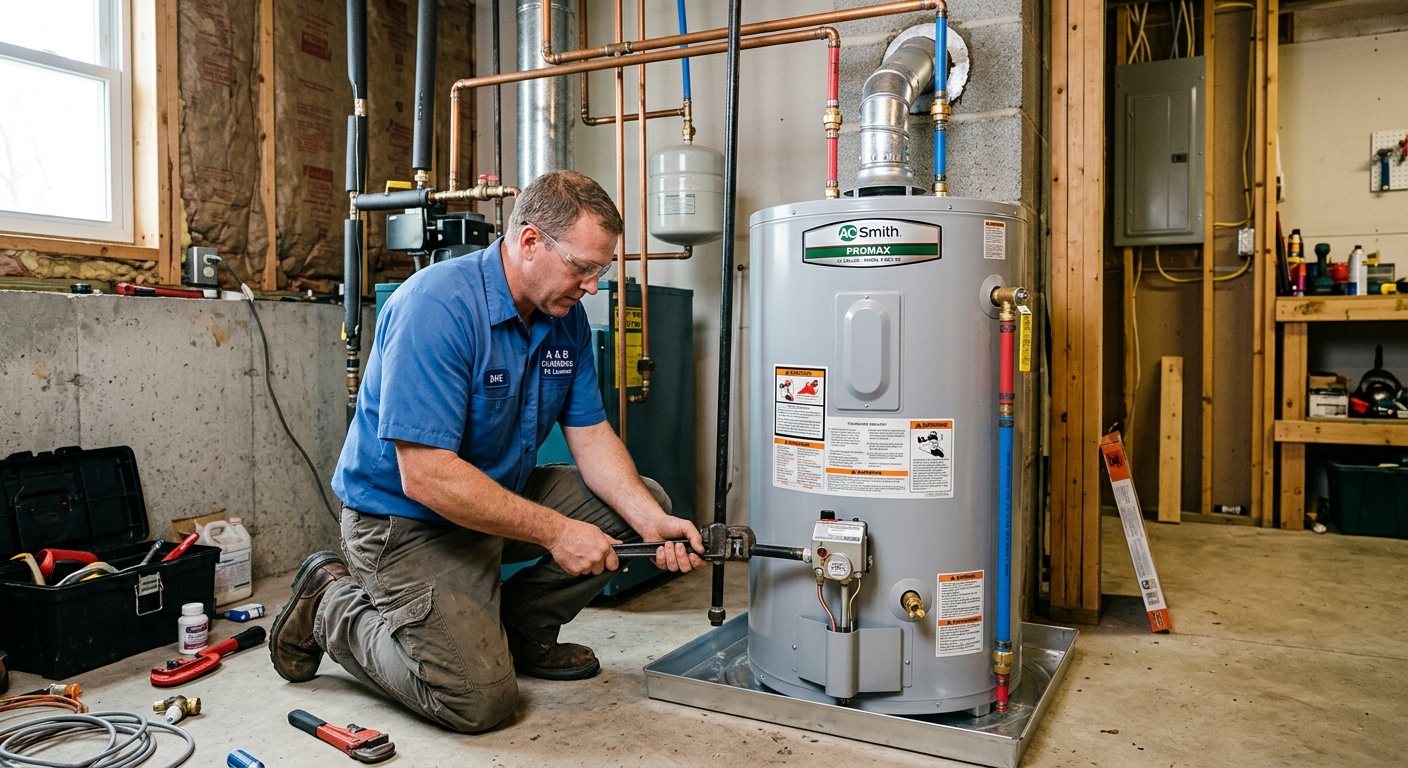
Plumbing costs in East Stroudsburg — 2026
East Stroudsburg homes, many built between the 1970s and 2000s as vacation and subdivision properties, bring a distinct plumbing profile shaped by their construction era and homeowner needs. With just 1,445 owner households and a homeownership rate of 49.0% (U.S. Census Bureau, ACS 2024), local plumbing costs swing widely based on whether you call for help in an emergency or plan ahead for repairs or upgrades. The reason is simple: the same job—for example, repairing a burst pipe—can cost far more after hours, or when work starts with water surging through a finished basement ceiling instead of a slow drip under a crawlspace.
Older East Stroudsburg homes, especially those built before 1980 (66.3%), often have original supply lines—sometimes copper, sometimes early plastics—which means past and future pipe repairs hinge on what is in the walls, and how accessible it is. Later homes, and homes already retrofitted, will have PEX supply lines and sometimes modernized drains, posing a different but no less real set of repair costs. Price is mainly driven by access: what’s behind drywall, in a finished basement, or tied into other remodeling. Here’s what you can expect to pay for typical jobs in the area:
| Service |
Scope |
Emergency rate |
Standard rate |
| Emergency repair — burst pipe |
locate, open, repair section, restore service |
$550–$1,150 |
$325–$1,150 |
| Water heater replacement (gas, 40–50 gal) |
remove old, install, test, haul away |
$1,800–$2,700 |
$1,150–$2,700 |
| Drain cleaning — main line |
augering or hydro-jet, camera if needed |
$350–$800 |
$200–$500 |
| Sewer line spot repair |
excavate or reline a failed section |
$1,900–$11,500 |
$1,900–$11,500 |
| Whole-house repipe |
replace supply lines throughout, patch and finish |
|
$3,300–$8,100 |
| Water service line replacement |
street to house, excavation and restoration |
|
$5,200–$11,500 |
Estimates for a typical East Stroudsburg home. Access difficulty and pipe material move these figures more than anything else.
Sewer line problems in East Stroudsburg
In East Stroudsburg, responsibility for the sewer lateral—the buried pipe that runs from your home to the municipal main—rests with the homeowner all the way to the street. This is the root of most disputes when a backup or break happens, since repair costs can jump from a minor fix to major excavation within a few feet. Typical symptoms progress from one slow-draining fixture (often the lowest in the house) to multiple slow drains, odd gurgling noises, and finally sewage backing up into tubs or floor drains. When the problem gets to that last stage, it’s an emergency.
Before considering any excavation or major dig, demand a full camera inspection. In homes built before 1980 in Monroe County, sewer laterals can be clay tile—prone to root intrusion and offset joints (“bellies”) that trap debris. A camera inspection not only pinpoints the issue but gives you proof if you need to compare quotes. Never accept a sewer excavation quote without seeing the footage yourself.
Repair options range from open-cut replacement—often disruptive and costly—to trenchless relining, which can be less invasive but won’t solve every type of failure. Costs for spot repairs typically run between $1,900–$11,500 for East Stroudsburg.
If you’re in one of the neighboring townships, be aware that many homes rely on private septic systems rather than municipal sewer. Problems here are different altogether—regular tank pumping (usually every 3–4 years) is essential, and drainfield failures call for separate repair expertise. Diagnosing a slow drain in a septic home is not the same as in town—confusing the two is expensive and avoidable.
What a plumbing quote should contain
Plumbers in East Stroudsburg generally use one of two billing models: flat rate or time-and-materials. Flat rate gives you a total job price up front, building the contractor’s risk into the number—there’s rarely a surprise but you may pay a bit more for straightforward jobs. Time-and-materials, on the other hand, can be cheaper on simple issues but exposes you to unknowns if it runs long. The important step is knowing which you’ve agreed to; a contract that doesn’t spell this out is a common red flag.
Any serious quote should detail a diagnostic fee (and if it’s credited toward the job), and spell out exactly what will be opened, repaired, and restored—including whether patching drywall and floors is included or left to you. Permitting, always required for major work, should be stated and priced, along with the explicit mention of brands and models for any fixtures. Look for a labor warranty defined separately from any parts warranty, and read the fine print for after-hours premiums, which easily turn a standard repair into a much higher bill.
| Line item |
What to look for |
Red flag if… |
| Billing model |
flat rate or hourly, stated up front |
unstated |
| Diagnostic fee |
amount, and whether it credits |
vague |
| Scope |
what is opened, repaired and restored |
price with no scope |
| Restoration |
drywall and finish explicitly in or out |
silent |
| Permit |
included and priced |
'not needed' |
| Parts |
brand and model for fixtures |
'standard fixture' |
| Warranty |
labour period stated separately |
parts only |
Who is allowed to do plumbing work in Pennsylvania
Pennsylvania does not license plumbers at the state level. Instead, municipal governments set their own licensing rules—so a plumber licensed in one borough may not hold credentials in the next township. In East Stroudsburg and throughout Monroe County, always ask if the contractor is licensed—and specifically, if they are licensed to pull permits in your municipality. The correct question is not “Are you licensed?” but “Are you licensed here?”
Plumbing work—meaning anything that alters fixed pipe or drainage—demands a permit for code compliance under the Pennsylvania Uniform Construction Code (UCC), itself based on the International Residential Code. In East Stroudsburg, code enforcement is handled by the Borough Code Enforcement office, which will also carry out the inspections. For anything over $500, the contractor must hold Home Improvement Contractor (HIC) registration through the Pennsylvania Office of Attorney General. You can and should verify this by searching the state registration site at hic.attorneygeneral.gov.
Workers’ compensation coverage is mandatory for any contractor with employees; verify insurance using WCAIS (wcais.pa.gov) to ensure protection in the event of a workplace injury on your job.
Emergency rates versus scheduled work in East Stroudsburg
Every homeowner dreads the bill that comes with an after-hours call—and with good reason. Emergency plumbing rates in East Stroudsburg can be double or more what you’d pay for scheduled work. The premium comes from several factors: a live dispatcher after hours, a trip charge to get a tech out immediately, overtime rates, and the reality that diagnosis happens with water pouring through ceiling or wall—there’s less time to plan and more risk for the contractor.
So what is a true emergency? Here’s a triage guide for our area:
- Emergencies (call now): Active flooding (water pouring into finished space), total loss of water supply, sewage actively backing up, or the smell of gas near a water heater or boiler.
- Can wait until morning: Slow drips (bucket under a pipe), one slow drain but no backup, toilets running, or minor leaks limited to a crawlspace or unfinished area.
The difference in cost for an emergency pipe repair—say, a burst supply line on a Saturday—could be $550–$1,150 compared with $325–$1,150 if scheduled during business hours. For water heater swaps, after-hours rates stack up—expect $1,800–$2,700 instead of $1,150–$2,700.
If you can safely shut off the water either at the main (look for a valve where the water line enters the house) or at the fixture (angle stops under sinks and toilets), you can often turn what feels like an emergency into a next-day, lower-cost repair. Every East Stroudsburg homeowner should know where the main shutoff is—if you’re not sure, ask your plumber to show you on the next service call.
What construction era means for your pipes
East Stroudsburg’s housing tells you a lot about what’s running behind the walls. More than 66% of homes here were built before 1980. In those homes, copper was common for supply pipes, but first-wave plastics like polybutylene also show up. Drains were typically cast iron or clay tile, which are both notorious for developing cracks and root intrusions with age. Sewer laterals from this era are usually clay, meaning root intrusion and offset joints are a regular headache as these systems age.
Much of the 1970s-2000s stock—especially vacation homes and subdivisions—now shows a patchwork of plumbing retrofits, with many properties upgraded to PEX supply lines. Some homes had builder-grade fixtures and polybutylene on the original build, so leaks start to accelerate as these materials hit their lifespan limits. In these cases, you may be on your second or third water heater: original units rarely last beyond 12–15 years. Septic tie-ins are typical outside the borough, so pay attention to tank age and drainfield condition if you’re not on sewer.
If your home has never had a full repipe and begins showing pressure or leak problems, odds are your plumbing is original and worth a close inspection. Old copper and galvanized will fail eventually—especially with the freeze/thaw cycles of the Poconos. A full assessment now can often save on big repairs later.
Spot repairs or whole-house repipe?
In East Stroudsburg’s housing stock, here’s the blunt truth: if you’ve had two or more leaks on the same pipe material in three years, it’s not random bad luck—your pipes are at the end of their useful life. Spot repairs work for an isolated issue on accessible, modern pipe, but repeated failures, falling water pressure throughout the house, brown or rust-stained water at first draw, visible corrosion at joints, or stubborn pinhole leaks all signal that it’s time to consider repiping.
With copper or PEX, choices come down to cost and what’s already in the walls. PEX is easier (and less invasive) for full or partial repipes, but if you’re still living with original galvanized, polybutylene, or cast iron, modern plumbing will pay for itself in avoided disasters. Keep in mind: the real hidden cost of a full repipe isn’t always the pipe—it’s patching drywall and repairing plaster after the fact, which can double labor costs if you have finished spaces throughout or older, thicker plaster walls. In many East Stroudsburg homes, this finish work rivals the plumbing itself.
| Situation |
Recommendation |
Cost |
Reasoning |
| One leak, accessible, modern pipe |
Spot repair |
$325–$1,150 |
Cheapest fix for an isolated problem on good piping |
| Two or more leaks in 3 years |
Partial repipe |
$3,300–$5,400 |
Recurrent leaks mean material failure, time for a systemic solution |
| Galvanized supply, pressure loss |
Full repipe |
$3,300–$8,100 |
Galvanized corrodes and closes up inside—only a full replacement restores flow |
| Polybutylene anywhere in the house |
Full repipe |
$3,300–$8,100 |
Polybutylene is a known liability; insurers may decline claims on this material |
| Cast iron drain with root intrusion |
Camera, then reline or replace |
$1,900–$11,500 |
Only visual confirmation can direct the least-invasive (and cheapest) repair |
| Suspected lead service line |
Test, then replace the lateral |
$5,200–$11,500 |
Lead is a health hazard—full line replacement is the only fix |
Frequently asked questions — plumbing in East Stroudsburg
How much does a water heater replacement cost in East Stroudsburg?
In East Stroudsburg, replacing a typical gas water heater (40–50 gallon) will run between $1,150–$2,700. Pricing depends on brand, warranty, whether you’re switching fuel type, and—especially in older homes—how accessible the heater is. Many area homes from the 1970s–2000s are on their second or third unit by now, but if yours was tucked into a finished corner or needs new venting, the job can get more complicated. Don’t pay for extra capacity unless your usage justifies it; most households in the area get by fine with a 40- or 50-gallon standard unit. Be wary of quotes that don’t include haul away of the old tank or final code-required gas and water testing, as those can bring unwanted extra charges at the end.
What do I do if sewage is backing up?
If sewage is coming up through a drain or fixture in East Stroudsburg, it’s an emergency—stop using water immediately and call a plumber with emergency response. Most backups are caused by blockages or failures in the sewer lateral, which is your responsibility from the house to the main. Expect an emergency call to cost between $550–$1,150 if it’s limited to clearing a blockage, but a break in the line can quickly escalate to a major repair. Make sure the plumber performs a sewer camera inspection before authorizing any excavation; seeing the footage protects you from unnecessary or oversized repairs. If you’re on a septic system (common in the surrounding townships), backups may relate to a full tank or failing drainfield—call a local septic specialist if you suspect that’s the case.
What does drain cleaning cost in East Stroudsburg?
For a main line drain cleaning in East Stroudsburg (think: your main sewer, not just a bathroom sink), costs typically range from $200–$500 if done during business hours, with emergency calls landing between $350–$800. The job should include mechanical snaking, and in older homes, a follow-up camera inspection is smart if blockages are recurring. Don’t let anyone convince you that hydro-jetting is always required; for most homes with PEX retrofits and cast iron or clay mains, a proper snake clears typical clogs. Expect to pay more if there are tree roots, or if you want a full inspection for potential pipe breaks or offsets.
Is East Stroudsburg on combined sewers or septic?
East Stroudsburg borough homes are generally on municipal sewer lines, which is a relief when it comes to backups and regular maintenance. However, many homes in the surrounding townships—like Stroud or Chestnuthill—are still on private septic systems. If you’re not sure, check your property tax bill for a sewer assessment or ask your township office. Problems differ: with municipal sewer, you’re responsible up to the main and must handle lateral repairs (costing from $1,900–$11,500 for a spot fix), while septic system issues mean pumping, drainfield inspections, and different contractors. Maintenance routines and emergency costs aren’t the same, so knowing your setup is worth a quick check.
Does insurance cover a burst pipe in East Stroudsburg?
In most cases, a burst pipe that happens suddenly, such as from a freeze, is covered by standard homeowners insurance as long as you’ve maintained heat and kept up routine maintenance. However, insurance won’t pay for repairing the pipe itself—just the damage to floors, walls, and belongings. For East Stroudsburg homes, this means you’ll likely pay $325–$1,150 for the pipe repair itself, with insurance handling water damage remediation. Always document the event with photos and receipts. If your insurer finds neglect—such as failing to shut off the main during an obvious slow leak—they may deny coverage. And remember, waiving your deductible is not allowed under Pennsylvania law.
What causes low water pressure in East Stroudsburg homes?
Low water pressure in East Stroudsburg often comes down to pipe age and original material. Many houses built before 1980 still have original galvanized or partially corroded copper piping, which clogs inside as minerals build up, leading to lower flow throughout the home. If you notice weak flow at all fixtures (not just one), the main supply line could be failing, possibly needing a full repipe in the $3,300–$8,100 range. If only one fixture is affected, the fix may be as simple as cleaning a clogged aerator or replacing a valve. Consistent low pressure? Have a plumber check for blockages, leaks you can’t see, or malfunctioning pressure-reducing valves, which are all common in local stock.
Can I do my own plumbing work in East Stroudsburg?
Pennsylvania plumbing licensing is strictly municipal, not statewide. In East Stroudsburg, code enforcement requires that permitted plumbing work—such as repiping, water heater replacement, or modifications to supply or drain lines—be done by a contractor registered and approved to pull permits in your municipality. For jobs that cost over $500, contractors also need Home Improvement Contractor registration, and must put your contract in writing under state law. Homeowners can often do their own minor repairs—like changing a faucet or toilet—but if you touch any concealed piping, the work must be inspected under the Pennsylvania Uniform Construction Code. Cutting corners can end up costing more, especially if you try and later need to bring the work up to code during a sale.
Do I need to drain outdoor spigots in East Stroudsburg?
Absolutely. The Pocono climate brings deep winters, with frost hitting 36 inches and cold snaps down to 4°F. Every fall in East Stroudsburg, you should shut off and drain your exterior spigots—or risk burst pipes and costly repairs (those winter pipe emergencies run $550–$1,150). Most area homes have a shutoff valve inside the basement or crawl space; turn it off and open the spigot outside to drain. If you have a “frost-free” sillcock, it still requires the hose to be removed, or water can freeze behind it. Every spring, check for leaks on first use—catching a split line early spares your finished basement from water damage in our high-snow, freeze-prone climate.
Is a tankless water heater worth it in East Stroudsburg?
Tankless water heaters promise endless hot water and some energy savings, but the calculation in East Stroudsburg is mixed. Upfront costs are higher (sometimes double): while a standard water tank swap is $1,150–$2,700, a quality tankless installation can easily start at the high end of that or exceed it, especially when factoring in rerouting gas lines, adding venting, or dealing with hard water from local wells or old copper piping. If hot water demand is moderate and you don’t mind regular maintenance (descaling is essential in our area), a tankless unit can pay off over years—but if your budget is tight or usage is normal, a standard unit is usually the smarter pick for typical Monroe County homes.