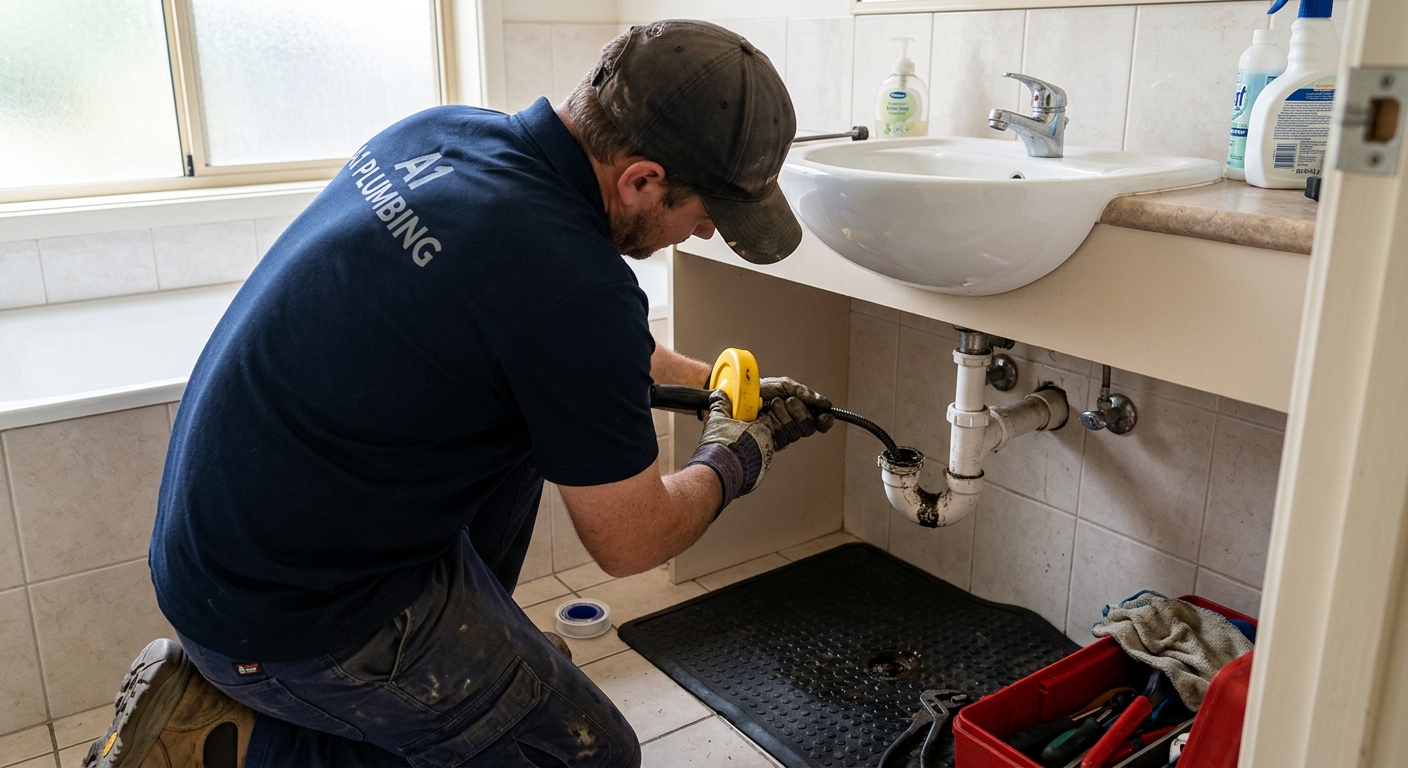
What plumbers charge in Benner
Homeowners in Benner, where 87.3% of residents own their home and 28.7% of homes were built before 1980 (U.S. Census Bureau, ACS 2024), face a unique set of plumbing costs tied directly to the age of their houses and the materials used during that building boom. Large subdivisions added around State College from 1960–1980 mean many Benner homes were piped with copper or galvanized supply lines, which now show their years in the form of leaks, lower water pressure, and rust-colored water.
Expect every plumbing job to have two prices: emergency and standard. Emergency work — like a burst pipe at 6 PM in January — costs more, sometimes twice the standard rate. Regular calls (where you can schedule out a few days or weeks) run at the low end of the range. Insurance may cover certain emergencies, but only after you pay the deductible.
Plumbing costs in Benner are very specific to site conditions and original construction. Access to the failed section, pipe location (in a finished basement versus under a slab), and how much wall or floor needs repair will move the price most. Here’s what typical services cost right now in Benner:
| Service |
Scope |
Emergency rate |
Standard rate |
| Emergency repair — burst pipe |
locate, open, repair section, restore service |
$650–$1,250 |
$375–$1,250 |
| Water heater replacement (gas, 40–50 gal) |
remove old, install, test, haul away |
$2,000–$2,900 |
$1,250–$2,900 |
| Drain cleaning — main line |
augering or hydro-jet, camera if needed |
$350–$800 |
$200–$500 |
| Sewer line spot repair |
excavate or reline a failed section |
$2,100–$12,500 |
$2,100–$12,500 |
| Whole-house repipe |
replace supply lines throughout, patch and finish |
|
$3,700–$8,900 |
| Water service line replacement |
street to house, excavation and restoration |
|
$5,800–$12,500 |
Estimates for a typical Benner home. Access difficulty and pipe material move these figures more than anything else.
How to find a good plumber in Benner
In Benner, where most homes are older and built with different standards than new construction, hiring the right plumber is not a small decision. Pennsylvania’s plumbing industry isn’t licensed statewide — except in Philadelphia and Pittsburgh, towns set their own rules. For Benner Township and surrounding areas, the most important legal proof is a current Home Improvement Contractor (HIC) registration from the Pennsylvania Office of Attorney General for contracts over $500. Always verify registration at hic.attorneygeneral.gov.
Ask if your plumber is insured and covered by workers’ compensation (required for all employers, which you can check on WCAIS at wcais.pa.gov). The policy should name your property address for the coverage. Find out if the company uses in-house techs or subs out the work — in thin markets like Centre County’s rural fringes, some operators take more work than they can actually handle directly.
- Confirm their HIC registration matches the business and is current.
- Check for valid workers' compensation coverage on the named property.
- Ask to see the insurance certificate directly, not just a promise.
- Find out if emergency rates are given up front and in writing.
- Ask who actually comes — in-house plumber or subcontractor.
- Require written contracts on work over $500, as the law demands.
- Look for a local address — not just a Post Office box or a cell number from another county.
- Ask for 2–3 recent Benner jobs for references (not just State College).
- Request before/after photos for larger work — good contractors keep records.
- Never agree to a quoted repipe or sewer replacement without camera footage and a pressure test to justify it.
- Be cautious if prices shift drastically when you ask for a written contract.
- Review the cancellation period (3 business days by law under HICPA).
Red flags here include vague or missing written terms, refusal to show camera evidence before a big dig, and high-pressure sales on full repipes or sewer excavations. In this moderate suburban market, a good plumber has time for your questions and respects Benner’s specific code and housing history.
Sewer laterals: the pipe you own and can't see
If you own a home in Benner, from the moment your main sewer line leaves your house to where it connects to the street main, you—not the township or the utility—are responsible for every inch. Most drainage disasters start with one slow fixture, then spread to multiple drains, sometimes followed by gurgling noises, water backing up at your basement shower or floor drain, and (in the worst cases) raw sewage coming up indoors.
The only right way to diagnose a suspected sewer problem in Benner is a camera inspection, performed before any quote for excavation or pipe lining. In older Benner neighborhoods, clay tile was a common sewer material and tree roots love to punch through joints, leading to blockages or slow-flowing drains. "Bellies," or dips where pipe sags and holds water, and "offsets," where pipe segments have shifted, are all visible on camera—guesswork does not belong here. Modern options include open-cut (ditch) replacement or less invasive trenchless relining, but you must see the inside of your pipe and know the problem before choosing.
If your home runs on a septic system—as many do in Benner and the surrounding rural Centre County townships—call for tank pumping every 3 to 5 years, and know that issues like saturated drainfields or backup into the house demand immediate professional attention. Septic problems look the same as a city sewer backup, but the fix is totally different.
Never accept a quote for sewer excavation or trenchless repair in Benner unless the plumber offers to show you the camera footage of your actual pipe with clear evidence of the problem. That is your best—and only—defense against unnecessary, expensive sewer digs.
Who is allowed to do plumbing work in Pennsylvania
Plumbing in Pennsylvania is not licensed the same way everywhere. There is no statewide plumbing license; instead, it’s up to each municipality to set its own rules. In Centre County, this means a plumber could be licensed in State College but have no credential at all in Benner Township, Bellefonte Borough, or College Township. If you live in Benner, the real question is always, “Are you licensed and approved to work here?”
Permits are essential if your project changes the plumbing system. In municipalities like State College, even a fixture move usually needs a permit and an inspection, handled by the Centre Region Code Administration or the county code office, depending on where you are. For something routine—like swapping out an old faucet—you often don’t need a separate permit in Centre Region municipalities, but anything larger may trigger one.
To check registration, visit the Home Improvement Contractor register (hic.attorneygeneral.gov), which covers all work over $500 statewide. Workers’ compensation status should be verified through WCAIS (wcais.pa.gov). The insurance should name your address, not just the contractor’s business. Always ask for a written contract as required by Pennsylvania law, and remember you cannot waive your own insurance deductible legally.
Water heater replacement decisions
Most Benner homes have conventional tank water heaters, with replacement typically needed every 8–15 years. The three main options—standard tank, tankless, and heat pump—each fit different needs and budgets. Tank models are cheapest up front ($1,250–$2,900 for gas, $1,250–$2,000 for electric), but they lose some energy just keeping water hot, and susceptibility to rust-out is the main cause of failure. Tankless models, usually gas, offer endless hot water and last longer, but installation may require upgrading your gas line and venting—a cost most Benner homeowners aren’t quoted until the job is half started. Heat pump water heaters are most efficient and cheapest to run, but demand ample space and drop ambient heat into their surroundings, which can be a damp chill in the wrong basement.
Sizing is handled by "first-hour rating” (how much hot water you can get at once) rather than tank size. Make sure your installer recommends an expansion tank (now required by most code authorities) and a good pan with a drain for leak containment. Most failures in Benner are from worn-out tanks, not failing controls.
| Type |
Installed cost |
Service life |
Operating cost |
Best when |
| Gas tank, 40–50 gal |
$1,250–$2,900 |
8–12 yrs |
moderate |
Gas line present, short payback is priority |
| Electric tank, 40–50 gal |
$1,250–$2,000 |
10–15 yrs |
high |
No gas available, needs simple install |
| Gas tankless |
$2,000–$2,900 |
18–25 yrs |
low-moderate |
Space tight, long-term value, happy with up-front cost |
| Heat pump water heater |
$2,000–$2,900 |
13–15 yrs |
lowest |
Electric-only homes, has the space and tolerates noise |
Detection methods and what they cost
If you suspect a hidden leak in your Benner home, start with this free test: shut off every fixture indoors, turn off the icemaker and sprinklers, then check your water meter out by the curb. If the dial still spins, you likely have a supply-side leak—sometimes hundreds of gallons a day slipping away unseen.
If the source isn’t obvious, a professional plumber can use acoustic listening ($200–$375 as part of a diagnosis), thermal imaging (infrared, typically for wall leaks), or tracer gas—injecting a harmless gas and sniffing for escapes (this costs more, usually folded into a $375–$1,250 emergency job if detection is complex). Slab leaks or irrigation lines require a nuanced approach and the right gear. In Benner, with its older copper and galvanized pipes, wall and ceiling leaks are most common—no professional should open drywall or jackhammer floors before pinpointing the leak first using non-destructive tools.
If a plumber’s first move is to cut open walls, you’re likely spending too much for guesswork. Insist on tracing the leak before authorizing repairs beyond a small opening for inspection.
Is your water line lead? How to find out
For Benner homeowners, the public water provider is the State College Borough Water Authority, which reports limited mapped lead service lines and a targeted—not systemwide—replacement policy. In this area, the water line from the curb to your home is your responsibility. Replacement programs, if run by the water authority, usually cover only the utility’s side of the line (street to curb) unless you’re invited into a special project.
To check if your water service line is lead, locate the pipe as it enters your basement or crawlspace. Lead pipe is dull gray, feels soft, and scratches easily with a coin; a magnet will not stick to it. If you’re unsure, you can ask the State College Borough Water Authority if your address is flagged for replacement, but always confirm at the source—don’t rely on word of mouth. If your line is lead and you replace only your half, be aware that partial replacements can temporarily increase lead in your drinking water because of disturbance of protective scale. Only a full replacement at once guarantees the lowest risk.
Centre County doesn’t have a cost-sharing program named in public records; for details, call the utility directly. If you need to replace your line, expect to pay $5,800–$12,500 for a standard water service line replacement or $3,700–$8,900 for a full-house supply repipe. These figures cover excavation, pipe installation, and site restoration for a typical Benner property.
Frequently asked questions — plumbing in Benner
How much does a plumber cost in Benner?
In Benner, plumbing prices can swing quite a bit based on the urgency of the work and the complexity of the repair. For an emergency situation—like a burst pipe—you might pay anywhere from $650–$1,250 for an after-hours call, while a standard appointment could run $375–$1,250. More routine services, like drain cleaning, are typically at the lower end of this scale, especially when scheduled in advance, but bigger projects like a water heater replacement or a full-house repipe range much higher. Always make sure to ask whether the quoted price is for emergency or standard hours, as that one factor explains most of the cost gap in Benner’s plumber bills.
Do I need to drain outdoor spigots in Benner?
Absolutely. Benner’s winters hit lows of 2°F and have some of the highest snow loads in Pennsylvania. That means pipes—especially outside spigots and any unheated lines—are at high risk for freezing and bursting. Every fall, you should turn off the indoor shut-off valve (if you have one), drain the exterior faucet, and leave it open to prevent trapped water from freezing and expanding. A frozen outdoor spigot nearly always means an emergency call in the middle of winter, which in Benner typically costs $650–$1,250. A few minutes of prevention every year can save a very expensive (and messy) repair.
What does drain cleaning cost in Benner?
Main line drain cleaning in Benner, whether augering or hydro-jetting, generally runs $200–$500 for a standard scheduled service. If you require an emergency clearing—like a complete blockage during a holiday or in the middle of the night—expect costs to land in the $350–$800 range. If the plumber recommends a main line camera inspection, that sometimes comes bundled, but always ask up front if it’s included or extra. The older plumbing stock in Benner, especially those clay or cast iron lines from the 1960s to 1980s, means roots and accumulated buildup are more common than in newer developments.
Should I reline or replace my sewer line?
In Benner, where many sewer laterals are aging clay or cast iron, this is a case-by-case decision. A plumber should first show you camera footage of your actual pipe. If damage is localized (like short root intrusion or a single offset), trenchless relining might run less than open excavation, often within the $2,100–$12,500 range. However, lines that are collapsed, severely bellied, or full of roots over a long stretch must usually be dug up and replaced entirely—often at the higher end of that range. Never accept a recommendation without visual proof, and always request a breakdown of how they arrived at that solution for your Benner home.
What counts as a plumbing emergency?
Any situation risking immediate water damage or making your Benner home unlivable qualifies as an emergency—burst pipes spraying water, a sewer backup flooding your lowest level, or a complete loss of hot water in the middle of winter (especially for families with young kids or elderly residents). Emergency calls in Benner run $375–$1,250 for burst pipes, so only use after-hours service when the problem can’t possibly wait. Clogged sinks or running toilets typically aren’t emergencies unless they create an overflow you can’t stop.
Is a sewer line replacement covered by homeowner's insurance?
Most basic homeowners’ policies in Benner do not cover the cost of replacing a sewer lateral due to wear, tree roots, or age—these are considered maintenance. Sudden, accidental damage (like a line crushed by a fallen tree) may be covered, but you’ll owe the deductible, which can be a big factor against a repair bill of $2,100–$12,500. You may be able to add a sewer or service line rider for an extra premium—always ask your carrier directly and read the fine print so you’re not caught off guard when trouble hits.
How do I verify a plumber's licence and insurance?
In Benner, don’t just take a contractor’s word for it. Check their Home Improvement Contractor registration at hic.attorneygeneral.gov, which is required for all plumbing jobs over $500. Workers’ compensation coverage (for companies with employees) can be checked on WCAIS at wcais.pa.gov. Always ask for an insurance certificate naming your address before any work begins. These checks cost nothing and can prevent disputes later, especially if you’re looking at a pricey job like a repipe ($3,700–$8,900).
How do I find a hidden water leak?
In Benner’s older homes, detecting leaks starts simple: shut off all fixtures, watch the water meter, and see if it still spins. Professional leak detection runs from acoustic listening and infrared imaging to tracer gas methods, with costs bundled into most emergency calls ($375–$1,250). Leaks under slabs, inside walls, or underground require special gear, and no plumber should open a wall or floor without sensible evidence of where the leak is. Always demand non-destructive leak location first—guesswork is expensive and unnecessary with modern tools.
Are tree roots a common sewer problem in Benner?
Tree root intrusion is not just common in Benner—it is the main reason that older clay and cast iron sewer laterals clog, especially in subdivisions built before 1980. As these lines age and joints shift, roots hunt for moisture and break in, eventually leading to backups and the need for root-cutting, hydro-jetting, or full sewer spot repairs. A main line root clearing typically costs $200–$500, while major repairs, especially if excavation is necessary, quickly rise into thousands of dollars. Regular camera inspections and root maintenance extend the lifespan of your sewer—don’t wait for a total blockage or backup to deal with it.