West Norriton plumbing prices by job type — 2026
In West Norriton—where the majority of homes were built before 1980 and 66.5% are owner-occupied (U.S. Census Bureau, ACS 2024)—plumbing repairs, repiping, and water heater replacements are routine expenses. When it comes to plumbing service, the cost of the same job can easily double depending on whether it’s an urgent emergency or a planned repair. This emergency/non-emergency divide governs every price you’ll see on this page.
Older homes, especially the prevalent 1950s–1970s split-levels and ranches in this part of Montgomery County, typically have galvanized steel or copper pipes. Pipe material dictates both failure patterns and repair cost. For example, whole-house repiping jobs are more frequent here because aging galvanized steel corrodes from the inside; water heater swaps are common, too, as tanks from the 1990s or earlier fail.
Emergency repairs—like burst pipes—run higher because speed means overtime and immediate dispatch. Planned projects (e.g., water heater replacement or full repiping) are less expensive if you can wait a few days and let the plumber fit you into a normal schedule.
| Service |
Scope |
Emergency rate |
Standard rate |
| Emergency repair — burst pipe |
locate, open, repair section, restore service |
$600–$1,250 |
$375–$1,250 |
| Water heater replacement (gas, 40–50 gal) |
remove old, install, test, haul away |
$2,000–$2,900 |
$1,250–$2,900 |
| Drain cleaning — main line |
augering or hydro-jet, camera if needed |
$350–$800 |
$200–$500 |
| Sewer line spot repair |
excavate or reline a failed section |
$2,100–$12,500 |
$2,100–$12,500 |
| Whole-house repipe |
replace supply lines throughout, patch and finish |
$3,600–$8,800 |
$3,600–$8,800 |
| Water service line replacement |
street to house, excavation and restoration |
$5,700–$12,500 |
$5,700–$12,500 |
Estimates for a typical West Norriton home. Access difficulty and pipe material move these figures more than anything else.
Verifying a West Norriton plumber's credentials
In Pennsylvania, plumbing is not licensed at the state level. Instead, licensing is handled municipally—each township or borough sets its own rules. This means that a plumber registered and permitted to work in Philadelphia or Norristown may not hold any credential in West Norriton. The real question is never simply “are you licensed,” but “are you allowed to work in West Norriton?”
Permits are required in West Norriton for any plumbing alteration, repipes, water heater replacement, or new/changing water, sewer, or vent systems. If the job is more than just replacing a faucet or toilet with an identical unit, expect to file for a permit. The township’s own office—not the county or state—handles both permit issuance and inspection.
Every contractor accepting a job over $500 must show Home Improvement Contractor (HIC) registration, which you can verify directly at hic.attorneygeneral.gov. Employers must carry workers’ compensation insurance, checkable through WCAIS (wcais.pa.gov). For homes built before 1978, ask whether the crew is EPA Lead RRP certified.
In summary: municipal licensing governs plumbing in West Norriton, so always confirm that your plumber is permitted locally. For protection, verify HIC registration, proper insurance, and—on bigger jobs—the permit and inspection plan. Anything else is not compliant with the actual rules in place here.
Water heater replacement decisions
Replacing a water heater in West Norriton comes down to more than price—it’s about what will work for how you live, in the house you actually have. In the classic ranch or split-levels here, gas is usually available, although electric models are common too. The three main choices are standard tank, tankless, and heat pump.
Tank heaters are cheapest to install and familiar, but they lose heat all day and need full replacement every 8–15 years. Tankless gas heaters give continuous hot water and last longer, but most 1950s–1970s homes don’t have a gas line large enough for one—upgrading both gas and venting can push costs to the top of the range. Heat pump water heaters use the least energy but need a large, warm space and make enough noise and cold air that putting one in a finished basement is not ideal.
Whatever you choose, size by first-hour rating, not gallons: figure out how much hot water your household uses at peak, not storage capacity. Modern code also requires an expansion tank, a safety pan and a floor drain or pump if the heater sits in finished space—which is especially relevant in West Norriton’s older basements. Most failures are tank ruptures, not control faults; the first sign is often a pool of water.
| Type |
Installed cost |
Service life |
Operating cost |
Best when |
| Gas tank, 40–50 gal |
$1,250–$2,900 |
8–12 yrs |
moderate |
existing gas, low upfront cost |
| Electric tank, 40–50 gal |
$1,250–$2,000 |
10–15 yrs |
high |
no gas available, smaller household |
| Gas tankless |
$2,000–$2,900 |
18–25 yrs |
low-moderate |
gas line and vent can be upgraded |
| Heat pump water heater |
$2,000–$2,900 |
13–15 yrs |
lowest |
large, warm unfinished space |
Dating your plumbing by what it's made of
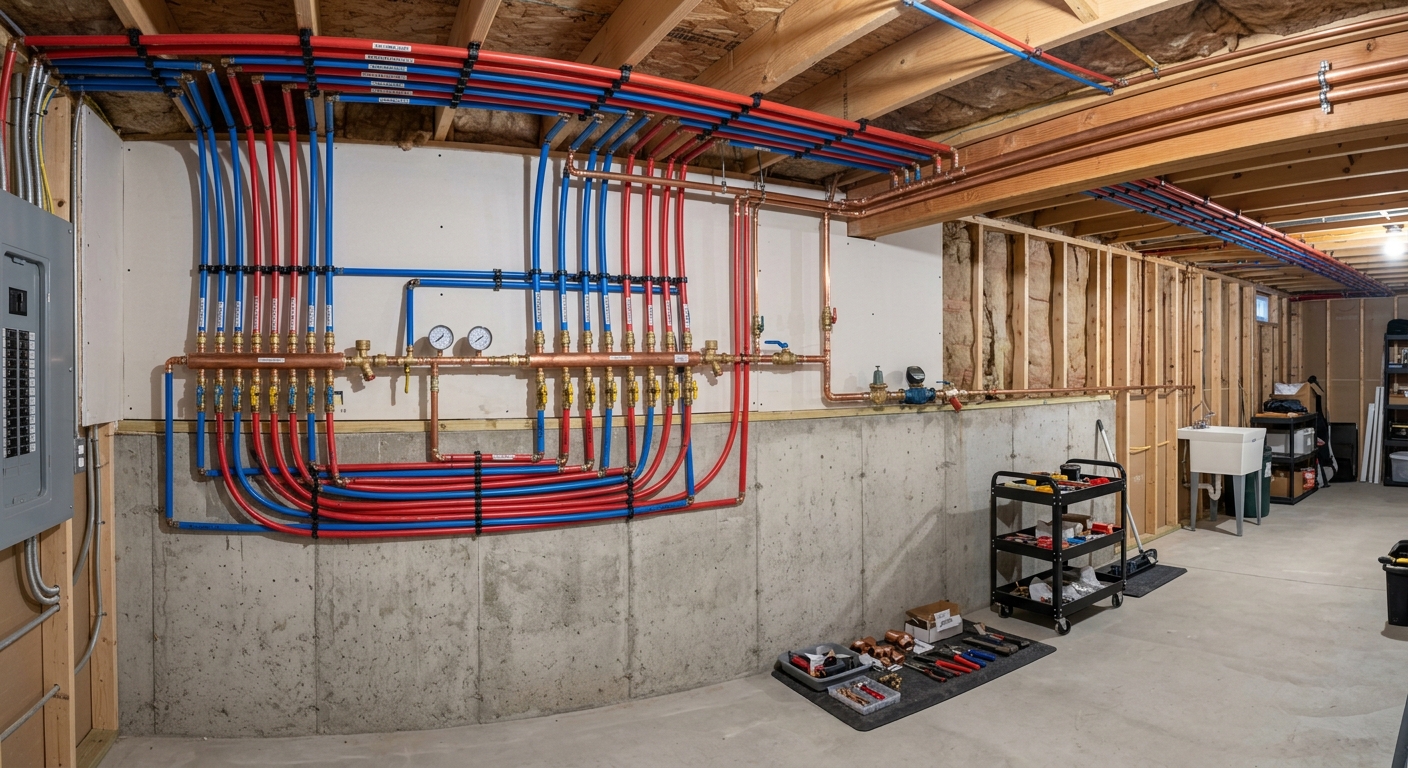
The dominant West Norriton houses—from the 1950s to the 1970s—typically have plumbing that tells their age. Galvanized steel, most common in pre-1960 builds, looks dark gray, is magnetic, and has threaded joints; its inner bore shrinks with rust long before it leaks. If your pressure has dropped or faucets clog with flakes, odds are you have original galvanized pipe that’s at the end of its run. Copper took over in the late 1950s and is usually joined by solder, turns green at joints, and is not magnetic. While copper lasts decades, pinhole leaks crop up with aggressive water—something experienced across Montgomery County.
Polybutylene, found in some late-’70s to mid-’90s townhomes, is soft gray or blue, joined with distinctive clamp rings; it can fail without warning and is difficult to insure. PEX—the current standard—is flexible, brightly colored, and joined by crimp or press rings. As for drains, cast iron (pre-1975) is black, heavy, and joined bell-and-spigot style, while clay tile sewer laterals (pre-1980) are brown-red and join every 3–4 feet—these are root magnets.
Not sure what you have? Try scratching the exposed pipe with a key; white for galvanized, copper color for copper, black for cast iron. Era matters: in a 60-year-old home with any galvanized left, plan for a repipe. The remaining life, as shown below, comes down to the material itself.
| Material |
Typical era |
Failure mode |
Service life |
| Galvanized steel supply |
pre-1960 |
internal corrosion, pressure loss |
40–60 yrs |
| Copper supply |
1950s–present |
pinhole leaks, joint failure |
50–70 yrs |
| Polybutylene supply |
late 1970s–1995 |
fitting failure, sudden bursts |
unreliable |
| PEX supply |
2000s–present |
fitting or UV degradation |
40–50 yrs |
| Cast iron drain |
pre-1975 |
corrosion, cracking, scale |
50–75 yrs |
| Clay tile sewer lateral |
pre-1980 |
root intrusion at joints, offset |
50–60 yrs |
| PVC / ABS drain |
1970s–present |
joint separation, crushing |
50+ yrs |
Vetting a plumber in Montgomery County
Montgomery County’s saturated contractor market means there are plenty of choices for plumbing work in West Norriton—but choosing right depends on local credentials, not just a generic business card. Because plumbing is municipally regulated, first confirm the plumber is licensed or permitted to do plumbing _in West Norriton_, not just a neighboring township. For any project over $500, Home Improvement Contractor (HIC) registration is mandatory. You can check this at hic.attorneygeneral.gov.
Demand a certificate of insurance listing your address—not just “general liability”—and verify workers’ comp for every worker on site at wcais.pa.gov. For larger jobs, ask if they use their own crew or subcontract. Always insist that pricing for emergencies or after-hours calls is disclosed upfront. In this area, pace of service is high, but so is the risk of oversold work—especially if someone proposes a costly repipe or sewer dig without camera proof or pressure testing.
- Confirm plumber is locally licensed or permitted—ask town hall
- Lookup HIC registration at hic.attorneygeneral.gov
- Verify insurance certificate naming your West Norriton address
- Check workers’ comp via wcais.pa.gov
- Ask who will actually do the work—company employees or subs
- Require clear after-hours/emergency rate disclosure
- Get estimates with both price and detailed scope
- Review proposed permit and inspection plan
- Ask about warranty—on labor and parts separately
- Insist on camera footage and/or pressure test for sewer or repipe jobs
- Do not accept vague terms like “standard fixture” or “all new piping”
- Written contract is required for anything over $500 by law
Red flags: In such a busy service area, the worst is a repipe or sewer quote pushed without showing you video footage or performing diagnostic work. If you’re hearing prices far below or above the range shown here, something is off.
Camera inspection, relining and replacement
In West Norriton and nearly every municipality in Montgomery County, the homeowner owns the sewer lateral from the house right out to where it joins the city’s main line—often well into the street. This means any break, root, or offset before the curb falls to you, not the township or county.
Common warning signs begin mild: slow draining at one fixture only usually means a local blockage. Slow water at several fixtures, gurgling toilets, or backups at the lowest drain point usually signal a main line problem. Before anyone digs, always request a camera inspection—this is the single most effective diagnostic, especially in neighborhoods where 1950s–1970s clay tile or cast iron laterals remain.
Clay tile laterals are especially vulnerable to root intrusion at every joint; cast iron corrodes and can develop flat spots or cracks. If a belly (low spot) or offset is found, your choices are open trench replacement (higher disruption) or trenchless relining (less digging, but not always possible if the line is extremely broken or contains collapses). Prices can range widely—from $2,100–$12,500—because access and depth matter more than length.
In outlying township pockets where septic is still in use, problems are different: regular tank pumping is needed every 3–5 years, and field failure is about groundwater, not roots. Never accept a sewer line replacement quote without being shown the actual camera footage from your line. Protect yourself by keeping a copy for your own records.
Flat rate versus time and materials
Most West Norriton plumbers offer both flat rate and time-and-materials pricing, and neither is inherently better—it’s about knowing what you’re agreeing to. Flat rate is the most common on emergencies or standard jobs: it guarantees a number up front, but bakes in the contractor’s guess at risk and time. Time and materials can be a win on small, straightforward repairs—if trust is high and the scope is clear—but leaves you exposed if unknowns crop up.
Ask about a diagnostic fee: some plumbers charge for their time to diagnose but credit it back if you proceed. Every written quote should spell out scope—what gets opened, what gets put back, whether wall and floor restoration is priced in or left to you. Permit fees, the warranty on labor (separate from fixtures), and any after-hours surcharges must be disclosed in advance.
| Line item |
What to look for |
Red flag if… |
| Billing model |
flat rate or hourly, stated up front |
unstated |
| Diagnostic fee |
amount, and whether it credits |
vague |
| Scope |
what is opened, repaired and restored |
price with no scope |
| Restoration |
drywall and finish explicitly in or out |
silent |
| Permit |
included and priced |
'not needed' |
| Parts |
brand and model for fixtures |
'standard fixture' |
| Warranty |
labour period stated separately |
parts only |
Frequently asked questions — plumbing in West Norriton
How much does a water heater replacement cost in West Norriton?
A standard water heater replacement in West Norriton typically ranges from $1,250–$2,900 for a gas or electric tank (40–50 gallon size), which covers removal, installation, testing, and hauling away the old unit. Emergency replacements or situations requiring unexpected upgrades to the gas line or venting can push costs toward the higher end. Most of the houses in the township were built before 1980, and many water heaters in these homes are now due for replacement due to age or efficiency concerns. Remember, the lowest quote is rarely the end price if permits or code-specific upgrades (like an expansion tank or drip pan) are left out, so make sure everything is spelled out up front for homes built to Pennsylvania Uniform Construction Code standards.
Do older West Norriton homes have galvanized pipes?
Yes—many homes built before 1960 in West Norriton have galvanized steel piping. This material corrodes from the inside out, and after 40–60 years, it commonly causes low water pressure and rusty water, sometimes followed by leaks. If you live in a classic mid-century home here and haven’t already replaced the pipes, odds are good that some galvanized remains, especially on the cold water lines. If you’re noticing poor flow or brown water after work on the main, it’s probably time to consider a partial or whole-house repipe, which typically ranges from $3,600–$8,800 depending on access and whether you choose copper or PEX.
How do I verify a plumber's licence and insurance?
In West Norriton, licensing for plumbing is a township matter—not statewide—so always ask your plumber to show proof they are permitted specifically for West Norriton jobs. For any contract over $500, check their Home Improvement Contractor (HIC) registration at hic.attorneygeneral.gov, and verify they carry workers’ comp coverage at wcais.pa.gov. For insurance, ask for a certificate listing your address as “certificate holder.” Legitimate plumbers in Pennsylvania expect these questions. If something about their paperwork doesn’t check out, think twice—especially if the job is expensive, like a sewer line repair, which can run $2,100–$12,500 in this area.
Why do plumbers charge a diagnostic fee?
Plumbers in West Norriton often charge a diagnostic fee for house calls to cover their time, tools, and travel—especially in a market where emergency response is common. This fee usually falls between service rates for simple repairs and is sometimes credited toward the cost of the repair if you go forward. For instance, the cost to just investigate a burst pipe may be included in the total emergency rate quoted ($600–$1,250), but you should always ask whether it is a standalone fee or part of the total. With dense housing here, travel time is short but demand is high, especially during freeze-thaw cycles, so charging for the “trip and look” helps keep base prices more predictable for everyone.
What do I do about a burst pipe right now?
If you discover a burst pipe in your West Norriton home, first shut off the main water valve—usually found at the front foundation wall or where the water line enters the basement. Open faucets to relieve pressure, then immediately call a local plumber with 24/7 emergency service. For this kind of emergency repair, expect to pay $600–$1,250 depending on timing and accessibility. Take photos, document the leak, and inform your homeowner’s insurance—but be aware you cannot lawfully waive your deductible for repairs. In a house built before 1980, old galvanized or copper lines are often the culprit. Don’t delay; water damage accelerates quickly in finished basements common to older West Norriton homes.
Who pays to replace a lead service line in West Norriton?
In West Norriton, as in most of Pennsylvania, the homeowner is responsible for the water service line from the street into the house. If your home—especially if built before 1950—still has a lead service line, replacement is your responsibility, though some water utilities offer limited cost-sharing programs. The job includes excavation from the house to the curb stop and restoration of disturbed lawn or pavement, and it usually falls in the $5,700–$12,500 range for West Norriton. Always request written estimates that include restoration and permit costs, and ask if any rebates or city programs are available—just don’t count on them covering the whole price.
Should I reline or replace my sewer line?
Whether to reline or replace your sewer in West Norriton depends on the pipe’s age, material, and problem. Clay tile (common pre-1980) is often found here and is prone to roots at joints; cast iron can crack or scale inside. Relining (trenchless) works if the majority is intact, offering less digging and quicker restoration, but cannot fix a completely collapsed or bellied pipe. Open trench replacement gives a longer-lived result, especially for heavily broken or offset lines, but costs more disruption and often more money. Pricing for either method starts at $2,100–$12,500 depending on depth and length. Insist on seeing a camera inspection before any contractor quotes; don’t let anyone recommend relining or replacement without showing you the real footage from your home.
How do I prevent frozen pipes in West Norriton?
With a winter design temperature of 14°F and moderate freeze-thaw cycles, frozen pipes are a real risk in West Norriton, especially in older homes with less wall insulation or drafty basements. To prevent freezing, insulate pipes running along exterior walls, seal up air leaks, and keep thermostats above 55°F at all times—even if you’re away. Let a faucet drip slowly on the coldest nights to keep water moving. If you find a pipe that’s frozen but not burst, gently warm it with a hair dryer (never a torch). If a pipe does rupture, repair bills for an emergency fix typically range from $600–$1,250. In general, newer PEX supply lines resist bursting, while old galvanized or copper pipes are much more vulnerable.
Is my water line lead?
In West Norriton, some homes built before the 1950s may still have original lead service lines from the street to the basement. Lead pipes are dull gray, very soft (scrape with a coin—it shaves easily), and are joined with bulb-shaped “wiped” joints. If you have a straight, round pipe entering the house just above the foundation, and it feels soft and leaves a silver streak, it may be lead. Replacement cost typically falls in the $5,700–$12,500 range, depending on length and required restoration. If you suspect a lead line, call your water utility or a trusted West Norriton plumber to perform an in-person inspection—don’t rely on guesswork, as exposure is a serious health risk.