Plumbing costs in Turtle Creek — 2026
Turtle Creek homes, like much of central Allegheny County, often face plumbing costs driven by house age and pipe material. With nearly all local housing built before 1980 and almost half classified as single-family homes (U.S. Census Bureau, ACS 2024), it’s no surprise that aging galvanized and cast iron pipes are common here, a legacy shared with Pittsburgh’s older neighborhoods. These materials are notorious for corrosion and blockages, meaning repairs are more frequent and replacement is often the only lasting fix.
Expect every plumbing job in Turtle Creek to carry two very different price tags: one for emergency (nights, weekends, active leaks) and another for standard, scheduled service. An emergency call always costs more—not just for the repair, but for the privilege of mobilizing fast, outside business hours, and diagnosing under pressure. Failures from old pipework, especially in winter, drive up both urgency and difficulty, so cost bands swing wide. Newer homes might escape with minor fixes, but for the typical Turtle Creek house, bigger issues like whole-house repipes or water service replacement are increasingly routine.
| Service |
Scope |
Emergency rate |
Standard rate |
| Emergency repair — burst pipe |
locate, open, repair section, restore service |
$550–$1,150 |
$325–$1,150 |
| Water heater replacement (gas, 40–50 gal) |
remove old, install, test, haul away |
$1,800–$2,600 |
$1,150–$2,600 |
| Drain cleaning — main line |
augering or hydro-jet, camera if needed |
$350–$800 |
$200–$500 |
| Sewer line spot repair |
excavate or reline a failed section |
$1,900–$11,500 |
$1,900–$11,500 |
| Whole-house repipe |
replace supply lines throughout, patch and finish |
|
$3,300–$8,000 |
| Water service line replacement |
street to house, excavation and restoration |
|
$5,200–$11,500 |
Estimates for a typical Turtle Creek home. Access difficulty and pipe material move these figures more than anything else.
Detection methods and what they cost
If you suspect a leak in your Turtle Creek home, start with the free and effective meter test. Shut off all taps, appliances, and toilets. Find your water meter—usually in the basement or a utility area—and watch the dial. If it continues to move, you have a leak somewhere on the supply side, which warrants further investigation but costs nothing beyond your time.
When it’s time for a pro, plumbers use targeted methods. Acoustic listening devices are the most common for pinpointing leaks hidden behind walls or below floors. Expect to pay for this specialist service, often rolled into the first hour of labor. Thermal imaging is used to find leaks where hot water lines run through walls or ceilings; it’s especially helpful for slab leaks—failures under the concrete common to older homes. For elusive leaks (like under a slab or deeply buried line), tracer gas is highly accurate. The plumber fills the pipe with an inert gas and uses a sniffer to locate exactly where it escapes; this can add some cost but avoids unnecessary demo. Most hidden irrigation or yard line leaks are found using variations of these methods.
Don’t let anyone talk you into opening up walls or jackhammering floors before location is confirmed—modern leak detection is non-invasive. The typical cost ranges from a minimum service charge up to a few hundred dollars, but accurate detection avoids bigger restoration bills later, especially in construction like Turtle Creek's, where old pipes rarely follow modern layouts.
What urgency costs you
In Turtle Creek, the cost difference between an emergency plumbing call and scheduled work is real—and sometimes steep. Emergency service fees come partly from after-hours or weekend dispatch, when a plumber leaves their evening to help you. There’s usually a higher trip charge; labor costs run overtime rates, not straight time. The diagnosis is often rushed, which increases the risk of less-than-perfect repairs, and emergency crews sometimes quote worst-case pricing to guarantee the job can be handled on the spot.
What truly counts as an emergency? Examples: water pouring into your house (burst pipe or failed water heater), no water at all, sewage coming up through drains, or any gas smell. These cannot wait: shut off supply at the main valve for water emergencies (usually found near where the pipe enters the basement; if in doubt, trace back from your water meter) or the gas main (if safe) for a suspected leak. For small leaks under a sink or the occasional slow drain, stop water at the fixture’s local shutoff and wait for normal business hours.
Here’s the price difference made real: a burst pipe fix during an emergency may run $550–$1,150, while the same work can drop to $325–$1,150 if scheduled. Knowing how to shut off water instantly means you control when to call—and whether you pay an emergency premium. Learn this, and half your plumbing “emergencies” become ordinary repairs.
Licensing and permits for plumbing work in Turtle Creek
In Pennsylvania, plumbing licensing is not handled at the state level. Everything is local: each city or township sets its own requirements. In Allegheny County, including Turtle Creek, plumbing permits and licenses for new or altered systems are administered through the local municipality or the Allegheny County Health Department Plumbing Program, depending on where the work is performed. This matters—a plumber registered in one town may have no authority in the next.
To do major plumbing work in most of Allegheny County, including anything beyond fixture swap-outs, you'll need an Allegheny County Health Department plumbing permit. Minor replacements—like swapping a faucet—are usually permit-free, but adding or altering any pipes is not. All permitted plumbing is subject to municipal or county inspections.
When hiring a contractor, check their Home Improvement Contractor (HIC) registration at hic.attorneygeneral.gov; this is required by state law for all contracts over $500. Confirm their workers' compensation through the WCAIS system (wcais.pa.gov), and ask to see certificates naming your property. For homes built before 1978, make sure the contractor complies with the federal EPA Lead RRP Rule—look them up at certifiedrenovatorsearch.epa.gov. Never assume all plumbers are equally credentialed; ask, “Are you licensed for plumbing here in Turtle Creek?”
Water heater replacement decisions
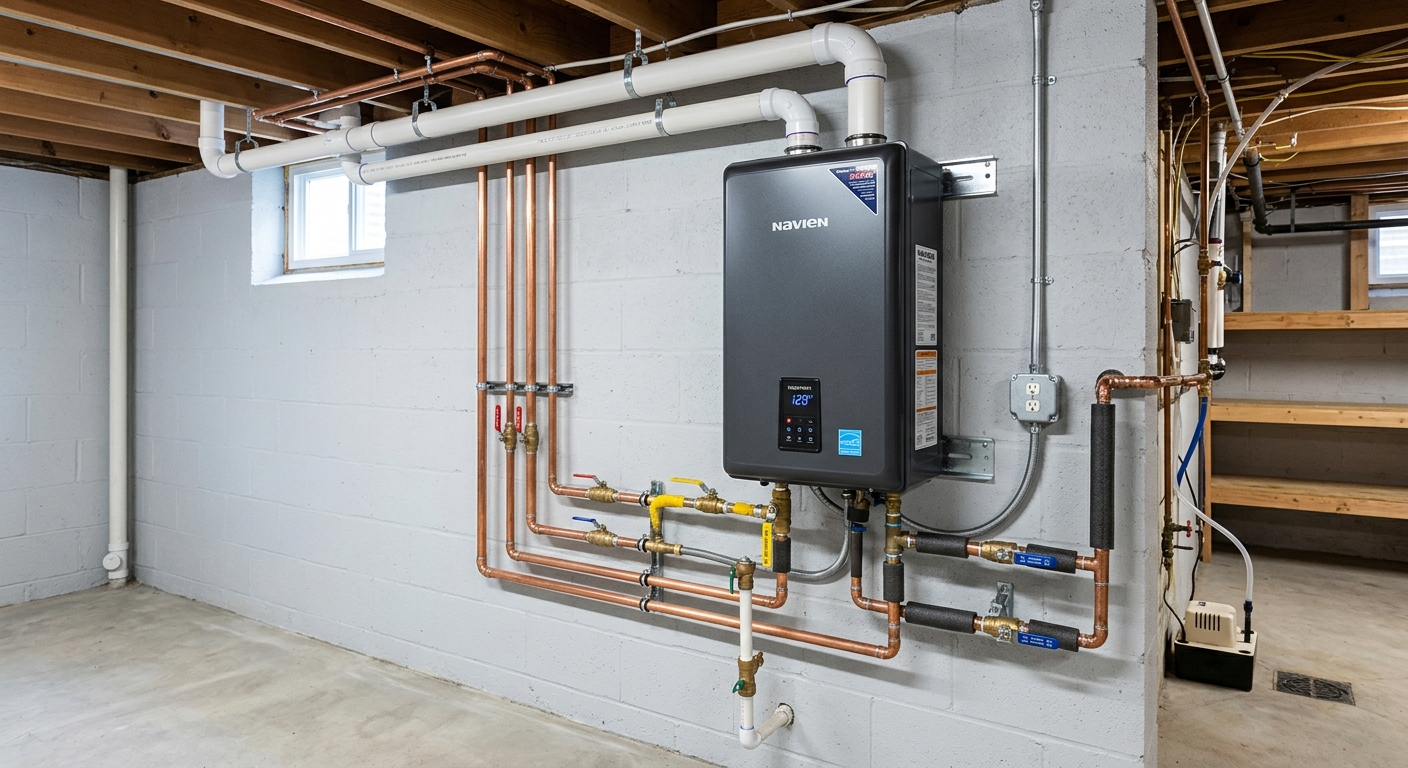
Choosing a water heater in Turtle Creek is about fit for your home’s setup and lifestyle, not just buying whatever's on sale. The old standard—gas or electric tank—remains the most common because it’s cheap to install and usually fits in the same spot as the old one, but these models waste energy through standby losses and usually need replacing first.
Tankless (“on-demand”) models are tempting for endless hot water and longer life. However, installation often requires a larger gas line and upgraded venting—extra costs most Turtle Creek homeowners don’t expect until the estimate lands. Heat pump water heaters cost less to run but need a lot of air to work efficiently and lower the temperature of nearby spaces, making them awkward choices for finished basements or winter operation.
Size by first-hour rating, not just gallons. Most homes do fine with 40–50 gallons if the rating matches your household demand. All modern water heaters should have an expansion tank installed if required by code or if you have a closed system, plus a drain pan and a proper floor drain if located above living space. In almost every failed water heater, it’s the tank that gives out, not the controls—a corroded tank leaks and is not worth trying to repair.
| Type |
Installed cost |
Service life |
Operating cost |
Best when |
| Gas tank, 40–50 gal |
$1,150–$2,600 |
8–12 yrs |
moderate |
existing gas, simple swap, lower upfront cost |
| Electric tank, 40–50 gal |
$1,150–$1,800 |
10–15 yrs |
high |
no gas available, low hot water use |
| Gas tankless |
$1,800–$2,600 |
18–25 yrs |
low-moderate |
endless hot water needed, already planning for vent and gas upgrades |
| Heat pump water heater |
$1,800–$2,600 |
13–15 yrs |
lowest |
large unfinished space, homeowner wants lowest utility bill |
Vetting a plumber in Allegheny County
Hiring a plumber in Turtle Creek means verifying more than just a license—most important, you need to check that their license or registration is valid for work specifically in your municipality or Allegheny County, as there is no state-issued plumbing license for Pennsylvania. Only the county and specific municipalities administer plumbing licenses and inspections.
Always check that the contractor’s Home Improvement Contractor (HIC) registration is valid (via hic.attorneygeneral.gov) for any contract over $500. Insurance certificates should specifically name your address as an additional insured party. Workers' compensation compliance can be verified through WCAIS. Ask directly whether employees performing the work are on the contractor’s payroll or are subcontracted, since this impacts quality control and insurance coverage. In a saturated contractor market like Allegheny County, confirm how emergency rates are disclosed and if bids include after-hours differential.
- Has an HIC registration, verifiable online
- Licensed for plumbing work in this municipality or under the Allegheny County Health Department where required
- Insurance certificate lists your property
- Workers’ compensation status confirmed by WCAIS
- Own employees, not just jobsite subs
- Emergency rate structure disclosed up front
- Detailed, written plumbing quote with clear scope
- Copy of plumbing permit (if needed) included with contract
- Camera footage provided for any main drain, sewer, or spot repair diagnosis
- Written warranty specifying labor and materials coverage
- Warranty process and point of contact explained
- References or online reviews relevant to Allegheny County
Red flags: pushy upsells, no proof of valid registration or insurance, or a recommendation for a whole-house repipe or major sewer replacement without diagnostic evidence like camera footage or a pressure test. In this market, that almost always means walk away.
What a plumbing quote should contain
In Turtle Creek, plumbing contractors use two billing models: flat rate, where the whole job is quoted in advance covering all labor and materials, or time-and-materials, where you pay for the plumber’s time and parts used. Both are legitimate; the risk comes from not knowing which you agreed to. Flat rate delivers certainty, but is usually padded for worst-case time. Time-and-materials can be less expensive for straightforward jobs but open-ended if the problem proves more complex.
A good quote spells out the diagnostic fee—whether it’s credited if you go forward, or it’s a sunk cost. Scope is critical: does the quote simply list a price, or say what will be opened, repaired, and restored? Always look for line items detailing permit fees, brands and models for fixtures, explicit language about drywall or floor restoration (in or out), and clearly stated warranties for both labor and parts. After-hours or emergency rates should be disclosed, never buried.
| Line item |
What to look for |
Red flag if… |
| Billing model |
flat rate or hourly, stated up front |
unstated |
| Diagnostic fee |
amount, and whether it credits |
vague |
| Scope |
what is opened, repaired and restored |
price with no scope |
| Restoration |
drywall and finish explicitly in or out |
silent |
| Permit |
included and priced |
'not needed' |
| Parts |
brand and model for fixtures |
'standard fixture' |
| Warranty |
labour period stated separately |
parts only |
Frequently asked questions — plumbing in Turtle Creek
Should I reline or replace my sewer line?
For many Turtle Creek homes, relining a sewer line can be a sensible alternative to full replacement—if the pipe’s structure is mostly sound but has some cracks or root intrusion. Relining is less disruptive and often cheaper up front. However, if the existing pipe is severely collapsed, back-pitched, or made from very brittle material (as is common in homes built before 1980), replacement gives a longer-term fix. Price-wise, expect spot repairs or relining to run from $1,900–$11,500 depending on the length and access, while a full replacement falls to the upper end of that band. Ask for a camera inspection and see the footage for yourself before deciding—never choose based on guesswork.
How much does a water heater replacement cost in Turtle Creek?
The cost to replace a standard 40–50 gallon water heater in Turtle Creek is usually between $1,150–$2,600, including removal of the old unit, installation, testing, and haul-away. Gas models with simple venting stay at the lower end, while tankless conversions or tricky venting drive the job upward within that range. Because almost every home here is older (U.S. Census Bureau, ACS 2024), expect some extra labor if shutoffs or lines are outdated. Prices are consistent across Allegheny County for this size project.
How do I find a hidden water leak?
If you suspect a hidden leak in your Turtle Creek home, start by running the free meter test: turn off all water in the house and check if the meter dial still moves. If it does, call in a plumber with leak detection tools—common methods include acoustic listening for walls and floors, or thermal imaging for hard-to-reach spots. Most pros will pinpoint the leak for the minimum service charge, with full detection rarely rising above $325–$1,150 unless a slab leak or multiple zones are involved. Never agree to open up walls before the exact location is found; in old homes here, that leads to big restoration bills.
Who owns the sewer lateral, me or the city?
In Turtle Creek and much of Allegheny County, the homeowner owns the entire sewer lateral from the house all the way to the main in the street. This means you’re responsible for repairs—both on your property and through the public right-of-way—unless the problem is with the main line itself. Spot repairs run from $1,900–$11,500 in this market, so before digging or relining, ask for a camera inspection to get a clear diagnosis. Always check with your local municipality for their exact policy, but don’t count on city help for standard lateral failures.
Does Pennsylvania license plumbers at the state level?
Pennsylvania does not issue a statewide plumbing license; all licensing is handled at the municipal or, in Allegheny County, the health department level. That means a plumber licensed in one part of the county may not be qualified to work in Turtle Creek. For jobs over $500, Home Improvement Contractor (HIC) registration is required by state law, but this is not a trade license. Always ask a plumber, “Are you licensed for plumbing in this municipality?” and verify at hic.attorneygeneral.gov.
What do I do if sewage is backing up?
If you have a sewage backup in Turtle Creek, don’t use any more water and avoid flushing toilets. The first priority is to stop the flow by shutting off the main water valve, especially if backup is running from fixtures on the lower floors. Call a plumber for emergency service—the cost typically falls in the $550–$1,150 range for a first response, which includes diagnosis and clearing the initial blockage. If the plumber recommends a major repair, ask for a video inspection before approving big-ticket work.
How much does sewer line repair cost in Turtle Creek?
Sewer line spot repair in Turtle Creek usually costs between $1,900–$11,500, depending on access, length, and how deep the line sits. Homes dating to the early 1900s often have sections made from clay or cast iron, which require full excavation or lining. The higher end includes repairs needing new sidewalks or significant street work. Always ask for camera evidence before you authorize repair or replacement, and confirm whether the quoted amount includes restoration of yard or paving.
Are tree roots a common sewer problem in Turtle Creek?
Tree roots frequently invade older sewer lines in Turtle Creek, especially those built with clay or cast iron common to homes erected before 1980. Combined with the hilly terrain and established vegetation, roots seek moisture through even tiny pipe cracks. Clearing a root clog is a common service and falls in the $200–$800 range for augering or hydro-jetting. If roots return repeatedly, a camera inspection will show whether relining or replacement is needed for a more permanent fix.
Do I need to drain outdoor spigots in Turtle Creek?
Yes, in Turtle Creek, draining outdoor spigots every autumn is essential. Heavy freeze-thaw cycles and a frost depth of 36 inches (per county code) mean undrained exterior fixtures are likely to burst in winter, leading to emergency repairs averaging $325–$1,150. If you don’t have frost-free hose bibs installed, shut off the water supply to exterior lines from the inside and open the spigot to drain. This simple step can save you a lot in costly pipe and drywall restoration come spring.