What plumbers charge in Jackson
Plumbing costs in Jackson, Lebanon County fall within a clear band, but they shift dramatically depending on whether your call is an emergency or a scheduled repair. In Jackson, with a homeownership rate of 81.5% and a large share of single-family properties (72.1% per U.S. Census Bureau, ACS 2024), most plumbing work involves older home types—especially in areas echoing Lebanon city’s mid-century housing. That era’s plumbing often means galvanized or early copper pipes, so you may face jobs like full pipe replacement sooner than in newer suburbs. Choice of material and access (how much needs cut open to reach the problem) both move the needle on price. A midnight leak repair is a very different animal from a weekday water heater install—both in urgency and in what you’ll pay. The older your home, the likelier it is to need repairs like galvanized-to-copper or PEX repiping, which can mean a bigger, faster bill but a lasting fix.
| Service |
Scope |
Emergency rate |
Standard rate |
| Emergency repair — burst pipe |
locate, open, repair section, restore service |
$600–$1,200 |
$350–$1,200 |
| Water heater replacement (gas, 40–50 gal) |
remove old, install, test, haul away |
$1,900–$2,800 |
$1,200–$2,800 |
| Drain cleaning — main line |
augering or hydro-jet, camera if needed |
$350–$800 |
$200–$500 |
| Sewer line spot repair |
excavate or reline a failed section |
$2,000–$12,000 |
$2,000–$12,000 |
| Whole-house repipe |
replace supply lines throughout, patch and finish |
|
$3,500–$8,600 |
| Water service line replacement |
street to house, excavation and restoration |
|
$5,600–$12,000 |
Estimates for a typical Jackson home. Access difficulty and pipe material move these figures more than anything else.
The leak you can hear but can't see
If you're in Jackson and suspect a hidden leak, you can get started without spending a dollar. Shut off every faucet, appliance, and fixture in your house, then check your water meter. If the dial is spinning, you’ve confirmed an active supply-side leak—a good trick in many Lebanon County homes, especially those with older galvanized lines prone to corrosion. This “meter test” costs nothing and narrows down whether you’re dealing with a supply or drain issue.
Professional leak detection uses tools that save you from unnecessary wall or floor demolition. Acoustic listening devices can pinpoint pipe noise behind walls ($200–$400 as a portion of emergency leak repairs). Infrared thermal imaging spots temperature drops as water moves, helpful for slab leaks or hidden supply lines. Tracer gases—harmless and odorized—may be introduced if water has fully drained, but this is rare in residential work. Locating a slab leak typically runs in the upper range ($600–$1,200 including repair), especially when access is tough.
For leaks in irrigation lines or buried supply pipes, pinpointing is often done with a combination of electronic listening and ground microphones. Some Jackson plumbers may mention cutting open a wall or slab—if they want to open without first locating, get a second opinion. It should be locate first, then selectively access. Jackson’s mix of slab-on-grade and crawlspace homes makes the right technique matter more than brute force.
Plumbing systems in Jackson homes
Jackson homes reflect Lebanon County’s suburban–rural pattern, but nearly 39% were built before 1980 (U.S. Census Bureau, ACS 2024). In these older homes, you'll often find galvanized steel supply pipes (especially pre-1960), increasingly replaced during kitchen and bath remodels with copper or, more recently, PEX. Sewer laterals from this era are usually clay tile, prone to root intrusion near joints, and cast iron for interior drains, which can scale and crack over time. Water service lines may be copper, plastic, or even a short run of old steel in corner cases. Many water heaters in these homes will be on their second or third replacement.
Newer Jackson housing—from the growth in the late 1970s onward—moved toward copper and even some polybutylene (late 1970s to mid-1990s), though that material is now disfavored due to reliability issues. In these houses, the original builder-grade fixtures may be due for an upgrade, and the first water heater is often nearing end of life. PVC or ABS is likely used for newer drains—less prone to corrosion issues but possible to see joint problems. In summary, a Jackson address doesn’t mean modern pipes; for many, it’s a blend of old and new, and swapping out materials is often the most cost-effective longevity play.
Comparing plumbing estimates in Jackson
Plumbers in Jackson use two billing approaches. Flat rate gives you a single price for the whole job—good for predictability but includes enough cushion for things to go wrong. Time-and-materials means you pay for labor and parts as they go; this can be cheaper when the job is simple, but risky if it takes a bad turn. Either approach is aboveboard as long as it’s clear upfront which you’re getting.
Diagnostic fees are common—usually a set amount to assess the problem. Sometimes it’s credited toward the job if you proceed, sometimes not. Make sure the quote actually spells out what will be done: what gets opened, what gets fixed, and what gets put back together. Permit inclusion is crucial for major work; it should be clear if the contractor will get one and cover inspection. Restoration should be explicit: drywall or concrete patched, painted, or left open. Warranties often split labor (the plumber’s work) from parts (backed by the manufacturer). After-hours rates can jump quickly; always ask before authorizing emergency or weekend work. If any of these details are fuzzy or omitted, get a revised written estimate before signing.
| Line item |
What to look for |
Red flag if… |
| Billing model |
flat rate or hourly, stated up front |
unstated |
| Diagnostic fee |
amount, and whether it credits |
vague |
| Scope |
what is opened, repaired and restored |
price with no scope |
| Restoration |
drywall and finish explicitly in or out |
silent |
| Permit |
included and priced |
'not needed' |
| Parts |
brand and model for fixtures |
'standard fixture' |
| Warranty |
labour period stated separately |
parts only |
Licensing and permits for plumbing work in Jackson
Pennsylvania does not run a statewide plumbing licensing system. Instead, licensing is typically handled municipally—so whether your plumber needs a municipal license depends entirely on where you are. For example, a contractor licensed in Lebanon city may have no credential in Jackson or another township nearby. In Jackson, the right question is “Can you perform plumbing work here?”—not just “Are you licensed?”
The Pennsylvania Uniform Construction Code (UCC), based on the IRC, sets the baseline for building, plumbing, and mechanical work across the state. In much of Lebanon County, including Jackson, code enforcement is handled by the Lebanon County Planning Department, which acts as UCC authority for multiple townships. For work like building additions or new dwellings in nearby municipalities such as North Londonderry Township, Lebanon County Planning issues permits.
Plumbing contractors must register as a Home Improvement Contractor (HIC) with the Pennsylvania Office of Attorney General for jobs over $500. You can verify this at hic.attorneygeneral.gov. Worker’s compensation is mandatory for all employers and can be checked via WCAIS (wcais.pa.gov). A written contract is required for jobs over $500 under the Home Improvement Consumer Protection Act, including a three-day right to cancel.
Ask your contractor about which permits your job requires and ensure they are pulling and paying for them. Never accept “not needed” as an answer for significant plumbing work; check directly with the Lebanon County Planning Department when in doubt.
Dating your plumbing by what it's made of
Jackson’s homes—much like those across Lebanon city’s mid-century core—typically show layers of plumbing history that predict both what fails and how soon. Galvanized steel is common in homes built before 1960; it looks gray and will hold a magnet, and threads into fittings. It narrows from internal corrosion, so low pressure is the warning sign, often followed by leaks at joints.
Copper supply piping started showing up by the 1950s and is now the mainstay—reddish-brown, joined by soldering and won’t hold a magnet. While generally reliable, it can develop pinhole leaks, especially if your water is aggressive or has high mineral content from Lebanon Authority’s public supply.
Polybutylene was popular in the late 1970s through the mid-1990s—usually gray or blue, crimped with metal bands, and often found in suburban homes of that vintage. It fails at fittings and isn’t considered reliable today. PEX (cross-linked polyethylene) has been the standard since the early 2000s—usually red, blue, or white, flexible and joined with crimp or push-fit fittings. It’s durable but can suffer if exposed to sunlight during storage or installation.
Drains before 1975 are often cast iron (black, heavy, non-magnetic), which can last 50+ years but eventually corrodes or cracks. Clay tile sewer laterals—brown or terra cotta, ringing hollow when tapped—are common for pre-1980 homes and fail at the joints after decades of root intrusion. PVC or ABS plastic piping (white or black, glued joints) began dominating new construction after the 1970s. Period and material together tell you not just what you have, but how long you can expect it to last and what replacement really means.
| Material |
Typical era |
Failure mode |
Service life |
| Galvanized steel supply |
pre-1960 |
internal corrosion, pressure loss |
40–60 yrs |
| Copper supply |
1950s–present |
pinhole leaks, joint failure |
50–70 yrs |
| Polybutylene supply |
late 1970s–1995 |
fitting failure, sudden bursts |
unreliable |
| PEX supply |
2000s–present |
fitting or UV degradation |
40–50 yrs |
| Cast iron drain |
pre-1975 |
corrosion, cracking, scale |
50–75 yrs |
| Clay tile sewer lateral |
pre-1980 |
root intrusion at joints, offset |
50–60 yrs |
| PVC / ABS drain |
1970s–present |
joint separation, crushing |
50+ yrs |
Tank, tankless or heat pump water heater?
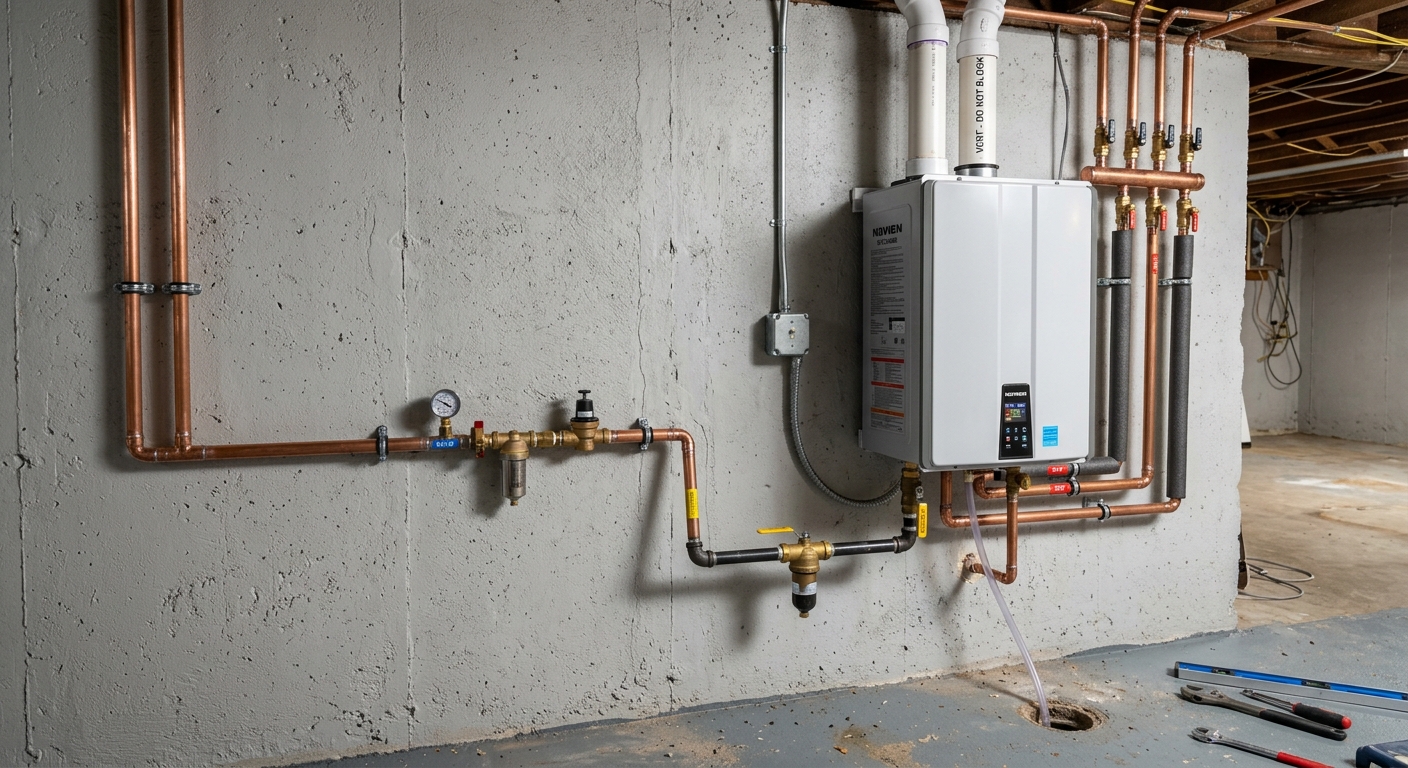
In Jackson, your water heater choice comes down to where it sits in the home, your budget, and what you’ll save on utilities. Traditional tank-style heaters (gas or electric) are cheapest to install, but only last 8–15 years and have the highest standby losses. Tankless units are more expensive up front—with installed costs around $1,900–$2,800—but give you endless hot water and occupy less space; however, many gas models require running a new, larger gas line and sometimes a new exhaust, both of which can bump up cost and complexity.
Heat pump water heaters (hybrid electrics) are increasingly popular in homes with warm basements or big utility rooms; they use ambient air to heat water, so they’re the lowest in operating cost, especially with electricity rates in Pennsylvania. They do, however, cool and dehumidify their surroundings a bit (problematic in a finished basement) and are louder than tanks.
Whatever you choose, size it by the first-hour rating (how much hot water it makes at peak), not just gallon capacity. All units need expansion tanks if your home is on the Lebanon Authority's public water. Pans and drains are smart additions—every replacement is due to tank failure and an unnoticed drip can do serious damage on a finished floor.
| Type |
Installed cost |
Service life |
Operating cost |
Best when |
| Gas tank, 40–50 gal |
$1,200–$2,800 |
8–12 yrs |
moderate |
utility gas and easy venting |
| Electric tank, 40–50 gal |
$1,200–$1,900 |
10–15 yrs |
high |
easy install, no gas line |
| Gas tankless |
$1,900–$2,800 |
18–25 yrs |
low-moderate |
endless hot water, limited space |
| Heat pump water heater |
$1,900–$2,800 |
13–15 yrs |
lowest |
ample indoor space, lower utility cost |
Frequently asked questions — plumbing in Jackson
What do I do if sewage is backing up?
If you notice sewage backing up into your Jackson home—whether it’s coming from a basement floor drain or backing up in your tub—the first step is to stop running water and avoid flushing toilets. If you’re in a part of Jackson that’s on septic (many townships in Lebanon County are), you’re likely dealing with a full tank, clogged baffle, or drainfield problem. In Lebanon city, backup means an issue with the separated sanitary line or an interior blockage. Call a plumber right away; emergency main line cleaning in Jackson runs $350–$800 depending on whether it’s after hours and how tough the clog is. While waiting, don’t let any more water down the drains—it just adds to the cleanup. If there’s any backup above floor level, get professional help fast, since this kind of sewage involves health risks and property damage that may quickly escalate.
Is Jackson on combined sewers or septic?
In Jackson, sewer and septic service depends on your address. Lebanon city uses separated sanitary and storm sewers, so homes in town discharge into the municipal sewer system. But in Jackson Township (and most outlying parts of Lebanon County), homeowners rely heavily on on‑lot septic systems—meaning a private tank and drainfield in your yard. If you’re not sure, look for a sewer billing line from the city or the Lebanon Authority. But odds are, if you’re outside the major towns, you’re on septic and need to schedule pumping every few years. Plumbing repairs like whole-house waste line replacement run $3,500–$8,600 and may involve both indoor and outdoor work, especially if old clay or cast iron is involved. Knowing your system type is key to understanding your risks and repair costs.
Does insurance cover a burst pipe in Jackson?
Most standard homeowners insurance policies in Jackson do cover accidental and sudden pipe bursts, including water damage cleanup—especially if you act quickly when a problem starts. What isn’t covered is a slow leak that’s gone undetected for weeks or months. To maximize your claim, halt water flow by shutting off the main, and call both your insurer and a licensed plumber immediately. Emergency leak repair typically costs $600–$1,200 here, and having fast professional documentation can help with claims. Remember, waiving a deductible is prohibited under the Home Improvement Consumer Protection Act (HICPA), and insurance may refuse claims if the plumbing was known to be failing (like old galvanized pipes left untouched for decades). Check your own policy and keep records if your home is in the older half of Jackson’s housing stock.
What causes low water pressure in Jackson homes?
Low water pressure in Jackson is often a function of both house age and material. Many pre-1980 homes have galvanized steel supply piping, which narrows due to internal rust over decades, severely reducing flow at fixtures. Even newer copper systems may suffer from mineral scaling, especially since the Lebanon Authority public water system is known for its mineral content. Sometimes the problem is as simple as a failed pressure-reducing valve or a partially closed main shutoff. Whole-house repiping is a common solution, running $3,500–$8,600 in Jackson—more if access is tough or you still have sections hidden in walls. If your low pressure is sudden or affects only one fixture, it could be a local blockage; widespread issues point to aging supply lines. Start by checking the pressure at an outdoor spigot to isolate the problem.
Who inspects plumbing work in Jackson?
In Jackson, plumbing inspections for permitted work are handled locally by the Lebanon County Planning Department, which enforces the Pennsylvania Uniform Construction Code (UCC) for multiple Lebanon County townships, including Jackson itself. The county acts as the authority for building, mechanical, and plumbing code compliance—not the state directly. Whenever you pull permits for a water heater replacement, repiping, or adding new plumbing for an addition, expect an inspection from this department, not just your plumber’s word. Permit costs and inspection requirements are typically baked into your contractor’s price; for example, a permitted water heater installation is usually between $1,200–$2,800. Always insist on final inspection and hold final payment until it passes—this is your assurance the work meets current code.
Do I need to drain outdoor spigots in Jackson?
Absolutely. Jackson’s climate includes pronounced freeze-thaw cycles and a winter design temperature of 12 °F—low enough to burst unprotected outdoor lines. If you have older homes with exterior spigots fed by copper or galvanized pipe, there’s no substitute for draining each line at its interior shutoff every fall and leaving the exterior open to drain. Those with frost-free hose bibbs are better protected—but only if the interior valve and pipe don’t freeze along the wall. Every year, plumbers in Jackson fix burst hose bibb lines for at least $350–$1,200, especially in the first hard freeze. The few minutes it takes to drain and shut off spigots can save you a far more expensive repair, plus the mess and disruption that comes with an interior flood.
How much does a plumber cost in Jackson?
In Jackson, you can expect to pay at the lower-middle end of the spectrum compared to urban markets like Harrisburg or Lancaster, but the numbers still add up fast—especially if you need someone in a hurry. Standard service calls for a main line drain cleaning run about $200–$500 for non-emergencies and $350–$800 after hours. Emergency burst pipe repairs typically range from $600–$1,200, while whole-house repipes (common in mid-century homes) start at $3,500. Most plumbers also charge a diagnostic fee, but honest shops credit this toward the work if you proceed. It pays to ask if after-hours or travel charges are built in, since larger outfits from outside Lebanon County often apply surcharges for rural jobs.
Repair or replace a leaking water heater?
That depends on both the age of the heater and where it’s leaking. In Jackson’s older homes, a water heater replacement (typical cost $1,200–$2,800) is usually the smartest move if your tank itself is leaking—tank failures aren’t repairable, and patch fixes won’t last. If you have a slow drip from a valve or fitting at the top, a targeted repair (usually well under $350–$500) makes sense, especially if the unit is under 7–8 years old and otherwise healthy. Keep in mind, in humid basements and utility rooms, small leaks can rust out the floor pan or go unnoticed until serious damage is done. Many Jackson homes replace their water heaters once per 10–12 years. If you’re already on your second replacement, investing in a heat pump or tankless unit could buy you a longer runway.
How much does a water heater replacement cost in Jackson?
In Jackson, most standard water heater replacements (gas 40–50 gallon tanks) fall between $1,200–$2,800. If you opt for a heat pump or tankless model, you’ll be closer to $1,900–$2,800 installed, depending on what venting or gas line upgrades are needed. This price covers the basics: removing and hauling away the old unit, installing the new one, and getting any required county inspection. Additional costs can kick in for expansion tanks, new pans and drains, or electrical upgrades—especially in older Lebanon County homes where the last water heater may have been installed decades ago. Always confirm that dumping the old unit and permit fees are included, so you aren’t surprised at invoice time. Compared to bigger cities nearby, Jackson’s prices sit in a more affordable middle range.