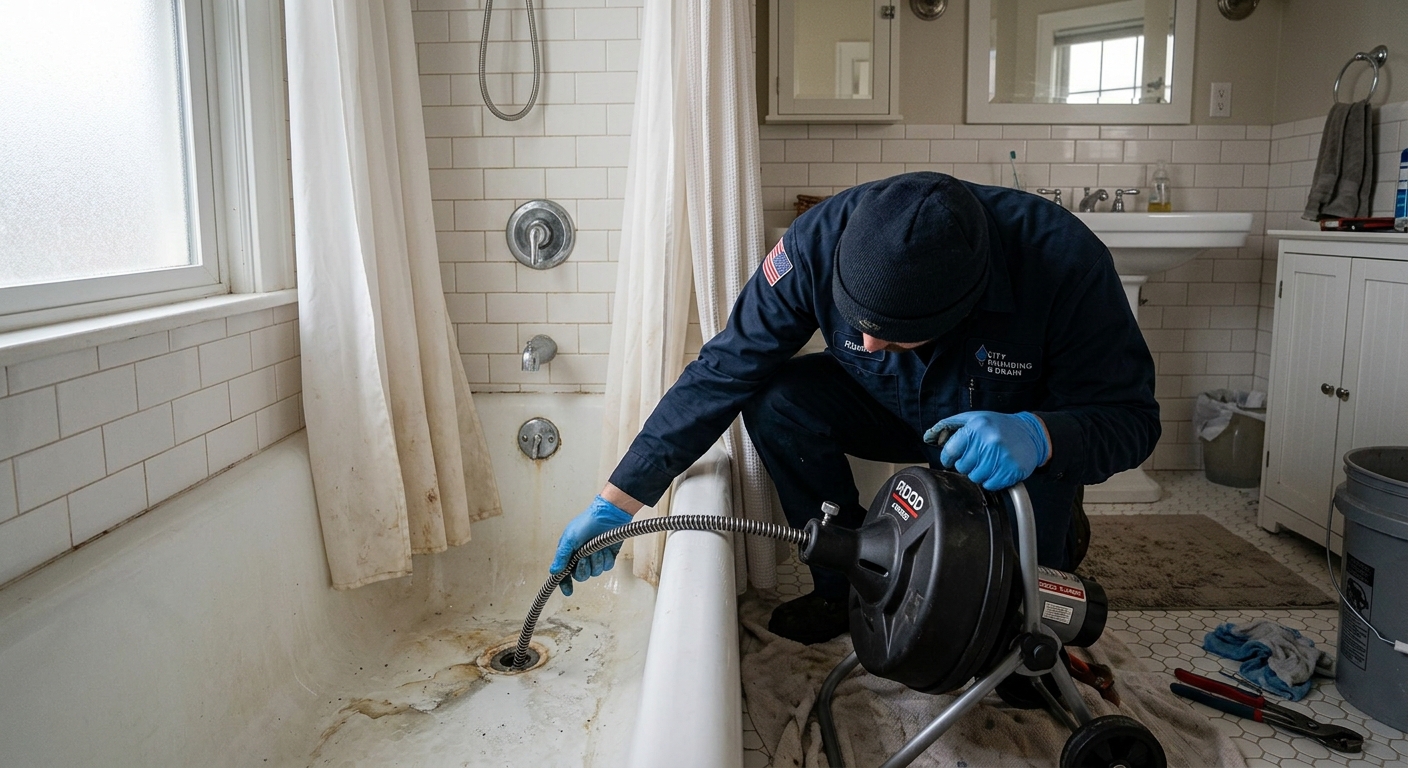
Dormont plumbing prices by job type — 2026
Dormont homeowners face a unique pricing landscape for plumbing because of the area’s pre-1980 housing stock (95.0%, U.S. Census Bureau, ACS 2024) and the dominant construction era of 1900–1950. The age of these homes means you’re likely dealing with galvanized or cast-iron piping, both of which tend to fail with age. With 57.8% homeownership, many houses have gone through at least one round of plumbing upgrades, but plenty still rely on original materials—and these old pipes drive what repairs you need and what you’ll pay.
The same plumbing job can cost more if you need it immediately. Emergency calls—like an active leak or frozen pipe that bursts overnight—command higher rates, sometimes double, because you’re paying for rapid response, not just labor and parts. Scheduled work, like water heater replacements or planned sewer repairs, usually land at the lower end of the band. In Dormont, the toughest cost drivers are access (how easy it is to reach the problem) and the pipe material itself.
| Service |
Scope |
Emergency rate |
Standard rate |
| Emergency repair — burst pipe |
locate, open, repair section, restore service |
$600–$1,150 |
$350–$1,150 |
| Water heater replacement (gas, 40–50 gal) |
remove old, install, test, haul away |
$1,850–$2,700 |
$1,150–$2,700 |
| Drain cleaning — main line |
augering or hydro-jet, camera if needed |
$350–$800 |
$200–$500 |
| Sewer line spot repair |
excavate or reline a failed section |
$1,950–$11,500 |
$1,950–$11,500 |
| Whole-house repipe |
replace supply lines throughout, patch and finish |
$3,400–$8,300 |
$3,400–$8,300 |
| Water service line replacement |
street to house, excavation and restoration |
$5,400–$11,500 |
$5,400–$11,500 |
Estimates for a typical Dormont home. Access difficulty and pipe material move these figures more than anything else.
Winter pipe failures in southwestern Pennsylvania
In southwestern Pennsylvania, Dormont homeowners contend with a 36-inch frost depth and a winter design temperature of 8 °F—cold snaps that can cause real trouble for pipes, especially in homes from the 1900–1950 era. The infamous freeze-thaw cycle in this region, paired with hilly terrain, means sections of piping found in exterior walls, unheated crawlspaces, under porches, garages, and unconditioned attics are most at risk.
Pipe bursts almost never happen where the pipe is actually frozen. Instead, ice blocks expand and trap water. Pressure builds up between the frozen plug and the nearest closed fixture—like a faucet or toilet—until the pipe ruptures somewhere downstream. This is why you’ll often find the split away from the visible freeze, especially in old galvanized lines.
Preventing frozen pipes isn’t rocket science. Insulate any exposed plumbing—especially where it runs through exterior walls or near rim joists. Heat tape (properly installed and UL listed) can help on problem areas. In extreme cold, let a trickle run from a faucet on an exterior wall or the farthest point from your meter. Open kitchen and bath cabinet doors overnight to let warm air reach hidden pipes. Most importantly, shut off and drain outdoor hose bibs before winter’s first freeze.
Never use an open flame to thaw a pipe—too many houses in Dormont have had fire department visits that way. Use a hair dryer, space heater, or warm towels. If you skip prevention and wake up to a burst, expect an emergency visit to run $600–$1,150 for the repair and cleanup.
Hardness, treatment and fixture life in Dormont
Dormont and the rest of central Allegheny County are served primarily by Pittsburgh Water and Sewer Authority, which provides an annual water quality report you can request. Many homeowners here see typical signs of moderately hard water—scale on faucet aerators, cloudy dishes, reduced soap lather, and shortened lifespan for water heaters and washing machines. That means more frequent replacements, especially if you’re running an original water heater in a 1950s copper system.
Hard water leaves scale inside appliances and on fixture valves. With most water heaters in Dormont’s older housing stock running past their expected life, scale can put them out of commission a few years early, costing you a replacement in the $1,150–$2,700 range. Softener systems are common, but honestly, for most homes in Dormont they’re a matter of preference—maintenance and salt costs mean you might not see a real “payback” unless you have specific appliances you want to protect or a known scale problem.
Whole-house filtration systems are sometimes helpful if you dislike the taste, but targeted, point-of-use filters (like for drinking water) are usually enough. Be wary of anyone selling expensive multi-stage or “salt-free” equipment for a typical Dormont home unless you have special needs—public water here is generally safe and well-regulated, so most treatment is about comfort, not health.
How to find a good plumber in Dormont
In Dormont, find a plumber by starting with the right credentials—because plumbing licenses are handled at the municipal level in this part of Pennsylvania, not statewide. That means checking if your plumber is licensed specifically for Dormont or your local Allegheny County municipality, where the Health Department Plumbing Program oversees licensing in many cases.
Always ask for a Home Improvement Contractor (HIC) registration number for jobs over $500, and verify it directly at hic.attorneygeneral.gov. Insurance is non-negotiable: you want an active certificate showing your property address. For jobs with multiple workers, confirm current workers’ compensation coverage through the WCAIS system. Ask if the company uses its own crews instead of subbing out work. And if you’re booking emergency dispatch, you’re entitled to upfront clarity—a plumber should disclose emergency rates before setting foot in your home.
- Ask which municipal license they hold and if it covers Dormont.
- Verify HIC registration for projects over $500.
- Request an insurance certificate naming your address.
- Check active workers’ comp via WCAIS for all employers.
- Ask if the crews are employees or subcontractors.
- See written estimates and full contract details for large jobs.
- Require written disclosure of emergency rates before work starts.
- Get camera footage and/or a pressure test before any big-ticket drainage or repipe quote.
- Be cautious if replacement is suggested without clear evidence—especially on old pipes.
- Clarify warranty terms in writing, not just verbal promises.
- Avoid shops that require full payment up front; a deposit is normal, the rest upon completion and inspection.
- Get references for major projects like sewer replacement or whole-house repipe.
With many contractors working the Pittsburgh metro area, you have choices, but that also means red flags show up often: hard sells for expensive work without evidence (especially without a camera on a drain), unclear or incomplete paperwork, and hesitation to provide city-specific credentials are signs to keep looking.
Pipe materials in Dormont homes and how they fail
Dormont homes reflect the Pittsburgh tradition: most were built between 1900 and 1950, meaning galvanized steel supply lines and cast iron or clay drain lines are common sights. Galvanized pipes corrode inside, gradually choking the flow and lowering your pressure long before you spring a leak. Copper comes next—durable but not invincible. Some copper pipes in this region develop pinholes due to aggressive (slightly acidic) public water, especially where the water chemistry varies or sections have repairs with incompatible metals.
Later homes—sometimes as renovations—may have polybutylene (late ’70s to mid-’90s), a gray plastic pipe with a history of sudden fitting blowouts that insurance companies hate. The current standard is PEX: flexible plastic in red, blue, or white, with crimped fittings, which handles freeze-thaw cycles better than copper or steel. Cast iron drains (pre-1975) are strong but eventually crack or scale up, and you’ll know it by the slow drains and odors from under the floor. Clay tile sewer laterals (pre-1980) mainly fail when tree roots sneak in at unsealed joints. Modern PVC and ABS drains resist corrosion but are only as strong as their installation.
To identify your pipes: scratch a hidden supply line with a key (galvanized looks dull gray and is magnetic; copper is reddish-brown and not magnetic; polybutylene is flexible and gray; PEX feels tough and is red, blue or white). Cast iron is heavy, black, and will often have rust streaks. Clay is orangey-brown and brittle, usually visible where the lateral leaves your foundation. Era gives you your best prediction for remaining life: pipes from before 1970 are usually on borrowed time unless they’ve been replaced.
| Material |
Typical era |
Failure mode |
Service life |
| Galvanized steel supply |
pre-1960 |
internal corrosion, pressure loss |
40–60 yrs |
| Copper supply |
1950s–present |
pinhole leaks, joint failure |
50–70 yrs |
| Polybutylene supply |
late 1970s–1995 |
fitting failure, sudden bursts |
unreliable |
| PEX supply |
2000s–present |
fitting or UV degradation |
40–50 yrs |
| Cast iron drain |
pre-1975 |
corrosion, cracking, scale |
50–75 yrs |
| Clay tile sewer lateral |
pre-1980 |
root intrusion at joints, offset |
50–60 yrs |
| PVC / ABS drain |
1970s–present |
joint separation, crushing |
50+ yrs |
What construction era means for your pipes
Dormont’s housing is overwhelmingly pre-1980, with 95.0% of homes built before that year (U.S. Census Bureau, ACS 2024). This vintage all but guarantees the original plumbing was galvanized steel for supply lines, cast iron or clay tile for drain and sewer, and possibly a lead or galvanized water service from the street. If your house hasn’t seen a major repiping, those materials are now decades beyond their best years—pipes may have made it 50 or 70 years, but odds are high you’re not getting much more out of them.
With every plumbing era, there’s a matching expectation: homes from 1900–1950 likely started with galvanized and cast iron. If your drains smell or your water pressure feels like a trickle, you’re probably still on those pipes. Water heaters in these houses are almost never original—most are on their second or third replacement. Expect to see copper retrofits in places, and PEX in any recent updates. Your sewer lateral is most likely clay tile, which is a favorite target for tree roots and shifting soils. Spot repairs on these older systems can run high compared to modern materials, and patchwork often signals it’s time to consider a whole-house upgrade while you’re ahead.
Verifying a Dormont plumber's credentials
Plumbing in Dormont and greater Allegheny County is uniquely regulated: Pennsylvania does not issue a statewide plumbing license. Instead, plumbing licenses are controlled at the municipal level, with the Allegheny County Health Department overseeing them for Pittsburgh and many nearby communities. This means a plumber licensed in one Allegheny County municipality may not have the credential to work across the township line—so the right question is always, “Are you licensed to work in Dormont?”
Any new or altered plumbing system in Dormont will require a permit—this includes repipes, sewer repairs, water heater installations, and water service line replacements. Permit applications go through Allegheny County Health Department Plumbing Program if your municipality uses it; otherwise, check with local offices. Minor fixture swaps like faucets usually do not require a permit unless they’re part of a larger project.
To protect yourself: for work over $500, always demand to see a valid Pennsylvania Home Improvement Contractor registration (verify at hic.attorneygeneral.gov), a certificate of insurance naming your address, and proof of workers’ compensation coverage if more than one worker is on site—check via WCAIS (wcais.pa.gov). Insist that permit paperwork is posted and final inspection arranged before final payment.
Frequently asked questions — plumbing in Dormont
Who owns the sewer lateral, me or the city?
In Dormont, you as the homeowner own and are responsible for the sewer lateral—the entire pipe from your house all the way to its connection with the main sewer in the street (sometimes called the tap). The city or utility is only responsible for the main. This means any backup, root intrusion, or collapse in that stretch is on you to repair or replace, including work under the sidewalk or street. Repairing a failed section of clay tile or cast iron lateral typically runs between $1,950–$11,500 depending on depth, location, and access. Always ask for camera footage before approving any sewer repair, especially given the age of Dormont’s housing and prevalence of root-prone laterals.
How much does a plumber cost in Dormont?
Plumbing costs in Dormont depend heavily on whether your need is urgent or can be scheduled. For emergency repairs like a burst pipe, you’ll pay a premium for rapid service—usually between $600–$1,150 for a typical leak repair. Standard, non-emergency work like a water heater replacement runs in the $1,150–$2,700 range. Drain cleaning, if you can wait, could be as little as $200–$500. Whole-house repipes or water service line replacements reflect the older housing stock and can reach $3,400–$8,300 or more. Always ask for a written estimate and know that access and original pipe material are the top drivers of cost in Dormont’s older homes.
How do I verify a plumber's licence and insurance?
In Dormont, always verify the plumber is licensed for your specific municipality. Plumbing licenses are not statewide in Pennsylvania—they are handled by the municipality, with Allegheny County Health Department overseeing most in the area. Confirm the company also holds an active Home Improvement Contractor (HIC) registration (look it up at hic.attorneygeneral.gov) for jobs over $500. Request a copy of the liability insurance certificate with your address listed as certificate holder, and, if more than one worker comes to your job, check their workers’ compensation coverage at wcais.pa.gov. Only permit work for which they show the current, correct paperwork. For any job, but especially major repairs like a water service ($5,400–$11,500), these verifications protect you legally and financially.
What do I do if a pipe is frozen but not burst?
In Dormont, the best approach to a frozen pipe is prevention, but if you find a line already frozen—no water coming out, but no sign of leakage—start by gently warming the exposed section with a hair dryer or space heater. Never use an open flame; too many fires around here start this way, especially in homes with old wood and framing. Leave the faucet slightly open so when the ice loosens, water can flow. If the pipe is hidden behind walls or in a crawlspace and you can’t safely heat it, call a local plumber before it bursts and creates a mess—emergency thawing and pipe repair can escalate quickly to $600–$1,150 if left unchecked. Don’t wait: if the pipe bursts, you’ll pay for water cleanup too.
Should I wait until business hours to call?
If you have a slow drip or minor leak in Dormont, you can likely wait until morning—after-hours work costs more and emergency rates run higher. But if there’s an active leak threatening to flood your space, a sewer backup, or no water at all, don’t delay. Emergency calls in Dormont typically start around $600–$1,150 for burst pipe repair. Shut off the water at your main valve first if you can, then call. Otherwise, schedule non-urgent work for regular business hours so you avoid the emergency surcharge and keep your costs down. If in doubt, a quick call—many contractors will help you triage over the phone and tell you if it can wait.
How hard is the water in Dormont?
Water hardness in Dormont, supplied by the Pittsburgh Water and Sewer Authority, is moderate and typical for southwestern Pennsylvania. You’ll see mineral buildup in kettles, on showerheads, and sometimes scale in water heaters. Over time, this can reduce the life of your fixtures and appliances—expect to replace water heaters closer to the early side of the $1,150–$2,700 range if scale builds up. While some folks choose whole-house softeners, most in Dormont find targeted point-of-use filters and routine maintenance are enough. The water quality report is published yearly, so you can always request a copy for specifics.
Is trenchless sewer repair reliable?
Trenchless sewer repair is a popular option in Dormont, especially with older clay or cast iron laterals under sidewalks or driveways. When done correctly by a qualified, municipally licensed plumber using camera inspection, these repairs hold up well—often decades. The cost relies on access and how much pipe needs relining or replacement, typically $1,950–$11,500 for a spot repair. Insist on seeing pre- and post-repair video. Avoid vendors who push trenchless as a cure-all; not all pipes, especially those collapsed or severely offset, are candidates. Choosing a local pro familiar with Dormont’s soil and code keeps your risk low.
Is my water line lead?
In Dormont’s older homes, especially those from the early 1900s through 1950, there’s a real chance your water service line from the street is lead or galvanized steel. The Pittsburgh Water and Sewer Authority has been actively replacing lead lines, but many remain. To check, look at where the line enters your basement—lead pipes are dull gray and easily scratched, while galvanized is steel-colored and magnetic. If you do have a lead line, replacement costs typically land in the $5,400–$11,500 range, but you may qualify for utility assistance. Replacing lead is a smart long-term move, especially with children at home.
How much does a water heater replacement cost in Dormont?
Replacing a standard 40–50 gallon gas water heater in Dormont today runs between $1,150–$2,700, with most homeowners averaging around $1,850 installed. That price includes removing the old unit, proper venting, and any code-required upgrades. Curbs or issues like tight basements, steps, or old piping sometimes add labor, especially in the many pre-1950 homes still common in Dormont. Always ask your plumber if permit and inspection are included—code requires it for a new or replacement unit in Allegheny County.