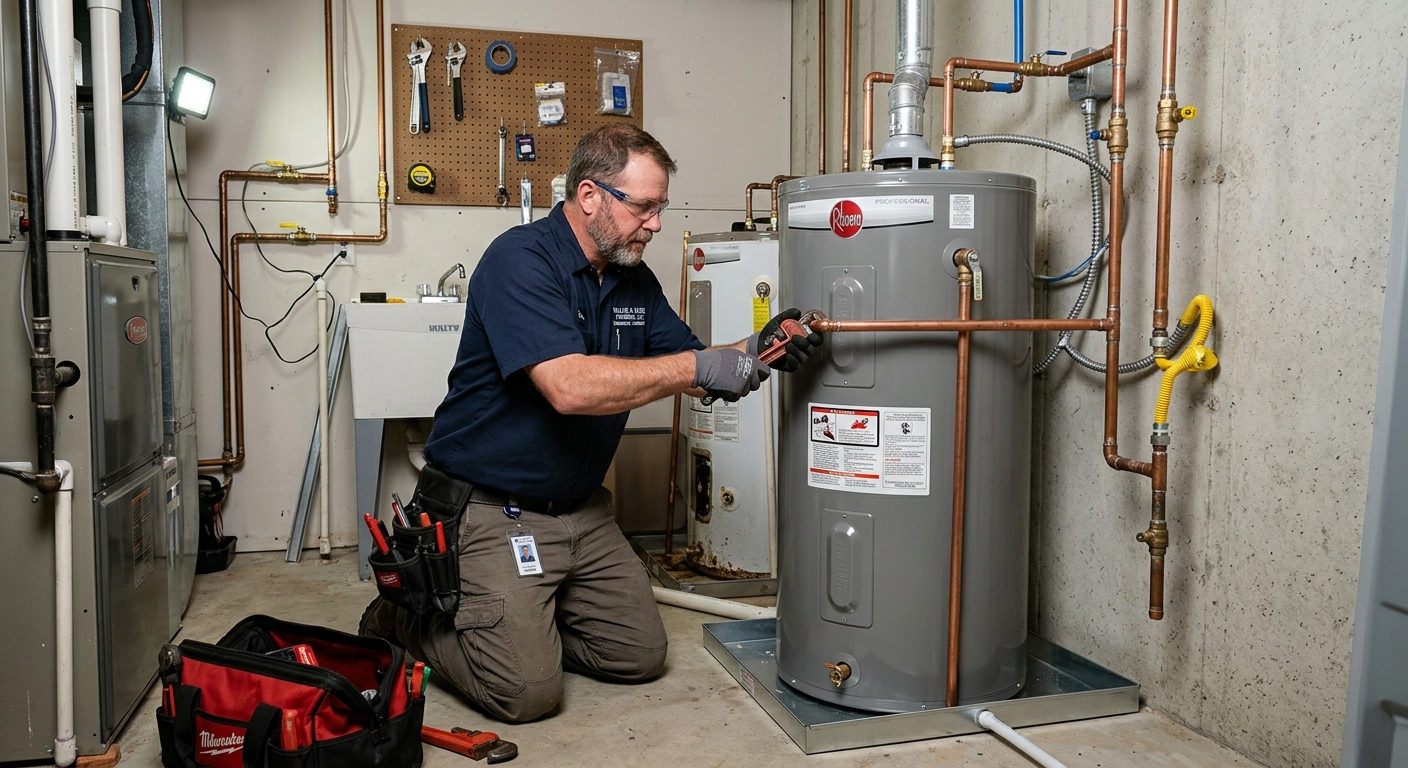
What plumbers charge in East Hempfield
East Hempfield homes, like much of Lancaster County, fall into two price categories for plumbing jobs: emergency and standard, depending on whether you call after-hours or for immediate flooding. With a homeownership rate of 72% and 40.5% of homes built before 1980 (U.S. Census Bureau, ACS 2024), the neighborhood has both aging plumbing and newer construction—each with its own cost quirks. In older areas, frequent galvanized-to-copper or PEX replacement drives up whole-house repiping and water service costs. The era your home was built predicts your pipe material, and pipe material predicts repair bills: galvanized pipes mean more surprises behind the walls; PEX or copper usually mean fewer emergencies.
With any job, an emergency call brings a premium—sometimes double—driven by after-hours labor, trip charges, and speed. A burst pipe at 2 a.m. will cost more than if you can shut off your main and wait for daylight. Here’s what you can expect to pay in East Hempfield:
| Service |
Scope |
Emergency rate |
Standard rate |
| Emergency repair — burst pipe |
locate, open, repair section, restore service |
$650–$1,250 |
$375–$1,250 |
| Water heater replacement (gas, 40–50 gal) |
remove old, install, test, haul away |
$2,000–$2,900 |
$1,250–$2,900 |
| Drain cleaning — main line |
augering or hydro-jet, camera if needed |
$350–$800 |
$200–$500 |
| Sewer line spot repair |
excavate or reline a failed section |
$2,100–$12,500 |
$2,100–$12,500 |
| Whole-house repipe |
replace supply lines throughout, patch and finish |
$3,700–$8,900 |
$3,700–$8,900 |
| Water service line replacement |
street to house, excavation and restoration |
$5,800–$12,500 |
$5,800–$12,500 |
Estimates for a typical East Hempfield home. Access difficulty and pipe material move these figures more than anything else.
What construction era means for your pipes
When you own a home in East Hempfield, the year it was built tells you most of what you need to know about what’s running through your walls and under your lawn. With more than 40% of homes built before 1980, odds are good you have some mix of galvanized steel, copper, or even older drain lines (U.S. Census Bureau, ACS 2024). Older homes often relied on galvanized supply lines, which corrode and lose pressure, as well as cast iron drains and clay tile sewer laterals—both prone to root intrusion or cracking after 60+ years. Chances are if your place is pre-1940, it’s seen at least one full or partial repipe, and the current water heater may be on its third replacement. Lead service lines are also a real concern in Lancaster city’s oldest neighborhoods.
In newer suburban homes—built in waves from the 1980s onward—the story shifts. You’re more likely to see copper or PEX supply lines, builder-grade fixtures, and in some houses built between the late 1970s into the 1990s, polybutylene piping, which is now out of favor and a liability for insurance. Water heaters in these homes are often nearing the end of their original service life if you haven’t replaced them yet, and plastic drain piping is common. So, “newer” doesn’t mean worry-free—it just means different vulnerabilities: sudden failures with PB pipe, slow unnoticed leaks, and water heaters that typically last 12–15 years before needing replacement.
What urgency costs you
The minute you call a plumber after hours or for a crisis, the clock and costs start spinning faster. Emergency rates in East Hempfield reflect the real-world scramble—whether it’s a midnight burst or a Sunday sewage backup. The premium covers rapid dispatch, out-of-hours labor (which often means overtime pay), a trip charge regardless of outcome, and the reality that troubleshooting in a crisis almost always takes longer. Weekday, daylight, and scheduled calls give contractors breathing room to batch jobs, avoid overtime, and bring the right materials, which shows up as savings for you.
So what is a true plumbing emergency? Active flooding from a burst pipe, your main water line fails and you have no water at all, sewage is backing up into the house, or you smell gas (from a water heater or appliance)—these all justify an emergency call. On the other hand, one slow drain, a dripping faucet, or a running toilet can nearly always wait until normal business hours. That difference matters: a burst pipe repair jumps from $375–$1,250 (standard) to $650–$1,250 (emergency).
Every homeowner should know two things: how to shut off the main water valve—typically where your service line enters the basement or crawlspace, usually a round or lever handle near a water meter—and how to turn off water at the fixture (look for shutoffs below sinks and behind toilets). Often, shutting the water buys you time, savings, and a full night’s sleep before you need to call out an emergency team.
The point where patching stops making sense
If you’ve had two or more leaks on the same type of pipe within three years, it’s not bad luck—it’s the start of a trend. In East Hempfield’s older homes, especially those with original galvanized or polybutylene supply lines, recurring leaks mean it’s time to consider repiping, not just another patch. Other telltale signals include pressure dropping throughout the entire house (not just at one sink), rusty or discolored water on first draw, visible corrosion at pipe joints in crawlspaces or basements, and more than one pinhole or joint failure.
Partial repipes make sense for accessible or localized problems, but when an entire system is aging out—especially in Lancaster’s pre-1940 row and twin homes, notorious for widespread galvanized—to-copper or PEX replacement—a full repipe is usually less painful (and less expensive in the long run) than chasing leaks through finished walls. Remember, drywall or plaster repair can rival the plumbing cost in an old house. In postwar and newer houses, pay close attention if you spot any polybutylene; it’s unsafe and unreliable.
| Situation |
Recommendation |
Cost |
Reasoning |
| One leak, accessible, modern pipe |
Spot repair |
$375–$1,250 |
Local repair is cheaper if no recurring pattern and pipe is sound |
| Two or more leaks in 3 years |
Partial repipe |
$3,700–$6,000 |
Aging material is showing failure trend; localized full replacement stops future leaks |
| Galvanized supply, pressure loss |
Full repipe |
$3,700–$8,900 |
Material is past design life; corrosion narrows pipes and impairs flow |
| Polybutylene anywhere in the house |
Full repipe |
$3,700–$8,900 |
Pipe is uninsurable and prone to failure at fittings |
| Cast iron drain with root intrusion |
Camera, then reline or replace |
$2,100–$12,500 |
Major root growth or collapse means opening for repair or lining |
| Suspected lead service line |
Test, then replace the lateral |
$5,800–$12,500 |
Eliminates health hazard and brings supply up to code |
Verifying a East Hempfield plumber's credentials
Pennsylvania does not issue a statewide plumbing license, and municipalities make their own rules. That means in East Hempfield—or anywhere else in Lancaster County—a plumber licensed in one town may not be licensed in the next, since requirements differ township to township. For you, the right question isn’t “are you licensed,” but “are you licensed to work on my home in this township, and do you pull permits here?”
Plumbing work that physically alters, expands, or adds value to a property typically requires a permit in Lancaster city and is enforced by local code officials. Minor repairs like faucet or toilet part swaps often don’t. To be certain, check with your township’s code office before starting work. Larger jobs—such as a repipe or water heater install—will almost always require a permit and final inspection by a local plumbing or building official.
Pennsylvania’s Uniform Construction Code (UCC) sets the state minimum, but enforcement and registration are local matters. Any contract over $500 requires a registered Home Improvement Contractor (HIC) number, issued by the Office of Attorney General—verify it at hic.attorneygeneral.gov. Employers must provide proof of workers’ compensation through the WCAIS system (wcais.pa.gov). For homes built before 1978, only EPA Lead RRP–certified contractors can disturb painted surfaces. Always ask for insurance certificates before any major work; your home policy can be voided by unregistered or uninsured contractors.
Freeze risk and what to do about it
In Lancaster County and East Hempfield, winter brings pronounced freeze-thaw cycles, with a frost depth of 30 inches and a winter design temperature down to 12 °F. Most plumbing failures during extreme cold happen not where the pipe freezes, but between the frozen plug and a closed faucet because water pressure builds up as ice blocks the flow. When the ice finally gives, the pipe splits and releases stored-up water—often after temperatures rise and you’re not looking for a leak.
Risks are highest for pipes running along exterior walls, in unheated crawl spaces, garages, and hose bibs, or anywhere above the insulation in an attic. In older East Hempfield homes, unfinished basements and exposed supply runs are especially vulnerable.
Preventing frozen pipes, in order of cost: start by insulating plumbing in crawlspaces and along outside walls, use heat tape for pipes with repeat freezing, let a faucet trickle during the coldest snaps, and open cabinets to expose pipes to warm air. Always shut off and drain outdoor spigots before the first hard freeze in fall.
If you do encounter a frozen line, warm it gently with a hair dryer, warm towels, or a space heater aimed at the area—never use an open flame. The cost of repairing a burst pipe ranges from $375–$1,250, so prevention is a worthwhile investment of time and a few dollars in insulation or heat tape.
Galvanized, copper, PEX, cast iron
To understand your plumbing in East Hempfield, you need to look at the era your home was built. Lancaster city’s high percentage of pre-1940 homes means frequent updates: many still have remnants of galvanized steel, copper, or even cast iron drains. Galvanized pipe, standard until the 1960s, corrodes from the inside, shrinking flow. Copper replaced it from the 1950s onward—durable, but in some neighborhoods with aggressive water chemistry, pinholes eventually show up. Polybutylene (PB) supply lines were used in the late 1970s to mid-90s, but they’re now a red flag for insurers. PEX is the latest standard, flexible and quick to retrofit in older homes. For drains, cast iron was common up to the mid-1970s, PVC and ABS took over after that, and clay tile is almost always a buried lateral running to the street in older property lines.
You can ID your pipes by scratch test and color: galvanized steel is gray and magnetic, copper is reddish and non-magnetic, PB is typically gray-blue plastic, while PEX comes in white, red, or blue flexible tubing. Cast iron is thick, black, and heavy, while clay tile is brittle orange-brown (underground only). Soldered joints and threaded fittings help distinguish copper and galvanized respectively.
Older East Hempfield homes are now reaching the end of life for their original service lines and main drains. If you have galvanized or cast iron, expect major repairs or replacement soon; PEX and copper still have decades of expected life if undamaged. Use this table to estimate what you might have—and how long you can expect it to last:
| Material |
Typical era |
Failure mode |
Service life |
| Galvanized steel supply |
pre-1960 |
internal corrosion, pressure loss |
40–60 yrs |
| Copper supply |
1950s–present |
pinhole leaks, joint failure |
50–70 yrs |
| Polybutylene supply |
late 1970s–1995 |
fitting failure, sudden bursts |
unreliable |
| PEX supply |
2000s–present |
fitting or UV degradation |
40–50 yrs |
| Cast iron drain |
pre-1975 |
corrosion, cracking, scale |
50–75 yrs |
| Clay tile sewer lateral |
pre-1980 |
root intrusion at joints, offset |
50–60 yrs |
| PVC / ABS drain |
1970s–present |
joint separation, crushing |
50+ yrs |
Frequently asked questions — plumbing in East Hempfield
What causes low water pressure in East Hempfield homes?
Low water pressure in East Hempfield homes is most commonly tied to the age and material of your supply lines. Many local properties—especially those built before 1980—still rely on stretches of original galvanized steel pipe, which narrows internally from corrosion. This restricts flow through the entire house, resulting in weak pressure. In newer developments, pressure drops can signal a whole-house pressure regulator issue or a localized supply leak. Other culprits include clogged aerators on faucets, partially closed shutoff valves, and, in rare cases, issues with municipal water delivery. If you notice pressure loss across every fixture, it's worth tracing exposed supply pipes to check for rust or corrosion. In many older homes, once pressure gets bad enough, a full or partial repipe—costing $3,700–$8,900—is the only real long-term fix. Always check the main shutoff is fully open before calling for major repair.
How much does a water heater replacement cost in East Hempfield?
Replacing a gas water heater (40–50 gallon) in East Hempfield costs between $1,250–$2,900, with most homeowners seeing quotes around the $2,000 mark. The final price depends on where your heater sits (basement or tight utility closet), whether your venting and supply connections are up to code, and haul-away charges for your old unit. East Hempfield homes—especially those built from the 1950s through the 1980s—often have their water heaters nearing end-of-life now, since even the best tanked models rarely last more than 12–15 years. Upgrades to higher efficiency or rapid-recovery models trend toward the top of the range. Permitting and disposal are generally included in the price bands listed above.
Is a tankless water heater worth it in East Hempfield?
Tankless water heaters can make sense in East Hempfield, especially for smaller households or those looking to save space and improve energy efficiency. However, installation costs run higher than standard tank replacements, often falling above the $2,900 upper end listed for conventional heater swaps. East Hempfield’s mix of home ages means you must consider your gas supply capacity, venting, and whether you’re upgrading electrical service. Tankless models last 20+ years with regular maintenance, and you’ll never "run out" of hot water. Still, in homes with inconsistent water quality or heavy lime, tankless units may need more frequent descaling. If your current heater is over a decade old and gas lines support a tankless upgrade, it’s worth reviewing. For many families, a well-chosen tank-style heater still offers the most cost-effective replacement.
Is a sewer line replacement covered by homeowner's insurance?
In East Hempfield (as throughout Pennsylvania), homeowner’s insurance rarely covers replacement of a failed or collapsed sewer lateral—especially if the cause is normal wear, tree root intrusion, or ageing clay or cast iron pipe. Sudden accidental events, like a collapse caused by a vehicle or other external force, may be eligible under some “service line” add-on policies. Standard claims stemming from slow root intrusion or years of settling usually aren’t covered. Since a sewer spot repair or full replacement ranges up to $12,500, always ask your insurer about service line endorsements if your pipes are aging. It’s also wise to camera-inspect if your house was built before 1980 to catch problems before an emergency arises.
What do I do about a burst pipe right now?
First, shut off your main water valve immediately—typically found where your municipal service line or well line enters the basement near the meter. This stops the flow and prevents further water damage. Next, open a faucet at the lowest point in your home to drain standing water from the system. If the break is near electrical or gas connections, cut power at the panel and avoid standing water. In East Hempfield, a burst pipe emergency repair typically costs $650–$1,250. Take photos for insurance, mop up what you safely can, and wait for a licensed plumber to assess. If you can schedule the repair for regular hours after stopping the leak, you may pay closer to the base rate. Consider insulation before next winter to avoid repeat events.
Can I do my own plumbing work in East Hempfield?
Pennsylvania does not issue a statewide plumbing license, so permit requirements and limits on DIY vary by township, including East Hempfield. For minor work—like replacing faucets or fixing a running toilet—you usually don’t need a permit. Larger jobs that alter supply, drainage, or water heater hookups nearly always require a permit and must meet Pennsylvania Uniform Construction Code (UCC) standards. DIY work risks insurance and inspection issues if it’s not properly permitted and documented. Any contract over $500 with a hired plumber also requires written HIC registration and consumer protection measures under state law. When in doubt, call your township code office before starting any significant work.
Are tree roots a common sewer problem in East Hempfield?
Yes, tree roots frequently infiltrate sewer lines in East Hempfield, especially in homes with older clay tile or cast iron laterals installed before 1980. These materials have joints that roots readily exploit, eventually causing blockages or pipe collapse. Even in newer homes, large shade trees can send roots a surprising distance in search of moisture from tiny sewer leaks. Clearing a main line blockage typically costs $200–$500 if you catch it early. But if roots have caused the pipe to crack or collapse, repairs can run as high as $12,500. Preventive camera inspections reveal issues before emergencies strike and can save you thousands if caught early.
What does drain cleaning cost in East Hempfield?
Main line drain cleaning in East Hempfield usually runs $200–$500 for standard augering or hydro-jetting. Emergency response, evening, or weekend calls push that to $350–$800. Prices include labor, basic equipment, and clearing the blockage. If a camera inspection is needed to diagnose a stubborn issue or verify line integrity afterward, that may be included or run slightly extra. Older homes, common in East Hempfield, are particularly prone to build-up or root infiltration, so regular cleaning can pay off by preventing expensive backups or even more costly lateral repairs in the future.
What do I do if a pipe is frozen but not burst?
If you discover a frozen pipe but there’s no visible rupture or water escaping, act quickly but calmly. Open the nearest faucet so any expanding ice has space to escape as it melts. Warm the pipe gently using a hair dryer or a portable heater—start near the faucet and move toward the frozen section to avoid steam pressure build-up. Never use an open flame. In East Hempfield’s climate, prevention next time is key—pipe insulation or heat tape where water lines pass through unheated spaces pays for itself compared to a $375–$1,250 repair after a burst. If the pipe won’t thaw or you spot cracks, shut off the main water and call a licensed plumbing contractor to prevent water damage when temperatures rise and ice gives way.