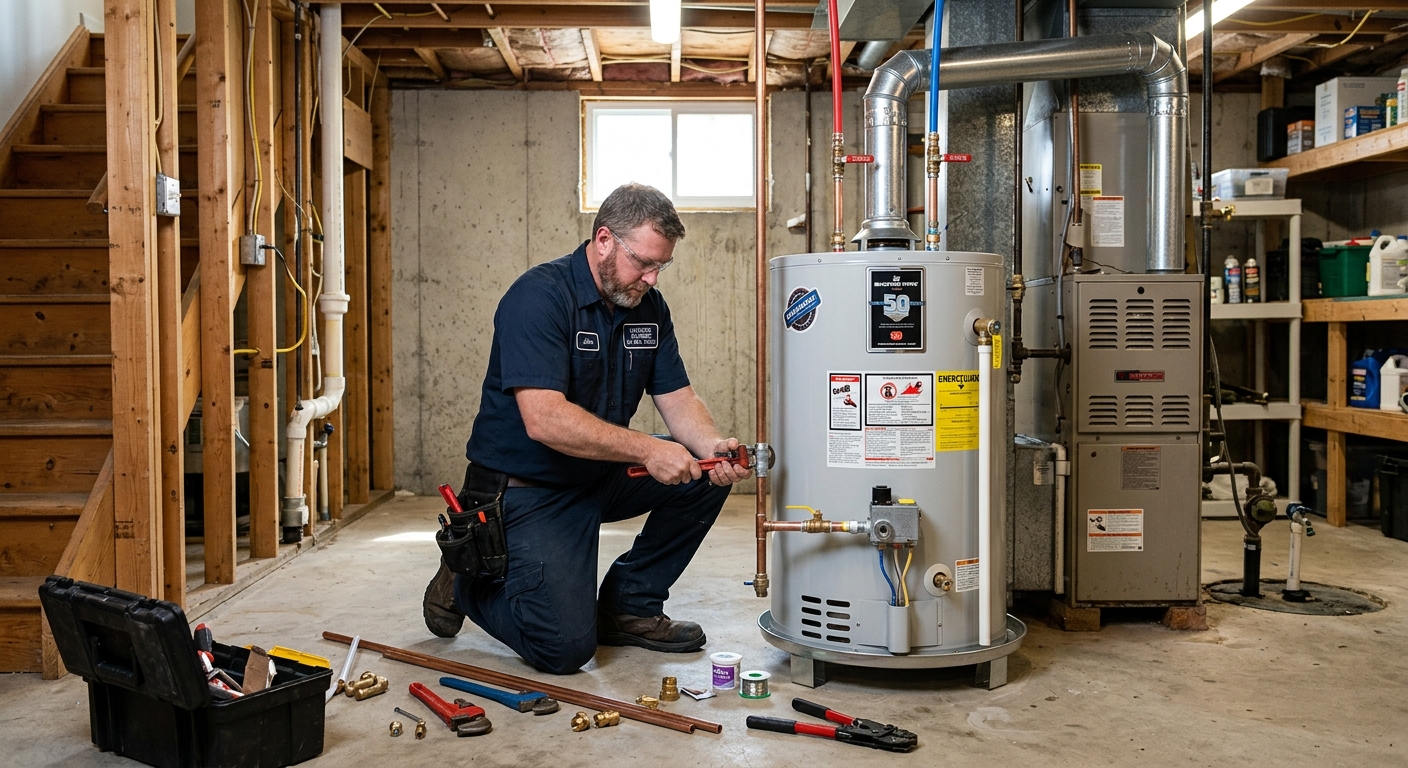
Marshall plumbing prices by job type — 2026
Homeowners in Marshall, nestled in Allegheny County, face plumbing costs shaped more by the nature of the call than any other factor—emergency or planned, urgent or scheduled. With over 3,200 owner-occupied homes (U.S. Census Bureau, ACS 2024) and about 20% of properties built before 1980, much of the local plumbing infrastructure matches that of Pittsburgh’s older neighborhoods. In these homes, original galvanized or cast iron pipes often remain, leading to service calls that skew toward replacement and repair. Pipe material doesn’t just dictate what goes wrong—it steers the cost: galvanized lines mean restricted flow and frustrating leaks, while older cast iron drains are prone to scale and hidden cracks. These issues cost more to handle on an emergency basis, as after-hours calls or urgent leak repairs command a premium.
Routine replacements—like a water heater swap—clock in well below the cost of an emergency burst or leak. And when it comes to hidden problems, access and how your pipe runs through hills or clay ground matter more than the work itself. Below, you’ll find typical 2026 price bands for major jobs in Marshall. Expect the higher end if you’re dealing with a sudden failure or if the fix involves excavation or complex restoration.
| Service |
Scope |
Emergency rate |
Standard rate |
| Emergency repair — burst pipe |
locate, open, repair section, restore service |
$650–$1,300 |
$375–$1,300 |
| Water heater replacement (gas, 40–50 gal) |
remove old, install, test, haul away |
$2,100–$3,100 |
$1,300–$3,100 |
| Drain cleaning — main line |
augering or hydro-jet, camera if needed |
$350–$800 |
$200–$500 |
| Sewer line spot repair |
excavate or reline a failed section |
$2,200–$13,000 |
$2,200–$13,000 |
| Whole-house repipe |
replace supply lines throughout, patch and finish |
$5,200–$9,400 |
$3,900–$9,400 |
| Water service line replacement |
street to house, excavation and restoration |
$8,000–$13,000 |
$6,100–$13,000 |
Estimates for a typical Marshall home. Access difficulty and pipe material move these figures more than anything else.
The leak you can hear but can't see
Before you call for leak detection in Marshall, there’s one free test worth your time: the meter test. Shut off every faucet and appliance in your house, then check your water meter (usually near the curb or in your basement). If the dial is still moving after 10 minutes, you have a supply-side leak somewhere in your system. This little check can rule out a lot of red herrings for nothing but five minutes of your day.
When it’s time for a professional, methods vary by need. Acoustic listening is a common first step, using sensitive microphones to pinpoint pressurized leaks under floors or inside walls. This service usually falls in the $375–$1,300 range, often bundled into the emergency repair. Thermal imaging cameras spot temperature changes from moisture behind walls, helpful when pipes run through tough-to-reach spots. For hard cases—like slab leaks—plumbers might use tracer gas and sniffers, which is more involved but non-destructive. If an irrigation line vanishes underground, a combination of tracer gas and electronic locators finds it without heavy digging.
Don’t let anyone start opening drywall or tearing up floors before a methodical search. Locating comes before demolition. In older homes typical to Marshall, where pipes weave through layers of renovations and add-ons, a careful approach saves money and avoids unnecessary mess. Modern leak detection limits guesswork and, paired with the right repair, keeps you on the lower end of the price spectrum.
Winter pipe failures in southwestern Pennsylvania
Winters in Marshall—and across southwestern Pennsylvania—bring sharp cold snaps and freezing wind. With a frost depth of 36 inches and a winter design temperature all the way down to 8°F, it’s no surprise that pipes here are among the region’s frequent plumbing casualties. The soil makeup—heavy clay and shale—keeps cold right up against shallow or uninsulated lines, compounding the problem.
The science of a burst pipe is straightforward: when water inside a pipe freezes, it forms a plug of ice. Pressure builds between that blockage and a closed faucet, until the pipe bursts—almost always at a weak point far from the original freeze. The spots most often hit are exterior walls, unheated crawlspaces, garages, hose bibs, and anywhere pipes run above the insulation layer, like unconditioned attics or additions.
Prevention is far, far cheaper than repair. The surest moves: add pipe insulation to vulnerable runs, install heat tape where pipes skirt an outside wall, and, in extreme cold, let a faucet trickle to keep water moving. For kitchen and bath sinks on exterior walls, open cabinet doors during cold snaps. Always shut off and drain outdoor spigots before the first serious freeze. Never, ever use an open flame—stick with a simple hair dryer or a heating pad for a safe thaw.
A burst pipe can rack up $650–$1,300 in emergency repairs—and that’s before you handle any drywall or flooring. Spending $20 on insulation beats these numbers every time.
Service line material and drinking water in Marshall
Most homes in Marshall are supplied by the Pittsburgh Water and Sewer Authority, which is actively mapping and replacing thousands of lead service lines across Allegheny County. The service line—the section between the street and your home—is often split ownership: the utility handles the main up to a curb stop or shutoff, and you own the lateral from there to your foundation. Replacement programs may only cover one side, so check your own line’s status directly.
To identify your service line: look for an exposed section where the line enters your basement. Use a coin to scratch the pipe: a soft, silvery streak means lead, while a dull gray that holds a magnet is galvanized steel. Copper won’t attract a magnet and shows a bright streak. Because partial lead replacements disturb old scale, they can actually spike lead levels short-term—making a full replacement the safest course.
Pittsburgh Water and Sewer Authority maintains a public inventory of service line materials and is your best first contact to see what’s installed at your address and whether you qualify for any replacement program or cost share. Don’t assume you’re covered—a quick call or website search is worth the time.
Replacing a private lead service line typically falls between $6,100–$13,000. Spot repairs for leaks from old galvanized or lead lines may cost $2,200–$13,000, depending on length and access. For Marshall homeowners, checking your material is a must—and replacement is among the best long-term investments in water safety.
Who is allowed to do plumbing work in Pennsylvania
Pennsylvania’s plumbing licensing system isn’t one-size-fits-all; credentials are issued at the municipal level, not statewide. In Pittsburgh and nearby Allegheny County municipalities, the Allegheny County Health Department runs its own licensing and exam program for journeyman and master plumbers. This means a plumber licensed in Pittsburgh may not be authorized to pull permits or work legally just a few miles away in another township, unless specifically licensed there.
For residential work—new installations and significant alterations like repipes, water heater swaps, or sewer lateral repair—you must pull a plumbing permit through the Allegheny County Health Department if you’re in Pittsburgh or one of the surrounding municipalities that participate. Minor fixture swaps (like faucets) are generally done without a permit across the county. Plumbing inspections are performed by local code authorities, not a statewide agency. The PA Department of Labor & Industry sets the code (the UCC, based on the IRC), but leaves local enforcement up to each jurisdiction.
If your contractor’s contract is over $500, Pennsylvania law says they must hold Home Improvement Contractor (HIC) registration with the Pennsylvania Office of Attorney General—check this at hic.attorneygeneral.gov. Insurance (including workers’ compensation) is mandatory for all plumbing employers; you can verify any company’s status through WCAIS at wcais.pa.gov.
Galvanized, copper, PEX, cast iron
Marshall’s homes mirror much of Pittsburgh in their plumbing DNA: many built before 1950, often with their original galvanized or cast iron pipes still ticking along. In these older systems, you’re likely to find a mix—some successor’s hot water lines in copper, a PEX repair tagged onto a basement run, maybe even clay sewer laterals out toward the street.
Galvanized steel dominated pre-1960 supply lines. Inside, slow corrosion constricts flow, causing pressure loss before the first visible leak. Copper, common since the ‘50s, is more durable but can pinhole—especially in areas with aggressive water. Polybutylene, a ‘70s–‘90s experiment, fails unpredictably at connections and often isn’t covered by insurers. PEX, now standard, needs to be protected from sunlight but otherwise fares well except at poorly made fittings.
For drains, cast iron was standard into the ‘70s, lasting 50–75 years but failing by rust or cracking at the hub. Clay was typical for sewer laterals up to 1980, and its weak point is at the handmade joints, where roots slip in and throw the whole run out of alignment. PVC and ABS stepped in by the 1970s, and with proper bedding will last decades unless crushed.
To tell what you’ve got: a magnet sticks to galvanized but not copper or lead; a bright scratch on copper, silvery and soft on lead. Threaded joints mean steel or iron; soldered joints mark copper. Knowing era lets you estimate your system's remaining life—and plan upgrades before leaks hit your wallet.
| Material |
Typical era |
Failure mode |
Service life |
| Galvanized steel supply |
pre-1960 |
internal corrosion, pressure loss |
40–60 yrs |
| Copper supply |
1950s–present |
pinhole leaks, joint failure |
50–70 yrs |
| Polybutylene supply |
late 1970s–1995 |
fitting failure, sudden bursts |
unreliable |
| PEX supply |
2000s–present |
fitting or UV degradation |
40–50 yrs |
| Cast iron drain |
pre-1975 |
corrosion, cracking, scale |
50–75 yrs |
| Clay tile sewer lateral |
pre-1980 |
root intrusion at joints, offset |
50–60 yrs |
| PVC / ABS drain |
1970s–present |
joint separation, crushing |
50+ yrs |
What a plumbing quote should contain
Most Marshall plumbers bill by flat rate or by time-and-materials. Flat rate means you get one number, risk and all, no matter how much trouble the job ends up being—the contractor assumes risk, and you pay for certainty. With time-and-materials, you save when a fix turns out simple, but costs can balloon if troubleshooting drags on. Neither is “right”; the problem comes when a customer doesn’t know which they agreed to, or what was included.
Don’t accept any quote without a stated diagnostic fee or a clear answer on whether it will be deducted from the repair. The paperwork should spell out the scope—not just the total, but what walls, floors, or ceilings may be opened and whether finish work is included. Permits must be clear (and their cost shown). Warranty terms should be split for labor and parts. And anything after-hours or outside standard scope must be disclosed before you sign.
| Line item |
What to look for |
Red flag if… |
| Billing model |
flat rate or hourly, stated up front |
unstated |
| Diagnostic fee |
amount, and whether it credits |
vague |
| Scope |
what is opened, repaired and restored |
price with no scope |
| Restoration |
drywall and finish explicitly in or out |
silent |
| Permit |
included and priced |
'not needed' |
| Parts |
brand and model for fixtures |
'standard fixture' |
| Warranty |
labour period stated separately |
parts only |
Frequently asked questions — plumbing in Marshall
How long should a water heater last in Marshall?
Water heaters in Marshall typically last 8 to 12 years. Hardness in local water provided by the Pittsburgh Water and Sewer Authority isn’t as aggressive as some regions, but older tanks—especially those installed before the mid-2000s—will likely be on borrowed time if not flushed and maintained. When sediment builds up, it reduces efficiency and shortens lifespan. If your tank is approaching 10 years or you notice rusty water or noise, it’s reasonable to plan for a replacement soon. A new gas water heater, including removal and disposal, will run $1,300–$3,100. If your heater is in a finished basement, include a budget for restoration work in case of a leak. Preventative replacement costs less than a surprise late-night emergency call, which can land at the top of that range.
Who inspects plumbing work in Marshall?
Plumbing work in Marshall and neighboring municipalities is typically inspected by the Allegheny County Health Department Plumbing Program. This applies to work requiring a permit—new or altered plumbing systems, such as a bathroom addition, water heater swap, or major pipe replacement. Minor fixture changes like faucet swaps usually don’t need inspection. Remember, Pennsylvania licenses plumbers at the municipal level, so always ask if your contractor is licensed to pull a permit where your home is located. Any reputable contractor should readily provide their license details. You can verify insurance and workers’ compensation through WCAIS at wcais.pa.gov. Inspection fees and permit costs are generally included in a full-service quote, which for something like a whole-house repipe runs $3,900–$9,400, so make sure it's spelled out in writing.
How deep do water lines need to be buried in Marshall?
In Marshall and the rest of southwestern Pennsylvania, the required burial depth for water lines is determined by frost depth, which is 36 inches locally. This requirement helps ensure that pipes are protected from freezing, even during the coldest part of winter when the temperature can drop to 8°F. Any line that isn’t buried deep enough is at serious risk of freezing and bursting, particularly given the area's heavy freeze-thaw cycles and clay subgrade. If you’re replacing or repairing a water service line, the excavation and proper burial will be a major part of the project cost, which usually falls in the $6,100–$13,000 range for a street-to-house replacement. Always confirm your plumber is following code for depth—your future self will thank you.
Is a water softener worth it in Marshall?
Whether you need a water softener in Marshall depends on your taste and the sensitivity of your fixtures. The Pittsburgh Water and Sewer Authority delivers moderately hard water, which usually doesn’t cause severe scaling but can leave some spots on glassware or build up in heaters and faucets over years. A softener adds a maintenance cost, but if you’re burning through water heaters faster than the average or see unusual mineral deposits, it might pay off. That said, a water heater replacement here costs $1,300–$3,100, so if your existing tank lasts the full 10–12 years, investing in a softener is likely overkill for most homes. Unless your appliances or laundry are suffering, you’re fine without one in Marshall.
How much does sewer line repair cost in Marshall?
Sewer line spot repairs in Marshall can be a major expense, usually ranging from $2,200–$13,000. The biggest cost swings come from how deeply the pipe is buried in your yard, whether it’s under concrete or a deck, and what material is involved—cast iron and clay lines in older homes often fail at joints or due to root intrusion. A repair in a front yard with easy access will run at the lower end; if your repair means cutting through driveways, retaining walls, or mature landscaping, numbers rise fast. Emergency calls after hours drive the price up as well, and restoring the yard, sidewalk, or pavement adds to the tally. Always ask your plumber to spell out what’s included in the quote.
Should I wait until business hours to call?
In Marshall, waiting for the next business day makes sense only if the problem can wait without property damage. Emergency response—middle of the night, weekends, or holidays—costs more. For example, shutting off the water and waiting until morning for a burst pipe repair will usually save you money, with repairs running $375–$1,300 for standard calls instead of climbing towards $1,300 for true emergencies. But if water is actively flowing in a way you can’t contain, or you can’t shut off your main valve, call right away. In Marshall’s older homes, even a minor leak can escalate quickly behind walls or in finished basements.
How much does a water heater replacement cost in Marshall?
You’re looking at $1,300–$3,100 for a standard 40–50 gallon gas water heater, including haul-away and disposal of the old tank. The wide range comes down to access (tight basement stairs or crawlspaces add labor), venting issues, upgrades to bring installations up to code, and any extra restoration if drywall or flooring is affected. Emergency replacements—the last-minute, no-hot-water situations—come in at the high end, closer to $3,100. Scheduling ahead and choosing a reputable, local plumber will almost always land you at the more reasonable part of the spectrum.
Do older Marshall homes have galvanized pipes?
Yes, it’s very common for older homes in Marshall—especially those built before 1960—to have some or all original galvanized steel supply pipes. Galvanized was the standard throughout the Pittsburgh metro, and as these pipes age, they corrode from the inside. You’ll notice reduced water pressure and, eventually, leaks at joints. Many homes have partial copper or PEX upgrades, but if your house predates 1960 and hasn’t been fully redone, there’s a good chance some galvanized remains. If you’re considering a whole-house repipe (to replace galvanized or failing copper), expect a project budget in the $3,900–$9,400 range. Knowing what’s in your walls helps plan repairs before leaks develop.
Is a sewer line replacement covered by homeowner's insurance?
In Marshall, standard homeowner’s insurance policies almost never cover sewer line replacement due to age, wear, or root intrusion—just sudden, accidental damage from covered perils like fire or collapse. If a sewer backs up and causes water damage inside the home, cleanup might be covered under a special rider, but the actual pipe repair or replacement (which typically costs $6,100–$13,000) is usually your responsibility. Some insurers offer optional “service line coverage” that can partly offset these costs, but it’s not standard. It’s smart to check your individual policy or call your carrier before problems occur rather than assuming coverage exists.