What plumbers charge in Cumberland
Cumberland homeowners face a unique plumbing market due to two local realities: most homes in Greene County were built before 1980, many between 1900 and 1940, and the rural setting brings regular travel surcharges from Pittsburgh-area plumbers. Of the 2,180 owner-occupied households here (U.S. Census Bureau, ACS 2024), about 74.6% live in homes built before 1980. That means pipe materials vary widely and so do the risks: many houses still have galvanized or cast iron sections prone to corrosion and pressure loss. This heritage influences not only what breaks, but how involved — and costly — repairs are. Simply put, the era your home was built predicts both your pipe material and the odds you’ll face a full repipe, a tank leak, or a drain backup.
Plumbing costs in Cumberland always split into two camps: what you pay during an emergency versus during scheduled, standard-hours work. For any job that cannot wait—like a burst pipe or sewer backup—the price reflects both the urgency and the difficulty. The same fix that runs $325–$1,100 under normal hours may push toward $1,100 if it's after hours or a holiday.
| Service |
Scope |
Emergency rate |
Standard rate |
| Emergency repair — burst pipe |
locate, open, repair section, restore service |
$550–$1,100 |
$325–$1,100 |
| Water heater replacement (gas, 40–50 gal) |
remove old, install, test, haul away |
$1,750–$2,600 |
$1,100–$2,600 |
| Drain cleaning — main line |
augering or hydro-jet, camera if needed |
$350–$800 |
$200–$500 |
| Sewer line spot repair |
excavate or reline a failed section |
$1,850–$11,000 |
$1,850–$11,000 |
| Whole-house repipe |
replace supply lines throughout, patch and finish |
|
$3,300–$7,900 |
| Water service line replacement |
street to house, excavation and restoration |
|
$5,100–$11,000 |
Estimates for a typical Cumberland home. Access difficulty and pipe material move these figures more than anything else.
Flat rate versus time and materials
In Cumberland and Greene County, plumbers usually price jobs one of two ways: flat rate, or time and materials. Flat rates give homeowners price certainty and shift the risk to the contractor — if the job runs long, the bill does not change. Time-and-materials offers more transparency and can save you money on simple issues, but if a hidden problem crops up (which is common in homes built before 1940), costs can climb. Neither model is dishonest; the problem is agreeing to work without making this clear.
Be sure any quote breaks down a diagnostic fee and whether that fee disappears if you hire them to do the work. Some contracts state only a price, but you need a scope: what exactly will be repaired, what is included in terms of restoration (patching drywall, replacing tile), and what is not. Permits should be listed and priced for your municipality if required. Don’t overlook labor warranties, which are separate from the part warranty, and be certain about after-hours premium rates—these may double a bill if not spelled out. A clear quote avoids all these surprises.
| Line item |
What to look for |
Red flag if… |
| Billing model |
flat rate or hourly, stated up front |
unstated |
| Diagnostic fee |
amount, and whether it credits |
vague |
| Scope |
what is opened, repaired and restored |
price with no scope |
| Restoration |
drywall and finish explicitly in or out |
silent |
| Permit |
included and priced |
'not needed' |
| Parts |
brand and model for fixtures |
'standard fixture' |
| Warranty |
labour period stated separately |
parts only |
Choosing a water heater in Cumberland
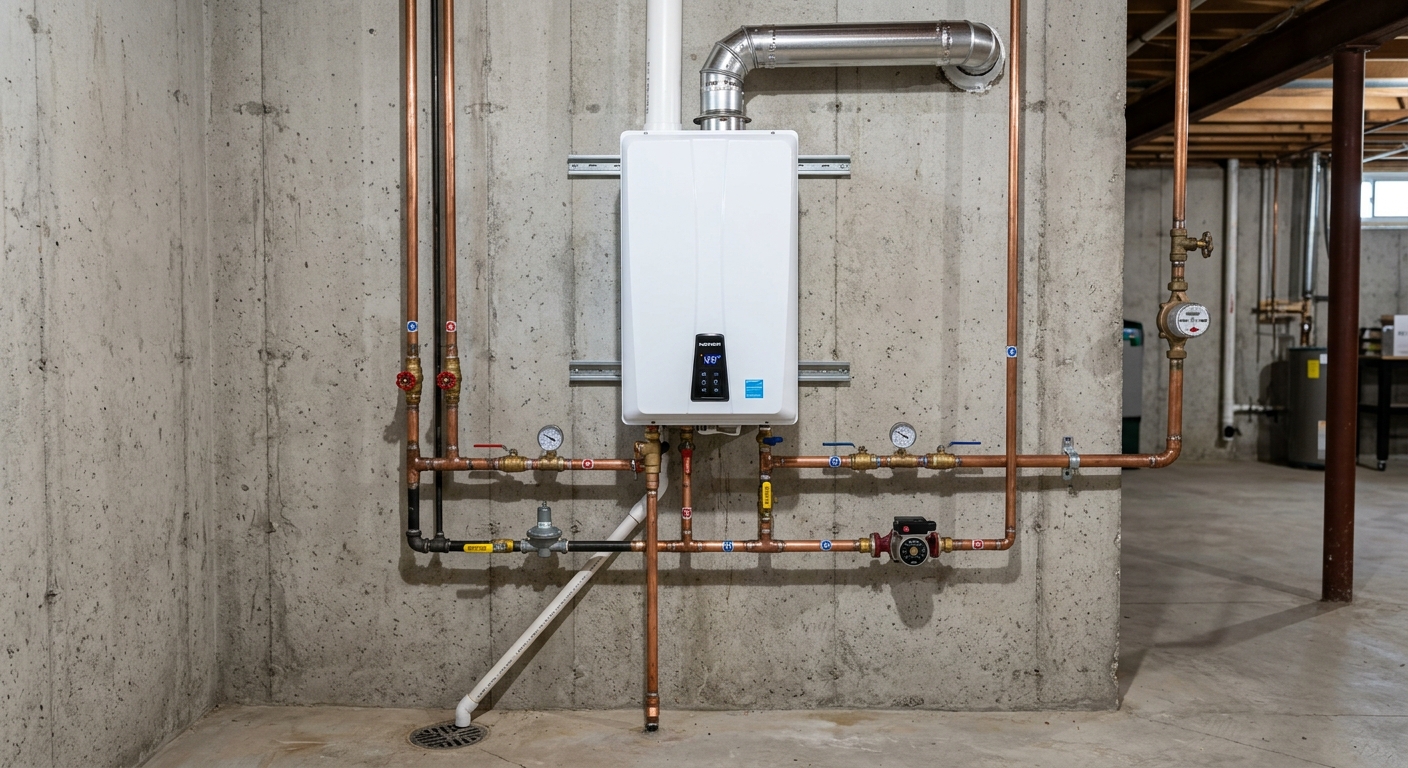
Cumberland homeowners have three options for water heaters, each with trade-offs. Tank-type water heaters are the cheapest to install, especially if you’re sticking with what you already have. Their downside is standby energy loss and a tank life that rarely tops 12 years. Tankless gas water heaters promise endless hot water and higher energy efficiency, but usually require a larger gas line and new venting—surprises that drive up installation costs fast. Heat pump water heaters run on electricity and draw warmth from the air, slashing energy costs. They need plenty of warm, indoor air space and are noisy, which makes them less practical for finished basements or tight utility rooms.
Since natural gas is available throughout much of Greene County, most existing homes lean toward gas tank or tankless systems for cost and familiarity. Where electric is the only fuel or venting options are poor, that’s when heat pump water heaters shine—assuming you have enough space to install one. For all of these, sizing by first-hour rating (how much hot water you’ll get in that first hour of heavy use) matters more than tank size. With older homes, always check that you have an expansion tank, a drip pan, and floor drain—these can prevent smaller leaks from turning into emergencies.
When these heaters fail in Cumberland, it’s almost always the tank corroding out, not the controls, because of the age and mineral content in the local water.
| Type |
Installed cost |
Service life |
Operating cost |
Best when |
| Gas tank, 40–50 gal |
$1,100–$2,600 |
8–12 yrs |
moderate |
existing gas, standard usage |
| Electric tank, 40–50 gal |
$1,100–$1,750 |
10–15 yrs |
high |
electric only, lower up-front cost |
| Gas tankless |
$1,750–$2,600 |
18–25 yrs |
low-moderate |
endless supply, new construction or upgrade-ready |
| Heat pump water heater |
$1,750–$2,600 |
13–15 yrs |
lowest |
ample space, electric only, high-efficiency |
Dating your plumbing by what it's made of
Old homes in Cumberland and Greene County are like time capsules: their plumbing tells you their age — and what repairs you’ll face. Homes built between 1900 and 1940 usually still have some galvanized pipes, which corrode from the inside out, eventually leaving you with both low pressure and leaks. Postwar houses generally feature copper: tough and reliable in good water chemistry, but prone to pinhole leaks when the water’s aggressive. Polybutylene, found in some late 1970s–90s homes, has a reputation for failing at the fittings, often without warning, and is considered uninsurable by some carriers. Today, PEX is standard and reliable if not exposed to sunlight. Drain pipes have their own lifespan: cast iron pre-1975 suffered corrosion and cracking after 50–75 years; clay sewer lines, common in older homes, let roots in at their joints and misalign over time.
You can do your own “scratch test” on an exposed supply line: galvanized is gray and magnetic, copper is reddish and takes a soldered joint, polybutylene is gray-blue and flexible, and PEX is plastic (usually white, red or blue) with crimped fittings. For drains, cast iron is heavy and black, PVC/ABS is white or black plastic, and clay is unmistakably brownish with thick joints.
If your home’s plumbing is original, era tells you the clock: pre-1960 galvanized usually needs replacing; copper is often fine unless leaks have begun; polybutylene is a ticking time bomb. Old cast iron drains and clay laterals should be inspected, especially in houses built before 1975. Knowing your pipes helps set your repair budget and decide if a full repipe is wise.
| Material |
Typical era |
Failure mode |
Service life |
| Galvanized steel supply |
pre-1960 |
internal corrosion, pressure loss |
40–60 yrs |
| Copper supply |
1950s–present |
pinhole leaks, joint failure |
50–70 yrs |
| Polybutylene supply |
late 1970s–1995 |
fitting failure, sudden bursts |
unreliable |
| PEX supply |
2000s–present |
fitting or UV degradation |
40–50 yrs |
| Cast iron drain |
pre-1975 |
corrosion, cracking, scale |
50–75 yrs |
| Clay tile sewer lateral |
pre-1980 |
root intrusion at joints, offset |
50–60 yrs |
| PVC / ABS drain |
1970s–present |
joint separation, crushing |
50+ yrs |
Freeze risk and what to do about it
Cumberland winters are hard on plumbing. Our frost depth is 36 inches, with winter design temps down to 8 °F and a long freeze-thaw season. In practice, pipes burst not at the freeze itself but between an ice plug and a closed valve—pressure builds and splits the pipe. That’s why the damage can be several feet away from where it froze.
Pipes most at risk are those run in exterior walls, unheated crawlspaces, garages, and attics without insulation. Hose bibbs (outdoor spigots) are a classic failure, as are pipes in boxed-out soffits, even in a basement. To avoid the $550–$1,100 cleanup after a burst during a deep freeze, prevention is worth your effort.
- Insulate all accessible piping in unconditioned spaces.
- Heat tape is a good bet, but use only UL-listed, properly installed tape.
- On the coldest nights, let a trickle run from a sink at the high end of the longest run.
- Open vanity or sink cabinet doors along exterior walls.
- Shut off and drain hose bibbs in fall before the ground freezes.
If a line does freeze, use a space heater, heat gun, or hair dryer (never an open flame). Start thawing near the faucet, not in the middle of the frozen run. The cost of a plumber visit after a freeze is well above what you’ll spend on insulation and preparation.
Sewer line problems in Cumberland
Most Cumberland homeowners are responsible for the sewer lateral running from their house to the public main—sometimes all the way under the street, not just to the curb. Many older homes here have clay tile laterals, which are notorious for letting tree roots penetrate the joints, especially after 50–60 years (and much of the township’s housing stock is older than that).
Trouble usually starts with one slow drain, then spreads: if tubs, toilets, and floor drains gurgle or back up together, your main line is the culprit—not just a bathroom sink trap. The gold standard for diagnosis is a camera inspection. Never accept a quote for excavation or relining without seeing what the plumber saw on camera, or you’re taking all the risk sight unseen. Root intrusion, bellies (sags), and misaligned joints are the most common issues in Cumberland. Repairs range from spot relining or digging up a single bad section ($1,850–$11,000), to full replacement.
If you’re in a part of Cumberland with a septic system—common just outside Waynesburg—know that slow drains can also mean a full tank or a failing drainfield, which is a different, often less costly fix. Pump your tank on schedule and keep heavy vehicles off the drainfield.
Who is allowed to do plumbing work in Pennsylvania
Pennsylvania does not have a statewide plumber license. Instead, licensing for plumbers is done at the municipal level. This means the plumber who is licensed in one city may not hold any credential in the next town or township—and in Greene County, there is no countywide plumber license. In Waynesburg Borough, all new or replacement interior pipe work generally requires a permit from the Waynesburg Borough Code Enforcement Office. In the surrounding unincorporated parts of Greene County, minor fixture repairs are often done without permits, but larger jobs should be checked against the specific township’s rules.
The ultimate test for hiring isn’t just “are you licensed” – it’s “are you licensed by the authority serving my area?” Always ask. For insurance and injury protection, Pennsylvania mandates workers’ compensation insurance for all employers; you can verify a contractor’s coverage through WCAIS (wcais.pa.gov). Any plumbing contract over $500 must have a written agreement per state law. If your home was built before 1978 and the work disturbs painted surfaces, federal EPA Lead RRP certification is also required. Never accept a contractor’s word—verify every credential.
Frequently asked questions — plumbing in Cumberland
How much does sewer line repair cost in Cumberland?
Repairing a sewer line in Cumberland can be a big-ticket project, especially with so many older clay tile laterals in Greene County homes. If a single section of your line fails (often due to root intrusion at the joints), you can expect a spot repair to run anywhere from $1,850–$11,000 depending on access, depth, and restoration requirements. The upper end typically involves digging through paved driveways or public rights-of-way. Always insist on a camera inspection before accepting a quote—some clogs are root balls or grease stoppages that don’t require excavation at all. For full line replacement, costs rise accordingly, so knowing the extent of the damage matters. For most Cumberland properties, lining or spot repair is cost-effective when the rest of the line is in good shape.
Who inspects plumbing work in Cumberland?
In Cumberland, plumbing inspections depend on your exact location. Within Waynesburg Borough, the Waynesburg Borough Code Enforcement Office typically handles plumbing permits and inspections for any new or replacement interior piping. In the rest of Greene County, each township sets its own inspection procedures; in some cases, minor repairs may not require inspection at all. For contract work over $500, Pennsylvania’s Home Improvement Consumer Protection Act requires a written contract and provides a three-business-day right of cancellation. Always make sure the contractor’s insurance is current and that they provide proof their workers’ compensation is active. If you suspect a job should have been inspected, call your municipal code officer for guidance.
Is a tankless water heater worth it in Cumberland?
For many Cumberland homes, a gas tankless water heater can be appealing: it provides endless hot water and is more energy efficient than a standard tank heater. However, installation costs are higher—typically $1,750–$2,600—and a retrofit can require upgrading your gas line and venting, adding to the bill. In houses with limited space or where maximizing efficiency makes sense, tankless is a solid option. But for older homes, or where water draws are spread out, a conventional tank still delivers the best value. Electric tankless isn’t practical on older wiring or for well water with mineral content. Before committing, have a plumber check your gas line size and vent path; in some Cumberland basements, those upgrades outweigh the energy savings.
How deep do water lines need to be buried in Cumberland?
In Cumberland and throughout rural Greene County, water lines must be buried below the local frost depth to prevent freezing. That means a minimum of 36 inches deep is standard, reflecting our frost line and cold winters (winter design temp of 8°F per Southwestern Pennsylvania data). In practice, contractors often aim for 40 inches or more to account for soil disturbance. If you’re replacing your water service line—costs typically run $5,100–$11,000—make sure the plumber puts the pipe at code depth and backfills with clean fill to minimize shifting. Any newly excavated trench should be inspected by your local code office before backfilling.
What does emergency plumbing cost in Cumberland?
An emergency plumbing visit in Cumberland—such as responding to a burst pipe, major leak, or sewer backup—will generally cost more than routine service. Expect the minimum rate for emergency repairs to fall in the $550–$1,100 range, particularly if you’re calling after-hours or on a holiday. Travel surcharges are normal, as locally based plumbers are few and many come out from the Pittsburgh metro area. If the fix involves a full pipe replacement or a water heater swap on short notice, total costs can be higher. For non-urgent issues, schedule work during regular hours for the best pricing.
Who owns the sewer lateral, me or the city?
In Cumberland, the homeowner is almost always responsible for the sewer lateral from the house all the way to the main line—sometimes extending into the public right-of-way or under the street. The city or municipality only takes over at the main, not at the curb. If you need to repair or excavate your line, you’ll bear the cost, which for a spot repair typically runs $1,850–$11,000. Always clarify this with your township or Waynesburg Borough code office, especially before you dig or contract a repair. Insurance riders can help offset this risk, but check the fine print on what’s covered.
Which utility supplies water to Cumberland?
Cumberland and many other municipalities in central and northern Greene County, including Waynesburg, are served by the Southwestern Pennsylvania Water Authority. If you live outside the main service area, however, you could have a private well, which brings its own plumbing considerations. For most residents on public supply, service line repairs are your responsibility and can cost $5,100–$11,000 if replacement is needed. Keep your utility’s contact information handy for emergencies or water quality questions.
How long should a water heater last in Cumberland?
Most standard tank-type water heaters in Cumberland—gas or electric—last 8 to 15 years, depending on maintenance and water chemistry. Homes on older galvanized lines can shorten heater life, as rust and sediment accumulate faster. Tankless water heaters last longer (up to 25 years), but reliable lifespan on an electric tank usually tops out at 15 years. If you budget for a replacement every 10 to 12 years (at $1,100–$2,600), you’ll be ahead of most surprises. Flushing your tank and using a sediment filter extends life, but in older homes, plan for replacement not just repair after the decade mark.
How do I shut off the water to my house?
In Cumberland, your main water shutoff is usually found in the basement or lower crawlspace, where the supply pipe enters from the street or well. It’s a round wheel or lever valve within a few feet of the foundation wall. Test it annually—older valves can rust or seize, making them useless in an emergency. If you ever have a burst pipe or active leak (with repairs running $550–$1,100), turning this valve off right away can save thousands in water damage. For additional safety, show everyone in the house where it is and how it works, especially if you travel during cold snaps.