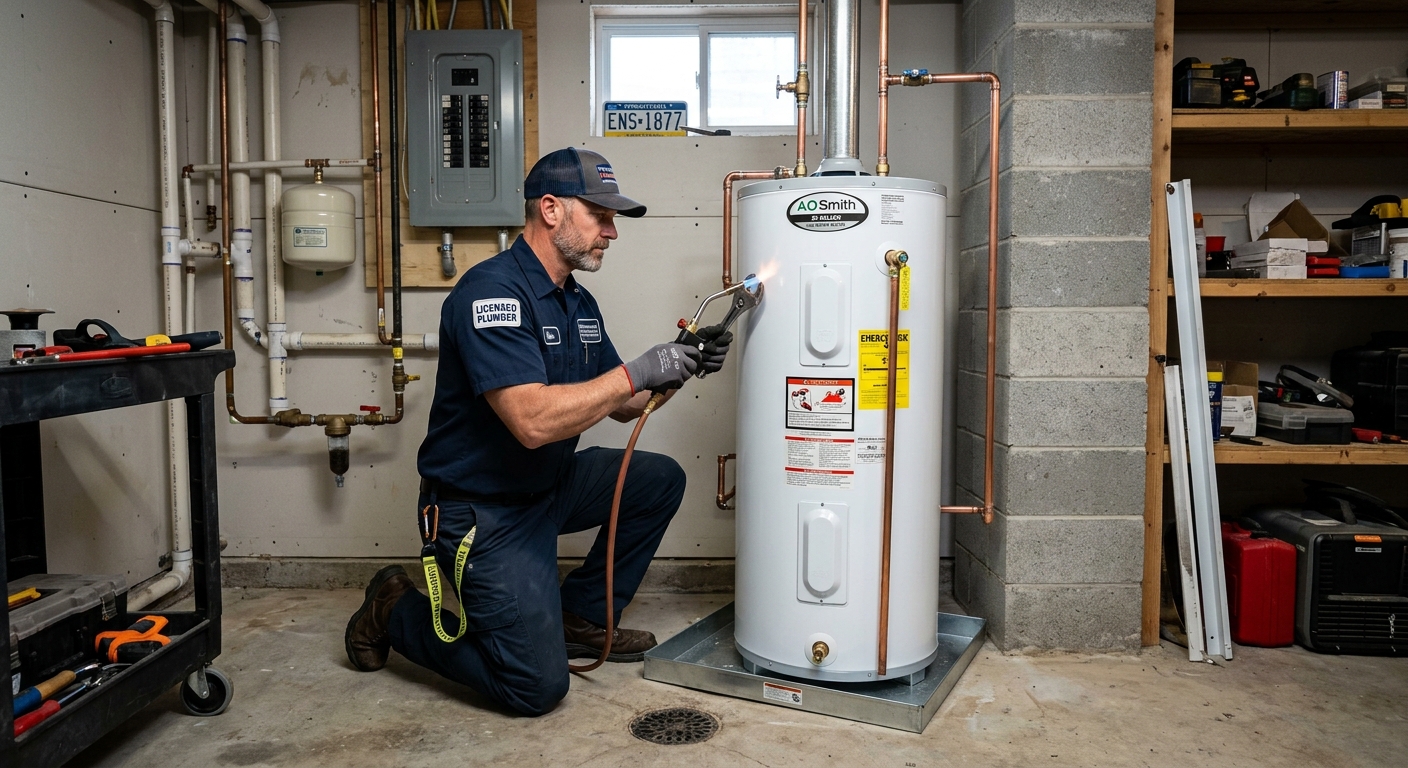
What plumbers charge in Northampton
In Northampton, plumbing costs follow the region’s challenges—high homeownership and a majority of homes built before 1980 (U.S. Census Bureau, ACS 2024) mean repair trends and prices are shaped by older pipes and fixtures. Two jobs never cost the same depending on whether it’s an emergency. That split matters: if you’re calling at night with water in the basement, you’ll pay towards the upper end. If you can wait for a scheduled visit, you stand to save a real sum.
The price you pay is tied to the era of your home. Levittown in Falls Township, just to the southeast, is a case in point: waves of homes from the post‑1950 boom filled Bucks County with undersized copper and galvanized plumbing. These pipes corrode and clog long before PVC, making them frequent candidates for repairs or total replacement. The material in your walls predicts everything from routine leaks to catastrophic failures, and directly sets repair costs.
The table below shows what Northampton homeowners pay for the most common jobs:
| Service |
Scope |
Emergency rate |
Standard rate |
| Emergency repair — burst pipe |
locate, open, repair section, restore service |
$700–$1,450 |
$425–$1,450 |
| Water heater replacement (gas, 40–50 gal) |
remove old, install, test, haul away |
$2,300–$3,400 |
$1,450–$3,400 |
| Drain cleaning — main line |
augering or hydro-jet, camera if needed |
$350–$800 |
$200–$500 |
| Sewer line spot repair |
excavate or reline a failed section |
$2,400–$14,500 |
$2,400–$14,500 |
| Whole-house repipe |
replace supply lines throughout, patch and finish |
|
$4,200–$10,000 |
| Water service line replacement |
street to house, excavation and restoration |
|
$6,600–$14,500 |
Estimates for a typical Northampton home. Access difficulty and pipe material move these figures more than anything else.
Sewer laterals: the pipe you own and can't see
Most Northampton homeowners are surprised to learn they own and are responsible for the pipe—the lateral—that runs from their house all the way to the public main, even if it crosses the sidewalk or street. This creates confusion and frustration, especially when a blockage or break leads to a backup or water in the basement. Bucks County’s mix of older and newer housing means laterals are often clay tile or cast iron in the older neighborhoods, both of which are susceptible to root intrusion, fractures, and collapsed sections.
The first sign of trouble is usually a single slow drain. When more than one drain slows down or you hear gurgling toilets after laundry or shower usage, the problem is further down the line—possibly in the sewer lateral itself. Sewage backing up at the lowest fixture means it’s critical. Never allow anyone to quote excavation or major repair without showing you the results of a camera inspection. This diagnostic reveals if your problem is tree roots, a broken section (offset), or a "belly" where waste collects.
Bensalem and northern townships in Bucks County still have homes on individual septic systems, especially outside the main boroughs. With septic, slow drainage may mean it’s time for pumping (usually every 2–4 years), not digging up the yard. Drainfield failure presents with persistent soggy ground or sewage odors outside, not just slow plumbing inside.
For sewer laterals, you’ll usually face two choices: open trench replacement, which is disruptive but thorough, and trenchless relining, which can save your yard. Insist on seeing camera footage—never trust a quote based only on guesswork or surface symptoms.
How to find a good plumber in Northampton
In Northampton, hiring a qualified plumber means checking more than just an ad or truck decal—plumbing is municipally licensed, and not all Bucks County plumbers are authorized everywhere. Always verify that your chosen contractor holds a valid Home Improvement Contractor (HIC) registration from the Pennsylvania Office of Attorney General for jobs over $500 (check at hic.attorneygeneral.gov), and check that they have liability insurance listing your address. For any employer, confirm their workers' compensation coverage through the WCAIS system (wcais.pa.gov) before they step onto your property.
If a company claims its licensing “covers Bucks County,” don’t accept that—each township (like Bensalem) may have its own requirements and inspectors. You want a plumber who runs their own crew, not one who simply subs out everything. Emergency work should always include clear pricing in writing before the work starts, and ask if they charge extra for late hours or holidays.
- Verify HIC registration at hic.attorneygeneral.gov
- Confirm insurance certificate names your property address
- Check active workers’ comp coverage at wcais.pa.gov
- Ask if the plumber is licensed in this specific township
- Get a written contract for work over $500 (per HICPA)
- Require written scope and itemized pricing up front
- Ask if the company uses full-time employees or subcontractors
- Request references from Bucks County jobs, not elsewhere
- Clarify emergency dispatch pricing, including after-hours fees
- Never accept a sewer or repipe quote with no camera footage or pressure test
- Insist on permit details if piping or fixture counts are being changed
- Look up lead certification for pre-1978 homes at certifiedrenovatorsearch.epa.gov
Red flags in the crowded Philadelphia metro market are lowball “flat rates,” reps who can’t show paperwork instantly, or push a full repipe or sewer job with nothing but a guess. With so many contractors active here, you can always shop around.
Emergency rates versus scheduled work in Northampton
In Northampton, plumbing emergencies trigger a different kind of billing: the emergency premium. This higher rate covers after-hours dispatch—someone dropping everything to drive out, overtime labor (often at 1.5x or 2x normal wage), a trip fee for getting to your address right away, and the extra risk and speed required to diagnose under pressure. If you call at 11 p.m. with water running in your basement, you’ll be quoted closer to $1,450 for a repair that might run $425 the next morning during business hours.
Some problems are true emergencies. If you have:
- Active flooding from a burst pipe
- No water service at all
- Sewage backing up into a tub, sink, or floor drain
- A gas smell near a water heater or furnace
—call right away. Waiting risks major property damage or health hazards.
Other issues can almost always wait until business hours:
- A slow drip from a faucet or under-sink pipe (bucket underneath until morning)
- One slow drain if others are fine
- A running or “phantom flush” toilet
To stop a crisis from getting worse, know how to turn off your main water shutoff—usually where the water line enters your basement. For most sinks and toilets, there’s a shutoff valve right below the fixture. Closing these at the first sign of trouble can take your problem out of “emergency” billing territory entirely. Waiting for a standard appointment can save Northampton homeowners $300–$700 or more on a single visit.
Verifying a Northampton plumber's credentials
Plumbing licensing in Pennsylvania is handled at the municipal level, not by the state. This matters in Bucks County—Doylestown, Bensalem, and Northampton Township all have their own rules. Just because a plumber is licensed in Philadelphia or Bristol doesn’t mean they’re cleared to work in Northampton Township. When you interview a plumber, the real question is: “Are you licensed to pull a plumbing permit here, in this township?”
For contracts over $500, they must have a Home Improvement Contractor (HIC) registration issued by the Pennsylvania Office of Attorney General. To confirm, look up their number at hic.attorneygeneral.gov. Make sure they will give you a certificate of insurance that lists your property—not just a generic policy. For workers' compensation, all employers in Pennsylvania must be covered, and you should check their status at wcais.pa.gov.
If your job involves changing the piping layout or adding/removing fixtures, local boroughs and townships (for example, in Bensalem) often require a plumbing permit and local code inspection under the Pennsylvania Uniform Construction Code, as enforced by each municipality. Minor swaps, like replacing a faucet inside an existing bath in Falls Township, typically do not trigger permit requirements.
Always check the specific township or borough office for current inspection and permit rules before work begins—you don’t want to be caught unpermitted or uninsured for major projects.
Plumbing systems in Northampton homes
The majority of Northampton homes are single-family and more than half were built before 1980 (U.S. Census Bureau, ACS 2024), which predicts some common plumbing issues. Older homes here are likely to have supply lines made of copper or sometimes galvanized steel; galvanized pipes, common in 1950s–1960s construction, are notorious for accumulating scale and corroding from the inside, leading to low pressure and leaks. Original drain lines are often cast iron (which rusts and clogs internally over decades) or clay tile in their sewer laterals, which attracts tree root intrusion and can collapse or offset where joints fail.
If your house dates to the post-1950 boom, as seen in parts of Levittown and similar developments, the plumbing may still be mostly original. Water heaters in these homes are rarely the first unit—they’re likely on their second or third replacement by now, given typical 10–12 year lifespans. Service lines installed midcentury may be copper, lead, or galvanized, and in some Bucks County neighborhoods, public records show suspected lead service lines awaiting replacement.
Even in houses built after 1980, watch for builder-grade fixtures reaching the end of their reliable service life and stress points where copper meets plastic. All of this means routine inspection and occasional replacement are part of owning a home in Northampton—especially if you haven’t had the pipes checked in the past decade.
What's in the water here
Most Northampton homes draw water from the Bucks County Water & Sewer Authority, which provides a consistent municipal supply. This utility publishes an annual water quality report—you can request it directly or look for it online if you’d like to see recent testing results for chlorine, lead, iron, or hardness.
Hard water is present in parts of southeastern Pennsylvania, sometimes resulting in mineral scale that can shorten water heater and fixture life—especially in older copper systems, leading to pinhole leaks over time. Scale-resistant anode rods help, but if you find your fixtures or water heater elements accumulating mineral deposits, you may consider a water softener. For most homes in Northampton, the economics of whole-house softening are mixed: if you’re not replacing fixtures every few years, it often doesn’t pay for itself—spot-treating at taps where scale is bothersome is usually enough.
If you’re on a private well (more common in northern Bucks townships), your water quality is yours alone to monitor—no one tests it for you. A full mineral and bacteria test every couple of years is a smart move. For most public water users in Northampton, whole-house filtration is rarely needed unless you have a specific complaint; point-of-use filters for taste or odor usually solve the problem at far lower cost. Be cautious about expensive treatments—they're often sold harder than they are needed.
Frequently asked questions — plumbing in Northampton
Repair or replace a leaking water heater?
In Northampton, whether you repair or replace your leaking water heater depends on the source of the leak and the age of your unit. If the leak is coming from a fitting or the pressure relief valve, a targeted repair can cost well under $425 and is worth a try, especially if the tank is less than 8 years old. But if the tank itself is leaking—meaning water is seeping from the body of the heater—it’s not repairable and replacement is the only real fix. Given that most water heaters in this area reach the end of their life between 10–12 years, and with our hard water, tanks rarely go much longer. Replacement, including removal, install, and haul away, typically costs between $1,450–$3,400. Prompt attention saves you from a rupture and unexpected flooding, which can require emergency service (at a premium) if you wait too long.
How do I verify a plumber's licence and insurance?
In Pennsylvania, and specifically in Northampton, plumbing licensing is handled at the local municipality level—not by any state board. For any work over $500, the plumber must have a Home Improvement Contractor (HIC) registration through the Office of Attorney General, which you can confirm at hic.attorneygeneral.gov. For work that needs a permit (like moving piping or changing fixture counts), ask your township’s code office if the plumber holds a license here—licensing isn’t universal across Bucks County townships. Additionally, request a certificate of insurance that actually names your property as insured, not just a general document. For workers' compensation, all Pennsylvania employers must have coverage, and the status is verifiable at wcais.pa.gov. Verifying these is worth your time—they protect you legally and financially on jobs as small as a faucet swap or as large as a $6,900 whole-house repipe.
Should I wait until business hours to call?
Whether to call now or wait until morning hinges on the severity of your situation. In Northampton, true emergencies—like water pouring from a burst pipe, total loss of water service, sewage backing up, or any gas smell—justify an after-hours call and the associated emergency rate (up to $1,450 for urgent repairs). For anything less urgent, like a slow drip, a single slow drain, or a toilet that won’t stop running, you can usually shut off the fixture supply or catch water in a bucket and wait until regular business hours. This can save you between $300–$700 by avoiding the emergency premium entirely. Knowing where your main shutoff is, and how to isolate fixtures, is the difference between a stressful night and a calm morning call with standard pricing.
What does emergency plumbing cost in Northampton?
Emergency plumbing services in Northampton cost more than standard appointments, reflecting after-hours labor, immediate dispatch, and on-the-spot troubleshooting. For a typical burst pipe or active leak, you can expect to pay between $700–$1,450 depending on how soon you need the work done and how easy the pipe is to access. Even drain cleaning after-hours jumps to $350–$800. Sewer line emergencies—like backups that threaten flooding—are much higher, from $2,400–$14,500 for repairs involving excavation or relining. Unless your problem threatens real damage or involves health and safety, waiting for a standard appointment (within regular hours) can save hundreds, making it wise to know when you can use a shutoff valve and safely delay the call.
How long should a water heater last in Northampton?
In Northampton, most water heaters—especially gas models between 40–50 gallons—are expected to last about 10–12 years. Hard water in southeastern Pennsylvania can accelerate corrosion and scale buildup, sometimes shortening life by a year or two. Regularly draining sediment and checking the anode rod helps, but if yours is over a decade old and showing signs of wear, budgeting for replacement is wise. The typical homeowner in Bucks County is on their second or third unit by now, given our housing stock. Replacement costs run $1,450–$3,400 (including installation and haul away), while holding on to a heater that’s well past its prime can bring sudden leaks and higher emergency charges.
Should I leave a faucet dripping in cold weather?
In Northampton and the Philadelphia metro area, winter lows hit 14°F, and older homes with pipes running in exterior walls or crawlspaces are vulnerable to freezing. Leaving a faucet dripping overnight can keep water moving just enough to reduce the freeze risk, especially when a hard freeze is forecast. While it does add a little to your water bill, it’s much cheaper than a burst pipe and an emergency visit, which can cost $700–$1,450 just for the repair. Make sure cabinet doors are open under sinks on exterior walls, and keep garage doors closed. If you’re planning to be away, shut off the supply at the main and drain your lines—it’s a small effort for peace of mind in a region prone to freeze-thaw cycles.
How much does a plumber cost in Northampton?
Plumbers in Northampton charge based on both the service and the urgency. A standard main line drain cleaning is typically $200–$500, while a burst pipe repair runs $425–$1,450 depending on access difficulty and whether it’s after-hours. Major work, like a whole-house repipe, runs between $4,200–$10,000. For water heater replacement—common with our aging housing stock—expect to pay $1,450–$3,400, with emergencies commanding the higher end of each range. Always get a written contract for any project over $500, as required by Pennsylvania’s Home Improvement Consumer Protection Act, and insist on a detailed scope so you’re not hit with surprises.
Who pays to replace a lead service line in Northampton?
In Northampton and the broader Bucks County, if your home has a lead service line, replacement is generally the homeowner’s responsibility from the property line to the house, even if the line passes under a public street. The Bucks County Water & Sewer Authority has confirmed about 2,000 known or likely lead lines countywide. Full water service line replacement—including street excavation and restoration—usually runs $6,600–$14,500, depending on how much of the line is on private land and the complexity of accessing it. Some utility districts and government programs may offer financial aid or prioritized replacements, but it is best to budget for the full cost unless you receive written notice of assistance. Always verify with the Authority and your township before scheduling the work.
Are tree roots a common sewer problem in Northampton?
Yes, tree roots are a frequent cause of sewer issues in Northampton, especially in older homes where laterals are clay tile or unlined cast iron. These materials—widespread in pre-1980 construction—develop tiny gaps or cracks at their joints, providing entry points for roots seeking moisture. The first sign is usually gurgling drains or backups at the lowest fixture after rain. Clearing roots mechanically (with an auger or hydro-jet) costs between $200–$800, but severe intrusions often require spot repair or trenchless relining, starting at $2,400 and up. Always ask for a camera inspection before any excavation—seeing the condition of your own lateral will determine if you can get by with cleaning or if repair is needed, avoiding unnecessary digging and high bills.