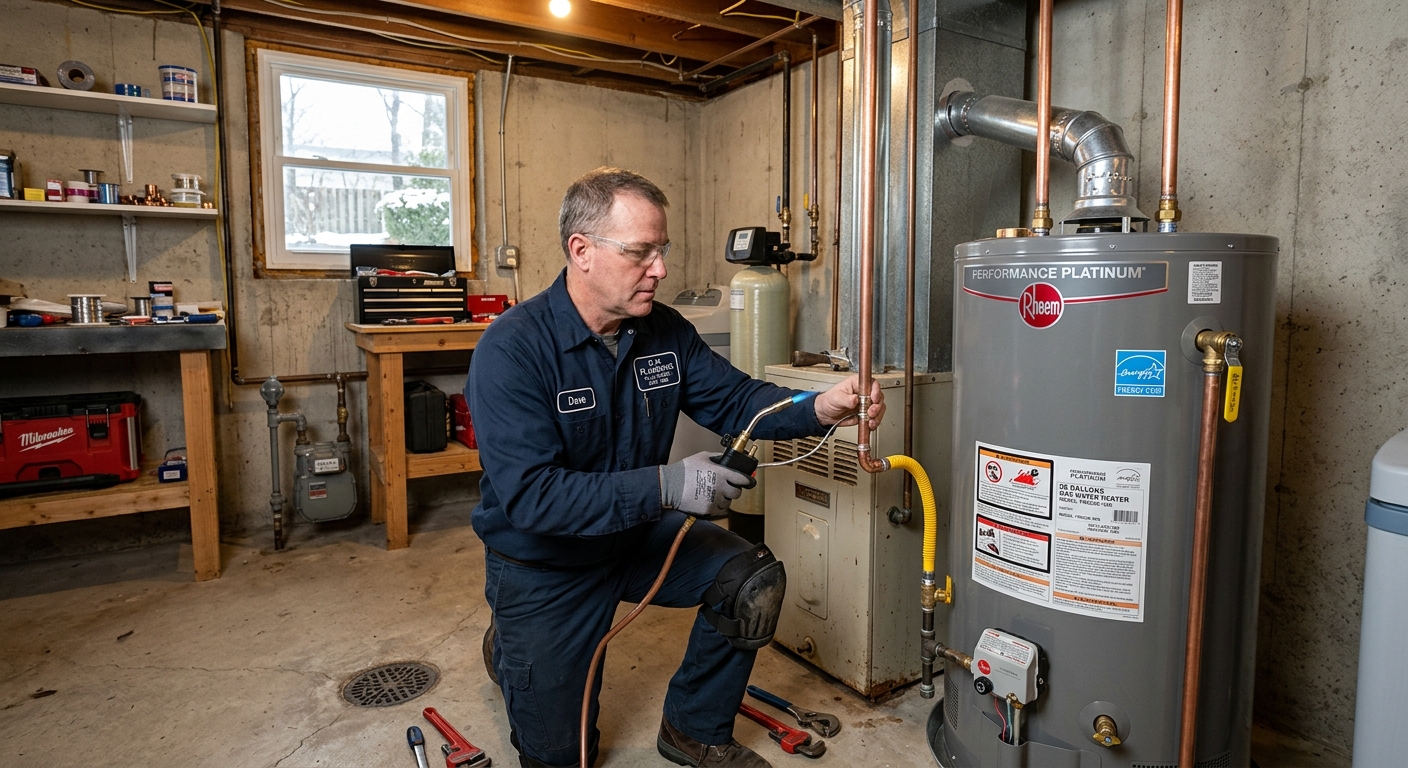
What plumbers charge in Fox Chapel
Fox Chapel’s plumbing costs reflect its housing mix and the reality that nearly three-quarters of local homes were built before 1980 (U.S. Census Bureau, ACS 2024). Older homes, especially those built between 1900 and 1950, are much more likely to have galvanized steel or cast-iron pipes, which mean higher risk of leaks, corrosion, and partial or whole-house repiping. In practical terms, the year your house was built is the most important factor in what a given repair or upgrade will cost—not just because of what’s already in the walls, but how accessible it is.
Emergency work always commands a higher price—sometimes double—compared to planned, standard-rate work. When you’re dealing with a burst pipe in the middle of January or a flooded basement with no time to wait, expect the high end of the price band. Fox Chapel’s high homeownership rate (92.5%) and overwhelmingly single-family housing (96.3%) mean emergency and large-scope plumbing jobs are common, not just fixture swaps. Below is an honest snapshot of typical charges in this area—emergency call or not—using actual Fox Chapel market price bands.
| Service | Scope | Emergency rate | Standard rate |
|---|
| Emergency repair — burst pipe |
locate, open, repair section, restore service |
$650–$1,300 |
$375–$1,300 |
| Water heater replacement (gas, 40–50 gal) |
remove old, install, test, haul away |
$2,100–$3,100 |
$1,300–$3,100 |
| Drain cleaning — main line |
augering or hydro-jet, camera if needed |
$350–$800 |
$200–$500 |
| Sewer line spot repair |
excavate or reline a failed section |
$2,200–$13,000 |
$2,200–$13,000 |
| Whole-house repipe |
replace supply lines throughout, patch and finish |
$6,100–$13,000 |
$3,900–$9,400 |
| Water service line replacement |
street to house, excavation and restoration |
$8,100–$13,000 |
$6,100–$13,000 |
Estimates for a typical Fox Chapel home. Access difficulty and pipe material move these figures more than anything else.
Verifying a Fox Chapel plumber's credentials
In Pennsylvania, plumbing is not licensed at the state level. Instead, it is regulated municipality by municipality. This means that a plumber who is licensed and permitted to work in one Allegheny County township might not be qualified (or even allowed) to pull permits in another—you need someone licensed to work specifically where your property is.
For Fox Chapel and its neighboring municipalities, the Allegheny County Health Department operates its own journeyman and master plumber licensing program, handling permits and inspections for new or altered plumbing systems. If you’re hiring for a remodel, repipe, or anything more than a new faucet, ask: “Are you licensed through the Allegheny County Health Department, and can you pull permits here?” For jobs over $500, Pennsylvania law (Home Improvement Consumer Protection Act) requires a written contract, a Home Improvement Contractor (HIC) registration number (look it up at hic.attorneygeneral.gov), and proof of workers’ compensation insurance (verify using WCAIS at wcais.pa.gov).
For minor fixture replacements—like changing a faucet or showerhead—a plumbing permit isn’t usually required in Allegheny County. But any new or modified piping does need both a permit and inspection. If in doubt, call the Health Department to confirm permit requirements before any work starts. Always verify credentials yourself— reputable plumbers welcome it.
Camera inspection, relining and replacement
In nearly every case in Allegheny County, including Fox Chapel, the homeowner owns the sewer lateral from the house all the way to the main—sometimes even into the street. If there’s a clog or break, you’re on the hook for the full cost of repair. Most problems aren’t sudden; they start as one slow drain, then multiple slow drains, followed by sewer gurgling or backups at the lowest fixture (usually a basement toilet or tub). Once you see slow drainage in more than one spot, get it inspected.
The single most critical step before taking any action—excavation or otherwise—is a camera inspection. You should never agree to a dig or lining without seeing that footage and understanding the problem first. In older Fox Chapel homes with clay tile or cast-iron lines, root intrusion, collapsed pipe, or “bellies” (pipe sagging and trapping water) are common finds. A camera will show exactly where and what the problem is. In these homes, roots love clay tile joints; cast iron often rusts at the bottom.
If your home is in an outlying Allegheny County township, you'll want to confirm if you are on public sewer or still using a septic system—septic problems are different (tank pumping every 3–5 years, drainfield issues). But in most Fox Chapel properties, you face the combined sewer system typical of Pittsburgh. For repair, you may see “open-cut replacement” (excavation) or “trenchless” relining or bursting. Each has pros and cons—trenchless is less disruptive, but not possible in every case. The right call comes from what the camera finds, not generic advice.
Is your water line lead? How to find out
Pittsburgh Water and Sewer Authority (PWSA) supplies most homes in Fox Chapel and central Allegheny County, where thousands of lead service lines are still in the process of replacement. The service line—the buried pipe from street to house—typically has a public (utility) and a private (homeowner) segment. PWSA and similar utilities often replace only the public side, leaving homeowners responsible for the rest. If your house was built before 1950, there’s a very real chance your lateral could be lead, especially if records are missing or unclear.
The best way to identify pipe material at the point where it enters your basement: scratch a small area clean. Lead will be soft and shiny, and a magnet will not stick. Copper will be reddish metal; galvanized steel is matte gray and magnetic. If your water line is lead or unknown, go to PWSA’s website to check their published service line inventory. If your address isn’t listed, do not assume you are in the clear—reach out to the utility and ask directly about the status and any existing programs.
Full replacement (both public and private sides) in Fox Chapel typically costs $6,100–$13,000, though this depends on yard, driveway, and distance. Partial replacement can be worse than none due to disturbed scale and potential spikes in lead at the tap. Never rush to replace just your side—pursue a coordinated full replacement if possible. The utility can confirm what they will (and won’t) pay for, and the rest is on the homeowner.
Water quality and what it does to your pipes
Like most of central Allegheny County, Fox Chapel's water is supplied by the Pittsburgh Water and Sewer Authority, which publishes an annual water quality report. Request it to know exactly what’s in your tap water—especially regarding hardness, pH, and overall mineral content. Hard water, common in older Pittsburgh-area systems, leads to scale buildup inside water heaters and fixtures, reducing efficiency and shortening lifespan.
On the other side, overly aggressive (softened) water can cause pinhole leaks in copper pipe well before their time, especially in homes with older solder joints. While water softeners can help extend the life of your appliances if you have visible scale or “hard” water, they’re not a cure-all—if your system is relatively balanced, payback can take years and may not cover the cost. Point-of-use filters on kitchen sinks are often a smarter spend than whole-house systems unless you have a specific contaminant you’re targeting.
If you’re on a private well (not common in Fox Chapel proper), you won’t get a published report—regular testing for bacteria and minerals is critical. For most Fox Chapel residents, annual or semiannual flush of the hot water tank and periodic cartridge changes on any filter systems are enough to keep pipes and appliances running at their best. Avoid overspending on miracle filtration promises—your water utility or a licensed plumber can read a report honestly.
Tank, tankless or heat pump water heater?
Choosing a water heater for a Fox Chapel home—many of which are older, with basements or tight mechanical spaces—means weighing installation costs, space, and runtime needs. A traditional tank water heater is still the cheapest to put in, but usually fails after 8–12 years due to internal rust. Tankless “on-demand” units offer energy savings and endless hot water, but gas models can require a larger gas supply line and different venting—common surprises in homes built 1900–1950. Heat pump water heaters are the new contender: they use less energy, but need lots of air and will cool off the space they’re sitting in, which isn’t ideal for a finished basement.
Sizing should be by first-hour rating (how much hot water it delivers at peak), not just gallons. Expansion tanks, pans, and floor drains are code in many upgrade scenarios. In Fox Chapel, gas is readily available, but installation complexity in older homes can push the price to the high end of these ranges. Most failures are from tank corrosion, not controls, so when it’s done, it’s done.
| Type | Installed cost | Service life | Operating cost | Best when |
|---|
| Gas tank, 40–50 gal |
$1,300–$3,100 |
8–12 yrs |
moderate |
Most older homes, gas line present, mid-size family |
| Electric tank, 40–50 gal |
$1,300–$2,100 |
10–15 yrs |
high |
All-electric homes, simpler install, fewer venting headaches |
| Gas tankless |
$2,100–$3,100 |
18–25 yrs |
low-moderate |
Endless hot water needed, space-saving, willing to upgrade gas line |
| Heat pump water heater |
$2,100–$3,100 |
13–15 yrs |
lowest |
Big utility savings, unfinished basement or mechanical room |
The point where patching stops making sense
In Fox Chapel’s housing stock—where many homes date from 1900–1950—calls about leaks and water pressure issues almost always trace back to aging pipe material. The critical threshold is this: if you’ve had two or more leaks in the same section or branch of pipe within three years, especially in galvanized or copper, it’s not bad luck—it’s the material wearing out. If your water pressure is weak across every fixture, or you notice rusty or discolored water in the morning, you’re likely overdue for a repipe.
Repeated pinhole leaks, visible rust on exposed pipes, or even a single leak behind a difficult wall usually signals that spot repairs are only a Band-Aid. When considering a whole-house repipe in Fox Chapel, homeowners compare copper and PEX. Copper is durable but expensive and takes longer to install; PEX is flexible and faster, but needs to be installed by someone who knows the material. Most forget the cost of drywall or plaster repair: older homes with pristine plaster walls can end up spending nearly as much on paint and patching as on the plumbing itself.
| Situation | Recommendation | Cost | Reasoning |
|---|
| One leak, accessible, modern pipe |
Spot repair |
$375–$1,300 |
Isolated issue, low disruption, newer material |
| Two or more leaks in 3 years |
Partial repipe |
$3,900–$6,300 |
Recurring leaks indicate systemic pipe failure |
| Galvanized supply, pressure loss |
Full repipe |
$3,900–$9,400 |
Internal buildup and corrosion in aging steel pipes |
| Polybutylene anywhere in the house |
Full repipe |
$3,900–$9,400 |
Known to fail unpredictably, insurance issues |
| Cast iron drain with root intrusion |
Camera, then reline or replace |
$2,200–$13,000 |
Only a camera can confirm the best fix |
| Suspected lead service line |
Test, then replace the lateral |
$6,100–$13,000 |
Health risk, and resale demands disclosure |
Frequently asked questions — plumbing in Fox Chapel
How much does sewer line repair cost in Fox Chapel?
Sewer line repair costs in Fox Chapel can range widely. For a typical spot repair—digging up and fixing a failed section—you should expect to pay between $2,200–$13,000 depending on how deep the sewer is, how hard the access is, and whether you end up with an open trench or a trenchless relining. Homes in Fox Chapel, much like the rest of Allegheny County, often have long runs to the street and lines passing under paved driveways or mature landscaping, which can increase costs at the high end. Before you sign any contract or commit to excavation, always insist on seeing camera footage so you know you’re fixing the real problem, not just the symptom. Trenchless repairs may be available in some situations and can save money if conditions are right.
Do I need to drain outdoor spigots in Fox Chapel?
Yes, you should drain and shut off your outdoor spigots before winter in Fox Chapel. Our area faces frequent freeze-thaw cycles and the winter design temperature drops as low as 8 °F, which puts outdoor plumbing at serious risk for burst pipes. Replacing a burst pipe or split sillcock typically costs anywhere from $375–$1,300, not including water damage inside the house. Always use the shutoff valve inside, usually in the basement, open the outside spigot to let it drain fully, and disconnect hoses well before the first hard freeze. Frost-free sillcocks help, but only if installed and pitched correctly. Preventive action in the fall saves expensive repairs later.
How do I tell what my pipes are made of?
The best way to identify pipe material in a Fox Chapel home is a hands-on check—especially at the water main entry or in the basement. Scratch the surface with a key or screwdriver: copper is reddish and not magnetic, galvanized steel is dull gray and magnetic, lead is soft, bends easily, and isn’t magnetic. Polybutylene is gray or blue plastic with a slightly flexible feel. If you suspect you have galvanized or lead pipe—which is common in homes built before 1950—you’re likely looking at future repairs or replacement. A camera inspection of the drain lines will confirm cast iron, clay, or plastic. Replacement for problematic material (like lead or old galvanized) usually runs $3,900–$9,400 for a full repipe.
Who pays to replace a lead service line in Fox Chapel?
In most of Fox Chapel, served by the Pittsburgh Water and Sewer Authority, the responsibility for replacing a lead service line is split between utility and homeowner. The public side (from main to curb) may be replaced by the utility, but the private side (curb to house) is almost always on you as the property owner. PWSA does run replacement and cost-share programs at times, but you can’t assume eligibility—contact them directly and check their current policies. If you need to replace your portion, plan for a cost between $6,100–$13,000 depending on length and access. Partial replacements should be avoided if possible, as they can increase lead levels in the short term after work is complete.
Why do plumbers charge a diagnostic fee?
In Fox Chapel and throughout Pennsylvania, most plumbers charge a diagnostic or “trip” fee for coming out and determining the cause of a problem. This fee, which is usually in the $200–$500 range, covers the time, tools, and expertise needed to inspect your system, run a camera, and give you an accurate estimate. It guarantees you’re getting a professional’s eyes on your problem—and if the issue is immediately obvious and fixable, some plumbers will apply the fee toward completed repairs. Residential plumbing is specialty work, and dispatching a licensed expert costs money, especially when homes in Fox Chapel may have hidden or outdated piping behind finished walls. Always request a full written estimate before work starts, and ask if the fee applies to the total bill.
Are tree roots a common sewer problem in Fox Chapel?
Yes, tree root intrusion is a frequent cause of sewer backups in Fox Chapel, thanks to the area’s mature landscaping and the high percentage of older homes using clay tile or cast iron sewer laterals. Roots seek out small cracks and pipe joints where moisture escapes, eventually clogging or even breaking the line. Clearing a root clog with a snake or hydro-jet usually costs $200–$800, but repeated issues signal a bigger problem: either a collapsed pipe or major offset. The right solution is a camera inspection to pinpoint exactly where the intrusion is. Persistent root issues often mean it’s time for a trenchless reline or, in worse cases, an excavation and replacement.
How do I shut off the water to my house?
In most Fox Chapel homes, the main shutoff valve is found in the basement where the water line comes in from the street—look for a round handle or lever-type valve on the pipe just after it enters the foundation. Older homes may have a valve that’s stiff or hard to turn; if so, do not force it—replacing or servicing a stuck main valve can cost $375–$1,300. If you can’t locate it or are unsure, your water utility (Pittsburgh Water and Sewer Authority) can provide guidance, and having this knowledge ahead of a leak or emergency can save significant water damage. It’s good practice to test the valve annually, so you’re not caught off guard when an urgent situation arises.
How do I verify a plumber's licence and insurance?
For Fox Chapel, always ask any plumber if they are licensed through the Allegheny County Health Department for plumbing work in your municipality. Do not settle for a “yes”—ask for the actual license or registration number. Contractors taking on jobs worth more than $500 must show a Home Improvement Contractor (HIC) registration, which you can check directly at hic.attorneygeneral.gov. Request a certificate of insurance for workers’ compensation and cross-check using the Pennsylvania workers’ comp system at wcais.pa.gov. For larger work, expect to see their permit issued by the Health Department. A reputable plumber will provide all of this without hesitation—if not, move on. Plumbing is a regulated trade, and verifying these details helps protect you from unlicensed or uninsured contractors who may leave you responsible for shoddy work or injuries. For a typical licensed plumbing repair, expect between $375–$1,300.
Is trenchless sewer repair reliable?
Trenchless sewer repair—such as pipe relining or pipe bursting—is a well-proven method in Fox Chapel, especially when dealing with older clay or cast iron lines common in this area. Done correctly, it can last 30–50 years and often costs less in yard and hardscape repairs than open trenching. A typical trenchless spot repair runs $2,200–$13,000 depending on length and accessibility. But be careful: not every pipe is suited for trenchless methods (heavy offsets, severe collapse, or small pipe sizes can be a barrier). The only way to know for sure is a camera inspection by a licensed plumber who will show you the footage and explain your real options. In the right scenario, trenchless is both reliable and less disruptive—but accept no trenchless contract sight-unseen.