Plumbing costs in Muhlenberg — 2026
Muhlenberg's plumbing costs can surprise first-time homeowners — and the wide homeownership rate (81.9%) means many local residents face these choices for the long haul (U.S. Census Bureau, ACS 2024). Age matters: with 63.0% of homes built before 1980, large numbers of houses in Muhlenberg and other inner Berks County townships were originally plumbed with cast iron drains and galvanized steel supply lines. These materials dictate both what will break and how much it will cost when repairs are needed.
In Muhlenberg, every job has two prices: the planned job, where you have time to compare quotes, and the emergency — evenings, weekends, or actively leaking water. Emergency rates are higher, covering rapid response and after-hours work. Pipe leaks, water heater failures, and main line blockages are nearly always emergencies. Services like replacing a water heater or repiping an old house can often be planned to avoid that premium. The table below gives real-world price ranges in the local market, shaped most by how difficult it is to access the work and what pipe materials you're dealing with.
| Service |
Scope |
Emergency rate |
Standard rate |
| Emergency repair — burst pipe |
locate, open, repair section, restore service |
$600–$1,200 |
$350–$1,200 |
| Water heater replacement (gas, 40–50 gal) |
remove old, install, test, haul away |
$1,850–$2,800 |
$1,200–$2,800 |
| Drain cleaning — main line |
augering or hydro-jet, camera if needed |
$350–$800 |
$200–$500 |
| Sewer line spot repair |
excavate or reline a failed section |
$1,950–$12,000 |
$1,950–$12,000 |
| Whole-house repipe |
replace supply lines throughout, patch and finish |
|
$3,400–$8,400 |
| Water service line replacement |
street to house, excavation and restoration |
|
$5,400–$12,000 |
Estimates for a typical Muhlenberg home. Access difficulty and pipe material move these figures more than anything else.
Service line material and drinking water in Muhlenberg
The pipe that carries water from the main under the street to your house in Muhlenberg is called a service line. There's a split responsibility: the Reading Area Water Authority owns the section up to your curb or property line, but beyond that — everything to your water meter inside — is yours to maintain.
The City of Reading has reported thousands of lead service lines in its inventory and is engaged in a multi-year replacement program. This matters, because homes with lead or galvanized service lines are much more likely to see elevated lead in drinking water. Replacement programs often cover just the utility side; if your private lateral is lead, you're still responsible for replacing it on your dime, which typically runs $5,400–$12,000 for full street-to-house excavation with restoration. If you have only a few feet to replace inside your property line, costs tilt to the lower end, but access, pavement, and landscaping all drive the price.
To check your own pipe, open the main shutoff and gently scratch it with a coin at the entry point. Lead is dull, soft, and gray; copper is orange and shiny; galvanized is gray but hard, and will grab a magnet. Partial replacement — swapping one section to copper or plastic but leaving lead on the other side — can disturb scale and temporarily increase lead at the tap, so full replacement is always safest. The Reading Area Water Authority maintains a published inventory online and should be contacted directly about current assistance, as the scope and availability of cost sharing can change.
For those facing full replacement, costs are similar to a full water service line job, with Buch to $12,000 possible for long runs under pavement but commonly $5,400–$8,000 in the township.
Plumbing systems in Muhlenberg homes
Muhlenberg’s houses were mostly built in the big wave from 1940 to 1970, with 63.0% older than 1980. This means your plumbing was probably installed with cast iron drain pipes, galvanized steel or early copper for supply, and possibly even lead for the water service line from the street. These materials are what now drive most repairs: cast iron eventually rusts and cracks, leading to sewer backups; galvanized steel supply pipes clog with rust and reduce water pressure; and lead service lines, still present in parts of Reading and adjacent areas, raise water quality concerns.
If your house is at the younger end of the spectrum — say, built after 1970 — you’re more likely to have copper or even early PEX for water supply, and PVC for drains. Most likely, these homes still have their original builder-grade fixtures, and if it’s a 1980s model, you could even see polybutylene pipe (notorious for later failures). In both groups, water heater age is telling: pre-1980 homes are almost always on a second or third water heater, while 1980s-2000s homes are now reaching end-of-life for the original or second one.
The bottom line: in Muhlenberg, older means watching for leaks and blockages from pipe aging. Newer means builder-grade parts may just be tiring out, especially water heaters or pressure valves. If you're not sure what you have, any plumber used to Berks County can tell by looking at your exposed pipe and fittings.
Finding a hidden leak in Muhlenberg
The first thing any homeowner in Muhlenberg should do to check for a hidden leak is simple and free: the meter test. Shut off all water-using appliances and fixtures. Watch your water meter; if the dial or digital readout moves, you’ve got a leak somewhere in the supply system, even if you can’t see or hear it.
Once you know there’s a leak, professionals move to non-destructive tools. Acoustic listening devices pick up pipe hissing or dripping in walls or under slabs, costing about $350–$1,200 for a full detection and repair if it’s an emergency call. Thermal cameras can spot moisture through walls, while tracer gas — safe, odorless — is pumped in and then “sniffed” with sensors to find escape points. Slab leaks, common in ranch houses or additions, often require both listening and gas tracing to avoid busting up concrete for no reason.
Leaks inside wall cavities or hidden irrigation lines are found without tearing everything open first; if a plumber leads with demo, something’s wrong. In older Muhlenberg homes, leaks usually turn up at old fittings, frozen sections near exterior walls, or corroded elbows. Hydrostatic tests and careful isolation with listening tools are the only ways to confirm location before opening up — minimizing damage and cost.
Hardness, treatment and fixture life in Muhlenberg
Most homes in Muhlenberg are on the Reading Area Water Authority system, which publishes an annual report you can request for free. Typical of much of Berks County, hardness is moderate, so scale builds in water heaters and shortens their useful life, especially where homes go years between flushes. Hard water can leave deposits on fixtures and shower heads but isn’t damaging to health.
Aggressive water — low pH — can cause pinhole leaks in copper lines. This crops up in a minority of homes, but if you see blue-green stains or tiny drips at solder joints, it’s worth testing. Home softeners are common, but unless you’re fighting extreme scale or want truly “soft” shower water, they often don’t pay back their cost. Most units run $800–$2,000 installed, with future salt expenses.
Whole-house filtration is only a necessity if you have taste, odor, or chlorine issues; more often, a simple filter at the sink does the trick. I rarely see filter systems save more money than they cost, unless you live with well water nobody is testing — which is not the case for most of Muhlenberg. If you are on a private well, test it yearly for bacteria and chemicals, since no agency is watching your water for you. Otherwise, before buying any treatment, get your results in writing and judge based on facts, not a salesperson’s pitch.
Water heater replacement decisions
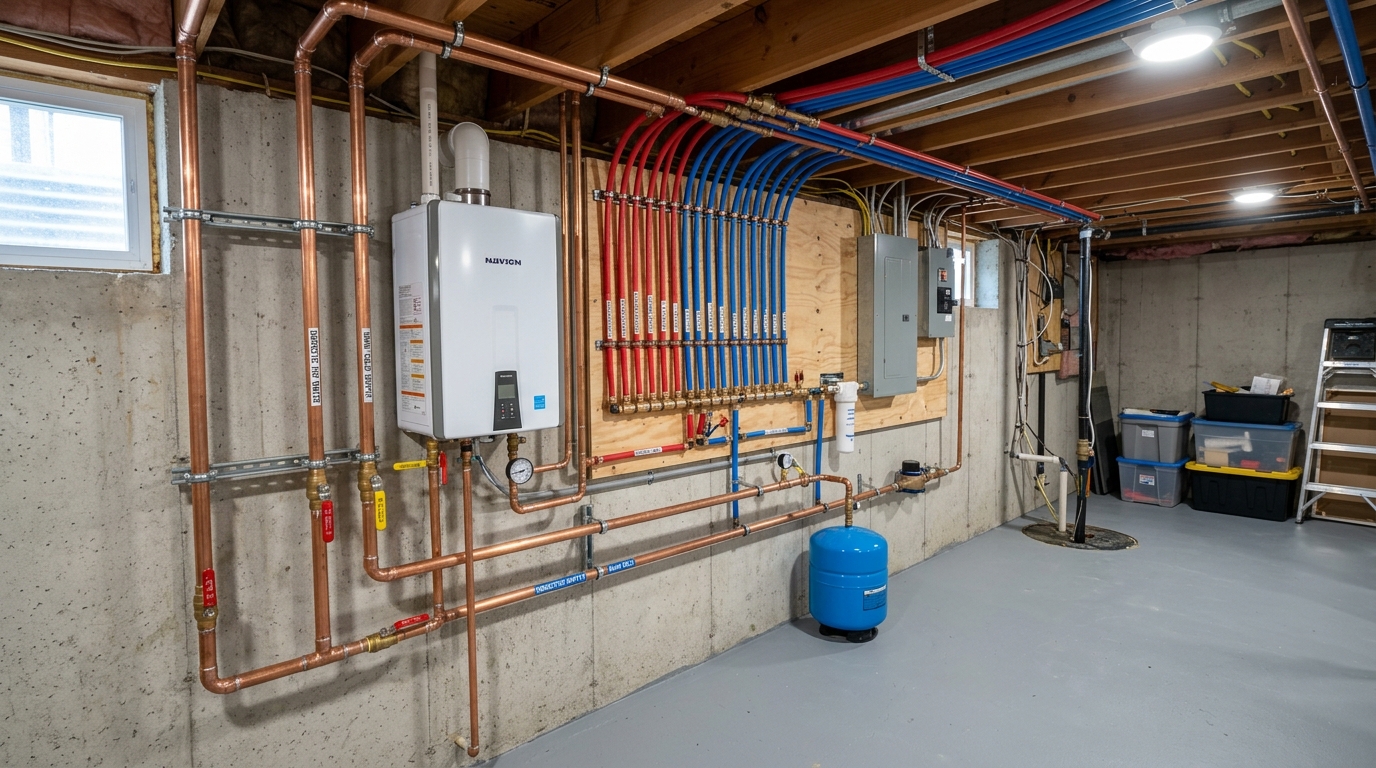
In Muhlenberg’s older homes, replacing a water heater is a regular event. Your broad choices are still tank, tankless, or (less common but rising) heat pump. Standard tank water heaters are cheapest up front and fit where an old one sits, but last the shortest time and waste some heat just holding water hot. Tankless units provide endless hot water, but most gas models require a larger gas line and venting upgrade. That can mean more plumbing and wall patching than many expect — and the installation price jumps. A heat pump water heater (HPWH) has the lowest operating cost, extracting heat from surrounding air, but needs a warm spot and at least 800 cubic feet of air space to avoid cooling your finished basement.
True payback? Tank units make sense for most. Tankless only pays back for bigger households or those running long, back-to-back showers, and can run noisy if the gas size/venting isn't upgraded right. HPWH units make most sense when you’re replacing an electric tank and can tolerate some cool-down in the room. When sizing, always use the first-hour rating — not just gallons — to be sure the heater meets your highest-use period. Expansion tanks are now standard for closed systems, and always set your unit in a pan with a real floor drain to avoid ceiling leaks below. When water heaters fail, it’s almost always the tank rusting through, not electronics or valves.
| Type |
Installed cost |
Service life |
Operating cost |
Best when |
| Gas tank, 40–50 gal |
$1,200–$2,800 |
8–12 yrs |
moderate |
Existing gas and vent, lower upfront cost |
| Electric tank, 40–50 gal |
$1,200–$1,850 |
10–15 yrs |
high |
No gas line, budget install, space heat not critical |
| Gas tankless |
$1,850–$2,800 |
18–25 yrs |
low-moderate |
Whole-house capacity, upgrades possible, longer life |
| Heat pump water heater |
$1,850–$2,800 |
13–15 yrs |
lowest |
Large open space, electric-only, lowest bills |
Licensing and permits for plumbing work in Muhlenberg
Pennsylvania does not have a statewide plumbing license. Every municipality decides for itself whether or not it licenses the plumbing trade. In Berks County, the City of Reading has its own plumbing trade license and registration process for work within city limits. Muhlenberg Township, like most townships around Reading, enforces code locally or via a third-party, but does not issue a plumbing trade license. This means a plumber working legally in Reading might not have any credential in Muhlenberg, and vice versa. The proper question to ask isn’t just “Are you licensed?” — it’s “Are you registered and permitted to work here?”
Permits: In Reading, any plumbing system installation, alteration, or replacement that’s more than a direct swap (like-for-like faucet or showerhead) needs a permit. Most Berks townships, including Muhlenberg, are similar: replacing water heaters, running new lines, or roughing in a bathroom means pulling a permit and passing inspection. Faucets and showerheads inside existing baths are commonly swapped with no permit, but bigger jobs require oversight. For any contract over $500, Pennsylvania requires Home Improvement Contractor registration — check the number at hic.attorneygeneral.gov. Make sure your plumber also carries workers’ compensation insurance, especially if anyone else is on the crew; confirm at WCAIS (wcais.pa.gov). A written contract and a right to cancel are your legal protections on any big job.
Frequently asked questions — plumbing in Muhlenberg
How much does sewer line repair cost in Muhlenberg?
Sewer line spot repairs in Muhlenberg range widely because of the different ages and depths of lines in local yards. Most often, a failed section is excavated or relined, with typical jobs running $1,950–$12,000. Older homes with original clay or cast iron laterals are more likely to see problems where roots, ground shifting, or decades of rust cause breaks or sags. With our mix of moderate frost and freeze-thaw cycles, deeper pipes can mean higher excavation costs, especially if sidewalks or driveways are involved. A camera inspection up front, usually $200–$400, is honest money well spent so you only fix what needs fixing. Ask for a written quote, and if a plumber quotes the top end, make sure you’re not paying for more footage than what’s actually failed.
How long should a water heater last in Muhlenberg?
In Muhlenberg, most standard tank water heaters last 8–12 years before rust or scale causes failure. This is mainly thanks to moderate water hardness from the Reading Area Water Authority, and a mix of original 1970s-to-1990s installs and frequent replacements ever since. Electric tanks sometimes go as long as 15 years if they’re flushed and serviced, but most are replaced for leaking or loss of heat. If your heater is over a decade old and starts showing rust at the connections or under the tank, it’s likely time. Replacing ahead of a rupture saves both water damage and emergency fees, which run $1,850–$2,800 for after-hours installs.
Should I repipe my Muhlenberg home or keep repairing?
The case for a full repipe in a Muhlenberg home comes down to age and frequency of leaks. If you’re in one of the many 1940–1970 houses with galvanized pipe and you’ve patched two or three leaks already, the rust and mineral buildup is only accelerating. Repeated repairs don’t address the section that will fail next month. A whole-house repipe is a big investment — $3,400–$8,400 for most homes — but it pays off in peace of mind and better water flow. If you have only one small, slow leak and your supply lines are copper from the start, a local repair can make sense for a few more years.
Am I responsible for the water line under the street?
In Muhlenberg, the homeowner is responsible for the water service line from the property line (usually the curb) into the house. The Reading Area Water Authority owns and maintains the main in the street, and often the portion up to the curb box. Anything past that — leaks, lead pipe, or a frozen section on your private side — is your job to replace or repair at your own cost. A full service line replacement, from curb to meter, typically runs $5,400–$12,000 depending on length, depth, and restoration. Always check with the utility to clarify exactly where their ownership stops before digging or committing to a big repair.
How deep do water lines need to be buried in Muhlenberg?
Water lines in Muhlenberg and greater Berks County are buried to avoid freezing. The typical frost depth here is 30 inches, so your water service line must be buried at or deeper than that to meet residential code and local building requirements. This helps prevent frozen and burst pipes during the winter months, when cold snaps below 12°F are realistic. Any plumber doing a repair or replacement will know this, and if someone quotes a much shallower trench, that’s a red flag. Underground water service work usually falls into the $5,400–$12,000 range because of the depth and restoration required.
Do I need a permit for plumbing work in Muhlenberg?
Yes, for nearly all plumbing jobs beyond swapping a faucet or showerhead, you will need a permit in Muhlenberg. This includes water heater replacement, rerouting pipes, and roughing in new fixtures. The township (or its third-party inspector) will check the work for code compliance and safety. The only regular exception is like-for-like fixture swaps inside bathrooms, which are often done without permits in Berks County townships. Any contract over $500 is also regulated by Pennsylvania’s Home Improvement Contractor registration. Factor permit and inspection into your job cost, especially for projects in the $1,200–$2,800 range and above.
What counts as a plumbing emergency?
In Muhlenberg, a plumbing emergency is any active water leak, burst pipe, sewer backup, or loss of hot water that threatens damage or the use of the house. With so many older homes, a pinhole leak in a galvanized line can quickly escalate, flooding a basement or soaking plaster walls. Sewer backups are hazardous and must be cleared quickly, not only for your household but to prevent neighbor issues with separated sanitary and storm lines. Emergency repairs often cost more, with a minimum call-out of $600–$1,200 for burst pipes or leaks during nights or weekends. If shutting the main valve solves the issue, you may be able to wait for a regular-hours service and save money.
Do older Muhlenberg homes have galvanized pipes?
Yes, many homes in Muhlenberg built between 1940 and 1970 originally had galvanized steel supply pipes. These pipes corrode internally over decades, leading to rusty water, low flow, and eventually leaks behind walls or at joints. If your house is part of the 63.0% built before 1980, odds are good that some galvanized piping still lingers, even after partial updates. Once leaks start, repairs stack up quickly, making a whole-house repipe ($3,400–$8,400) the only sure fix. Any plumber familiar with Berks County can identify galvanized pipes by look or test, so you don’t have to guess.
How much does a water heater replacement cost in Muhlenberg?
Replacing a standard gas or electric water heater in Muhlenberg typically runs $1,200–$2,800, including removal of the old tank, code updates, and hauling away debris. The price depends most on tank size (40-50 gallon is standard), venting needs, and whether additional work is ordered — such as expansion tanks or upgraded gas line. Emergency evening or weekend replacements push costs to the upper end. Keep in mind, the best way to save is to replace an aging unit before it fails, as planned jobs almost always cost less than same-day emergencies.