What plumbers charge in South Middleton
South Middleton homeowners—especially in the dense I-81 corridor—see a wide range on major plumbing work. The same job will cost more as an emergency: a burst pipe on a January weekend is never the same call as replacing a laundry valve on a Tuesday. Homeownership is high (79.7%, U.S. Census Bureau, ACS 2024), so a lot of people are handling both routine maintenance and true emergencies. Here, almost half of homes were built before 1980, so older materials crop up more often than you might guess.
A home’s age and foundation matter: in post-1960 growth areas like Hampden and Lower Allen Townships, slab-on-grade foundations complicate drain access. Pipe replacements can mean removing flooring or even concrete, which adds labor and cost fast. Typically, pipe material and how easy it is to reach are what move costs—no two jobs land at the same number. Here’s what you can expect for common plumbing services in South Middleton:
| Service |
Scope |
Emergency rate |
Standard rate |
| Emergency repair — burst pipe |
locate, open, repair section, restore service |
$600–$1,250 |
$375–$1,250 |
| Water heater replacement (gas, 40–50 gal) |
remove old, install, test, haul away |
$1,950–$2,900 |
$1,250–$2,900 |
| Drain cleaning — main line |
augering or hydro-jet, camera if needed |
$350–$800 |
$200–$500 |
| Sewer line spot repair |
excavate or reline a failed section |
$2,100–$12,500 |
$2,100–$12,500 |
| Whole-house repipe |
replace supply lines throughout, patch and finish |
— |
$3,600–$8,800 |
| Water service line replacement |
street to house, excavation and restoration |
— |
$5,700–$12,500 |
Estimates for a typical South Middleton home. Access difficulty and pipe material move these figures more than anything else.
Verifying a South Middleton plumber's credentials
Pennsylvania does not license plumbers at the state level—there’s no statewide trade license for plumbing. Instead, plumbing is licensed and inspected by individual municipalities when they choose to do so. In South Middleton and all of Cumberland County, this means a plumber licensed in one township or borough may not be authorized in your neighborhood. For example, Carlisle Borough has its own plumbing registration, which is separate from Philadelphia or Pittsburgh’s systems, and rules are set municipality by municipality.
If your plumbing job will change the piping layout—like moving a fixture or relocating a drain in Carlisle Borough—you’ll likely need a permit. The local codes office inspects permitted plumbing work. For like-for-like fixture swaps where pipes stay in place, most Cumberland County townships and boroughs typically do not require a permit at all. Always confirm with your code office before work begins.
For insurance: in Pennsylvania, employers must carry workers’ compensation coverage. You can confirm this at the WCAIS system (wcais.pa.gov). Any contract over $500 must be with a firm registered as a Home Improvement Contractor (HIC)—verify this at hic.attorneygeneral.gov. Make the plumber show both their HIC registration and a copy of their insurance certificate for your address before signing anything.
If a plumber avoids answering what credential they hold in your specific borough or township, that’s a flag to get someone else.
Freeze risk and what to do about it
South Middleton’s winter design temperature is 12°F, with freeze-thaw cycles and a frost depth of 30 inches. Most pipe freezes happen in unconditioned spaces—sections in exterior walls, basements, crawlspaces, and attached garages, especially in older homes that make up nearly half the housing stock here. Slab-on-grade homes from post-1960 suburban developments sometimes run pipes just below the slab, but outside walls, garages, and attics are still vulnerable.
When pipes freeze, water expands and pressure builds between the ice plug and a closed valve. The pipe usually bursts just beyond the frozen section. The thawed water then has a clear path to flood your home—a situation that routinely leads to emergency repair costs of $600–$1,250 for a burst pipe.
Prevention pays off and is usually simple:
- Insulate any exposed supply lines in unheated areas—fiberglass wrap or foam sleeves work well.
- Use electric heat tape for pipes you can’t insulate well.
- On the coldest nights, open sink cabinet doors and let a single faucet trickle to keep water moving.
- Shut off and drain outdoor hose bibs and supply lines before the first real freeze.
If pipes do freeze, never use an open flame. Safe thawing: a hair dryer, portable space heater, or warm towels. Work slowly from the faucet out toward the freeze. If you can’t access the frozen section or you see a bulge, shut off your main and call a professional.
Dating your plumbing by what it's made of
Most South Middleton homes fall into two plumbing eras: pre-1960 houses, usually with basements and galvanized or cast iron, and the post-1960 slab-on-grade boom in places like Hampden and Lower Allen Townships, which brought in copper, polybutylene, and eventually PEX. What those pipes are made of tells you how long they’ll last—and what problems to expect.
Galvanized steel supply lines (dull gray, threads, attracted by magnet) corrode from inside, so pressure drops before leaks occur. Copper (reddish, no magnet, usually soldered joints) is more durable, but in areas with aggressive water, pinhole leaks can appear. Polybutylene (gray-blue, crimped metal or plastic fittings, flexible, not used after 1995) tends to fail at fittings without warning and can be uninsurable. PEX (usually red, blue, or white, crimp rings at joints) is today’s standard.
Drain pipes are often cast iron (very heavy, dark, magnet sticks, sometimes flaking with rust), clay tile (orange-brown at sewer entry), or PVC/ABS (white or black plastic, glued seams). Cast iron cracks and scales up after 50–75 years—many homes built before the 1970s are now facing that end-of-life stage. Clay tile admits roots through joints and often needs replacement at 50–60 years.
To check your pipes, find an exposed spot near the main shutoff, water meter, or basement ceiling joists. Try a scratch test (steel: shiny, copper: red, lead: dull silver) and a magnet for steel or cast iron. Each era has a predictable lifespan:
| Material |
Typical era |
Failure mode |
Service life |
| Galvanized steel supply |
pre-1960 |
internal corrosion, pressure loss |
40–60 yrs |
| Copper supply |
1950s–present |
pinhole leaks, joint failure |
50–70 yrs |
| Polybutylene supply |
late 1970s–1995 |
fitting failure, sudden bursts |
unreliable |
| PEX supply |
2000s–present |
fitting or UV degradation |
40–50 yrs |
| Cast iron drain |
pre-1975 |
corrosion, cracking, scale |
50–75 yrs |
| Clay tile sewer lateral |
pre-1980 |
root intrusion at joints, offset |
50–60 yrs |
| PVC / ABS drain |
1970s–present |
joint separation, crushing |
50+ yrs |
Knowing your pipe’s age helps estimate remaining runway—and plan repairs before emergency pricing hits.
Service line material and drinking water in South Middleton
Most Carlisle homes, including South Middleton, get public water from Carlisle Borough Municipal Authority. Here, the buried water service line has two sections: the utility’s side (usually up to the curb stop) and the homeowner’s side (from curb to house). The Borough of Carlisle is actively mapping and replacing lead service lines, but there are still homes with lead laterals or connectors—especially in the pre-1980 stock.
Replacement programs usually only cover the utility side unless a cost share is specified. To check your own service line, look for the pipe entering your basement or crawlspace, scratch the surface (lead is soft and silvery, copper is red-orange, galvanized is dull gray and magnetic), and test with a magnet (lead won’t attract). Always ask the utility for their latest published service line inventory.
Partial replacements—where only one side is swapped—can sometimes spike lead levels in tap water for several months, as scale protecting you from exposure is disturbed. That’s why it’s worth discussing with the utility whether they coordinate both sides and what cost responsibilities fall to you. Don’t assume—ask directly if they’ll cost share, or if your side is all your responsibility.
If you need to replace your half, expect costs in the $5,700–$12,500 range, but this can rise if access is difficult (think slab-on-grade or mature landscaping). For a spot repair (where a lead gooseneck or section is found), you’re still looking at $2,100–$12,500.
Choosing a water heater in South Middleton
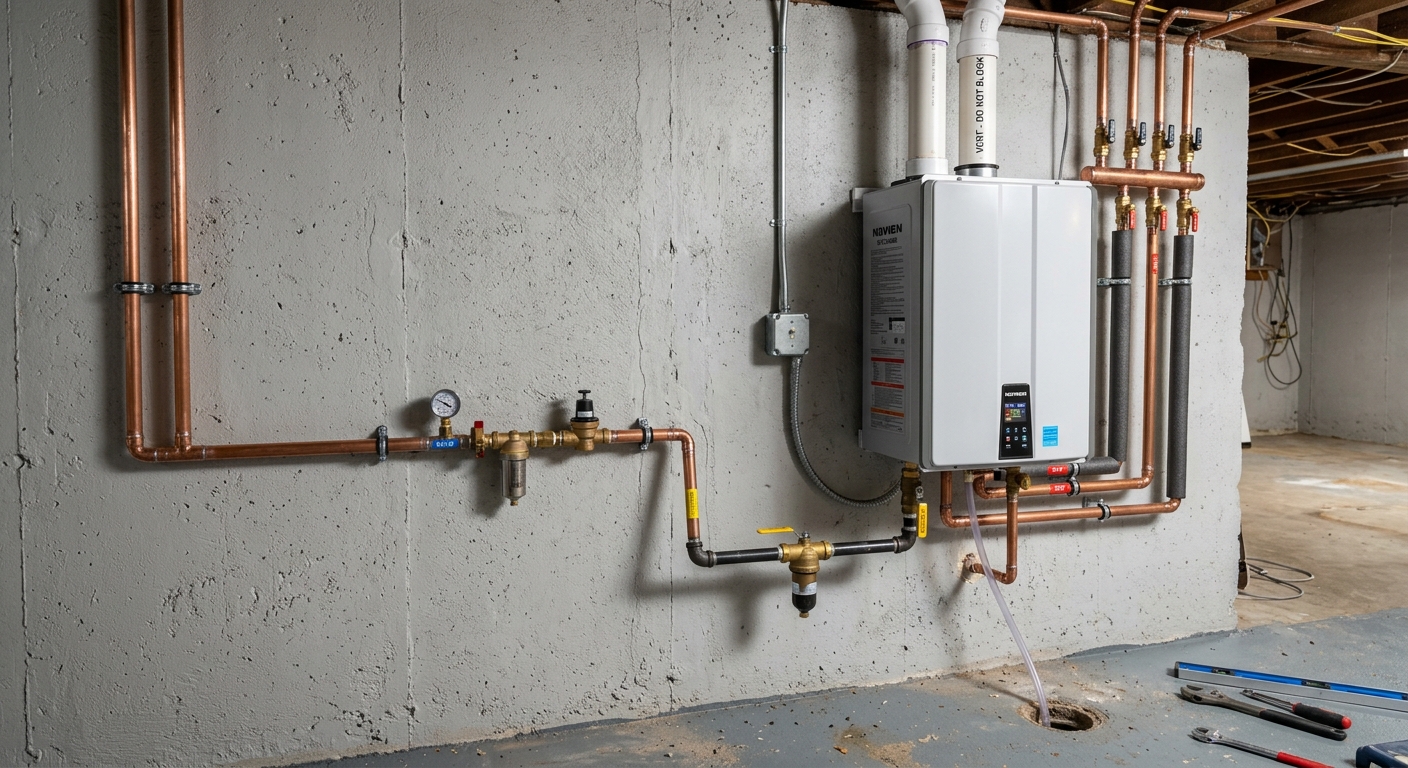
Choosing a new water heater in South Middleton comes down to life cycle, energy costs, and where you’ll put the unit. Tank-style heaters are the cheapest up front, but use more energy due to standby losses and last 8–12 years. Tankless gas units mean never running out of hot water, but run much more to install (often needing a larger gas line and upgraded vent), and savings rarely pay back the extra cost unless you’re a very heavy user.
Heat pump water heaters have the lowest running costs, but they cool and dehumidify the space where they sit. In a finished basement or smaller mechanical room, they can be too loud or make the room uncomfortably chilly. They need enough surrounding air (typically 700–1,000 cubic feet) to run efficiently.
In South Middleton, most homes have natural gas, which typically favors gas tank models for cost and reliability. If your home is electric-only or you want the lowest long-term bill, a heat pump unit can make sense if you have a suitable space.
All types now require expansion tanks if your water system has a backflow preventer. Pan with a floor drain is state code if your heater is above finished areas or in a place where a leak would cause damage.
| Type |
Installed cost |
Service life |
Operating cost |
Best when |
| Gas tank, 40–50 gal |
$1,250–$2,900 |
8–12 yrs |
moderate |
replacing like for like, no special venting needed |
| Electric tank, 40–50 gal |
$1,250–$1,950 |
10–15 yrs |
high |
gas isn’t available and usage is low |
| Gas tankless |
$1,950–$2,900 |
18–25 yrs |
low-moderate |
endless hot water, will pay a premium for install |
| Heat pump water heater |
$1,950–$2,900 |
13–15 yrs |
lowest |
plenty of air, unfinished basement or open utility area |
Vetting a plumber in Cumberland County
Since licensing for plumbing is handled at the municipal level in Cumberland County, always check a plumber’s registration with your specific township or borough. Do not rely on a state license or on a license from a neighboring municipality. Every firm should show you their Home Improvement Contractor (HIC) registration (verify at hic.attorneygeneral.gov). Demand an insurance certificate naming your property, and check their workers’ compensation via the WCAIS portal (wcais.pa.gov). This market’s competition near I‑81 does mean you’ll find both reputable firms and fly-by-night crews—especially in emergencies.
Find out if the company uses their own W-2 crews or subs out to unvetted labor. Have them explain their emergency rates before a truck rolls. And push for specifics: for major jobs like repiping or sewer replacement, you should receive camera footage and/or pressure test results as proof of need. A one-page quote that skips these is a common red flag.
- Is the plumber registered in your municipality—not just Carlisle?
- HIC registration number checked at hic.attorneygeneral.gov?
- Proof of liability insurance, naming your address?
- Proof of workers’ compensation via WCAIS?
- All work and emergency pricing disclosed in advance?
- Will they pull required plumbing permits for layout changes?
- Written contract provided for work over $500?
- Do they run their own background-checked crews?
- References from previous customers in your immediate area?
- Camera inspection or pressure test before quoting repipe or main replacement?
- No pressure to sign on the spot, 3-day cancellation right honored?
- Who actually answers the phone after hours?
Red flags: pricing that’s all over the map; no credentials you can verify; refusal to show you inspection camera footage; demanding cash or rush decisions. In this competitive area, skip anyone who doesn’t check every box.
Frequently asked questions — plumbing in South Middleton
What do I do about a burst pipe right now?
If you have a burst pipe in South Middleton, turn off the main water shutoff valve immediately—usually located near where the water line enters your basement or crawlspace. This stops more water from flooding your home. Open a few faucets to drain pressure and minimize spreading water. Take photos of any damage for insurance purposes and call a licensed local plumber for emergency service. In this area, expect to pay between $600–$1,250 for a typical burst pipe repair, depending on access and time of day. Until a plumber gets there, avoid using space heaters or open flames to dry out the area. If the damaged pipe is in a finished space or above electrical wiring, stay cautious and cut power to affected circuits. Once repairs are done, monitor for mold in the weeks ahead—South Middleton’s older homes can hide water under floors or in walls.
How much does sewer line repair cost in South Middleton?
Sewer line repair in South Middleton falls in a broad range based on location, material, and whether replacement requires breaking a slab or just digging in the yard. For a spot repair—replacing or relining one failed section in a separated system—expect anywhere from $2,100–$12,500. The higher end covers deep excavations, work under pavement, or extensive restoration in post-1960 slab-on-grade homes. Costs are controlled most by how easy the pipe is to access and whether clay, cast iron, or PVC/ABS is present. Always ask for camera footage to make sure work is justified, and push for a firm, itemized quote. In Cumberland County, no reputable plumber skips camera verification before quoting a big sewer job.
What does discoloured water on first draw mean?
In South Middleton, discoloured water—often brown, rusty, or yellowish at first draw—can signal either pipe material issues or utility maintenance. Commonly, this points to galvanized steel supply lines starting to corrode from the inside (common in pre-1960 homes), though sediment from a water heater (especially electric models) is another suspect. In a house with older plumbing, these symptoms warn the pipes are nearing their end of life. If only one faucet shows color, try flushing several gallons; if the source is main water lines, neighbors may have the same issue. Most fixes involve replacing sections of supply pipe, which can cost $3,600–$8,800 for a whole-house repipe, depending on access. For a quick check: fill a clear glass first thing in the morning, and see if color settles. If it does, pipe corrosion is likely.
Is a tankless water heater worth it in South Middleton?
Tankless water heaters, especially gas models, are a popular upgrade in South Middleton, but whether they’re “worth it” depends on your home’s needs and budget. They cost more to install—expect $1,950–$2,900—and many older homes, especially those without a large gas supply or modern venting, need upgrades that add to the bill. Where tankless shines is for households running multiple showers or big soaker tubs at the same time; you’ll never run out of hot water. Over a decade-plus, savings can help recoup some installation cost if you use lots of hot water. For smaller homes or those staying electric, the payback isn’t as strong. In finished basements, pay attention to venting and noise—tankless units have blower fans that run every time hot water flows.
Does Pennsylvania license plumbers at the state level?
No—Pennsylvania does not issue a statewide plumbing license. Instead, licensing and credentialing are run by individual municipalities, so a plumber authorized in one area of South Middleton might not be legal to work in another. For any work above $500, the contractor must hold a Home Improvement Contractor (HIC) registration with the Pennsylvania Office of Attorney General, which anyone can confirm online. Beyond that registration, actual trade credentials, bonding, and permit rules depend on your township or borough. Always ask precisely what credential or registration a plumber holds in your specific area.
Who pays to replace a lead service line in South Middleton?
In South Middleton—served by Carlisle Borough Municipal Authority—the water service line from the main in the street up to the curb is typically the utility’s concern, while the section from the curb to your house is yours. While Carlisle Borough is mapping and systematically replacing its half, unless a special program covers both sides, homeowners usually pay for their own lateral. Full replacement costs run from $5,700–$12,500 depending on distance, material, and obstacles (like landscaping or mature trees). Ask the utility if there’s a cost-sharing program; don’t assume. Partial replacements sometimes disturb pipe scale and can temporarily spike lead in your drinking water, so coordinate the timing if you can.
How much does a water heater replacement cost in South Middleton?
A typical 40–50 gallon gas water heater replacement in South Middleton runs from $1,250–$2,900. This covers removal of the old unit, installation, new vent connections, and haul-away service. If you’re upgrading from electric, or to a tankless or heat pump model, you’ll be closer to the top of that range due to extra plumbing, electrical, or vent work. Older homes here sometimes lack a drain pan or expansion tank, which are now required by Pennsylvania Uniform Construction Code (UCC) for certain installs—so double-check that your quote includes these. Demand a written estimate and check that the plumber is registered for work in your specific borough or township.
Do older South Middleton homes have galvanized pipes?
Many pre-1960 homes in South Middleton and surrounding Cumberland County were originally plumbed with galvanized steel supply lines and cast iron drains. If your house was built before 1960, chances are good you still have at least some galvanized piping unless it’s been replaced. These pipes corrode from the inside, causing low pressure and discoloration before actual leaks start. Full replacement (a whole-house repipe) often falls between $3,600–$8,800 depending on size, access, and the number of fixtures. If you notice brown water on first draw or your water pressure is poor, have a plumber check for galvanized runs so you can plan accordingly.
Should I leave a faucet dripping in cold weather?
Yes—during nights where South Middleton drops into the teens or lower (the winter design temp here is 12°F), letting a faucet trickle in the coldest room can help prevent pipes from freezing and bursting. Moving water resists freezing better than standing water. Make sure to pick a faucet on an exterior wall or above an unheated space—these are the most likely places pipes freeze. The cost of a small amount of wasted water is nothing compared to the emergency repair bill for a burst pipe, which often runs $600–$1,250 here. In newer slab-on-grade homes, even kitchen island or garage pipes can freeze during a snap, so open cabinet doors as well when in doubt.