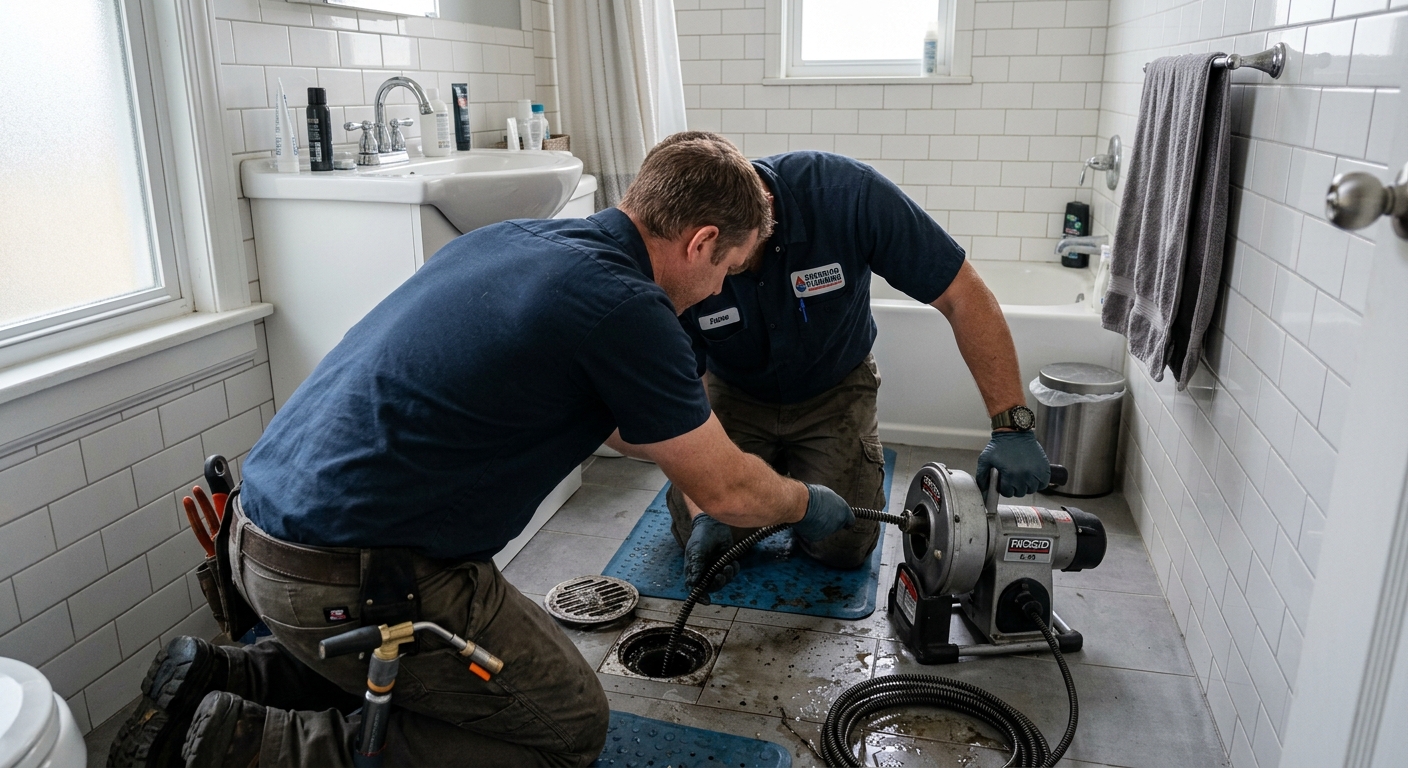
Bradford plumbing prices by job type — 2026
Bradford’s plumbing costs reflect an old housing stock (91.3% of homes built before 1980) and a high prevalence of 1900–1940 wood-frame construction. If you live in one of Bradford’s 1,830 owner-occupied homes (U.S. Census Bureau, ACS 2024), odds are your original plumbing is now well past its design life. The material in your pipes – whether galvanized steel, copper, or newer PEX – drives both what can go wrong and what it costs to fix.
A burst pipe or heater failure costs more on a Sunday night than a weekday afternoon. Every plumbing job in Bradford has two prices: one for emergency callouts (after hours, flooding, total loss of water) and another for planned or scheduled work. Emergency rates include premium labor, overtime, and the expense of rearranging a crew’s regular jobs. This split accounts for the largest price differences seen between repair jobs of the same scope, sometimes a swing of several hundred dollars, and is especially noticeable in a rural market where travel surcharges stack on top.
| Service |
Scope |
Emergency rate |
Standard rate |
| Emergency repair — burst pipe |
locate, open, repair section, restore service |
$550–$1,050 |
$300–$1,050 |
| Water heater replacement (gas, 40–50 gal) |
remove old, install, test, haul away |
$1,700–$2,500 |
$1,050–$2,500 |
| Drain cleaning — main line |
augering or hydro-jet, camera if needed |
$350–$800 |
$200–$500 |
| Sewer line spot repair |
excavate or reline a failed section |
$1,750–$10,500 |
$1,750–$10,500 |
| Whole-house repipe |
replace supply lines throughout, patch and finish |
— |
$3,100–$7,500 |
| Water service line replacement |
street to house, excavation and restoration |
— |
$4,900–$10,500 |
Estimates for a typical Bradford home. Access difficulty and pipe material move these figures more than anything else.
Vetting a plumber in McKean County
Choosing a plumber in McKean County, and especially in Bradford, requires more than just checking online reviews. There is no state-issued plumbing license here; most municipalities—including Bradford—handle licensing at the local level, if they require it at all. Home Improvement Contractor (HIC) registration is mandatory for any plumbing job estimated at over $500, and it’s your right to request proof at hic.attorneygeneral.gov. Valid insurance—including workers’ compensation (verify via WCAIS)—must name your property on the certificate. If a plumber cannot prove coverage, don’t let them start. Always confirm whether the company uses their own trained employees or subs out work to other crews, as this affects both liability and quality control. Emergency job pricing should be transparent before any dispatch—ask how after-hours and trip charges are structured.
- Check HIC registration at hic.attorneygeneral.gov
- Ask for a certificate of insurance with your property listed
- Verify workers’ compensation status via WCAIS
- Confirm the plumber’s experience with early 20th-century Bradford homes
- Request references specifically from McKean County
- Ask if the plumber will do the work themselves or send subcontractors
- Get a written contract for any project over $500, as required by state law
- Clarify all emergency, after-hours, and trip fees up front
- Ask how they handle repairs on galvanized and lead lines common in the area
- Expect a detailed breakdown for major work, including camera footage for sewers
- Don’t accept a repipe recommendation with no pressure test or video evidence
A legitimate concern in a thin rural market like McKean County is one-man shops bidding beyond their capacity, or quoting expensive work (whole-house repipes, sewer replacement) on a hunch rather than evidence. If a plumber recommends thousands in repairs without showing you a camera recording or demonstrating a pressure loss, that’s a red flag. Never accept a handshake deal for anything over $500; insist on full documentation.
Service line material and drinking water in Bradford
Bradford City Water Authority manages public water service for the city. The water main from the street to your home splits ownership: the city handles everything up to the curb stop (usually near the property line), while the homeowner owns and is responsible for the line from the curb to the house, called the “lateral.” Bradford has a known issue with legacy lead service lines in its oldest homes, though there’s no published replacement inventory—so it’s up to each homeowner to investigate.
Checking if you have lead pipes is straightforward. Where your water line enters the basement, gently scrape a small patch with a coin: if it’s dull grey and easy to scratch, likely lead. Try with a magnet—lead won’t attract, steel will. Brass or copper will show their respective hues beneath. If you find evidence of lead, don’t assume a city program will foot the bill; with no formal inventory or cost-share named by Bradford City Water Authority, call them directly to understand current policy.
Partial service line replacement—just swapping out one side—can make things worse for a while by disturbing the protective scale within old pipes. Full replacement, covering both utility and homeowner sides, is the safest and healthiest approach. If your lateral is lead, expect a cost of $4,900–$10,500 for a total replacement, depending on the distance to the street and what surface needs restoring. Spot repairs or temporary fixes may land in the $1,750–$10,500 band, but lasting improvement means full replacement.
Who is allowed to do plumbing work in Pennsylvania
In Pennsylvania, there is no statewide plumbing license—licensing is municipally controlled. This matters in McKean County, where each municipality decides its own permitting and licensing requirements. In Bradford, the City of Bradford Code Enforcement Office oversees plumbing permits and inspections. Neighboring townships each have their own rules, or in some cases, very limited oversight.
A plumber with experience in Kane or Smethport may not hold any recognized credential for Bradford jobs. When hiring, ask “Are you licensed and permitted to do plumbing here in Bradford?” instead of the generic “Are you licensed?” For contract values over $500, Home Improvement Contractor (HIC) registration from Pennsylvania’s Office of Attorney General is mandatory, and you must be given a written agreement regardless of who enforces the code locally.
In Bradford, any interior plumbing alteration that introduces new fixtures or pipe runs almost always requires a permit and inspection. For minor fixture swaps in the surrounding townships, permitting is often not required for single-family homes. Always verify insurance and workers’ compensation with certificates naming your property, using the HIC and WCAIS systems referenced above. It’s not enough for a plumber to show any license—the credential must match the location and scope of work.
Frozen pipes in Bradford: prevention and thaw
With a typical frost depth of 36 inches and winter lows to 2°F, Bradford faces some of the coldest winters in Pennsylvania. The area’s 1900–1940 homes often have pipes run in exterior walls, unheated crawlspaces, or old summer kitchens—prime targets for freezing. Most pipe bursts actually occur not at the ice plug, but between the frozen point and a closed fixture, as water pressure builds between the blockage and the valve.
Common trouble spots: pipes along outside walls, under floors in crawlspaces, through garages, or up into unconditioned attics. Hose bibs (outside spigots) are classic problem points. Preventing catastrophe beats any emergency repair: start with good pipe insulation, especially in crawlspaces and attics. Heat tape, properly installed, protects lines exposed to the coldest drafts. In record cold snaps, let a faucet farthest from your main trickle overnight to keep water moving, and open cabinet doors under sinks on exterior walls to share room heat. Most importantly, shut off and drain outdoor faucets well before the first big freeze—winter comes early in McKean County.
If a pipe freezes, use a portable heater or hair dryer to thaw gently. Never use an open flame; torches and heat guns are common sources of home fires and burst pipes. If a pipe does rupture, expect a repair bill between $300–$1,050 for a typical Bradford emergency. Spending on insulation and smart prevention is far cheaper than dealing with mid-winter water damage.
When to call now and when to wait until Monday
Every plumbing problem in Bradford sits somewhere between a disaster needing a 2am call and a nuisance you can live with for a few days. Emergency service brings an extra premium: after-hours service, overtime pay, mileage surcharges for remote townships, and the challenge of diagnosing under the gun. This is why the same burst pipe repair that costs $300 on a weekday can hit $1,050 during an ice storm at 10pm.
Call right now if you have: active flooding from a burst pipe, complete loss of water to the house, sewage backing up in main drains, or any gas smell near a water heater. These are true emergencies—waiting risks serious property damage or safety. On the other hand, a slow leak beneath a sink, a single sluggish drain, or a toilet that runs constantly can generally wait for normal business hours. The cost difference is real: waiting can often save you several hundred dollars.
To take control of most situations, learn where your main water shutoff is (often by the water meter or where the service line enters the basement) and how to close it. For isolated leaks, each fixture (toilet, sink, water heater) has its own shutoff valve—closing this stops the flood and buys you time to schedule a repair. This single skill transforms a midnight disaster into a Monday appointment.
When to repipe a Bradford home
In Bradford’s 1900–1940 wood-frame homes, original galvanized pipes are well beyond their lifespan. If you’ve had two or more leaks from the same material in three years, that’s not bad luck—it’s a system failure. Time to plan a repipe.
Signals that trouble’s coming: falling pressure throughout the house (not just at a single sink), brown or rusty water on first draw, visible rust or corrosion at pipe joints, and repeated pinhole leaks—especially in older copper or galvanized runs. If your home still has polybutylene piping (not uncommon in postwar remodels), that’s an automatic candidate, as insurance companies often exclude it from coverage.
Copper versus PEX: In Bradford’s small homes, PEX usually means lower costs, less wall cutting, and fewer joints. Copper is still an option, but requires more time and wall repair. Don’t forget—the biggest hidden expense is restoring drywall or plaster after piping work. In homes with original plaster, that finish cost may rival the plumbing labor itself.
| Situation |
Recommendation |
Cost |
Reasoning |
| One leak, accessible, modern pipe |
Spot repair |
$300–$1,050 |
No systemwide problem detected; repair is efficient |
| Two or more leaks in 3 years |
Partial repipe |
$3,100–$5,100 |
Recurring failure signals aging pipes upstream |
| Galvanized supply, pressure loss |
Full repipe |
$3,100–$7,500 |
Common in Bradford’s oldest housing; performance can’t be restored |
| Polybutylene anywhere in the house |
Full repipe |
$3,100–$7,500 |
Material is failure-prone and excluded by insurers |
| Cast iron drain with root intrusion |
Camera, then reline or replace |
$1,750–$10,500 |
Cannot be solved permanently with cleaning alone |
| Suspected lead service line |
Test, then replace the lateral |
$4,900–$10,500 |
Lead lines pose significant health risk |
Frequently asked questions — plumbing in Bradford
Should I reline or replace my sewer line?
Bradford’s older homes often have clay or cast iron sewer lines that can suffer root intrusion or collapse over time. Relining (using a cured-in-place pipe) is less invasive—no large trench in your yard—and is best for pipes with localized cracks or intrusion but no major collapse. Replacement, which is more disruptive, is needed if sections have fallen apart or show repeat failures even after cleaning. Expect relining or spot repairs to run from $1,750–$10,500, depending on access and length. Always insist on camera footage before authorizing major work so you know what’s really happening underground. In Bradford, shifting soils and old trees can make replacement more common than it would be elsewhere.
What does emergency plumbing cost in Bradford?
Emergency repairs in Bradford carry a noticeable premium. A typical burst pipe repair will cost between $550–$1,050 after hours, while the same job scheduled during business hours could be as little as $300. The extra cost comes from after-hours dispatch, overtime pay, and the need to prioritize your job over others. This is especially true in our area, where thin plumbing market coverage often means travel surcharges for crews coming from outside Bradford. If you can safely shut off the water, you can save significantly by waiting for regular business hours.
Do older Bradford homes have galvanized pipes?
Yes—Bradford’s dominant housing wave is 1900–1940, so most homes originally had galvanized steel pipe. By now, this material is well past its prime: it rusts internally, causes brown water, and suffers falling pressure. If you’re seeing chronic flow problems or discolored water, replacement is often the only real fix. The cost for a full repipe (switching to modern PEX or copper) is between $3,100–$7,500 for a typical two- or three-bedroom home. If you’ve only had one leak, you may be able to get by with a $300–$1,050 repair—but with galvanized, more leaks are usually coming.
Am I responsible for the water line under the street?
In Bradford, the homeowner is generally responsible for the “lateral” from the curb stop (at your property line) into your home. The utility handles the main under the street and up to the curb. If your service line fails or is made of lead, the replacement cost—often between $4,900–$10,500—typically falls on you, unless there’s a specific program in place (Bradford has no published cost-share program, so always confirm with Bradford City Water Authority). Don’t assume the city will cover it; ask first and get any commitment in writing.
Should I wait until business hours to call?
If there’s active flooding, loss of water to the whole house, sewage backup, or a gas smell, call for emergency plumbing right away—it’s worth the after-hours rate to prevent thousands in damage or risk to health. For most other issues—dripping pipes, a slow single drain, or a toilet that won’t stop running—you can mitigate damage by shutting off water to the affected area and waiting until the next business day. You might save upwards of $250–$750 by waiting even a day for normal rates, especially since Bradford’s emergency premiums can be steep due to rural travel surcharges.
How do I verify a plumber's licence and insurance?
In Pennsylvania, there’s no state plumbing license—municipalities set their own rules. In Bradford, check with the City’s permit office to see if the plumber holds the right credential. For any contract over $500, statewide Home Improvement Contractor (HIC) registration is mandatory—look up the number at hic.attorneygeneral.gov. Insurance should be evidenced by a certificate listing your address, with workers’ compensation status checked via WCAIS at wcais.pa.gov. Never take a trade’s word—demand to see paperwork before any work begins, whether you’re spending $300 or $7,500.
How much does a water heater replacement cost in Bradford?
The going rate in Bradford for a gas water heater replacement (40–50 gallons, including new connections and haul-away of the old unit) falls between $1,050–$2,500. The main variables are access, how much repair is needed to tie into older plumbing, and whether you discover code-required upgrades during the swap. Emergency replacements after hours will land at the top end: up to $2,500. For most scheduled jobs in the city, expect around $1,700.
What does discoloured water on first draw mean?
In Bradford, discolored water—especially reddish or brown tint right when you turn on a tap after hours of no use—often signals rust inside old galvanized steel or iron pipe. This is typical in homes built during the dominant 1900–1940 wave. While flushing the line may clear things up temporarily, repeated color is a sign the pipes are corroding from the inside out, and could soon start leaking. A spot repair may run $300–$1,050, but full replacement is usually needed to solve the problem for good ($3,100–$7,500).
Do I need to drain outdoor spigots in Bradford?
Absolutely. Bradford winters reach 2°F and see deep ground frost—undrained outdoor faucets (hose bibs) almost always freeze and split if not winterized. Shut off the inside supply valve (usually in your basement), then open and drain the outside spigot before the first hard freeze, which can come early in McKean County. Skipping this step is why so many calls for emergency burst repairs come after the season’s first cold snap. Each repair can cost $300–$1,050, so prevention is almost always cheaper.