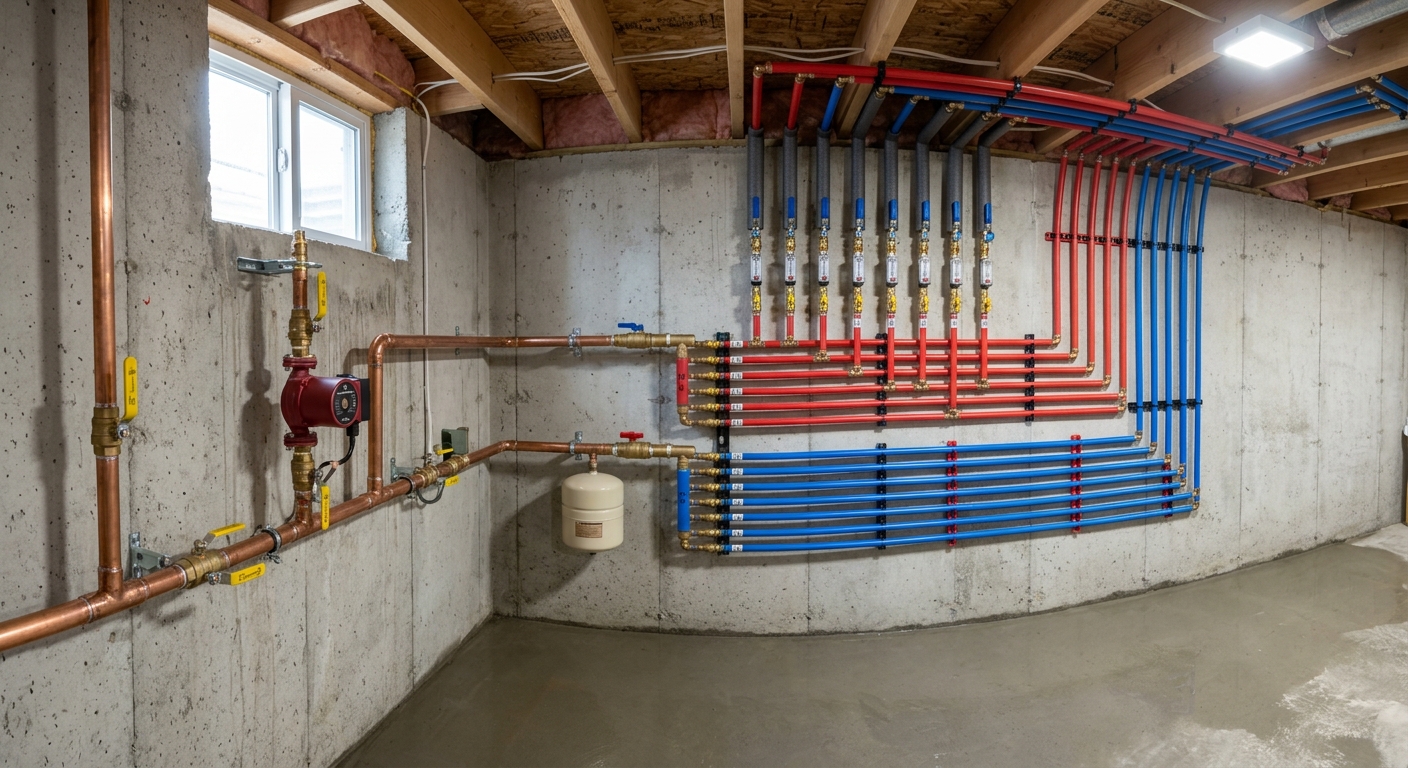
Douglass plumbing prices by job type — 2026
Douglass homeowners—especially the 3,186 who own single-family homes (U.S. Census Bureau, ACS 2024)—face plumbing costs that depend heavily on two factors: whether it’s an emergency call and what kind of pipes were installed when their house was built. With nearly half the homes in Douglass built before 1980 and most neighborhoods dominated by 1950s-1970s suburban construction, the average job here means working with aging copper, some outdated galvanized, and fixtures reaching the end of their life—so repipes and water heater replacements are both frequent and predictable.
Whether you’re calling at midnight with a burst pipe or scheduling a planned upgrade, price bands in Douglass swing sharply based on urgency. A burst pipe, for example, costs far more after hours—when shutting off water quickly matters most, both to limit damage and because repair often means cutting out old sections on the spot. Planned upgrades (like water heater replacement or whole-house repiping) give you more control over the timing and often mean lower costs, but don’t assume the cost will drop to nothing; drywall and restoration factors still apply.
The table below compares what you can expect to pay for common Douglass plumbing services—emergency or not—given the realities of Philadelphia’s western suburbs: dense service coverage, short travel times, and homes with aging systems. These prices assume normal access and standard system materials; severely corroded galvanized, buried shutoffs, or difficult crawlspaces can all push into the higher range.
| Service |
Scope |
Emergency rate |
Standard rate |
| Emergency repair — burst pipe |
locate, open, repair section, restore service |
$700–$1,350 |
$400–$1,350 |
| Water heater replacement (gas, 40–50 gal) |
remove old, install, test, haul away |
$2,200–$3,200 |
$1,350–$3,200 |
| Drain cleaning — main line |
augering or hydro-jet, camera if needed |
$350–$800 |
$200–$500 |
| Sewer line spot repair |
excavate or reline a failed section |
$2,300–$13,500 |
$2,300–$13,500 |
| Whole-house repipe |
replace supply lines throughout, patch and finish |
$4,000–$9,700 |
$4,000–$9,700 |
| Water service line replacement |
street to house, excavation and restoration |
$6,300–$13,500 |
$6,300–$13,500 |
Estimates for a typical Douglass home. Access difficulty and pipe material move these figures more than anything else.
The point where patching stops making sense
If you own a home in Douglass—where nearly half the housing is pre-1980 and 1950s-1970s suburban housing dominates—deciding whether to repair or repipe comes down to watching for patterns, not just the last leak. One leak in a decade is bad luck. Two or more leaks—especially in the same pipe material over three years—means it’s time to consider a repipe. This isn’t just about saving money long-term: frequent repairs bring wall repairs, water damage, and higher risk of a sudden, damaging burst.
Signals that patching has run its course: low water pressure throughout the house rather than at a single tap, rusty or discolored water on first draw, visible green, white, or powdery corrosion at exposed pipe joints, or the frustration of repeated pinhole leaks. In Douglass, older pipe can be copper (easy to repipe in sections), galvanized steel (pressure loss and corrosion, more expensive restoration), polybutylene (must replace, poor reliability), or even lead service lines in rare older homes.
PEX repiping now dominates replacements for cost and flexibility, but you’ll see copper in higher-end work. One area homeowners overlook: the labor for drywall and plaster repair, especially if your house still has plaster walls. Sometimes, finishing the walls after the plumbers leave can match the plumbing bill—factor that in before you decide.
| Situation |
Recommendation |
Cost |
Reasoning |
| One leak, accessible, modern pipe |
Spot repair |
$400–$1,350 |
No pattern; fix and monitor |
| Two or more leaks in 3 years |
Partial repipe |
$4,000–$6,500 |
Pipes are failing, more will follow |
| Galvanized supply, pressure loss |
Full repipe |
$4,000–$9,700 |
Corrosion throughout; wasting repairs |
| Polybutylene anywhere in the house |
Full repipe |
$4,000–$9,700 |
Material failure risk |
| Cast iron drain with root intrusion |
Camera, then reline or replace |
$2,300–$13,500 |
Will recur until pipe is fixed |
| Suspected lead service line |
Test, then replace the lateral |
$6,300–$13,500 |
Health and code requirement |
What a plumbing quote should contain
In Douglass and across Montgomery County, plumbers bid jobs either by flat rate (a set price for the full job) or by time-and-materials (you pay for hours worked plus parts used). Flat rate makes the final cost predictable and includes contractor risk if something runs long. Time-and-materials can be a bargain for simple repairs but can balloon in price if access is tough—so you must know which model you’re signing off on.
Every reliable quote handles the critical details: Is there a diagnostic fee—and does it count toward the job if you proceed? Is the scope written out, not just the price? Who pulls the permit and is it included? Look for clear restoration terms—especially in homes with plaster walls. Make sure the contract lays out the warranty on labor and separate coverage for parts. If you’re dealing with after-hours work, that rate must be spelled out up front; no one likes surprises on the final bill.
| Line item |
What to look for |
Red flag if… |
| Billing model |
flat rate or hourly, stated up front |
unstated |
| Diagnostic fee |
amount, and whether it credits |
vague |
| Scope |
what is opened, repaired and restored |
price with no scope |
| Restoration |
drywall and finish explicitly in or out |
silent |
| Permit |
included and priced |
'not needed' |
| Parts |
brand and model for fixtures |
'standard fixture' |
| Warranty |
labour period stated separately |
parts only |
Detection methods and what they cost
Start with what you can do free as a Douglass homeowner. Shut off every fixture, don’t run appliances or toilets, then check your water meter. If the dial is still moving, there is a supply-side leak somewhere in your system. That’s a zero-cost test and rules out a lot before calling a pro.
If you do need professional help, here’s what’s offered locally: Acoustic listening devices pinpoint leaks inside walls by sound, usually costing $200–$400. Thermal imaging uses heat differences (good in uninsulated walls or slab floors) and costs a similar range. Tracer (inert) gas, rarely needed, detects the tiniest leaks in lines that can’t be pressurized with water. Locating a slab leak—an issue in homes with poured floors or finished basements—runs higher, sometimes into the $500–$800 range due to specialty equipment. Leaks in irrigation lines or buried pipes often require a combination of acoustic and tracer gas, paired with local access maps.
No plumber should cut open your drywall without first using these techniques. In Douglass, the majority of leaks are found and marked before a wall is ever touched—especially with aging copper or polybutylene systems. If a plumber wants to open up before locating, call someone else.
Verifying a Douglass plumber's credentials
Plumbing in Pennsylvania is licensed at the municipal—not state—level. Unlike some trades, there is no statewide plumbing license; instead, each municipality decides if and how it licenses plumbers. That means the right question to ask is never “are you licensed?” but “are you licensed here, in this township?” A plumber properly registered in Norristown may not be authorized in another Montgomery County town.
For jobs over $500, all contractors must carry Home Improvement Contractor (HIC) registration from the Pennsylvania Office of Attorney General. You can verify this registration instantly at hic.attorneygeneral.gov. Insurance is also critical: every employer in Pennsylvania must have workers’ compensation, which homeowners can verify through the WCAIS system (wcais.pa.gov).
Permits are required in Douglass for any plumbing alterations, whole-house repiping, water heater replacement, or installing new or changed sewer, vent, or water systems. Routine like-for-like fixture swaps—think replacing a toilet without touching the pipes—do not require a permit. Once permitted, municipal inspectors (usually the local code enforcement office) handle approval, making sure the job conforms to the Pennsylvania Uniform Construction Code (UCC).
Choosing a plumbing contractor
In Douglass, with a dense contractor field and quick response across Montgomery County, picking a plumber means more than just price. Always verify registration at hic.attorneygeneral.gov for any job over $500. Because plumbing licensing is municipal, confirm the company holds credentials for Douglass or your specific township—not just for broader Montgomery County. Review the insurance certificate: it should name your address as the insured location, and you can verify workers’ compensation status at wcais.pa.gov.
Ask directly if the company employs its own crews or subs the work out. For emergency jobs, make sure the after-hours pricing is detailed in writing before you agree. Pressure-test or camera evidence is a must before you accept any major work like a whole repipe or sewer repair.
- Check HIC registration at hic.attorneygeneral.gov
- Confirm municipal license specific to Douglass/township
- Ask for certificate of insurance naming your address
- Verify workers’ compensation at wcais.pa.gov
- Request references from similar Douglass jobs
- Confirm scope of work—written and detailed
- Clarify if restoration is included (drywall/finishes)
- Ask if the company employs its own crew
- Request camera footage for drain or sewer line work
- Require after-hours/evening rates in writing
- Ask for a permit copy, not just a verbal promise
- Get warranty terms in clear, written language
Red flags include bids for major work with no evidence (no pressure reading or camera), lack of insurance proof, vague or generic quotes, and companies offering to “waive” your deductible (illegal under state law). With so many plumbers nearby, there’s no good reason to accept corner-cutting or ambiguity.
Douglass's housing stock and its plumbing
Nearly half of Douglass homes were built before 1980, with most concentrated in the postwar suburban boom. In practical plumbing terms, this means a high likelihood of original copper supply lines, sometimes aging galvanized, and clay tile sewer laterals on larger lots. Exposed copper in basements often shows green patina or minor leaks. Some homes from the 1970s will have cast iron drains—prone to root intrusion near mature trees, or scaling that cuts flow. Replacement cycles for water heaters are often in the third or fourth round, depending on maintenance and water chemistry.
If your home was built after 1980 (a minority in Douglass but possible in pockets), your concerns shift: builder-grade fixtures nearing end of first life, copper paired with occasional PEX retrofits, and potential polybutylene in 1980s installations. Remember, even newer homes aren’t immune—PEX can fail from mishandling, and early water heaters in these builds are now 30–40 years old. Across the board, homes here rarely have original supply lines unless fully gutted and rebuilt in a recent remodel.
For most Douglass homeowners, the best prevention is regular visual inspection and water pressure checks, instead of waiting for a wall to get wet or for roots to clog a sewer lateral running under a mature front lawn.
Frequently asked questions — plumbing in Douglass
Do I need to drain outdoor spigots in Douglass?
Even though southeastern Pennsylvania winters aren’t the harshest, Douglass still hits a ground frost depth of 30 inches and has a winter design temperature of 14 °F. If your outdoor hose bibs are the older, non-frost-free type common in homes built before 1980 (which is about 48.8% of Douglass’s stock), draining and shutting them off each fall is cheap insurance against a split pipe or sudden indoor leak. A burst pipe repair ranges from $400–$1,350, and most can be prevented by winterizing spigots properly each year. For a newer, frost-free sillcock, just remove the hose and let it drain—no further action is needed.
Are tree roots a common sewer problem in Douglass?
With almost half the homes built before 1980 and a lot of mature landscaping, root intrusion into sewer lines is a real and repeating headache in Douglass. Older houses often have clay or cast iron laterals, which are especially vulnerable at pipe joints. When roots do break through, you’ll notice repeated main line backups, slow drains, and possibly wet spots in the yard. Drain cleaning runs around $200–$500 for a standard call, but if roots have done damage, repair or relining jumps to $2,300–$13,500. Camera inspection before digging is essential, and most reputable plumbers here recommend one before any big drain job.
How much does a plumber cost in Douglass?
Plumber rates in Douglass reflect Montgomery County’s busy suburban market—meaning you pay for experience, parts, and sometimes how fast you need it. Emergency repairs like a burst pipe, especially after hours, carry labor rates of $700–$1,350. Non-emergency work—water heater replacements, routine drain cleaning, or common fixture swaps—usually falls inside $200–$3,200 depending on the size and complexity. Factors that influence rate are whether the plumber carries local credentials, if parts are stocked, and how much wall or floor restoration is needed after the fix.
Repair or replace a leaking water heater?
For homes in Douglass—where many water heaters are now on their third or fourth run—small leaks or pilot outages are sometimes worth a basic repair if the unit is under ten years old and the tank itself is sound. However, once a water heater tank itself starts leaking, replacement is the only option; tank failures aren’t safe to patch and can cause water damage. A water heater swap in Douglass typically costs $1,350–$3,200. Don’t bother chasing multiple repairs or replacing critical parts if you’re near end-of-life, especially if rust appears at the drain or around the base. Replacement is often simplest and prevents future inconvenience.
How much does a water heater replacement cost in Douglass?
A standard gas water heater replacement for a Douglass home lands in the $1,350–$3,200 range, with the average job coming in close to $2,200. This price includes removing the old unit, installing the new one, hauling away debris, and connecting to both plumbing and gas (if applicable). Some older homes may incur extra charges for vent changes or code updates, thanks to the housing era common in Douglass. If you want a larger tank, high-efficiency, or tankless unit, expect to pay at the higher end of the range or above.
Who owns the sewer lateral, me or the city?
In Douglass, as in the rest of Montgomery County’s towns, the homeowner owns and is responsible for the entire sewer lateral from the house to where it connects at the main in the street or right-of-way. The local municipality only maintains the public main, not the pipe under your lawn. Sewer backups or collapse in your private lateral mean you pay for the repair, with typical costs between $2,300–$13,500 depending on access and pipe depth. Always get camera footage before approving big sewer jobs, especially in older properties.
How do I find a hidden water leak?
If you suspect a hidden leak in your Douglass home, start with the meter test: shut off all fixtures and see if your water meter dial moves. If it does, there’s a leak on the supply side. For pinpointing, plumbers use acoustic listening, thermal imaging, or even tracer gas if necessary—each ranging from $200–$800 depending on the method. Leaks inside walls or under slabs can usually be located before any demolition, so if a plumber wants to start opening drywall immediately, get a second opinion. With the age and construction history of Douglass homes, these professional techniques often catch leaks early, saving you from bigger restoration bills.
What do I do about a burst pipe right now?
If you find a burst pipe in your Douglass home (a more likely problem in the many homes with older copper or galvanized pipe), shut off the main water immediately—most shutoffs are in the basement near the point where the service line enters. Open upstairs faucets to relieve pressure, put buckets under any dripping, and call a plumber. Immediate repairs generally fall between $700–$1,350 for after-hours service or $400–$1,350 during regular hours. Avoid touching exposed wires or standing water, especially in finished basements. Prompt action contains the damage, especially during winter freeze-thaw cycles common in Montgomery County.
Does Pennsylvania license plumbers at the state level?
No—Pennsylvania does not issue state plumbing licenses. Plumbing is regulated at the municipal level, so Douglass residents must verify that a contractor is licensed specifically for their township (not just somewhere else in the county). For any job over $500, Home Improvement Contractor (HIC) registration from the Pennsylvania Office of Attorney General is required, and you can verify it at hic.attorneygeneral.gov. For context, an emergency pipe repair in Douglass might cost $700–$1,350; always check that your plumber is properly credentialed for the specific location before any serious work is started.