What plumbers charge in Pine
Pine homeowners are used to dealing with the quirks of older plumbing systems, and price is almost always the first question. In Pine, which has a homeownership rate of 83.9% and a high proportion of single-family homes (71.7%) (U.S. Census Bureau, ACS 2024), plumbing service costs depend heavily on both the age of the house and whether you're calling for an emergency. Homes built during Pittsburgh’s housing boom from 1900 to 1950 often used galvanized or cast-iron piping—materials now at the end of their reliable lifespan. Pipe material doesn't just dictate what goes wrong, but how involved the fix is and what you'll pay for it.
Emergency response adds a premium to every job. A plumber called out for a burst pipe at midnight will not charge the same as for a scheduled water heater install. For major work like a whole-house repipe or sewer repair, costs depend not only on the feet of pipe but where it runs—tucked beneath finished basements or under old landscaping. Even a routine water heater replacement can turn complex if original installation corners were cut. In Pine, your bill moves most based on what needs opened up and what kind of pipe (old steel, new PEX, or copper) is hidden behind your walls or underground.
| Service |
Scope |
Emergency rate |
Standard rate |
| Emergency repair — burst pipe |
locate, open, repair section, restore service |
$650–$1,300 |
$375–$1,300 |
| Water heater replacement (gas, 40–50 gal) |
remove old, install, test, haul away |
$2,100–$3,100 |
$1,300–$3,100 |
| Drain cleaning — main line |
augering or hydro-jet, camera if needed |
$350–$800 |
$200–$500 |
| Sewer line spot repair |
excavate or reline a failed section |
$2,200–$13,000 |
$2,200–$13,000 |
| Whole-house repipe |
replace supply lines throughout, patch and finish |
|
$3,900–$9,400 |
| Water service line replacement |
street to house, excavation and restoration |
|
$6,100–$13,000 |
Estimates for a typical Pine home. Access difficulty and pipe material move these figures more than anything else.
Licensing and permits for plumbing work in Pine
Pennsylvania does not have statewide plumbing licensing. Instead, licenses are municipal—what counts in Pittsburgh (covered by the Allegheny County Health Department Plumbing Program) may not apply in Pine or the next township over. So, in Pine, the right question is, “Are you licensed to do plumbing here?” not simply “Are you licensed?” Plumbers must be registered as Home Improvement Contractors (HIC) through the Pennsylvania Office of Attorney General for work over $500. You can confirm HIC status at hic.attorneygeneral.gov. Remember, this isn’t a plumbing license, but a consumer protection and registration requirement.
If you need new or altered plumbing systems (like a complete repipe or sewer repair), an Allegheny County Health Department plumbing permit is required. Minor fixture swaps such as changing out a faucet typically do not require a permit. Inspection of permitted work is handled by the Health Department in covered municipalities or the local authority elsewhere. Always ask for proof that your project is being permitted and inspected as required—this is your safeguard against unpermitted work causing insurance or resale headaches down the line.
Insurance and workers’ compensation are mandatory for any employer; you can verify coverage using the state’s WCAIS system at wcais.pa.gov. A reputable plumber will give you a certificate of insurance naming your property as the insured location. Permitted jobs over $500 also require a contract under the Home Improvement Consumer Protection Act—and you have a three business-day right of cancellation.
Vetting a plumber in Allegheny County
Given Allegheny County’s saturated plumbing market, it’s on the homeowner to confirm a plumber’s credentials are current and valid for Pine. If your project is over $500, check the contractor’s HIC registration at hic.attorneygeneral.gov. Remember, plumbing licenses are not state-issued in Pennsylvania; licensure is through the relevant municipality. That means a company licensed in Pittsburgh may actually not be licensed for Pine or other Allegheny County municipalities—one town’s master plumber may have no legal standing to pull permits across the line.
Look for a current certificate of insurance that names your property, not just a generic policy. Workers’ compensation is required for all employers in Pennsylvania with coverage verifiable at wcais.pa.gov. Ask whether the company uses its own employees or sends subcontractors to your job—this affects quality control and who’s responsible if there’s a problem. On emergency calls, always confirm the pricing structure in advance; reliable contractors are upfront about after-hours and diagnostic fees.
- Home Improvement Contractor (HIC) registration verified online
- Municipal plumbing licence valid in Pine or your township
- Current certificate of insurance for property address
- Workers’ compensation coverage confirmed at wcais.pa.gov
- Written contract for work over $500 (per HICPA)
- No request to waive your insurance deductible (not legal in PA)
- EPA Lead Renovator certification if disturbing paint in pre-1978 homes
- All emergency and after-hours pricing disclosed in writing
- Clear scope and itemized bid for major jobs
- Camera footage and/or pressure test for major repipe or sewer recommendations
- Direct employees on site (not day labor or unvetted subs)
- Good standing with relevant municipal authority
Red flags include contractors who won’t supply permit numbers, who quote sewer or water line replacements without camera footage, or who pressure for immediate and extensive work with no proof. In this dense Pittsburgh metro market, you can afford to be extremely picky—there’s plenty of choice, so don’t reward scare tactics.
Finding a hidden leak in Pine
Before you pay for leak detection in Pine, do the meter test yourself: turn off every faucet, appliance, and fixture. Then check the water meter—if its dial moves over several minutes with everything off, you have a supply-side leak somewhere between the meter or street and your home’s internal plumbing. This simple check is free and can rule out phantom consumption.
If you can’t find the leak, pros use acoustic listening (listening devices that pick up the sound of water escaping under pressure), thermal imaging cameras to “see” cold pipes or moisture in walls, or tracer gases for especially tricky slab leaks. Acoustic or thermal techniques for pinpointing a leak in a wall or ceiling usually add about $350–$800 on top of actual repairs. Locating a slab leak or hidden line outside can run higher, but should always precede any demolition—the days of opening walls blindly are long gone for reputable contractors.
Inside a wall cavity, thermal imaging quickly tells if it’s an active line or a condensation problem. For underground, tracer gases help spot leaks in irrigation or lines running beneath foundations. In Pine, no one should be touching drywall or floors until the leak is isolated—“find and fix” means just that: find first, then fix.
Hardness, treatment and fixture life in Pine
Pine is served primarily by the Pittsburgh Water and Sewer Authority. Every public water system, including this one, must provide annual water quality reports—if you haven’t seen one, request the latest copy. Public water in this area tends toward moderate hardness, which means scale does build up inside water heaters and on showerheads, shortening the lifespan of both. This typically makes water heaters due for replacement closer to the 10–12 year mark. Copper pinhole leaks are less common with Pittsburgh’s water chemistry but not unheard of, especially in branches with low circulation.
Softening systems promise longer fixture life, but for many Pine households, the savings on appliance wear rarely offset the cost and maintenance of whole-house softeners. Be wary of high-pressure sales pitches—most homes here benefit more from routine flushing of water heaters than from an expensive treatment system. Whole-house filtration is worthwhile if taste or odor is a concern, but for most, a simple point-of-use (kitchen faucet or fridge filter) handles what matters. Don’t let yourself be sold commercial-grade setups unless you have a specific health or plumbing issue you’re trying to solve.
Plumbing systems in Pine homes
Pine’s housing stock is newer on average than Pittsburgh’s core, with only 18.7% of homes built before 1980 (U.S. Census Bureau, ACS 2024). What this means: supply lines are more likely to be copper or PEX, not the old galvanized steel you find in 1900–1950 builds. Main sewer drains may be cast iron for homes up through the mid-1980s, with plastic (PVC) taking over after that. Service lines from the street might be copper, with some homes possibly still on older materials depending on the original builder’s preference and any prior utility upgrades.
Water heaters in Pine are often on their first or second replacement, with builder-grade units now reaching their usual end-of-life window. Watch for reliability issues and corrosion at 10–12 years. Polybutylene is a rare concern, but if your home was built during the transitionary window (late 1980s), it’s wise to verify supply pipe material, especially before remodeling. Even with newer homes, expect the first wave of fixture failures around the 15–20 year mark—valves, tank parts, and disposals that weren’t “upgraded” at move-in may start to leak or stick. Newer doesn’t mean maintenance-free—just a different punch list than houses in Pittsburgh proper.
Service line material and drinking water in Pine
The Pittsburgh Water and Sewer Authority serves much of Pine and the surrounding area. The utility has been actively identifying and replacing thousands of lead service lines in Allegheny County, but not every property is covered—especially those outside utility boundaries or in newer developments. The critical thing most people overlook: the service line from the street to your house is split into a utility-owned section and a homeowner-owned section. Often, only the public portion is replaced under these programs, leaving the private side untouched unless you contract it yourself.
To identify what you have, you can test the pipe where it enters your basement or crawlspace. Lead lines are dull silver, easily scratched with a key or coin, and will not attract a magnet. Copper is reddish-brown even under corrosion. Galvanized steel is magnetic and gray. If you have a lead service line—especially if the utility has just replaced their portion—disturbed scale can briefly increase lead in your water.
Pittsburgh Water and Sewer Authority publishes an online service line inventory; look up your address or call to check if your property is listed for future replacement. If the program does not automatically cover full replacement or you’re outside the priority area, you’ll need to contract your side privately—in Pine that typically costs $6,100–$13,000. Sewer lateral spot repairs (often revealed during real estate transactions) run $2,200–$13,000 depending on length and location. Always get a written estimate with camera footage documenting what needs to be done. If the utility’s current program doesn't include your whole line, ask how to coordinate so you don’t end up paying twice.
Frequently asked questions — plumbing in Pine
How much does a plumber cost in Pine?
Plumbing costs in Pine vary based on whether it’s an emergency, the specific repair, and what type of pipe is in your home. For a common emergency like a burst pipe, expect to pay between $650–$1,300 for an after-hours call where rapid response and temporary access repairs are involved. A scheduled water heater replacement lands in the $1,300–$3,100 range, with most falling around $2,100. The biggest swing in pricing comes from the age of your home and how easy it is to reach existing plumbing—especially if your home’s piping is buried under finished spaces or landscaping. Always get a clear, written quote, and remember that all jobs over $500 require an HIC-registered contractor by law in Pennsylvania.
Is Pine on combined sewers or septic?
Pine and the outlying parts of Allegheny County have a mix of separated sewer systems and septic systems, unlike Pittsburgh, which is mostly on combined sewers (sewer and stormwater in one pipe). In many Pine neighborhoods, it’s still common to find individual septic tanks, especially for homes away from the main utility corridors. If you’re new to the area or unsure, check your closing documents or ask the Pittsburgh Water and Sewer Authority if you’re billed for sewer service. Regular sewer line repairs here usually run $2,200–$13,000 depending on the problem’s size and location, so knowing your connection type is critical before any digging or repairs.
Does insurance cover a burst pipe in Pine?
In most Pine homes, residential insurance does cover sudden, accidental water damage from burst pipes, provided the property was properly maintained and heated. However, slow leaks or damage from poor maintenance are typically excluded. Emergency burst pipe repairs usually cost between $375–$1,300, but insurance may also cover the resulting restoration work (drywall, flooring) after the pipe itself is fixed. Always check your policy and document everything, as insurance companies may ask for proof that the work was permitted and done by a properly registered HIC contractor.
Is a tankless water heater worth it in Pine?
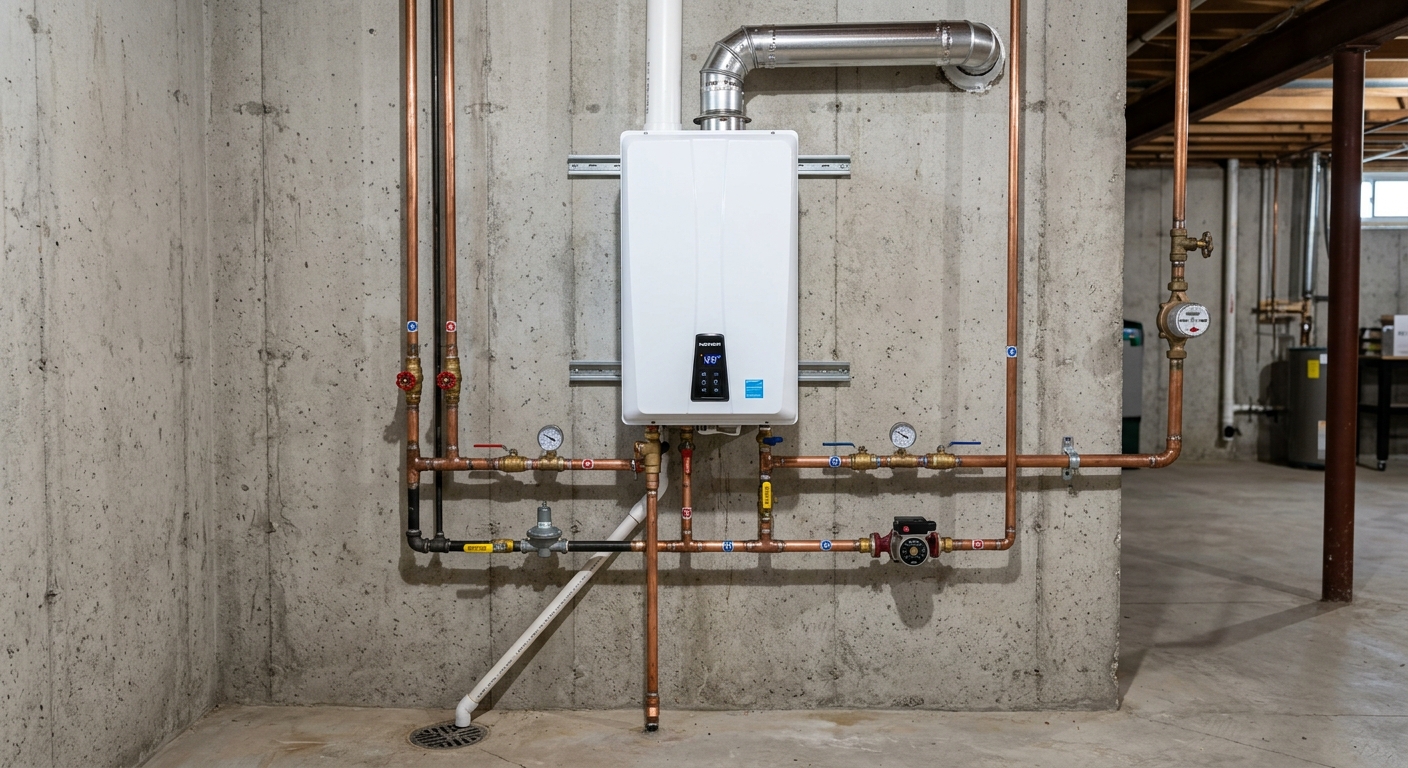
Tankless water heaters can be a good upgrade for Pine households that want endless hot water and better energy efficiency, but installation costs are higher than traditional tanks—often over $3,100 for a full retrofit. In newer Pine homes with properly sized gas lines and venting, the install is easier, but older homes may need expensive upgrades before a tankless unit can even be installed. Consider the longer lifespan and energy savings against three to five extra years of maintenance and filter cleaning. For many, a quality tank model at $1,300–$3,100 is simpler and pays off faster.
What does discoloured water on first draw mean?
In Pine, discoloured water, especially after overnight sitting or after main breaks, is often due to sediment or rust in aging service lines or older interior galvanized pipes. This is more likely in homes built before 1980, which is about 18.7% of Pine housing. If you have a lead or galvanized service line, always run water to flush it before use. Replacing an old water service line due to chronic discoloration usually lands in the $6,100–$13,000 range. If the problem is recent or widespread, check Pittsburgh Water and Sewer Authority updates first—it could be utility-side maintenance.
How do I prevent frozen pipes in Pine?
Winters in Pine get cold, with a design low of 8 °F and frequent freeze-thaw cycles. To avoid pipe freezes, insulate all supply lines in unheated spaces like garages or crawlspaces and always leave heat on during cold snaps. Pipes under sinks against exterior walls are vulnerable—open cabinets overnight when it’s below freezing. If you do have a freeze and it bursts, repairs run $375–$1,300 for the pipe and more if walls or floors need rebuilding. Drip faucets only as a last resort; insulation and sealing drafts are your best defense in Pine’s climate.
Can I do my own plumbing work in Pine?
Homeowners in Pine can perform some minor plumbing, like changing faucets, without pulling a permit; this matches local custom in Allegheny County. But for any substantial work—altering supply, replacing water heaters, repiping, or adding new fixtures—a permit is required and must be pulled by a licensed plumber in the relevant jurisdiction. Unpermitted work can create issues with insurance claims and home sales. If you’re not sure, the safest move is to ask the Allegheny County Health Department or a registered plumber. Professional work for a typical fixture or line change starts around $375–$500 and comes with code and insurance protection.
Why do plumbers charge a diagnostic fee?
Plumbing diagnostic fees in Pine usually cover the time and equipment used to assess your problem before giving a quote. Many issues (like pinpointing a slab leak or investigating hidden shutoffs) require specialty tools—acoustic listeners or thermal cameras, for example. Typical diagnostic fees in an emergency run $200–$500, but many plumbers roll this into the cost of the actual repair if you choose to proceed. In a crowded market like Allegheny County, use the diagnostic as a way to see if the contractor gives you useful, written findings you can use for a second opinion.
What counts as a plumbing emergency?
In Pine, a plumbing emergency is any event where active leaking, flooding, or imminent damage to property is at risk—examples include burst supply lines, sewage backing up into the home, or a failed water heater flooding the area. These take priority and generally cost more: emergency burst pipe repairs land in the $650–$1,300 range. Non-emergencies include slow drips, leaky faucets, or clogged toilets where a backup isn’t endangering your home. Knowing the difference helps you avoid premium fees and lets you shop around if a fix can wait for regular business hours.