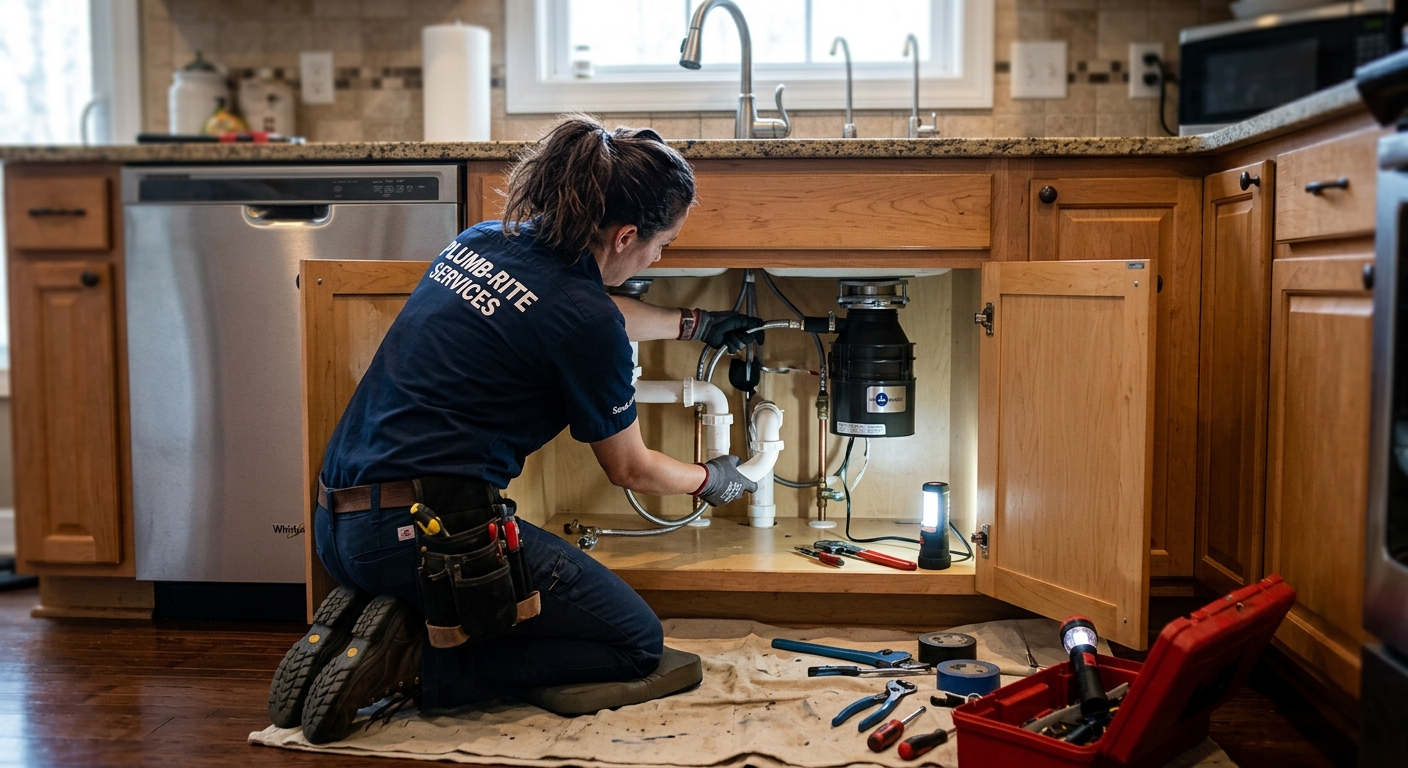
What plumbers charge in Sayre
In Sayre, the cost of plumbing services depends not just on the job, but on whether you’re dealing with an emergency. Emergency rates are higher, especially for leaks and burst pipes needing immediate repair. With about 68.6% of Sayre’s homes being single-family (U.S. Census Bureau, ACS 2024), jobs tend to take longer on larger, older systems—especially true for the area’s many houses built before 1980. Bradford County’s common 1880–1930 oil and rail-era homes often still have galvanized supply lines that now require full replacement to copper or PEX, shifting the cost upward compared to modern homes where only spot repairs are usually necessary.
Routine work—like replacing a water heater—follows a standard price, but if your water heater fails on a Saturday night, expect a bill on the high end of the range. Main drain cleaning, whole-house repiping, and water service lines have wide price bands, because access difficulty and pipe material are the main cost drivers; older cast iron or galvanized pipes always run higher for both material and labor. A whole-house repipe is a heavy investment but common in Sayre due to the age and materials of the existing stock. Table below summarizes typical plumbing service prices in Sayre:
| Service |
Scope |
Emergency rate |
Standard rate |
| Emergency repair — burst pipe |
locate, open, repair section, restore service |
$550–$1,100 |
$325–$1,100 |
| Water heater replacement (gas, 40–50 gal) |
remove old, install, test, haul away |
$1,750–$2,600 |
$1,100–$2,600 |
| Drain cleaning — main line |
augering or hydro-jet, camera if needed |
$350–$800 |
$200–$500 |
| Sewer line spot repair |
excavate or reline a failed section |
$1,850–$11,000 |
$1,850–$11,000 |
| Whole-house repipe |
replace supply lines throughout, patch and finish |
$3,200–$7,800 |
$3,200–$7,800 |
| Water service line replacement |
street to house, excavation and restoration |
$5,000–$11,000 |
$5,000–$11,000 |
Estimates for a typical Sayre home. Access difficulty and pipe material move these figures more than anything else.
What construction era means for your pipes
In Bradford County, especially Sayre, nearly 96% of homes were built before 1980 (U.S. Census Bureau, ACS 2024). These older homes—often dating to the oil and rail boom from 1880 to 1930—were built with galvanized steel supply pipes, cast iron drains, and, in some cases, even clay tile sewer laterals. Most water heaters in these homes are not originals; odds are, if your system predates the 1980s, you’re on your third water heater or more. Galvanized steel supply lines were standard back then and now are reaching the end of their useful life—they corrode, restrict flow, and often leak or burst, which is why full replacements to copper or PEX are increasingly common here.
For that kind of housing stock, expect your pipe material to dictate what fails next. Galvanized pipes regularly produce rusty water on first draw, pinhole leaks, and pressure loss. Sewer laterals in Sayre’s historic neighborhoods tend to be clay tile, which roots invade through every joint—the main reason behind main-line backups and expensive spot repairs.
If your house is newer, original 1980s-2000s construction in the outlying subdivisions, you might be dealing with builder-grade copper or even polybutylene (in late-80s to mid-90s builds). Polybutylene is a problem material that should be replaced outright. Water heaters in these homes are likely at the end of their first or second life, and you’re unlikely to have old galvanized or clay to tackle, but keep an eye on plastic drain and supply systems, as well as aging shut-off valves and supply hoses.
Spot repairs or whole-house repipe?
In Sayre, a single leak on a modern copper or PEX pipe likely just needs a spot repair. But here’s a real threshold: If you’ve had two or more leaks in the same material in three years, especially in galvanized or polybutylene, it’s not just bad luck—it’s a failing system. The costs of chasing each new leak add up fast, and repeat repairs on corroded material do little for your peace of mind. Warning signs: a noticeable drop in water pressure throughout the house, brown or rusty water after periods of no use, visible corrosion at joints, and pinhole leaks reappearing in nearby spots. Above all, homes with original galvanized lines from Bradford County’s oil and rail era are prime candidates for copper or PEX repipes, as these systems have simply reached the end of the line.
Whole-house repiping—copper or PEX—carries a bigger upfront cost but ends the cycle of leaks and low flow. PEX is less labor-intensive to install (especially in tight attics, crawlspaces, or finished basements); copper is more durable but costs more, especially with today’s materials. Both jobs leave you with drywall or plaster repairs. In Sayre’s older homes, that finish work—plaster patching and repainting—can rival the cost of the pipework itself. If you’re already opening walls for other renovations, consider repiping, as it saves money and disturbance in the long term.
| Situation |
Recommendation |
Cost |
Reasoning |
| One leak, accessible, modern pipe |
Spot repair |
$325–$1,100 |
No signs of corrosion or repeated failure |
| Two or more leaks in 3 years |
Partial repipe |
$3,200–$5,200 |
Pattern signals system-wide problem |
| Galvanized supply, pressure loss |
Full repipe |
$3,200–$7,800 |
Aging pipes at end of life, common in 1880–1930 stock |
| Polybutylene anywhere in the house |
Full repipe |
$3,200–$7,800 |
Unreliable pipe, known failure risk |
| Cast iron drain with root intrusion |
Camera, then reline or replace |
$1,850–$11,000 |
Roots mean ongoing clogs and leaks |
| Suspected lead service line |
Test, then replace the lateral |
$5,000–$11,000 |
Lead exposure risk, best addressed by full replacement |
Frozen pipes in Sayre: prevention and thaw
With a winter design temperature of 4°F and a required frost depth of 36 inches, Sayre’s freeze exposure is real—especially in older homes with pipes running through crawlspaces, exterior walls, or even unconditioned attics. The burst usually happens not where the pipe first freezes, but in the section between the ice plug and the nearest closed faucet. As pressure builds up behind the blockage, the pipe gives way, causing water damage once it thaws. It’s a surprise that often strikes after the cold snap ends, when you least expect it.
In Bradford County, the highest-risk spots are water lines in unheated crawlspaces, exterior kitchen or bath walls, garages with laundry hookups, and the classic hose bibs that serve backyard faucets. Pipes in attics, especially in older homes, are also vulnerable unless insulated. Preventing frozen pipes is far cheaper than repairing them: insulate exposed lines, install heat tape on riskiest runs, keep cabinet doors open so indoor heat can circulate, and let a faucet trickle during the coldest nights. Crucially, shut off and drain exterior spigots before the first hard freeze to avoid a split pipe in spring.
If you find a frozen line, never use an open flame. Stick with a hair dryer, heat gun (on low), or towels soaked in hot water. Thaw slowly, starting at the faucet end, and check for leaks as the ice clears. The bill for a burst pipe repair in Sayre commonly runs $550–$1,100 when emergency response is required. A roll of insulation and a careful walk through your crawlspace beats that every time.
Water heater replacement decisions
In Sayre, water heater choices come down to three main types: storage tank, tankless, and heat pump. The traditional tank is cheapest to install with a typical life of 8–12 years for gas, 10–15 years for electric. They’re simple, but have standby losses—meaning they slowly lose heat even when not in use—which costs more to operate over time. Tankless heaters provide endless hot water and last up to 25 years, but cost more upfront, especially if your gas line or venting needs rework. Many older homes in Sayre need a bigger gas line or a new vent, which can turn a straight swap into a major project.
Heat pump water heaters are the most efficient to run but need a warm, large space—like an unfinished basement free of freezing risk. They cool the area they sit in, so they aren’t great for small, conditioned finished spaces, and they’re loud enough to be annoying in living areas. Sizing should be by first-hour rating: how much hot water the unit can deliver in an hour at peak demand, not just on total gallons. For most Sayre households with typical families, 40–50 gallons (or about 60–70 first-hour gallons) is the right starting point.
Regardless of type, replacing a water heater in Sayre usually involves a new expansion tank to guard against pressure swings and a drain pan if on a finished floor. Most failures happen when the tank itself finally corrodes through, not the thermostat or the gas control. Best advice: Don’t wait to replace until after a flood—plan ahead when yours is more than a decade old.
| Type |
Installed cost |
Service life |
Operating cost |
Best when |
| Gas tank, 40–50 gal |
$1,100–$2,600 |
8–12 yrs |
moderate |
gas line accessible; tight budget |
| Electric tank, 40–50 gal |
$1,100–$1,750 |
10–15 yrs |
high |
no gas; basement install |
| Gas tankless |
$1,750–$2,600 |
18–25 yrs |
low-moderate |
high hot water use; upgrade existing gas line |
| Heat pump water heater |
$1,750–$2,600 |
13–15 yrs |
lowest |
warm, unfinished basement; moderate use |
Who is allowed to do plumbing work in Pennsylvania
In Pennsylvania, plumbing is not licensed at the state level. Instead, licensing is handled by each municipality, so a plumber cleared to work in Sayre might not have any credential to do the same job in Towanda or Athens. In Sayre Borough, you need to check whether your plumber is approved to pull permits there, since the Sayre Borough Code Enforcement Office issues and inspects all new plumbing system installations or extensions to additional fixtures. For like-for-like faucet or toilet replacements, Athens Borough typically does not require a plumbing permit inside a single dwelling, but every township can differ.
There’s no central Pennsylvania plumbing board or registry. Contractor registration for jobs over $500 is required under the Home Improvement Contractor (HIC) system—always check registration at hic.attorneygeneral.gov. For businesses with employees, state law mandates workers’ compensation, which is verified through the WCAIS system (wcais.pa.gov). Always ask for written proof of both. Insurance is critical—any contractor asking you to waive your deductible is breaking state law.
Final word: In Sayre, any significant change (new piping, adding fixtures) requires a borough permit. If you’re outside Sayre, check with your local township’s code office. Never assume your plumber’s “license” means anything unless it applies to your municipality and job specifically.
Lead service lines in Sayre
Sayre’s water is supplied by the Pennsylvania American Water Company Northern District system. While Bradford County municipalities report minimal documented lead service lines and there’s no published countywide inventory, the issue isn’t impossible—it just isn’t as common as in cities with much older plumbing stock. Regardless, the split in responsibility is clear: The utility owns the main, and usually the portion running to the curb shutoff or meter pit; the rest is your lateral, and yours to maintain or replace.
If you’re concerned your Sayre home may have a lead service line, the only way to know is to inspect the pipe where it enters your home. A scratch test (lead is soft and shiny; copper is orange-brown) plus a magnet (lead isn’t magnetic, steel is) is the homeowner’s first check. Partial replacements—where only the street or only the house portion is swapped—can actually spike your lead exposure in the short term, as scale inside old pipe is disturbed. Full, end-to-end replacement is safest.
No countywide cost-share or program is listed, so contact the Pennsylvania American Water Company directly to ask about replacements or financial help; don’t assume coverage. Replacement usually runs between $5,000–$11,000 for a full service lateral, and if done as a spot repair (opening only a failed section), costs are in the $1,850–$11,000 range. With most Sayre service lines already swapped to copper or plastic, don’t pay for work until you know for sure what you have.
Frequently asked questions — plumbing in Sayre
How long should a water heater last in Sayre?
For most Sayre homes—especially those built before 1980—the average gas water heater will last about 8–12 years, and an electric model about 10–15 years. The area’s hard water and older plumbing increase the rate of sediment buildup, especially in houses with original piping, which can cut service life short if annual maintenance is skipped. If your tank is approaching its tenth birthday or older, watch for temperature inconsistency and leaks near the base. Once the tank wall corrodes through, replacement is your only real option. Installing a new water heater in Sayre usually costs $1,100–$2,600. Whenever you’re budgeting, remember that the third or fourth replacement isn’t unusual for Century-old houses here.
Does Pennsylvania license plumbers at the state level?
No—plumbing isn’t licensed at the state level in Pennsylvania. Instead, each municipality regulates who is allowed to pull permits and perform plumbing work in their area. So a Sayre plumber may be fully cleared in Sayre but not have the paperwork to work a block away in Towanda or Athens. There’s no statewide plumbing license or board. However, any contractor doing work over $500 must register under the state Home Improvement Contractor system, with verification available at hic.attorneygeneral.gov. Always check that your plumber is registered and permitted in your exact municipality. For anything beyond a faucet or toilet swap, in Sayre a borough permit is required and standard emergency jobs like repairing a burst pipe run $550–$1,100 when done on an urgent basis.
How much does a plumber cost in Sayre?
Plumbing prices in Sayre rely on the job, pipe material, and whether it’s an emergency. Emergency repairs—like an active leak or a burst pipe—typically cost $550–$1,100. Routine work, such as water heater replacement, usually lands between $1,100–$2,600. Drain cleaning, especially for older main lines, runs $200–$800 depending on whether you need a camera or hydro-jetting. Whole-house repiping, especially common in Sayre’s older homes, costs $3,200–$7,800. The wide range reflects unique access issues—old plaster walls, crawlspaces, and hidden runs all add time and cost.
Why do plumbers charge a diagnostic fee?
In Sayre, many plumbers charge a diagnostic fee to cover the time and skill needed to accurately identify your plumbing issue before beginning repairs. This fee isn’t just a “show-up” charge—it’s for inspecting old supply lines inside walls, crawling under floors, and testing fixtures to identify the real problem (especially in homes built 1880–1930 with nonstandard plumbing runs). The charge is usually rolled into the cost if you proceed with the repair. For example, if you call about a burst pipe and the job costs $550–$1,100, the diagnostic may be deducted. This approach helps weed out small issues that don’t need urgent, expensive attention—saving you money if the real fix is as simple as a loose connection.
How do I prevent frozen pipes in Sayre?
Frozen pipes can be a real problem in Sayre due to the local winter design temperature of 4°F and the 36-inch frost depth. First, insulate pipes in crawlspaces, attics, and exterior walls. Apply heat tape to vulnerable lines (especially laundry rooms in unheated garages or basements). Let a cold-water faucet trickle during extended cold snaps, particularly overnight. Always open cabinet doors under sinks so warm room air circulates. Before the first freeze, shut off and drain exterior hose bibs. These low-cost steps can help you avoid a burst pipe—which costs $550–$1,100 to repair in an emergency. Prevention is far cheaper than thawing out and patching a water-soaked mess.
What do I do if sewage is backing up?
If you find sewage backing up in your Sayre home, stop all water use immediately. Don’t flush toilets or run water down sinks until you call a plumber to diagnose the blockage. In Sayre and Athens Boroughs, separated sanitary sewer systems mean backups almost always trace to a clogged line, not stormwater. Older houses with cast iron or clay tile drains—common in this area’s housing stock—often see blockages from roots or collapsed sections. A typical main-line sewer clearing runs $200–$800, or more if hydro-jetting or a camera inspection is needed. If the camera finds a break or root intrusion, you could face a repair bill in the $1,850–$11,000 range for spot repairs.
Is a sewer line replacement covered by homeowner's insurance?
In Sayre, homeowner’s insurance usually will not cover routine sewer line replacement. Most policies exclude wear and tear, root intrusion, and failure due to age or material issues—problems all too common with the area’s older, clay or cast iron sewer laterals. Insurance may pay only for accidental, sudden damage but not system failure. Sewer line spot repairs or replacement here typically run $1,850–$11,000. A few insurers let you add specific endorsements for buried utilities at extra cost; check your declarations page. Always read your policy and ask your insurer for details before assuming any coverage.
Should I repipe my Sayre home or keep repairing?
If you’ve had more than one leak in the same supply material (especially galvanized or polybutylene) within three years, it’s usually a smarter move to invest in a full or partial repipe rather than keep repairing. Sayre’s 1880–1930 homes are notorious for repeated failures as galvanized pipes age. Chasing two or three leaks at $325–$1,100 each quickly matches the cost of a partial repipe ($3,200–$5,200). If you have falling water pressure, widespread discoloration, or visible corrosion at joints, a repipe won’t just save money—it’ll save you the hassle of unexpected water damage and repeated repairs.
Do older Sayre homes have galvanized pipes?
Yes—older Sayre homes, particularly those built in the late 1800s through about 1950, almost always have or had galvanized steel supply pipes. Bradford County’s oil and rail-era homes feature galvanized lines that corrode from the inside out, causing low water pressure and leaks. By now, many have been partially or fully replaced with copper or PEX, but a great number remain. If you see rusty water on first draw or pinhole leaks, it’s a sign the original pipe is still in place. Replacing old galvanized supply lines with copper or PEX is a major job, costing $3,200–$7,800 for a full repipe depending on size and finish work.