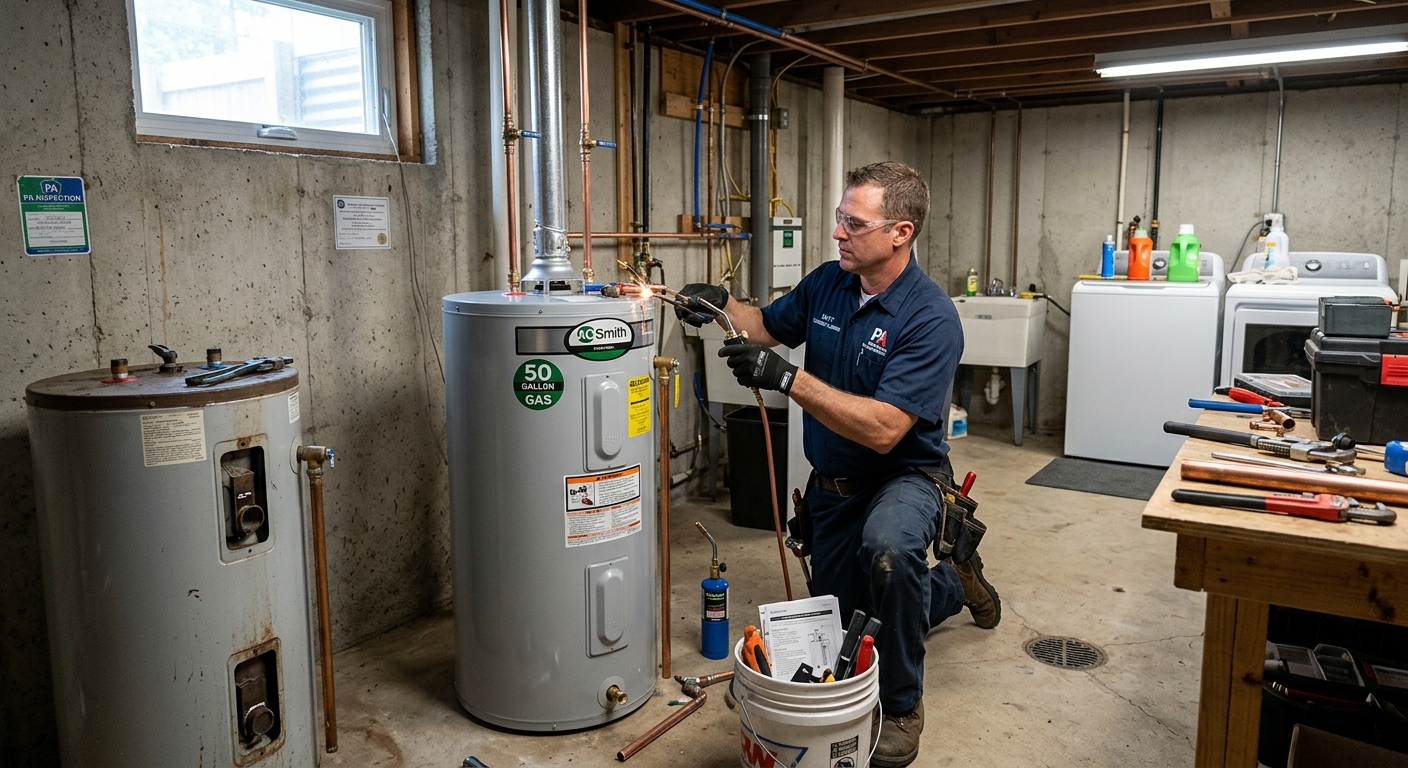
Plumbing costs in York — 2026
York homeowners are working with one of the oldest housing stocks in Pennsylvania, with 88.6% of residences built before 1980 and a homeownership rate of 43.5% (U.S. Census Bureau, ACS 2024). Here, a 1920s row home could have pipes that are now a century old, and replacing galvanized steel with copper or PEX is a routine job after decades of corrosion. More than most places, construction era directly predicts the plumbing material in your walls— and that, in turn, determines what’s most likely to go wrong and what it will cost to fix.
Plumbing costs in York split sharply depending on whether you have an emergency. The same repair—a burst pipe under your kitchen sink, for example—costs more after-hours, as quick response, mobilization, and temporary repairs factor in. Non-emergency work gives you more flexibility and less markup, so if you catch a leak early, act before it becomes urgent. That framing—emergency versus standard rate—shapes every price worth knowing in York.
| Service |
Scope |
Emergency rate |
Standard rate |
| Emergency repair — burst pipe |
locate, open, repair section, restore service |
$550–$1,150 |
$325–$1,150 |
| Water heater replacement (gas, 40–50 gal) |
remove old, install, test, haul away |
$1,800–$2,700 |
$1,150–$2,700 |
| Drain cleaning — main line |
augering or hydro-jet, camera if needed |
$350–$800 |
$200–$500 |
| Sewer line spot repair |
excavate or reline a failed section |
$1,900–$11,500 |
$1,900–$11,500 |
| Whole-house repipe |
replace supply lines throughout, patch and finish |
- |
$3,400–$8,100 |
| Water service line replacement |
street to house, excavation and restoration |
- |
$5,300–$11,500 |
Estimates for a typical York home. Access difficulty and pipe material move these figures more than anything else.
Galvanized, copper, PEX, cast iron
York’s streets are lined with homes built long before plastic piping was the norm. If you live in a house from 1900–1950—the bulk of York’s housing—you probably started with galvanized steel pipes. Over time, many owners swapped these out for copper or, more recently, PEX. Knowing your pipe material is not just academic: it tells you which failures to expect and when a wholesale repipe is likely.
Identifying your pipe is straightforward. Expose a few inches near the water meter or under a sink. For galvanized steel, a scratch test shows shiny silver metal, a magnet sticks, and joints are threaded. Copper is reddish and non-magnetic, with soldered joints. PEX is flexible and usually red, blue, or white, with crimped or push fittings. If you spot bluish-gray, flexible pipe with metal rings, that's likely polybutylene, now considered a defect risk. Cast iron is thick, heavy, and black with hub joints; clay tile outside shows as orangey-red at a broken section, while white or black plastic is modern PVC or ABS.
If your home holds original plumbing from the 1940s or 1950s, you are living on borrowed time with galvanized or cast iron. Typical service life for these materials is 40–75 years. Copper is better, but York’s water chemistry still sees pinhole leaks in 50-plus-year-old lines. PEX isn’t perfect but is the current standard. Map your own remaining runway below.
| Material |
Typical era |
Failure mode |
Service life |
| Galvanized steel supply |
pre-1960 |
internal corrosion, pressure loss |
40–60 yrs |
| Copper supply |
1950s–present |
pinhole leaks, joint failure |
50–70 yrs |
| Polybutylene supply |
late 1970s–1995 |
fitting failure, sudden bursts |
unreliable |
| PEX supply |
2000s–present |
fitting or UV degradation |
40–50 yrs |
| Cast iron drain |
pre-1975 |
corrosion, cracking, scale |
50–75 yrs |
| Clay tile sewer lateral |
pre-1980 |
root intrusion at joints, offset |
50–60 yrs |
| PVC / ABS drain |
1970s–present |
joint separation, crushing |
50+ yrs |
What a plumbing quote should contain
Plumbing in York is quoted two ways: flat rate (you pay the agreed price no matter what), or time-and-materials (you pay an hourly rate plus parts). Flat rate gives you price certainty. The risk is mostly on the contractor, so it’s built into the number—higher for unknowns. Time-and-materials can work out cheaper for simple or predictable jobs but is open-ended if there are surprises. Neither model is a scam, but walking into a job without being clear on which you have is the single biggest risk homeowners take.
Your quote should spell out the diagnostic fee—what it covers and if it is credited to the final bill. Look for a detailed scope of work: what’s being opened, what’s being fixed, and what gets patched afterward. Permits should be included (and priced), because most plumbing changes in York City require one. Restoration (drywall, flooring) should be explicit—either in or out. Warranty coverage must give you the labor warranty separate from parts, and any after-hours rates need to be flagged upfront, not in small print.
| Line item |
What to look for |
Red flag if… |
| Billing model |
flat rate or hourly, stated up front |
unstated |
| Diagnostic fee |
amount, and whether it credits |
vague |
| Scope |
what is opened, repaired and restored |
price with no scope |
| Restoration |
drywall and finish explicitly in or out |
silent |
| Permit |
included and priced |
'not needed' |
| Parts |
brand and model for fixtures |
'standard fixture' |
| Warranty |
labour period stated separately |
parts only |
Is your water line lead? How to find out
For York City homeowners, the question of a lead water line comes up immediately—especially in neighborhoods where homes date to the early 1900s. Here, the York Water Company owns the public part of the line (main to curb), while you own from the curb to your home. Historically, lead lines were common on both sides. Replacement programs in Pennsylvania, including York’s, have often focused on just the utility side, which can leave the homeowner’s portion untouched. That’s why knowing the current status is critical.
Thankfully, as of their last published inventory, York Water Company reported full lead service line replacement for their York City system. But the only way to be certain about your side—and any house built before 1980 should check—is to look at your own service line where it enters your basement or crawl. Scratch it with a key: lead is dull, silver, and easily scratched (a magnet won’t stick). Copper is reddish, iron is magnetic, and plastic is, of course, plastic.
A critical warning: partial replacement often does more harm than good in the short term, disturbing pipe scale and releasing spikes of lead into water. If you suspect lead pipe, ask York Water Company directly and consult their published inventory. Never assume your line is safe based on the age of the property alone.
If you need to replace your full service line to the street, typical costs run $5,300–$11,500, depending on length, surface restoration, and access. For whole-house repiping (if you discover lead inside), costs are typically $3,400–$8,100.
Vetting a plumber in York County
In York County, a legitimate plumbing contractor starts with Pennsylvania’s Home Improvement Contractor registration, but licensing is municipal—Spring Garden Township, for example, requires its own plumbing license. Never skip confirming the plumber is permitted to work in your municipality and not just “registered in PA.” Check registration at hic.attorneygeneral.gov. Confirm current workers’ compensation via WCAIS (wcais.pa.gov)—it’s required for all employers, and the policy must name your address before work begins.
Ask for an insurance certificate that covers both liability and property damage with you as the named insured. Clarify who will perform the work: their employees or a subcontractor. Request after-hours/emergency rates in writing before work starts—not all companies disclose these up front. Demand camera proof and pressure test results for any repipe or sewer replacement quote.
- Home Improvement Contractor number, checked at hic.attorneygeneral.gov
- Municipal plumbing license, confirmed with local office if required
- Workers’ compensation coverage — verify active status at WCAIS
- Insurance certificate with your property named
- Written contract for jobs over $500, per state law
- Written scope with specifics, not just price
- Brand/model for water heaters and fixtures — not just “standard”
- Camera video for sewer/drain replacements, not just a “diagnosis”
- Pressure test results for full repipes
- Policy on subcontracting — who is actually in your home
- Emergency rate disclosed before dispatch
- Warranty in writing, with term and coverage
Red flags in York are contractors offering big-ticket repipes or sewer spot repairs without camera footage or test evidence, or pressure-selling full pipe replacement in thinly populated rural areas where legitimate jobs are few and far between.
Verifying a York plumber's credentials
In Pennsylvania, plumbing is not licensed statewide. Instead, each municipality controls its own licensing if it chooses; some, such as Spring Garden Township in York County, register plumbers separately from the rest of the state-level requirements. This means that a plumber licensed in one locality may have no credential at all in the next. For York homeowners, the real question isn’t “Are you licensed?” but “Are you licensed here?” Always check with your municipality’s permit office if in doubt.
In York City, any new or altered plumbing system work beyond fixture replacement requires a permit. Same-location replacements of existing plumbing fixtures usually go forward without one. All permit applications are handled by the Bureau of Permits and Inspections or by the permit office in your township—Springettsbury, West Manchester, and others all run their own systems. All employers must carry workers’ compensation (verify via WCAIS), and your proof of insurance should name your property specifically.
Do not rely on statewide “plumbing licenses”—they simply do not apply here. Verify municipal credentials and permit requirements for your specific address before any contract is signed.
Detection methods and what they cost
Start free: if you suspect a leak, shut every faucet and appliance, then check your water meter. Any movement on the dial means a supply-side leak. This simple test is first for a reason—the only equipment is a flashlight.
Professional leak detection in York is chosen based on where the problem hides. Acoustic listening (electronic stethoscopes) pinpoints leaks in walls or under floors and typically falls in the $200–$500 range. Thermal imaging contacts cool moisture behind drywall ($200–$500). Tracer gas detection—pressurizing non-toxic gas into emptied pipes—finds slab and underground leaks and usually runs a bit higher, up to $550–$1,150 including isolation and opening.
Slab leaks are rare in York City’s basements but common in post-war slab-on-grade homes in the townships. A skilled plumber doesn’t open walls or floors before locating the leak: they confirm the source, then cut only where repair is needed. Opening up before proving the problem is backward, and often leaves you facing restoration bills for a misdiagnosis.
Frequently asked questions — plumbing in York
How do I tell what my pipes are made of?
York’s older homes (most built before 1950) often have a mix of pipe types from renovations over the years. For water supply, look for exposed pipe near your shutoff or meter. Scratch the pipe: if it’s silvery and a magnet sticks, it’s galvanized steel. Reddish metal that isn’t magnetic is copper; white, black, red, or blue flexible tubing is PEX. If you find a dull, soft, grey pipe that scratches easily and reacts to neither magnet nor copper polish, you might have lead—rare but still present in pockets. For drains, cast iron is black and heavy, while clay tile (outside) is red-brown. If you’re unsure and live in a York City home built before 1980, don’t guess—have a plumber confirm. Full repipe jobs in York run $3,400–$8,100, so identifying original material is worth your time.
Do I need to drain outdoor spigots in York?
With a winter design temperature of 12 °F and 30 inches of frost depth, York’s climate gives little margin for error. You should drain and shut off outdoor spigots every fall. If your home uses frost-free hose bibs but the pipe isn’t pitched back toward the interior, water will still collect and freeze inside. The safe approach is to turn off the interior shutoff, open the exterior spigot, and let it drain each October. A split sillcock can cost $325–$1,150 to repair if it freezes and bursts, especially in an emergency. For homes with unfinished basements and visible lines, add pipe insulation for extra insurance.
What does emergency plumbing cost in York?
Emergency rates in York run higher than standard for the same job, reflecting after-hours labor and rapid dispatch. If you call for a burst pipe or active leak at night, you’ll see a typical bill of $550–$1,150—that covers locating, opening, repairing, and restoring service. These prices reflect York’s labor rates, permit fees, and the challenges of older housing stock. If you can safely shut off the water and wait until business hours, repairs often fall at or below the low end of the emergency band. Always confirm whether quoted prices are for emergency or standard service before authorizing work.
How much does a plumber cost in York?
In York, the cost of hiring a plumber varies by job, time, and whether it’s emergency or scheduled service. Drain cleaning for a main line typically runs $200–$500 during regular hours and $350–$800 for after-hours calls. Water heater replacement (gas, 40–50 gal) lands in the $1,150–$2,700 range, installed. Labor rates reflect York County’s moderate suburban demand and the older, more labor-intensive homes common in the city—many built decades before modern plumbing. Always insist on a clear, itemized estimate, and check if the price includes permits, parts, and restoration.
Does insurance cover a burst pipe in York?
Most York homeowner policies cover damage from burst pipes—provided you maintained heat and didn’t ignore a known issue. The insurer usually pays for water damage restoration and needed access, but not always the repair to the pipe itself. Review your policy’s “sudden and accidental” coverage section. In practice, a burst pipe repair typically costs $325–$1,150 in York. Remember, state law prohibits a contractor from waiving your insurance deductible; if you’re offered that, it’s a red flag. Claims may also require a permit if repair involves opening walls or replacing multiple sections.
Who inspects plumbing work in York?
In York City, the Bureau of Permits and Inspections handles permits and inspections for most plumbing work—any new or altered system, not just fixture swaps. Surrounding townships like Springettsbury and West Manchester each run their own permit offices and may have different requirements. Inspections check compliance with the Pennsylvania Uniform Construction Code (UCC), based on the IRC. For most projects beyond a simple replacement, expect rough and final inspections. Permitting protects the homeowner: jobs over $500 require a written contract and 3-day cancellation window under Pennsylvania’s consumer law.
Is trenchless sewer repair reliable?
Trenchless sewer repair (pipe lining or pipe bursting) is a reliable option in many York homes—especially where digging up yards or old sidewalks is difficult or expensive. It works best on straight, structurally sound pipes without heavy offset or collapse. Root intrusion and clay joints are common issues before 1980 here, and trenchless solutions can address many but not all such failures. Typical spot repair costs fall between $1,900–$11,500 in York County. Insist on a pre-repair sewer camera inspection, and always request footage to confirm what you’re dealing with.
How do I shut off the water to my house?
In most York homes—especially those built before 1950—you’ll find your main shutoff near where the water line enters through your foundation, often next to the meter. Look for a round “wheel” or lever valve on the pipe. Turn it clockwise to shut off. If you can’t find it, check basements and crawl spaces along the front wall closest to the street. It’s critical to test your main shutoff before there’s an emergency—a fast response in a burst pipe situation can save you $325–$1,150 in damages. If the valve is rusted or frozen, have it replaced before you need it.
How hard is the water in York?
York Water Company draws from primarily surface sources. Most York homes have moderately hard water—hard enough to cause scale in older galvanized and copper pipes over decades, but rarely so hard as to demand a softener unless you notice staining, crusty fixtures, or pinhole leaks in pipes over 50 years old. While a softener isn’t strictly necessary for most, regular inspection and cleaning of aerators and heater elements is wise. If you suspect chronic buildup, a water heater flush ($200–$500) every couple of years can extend its life. Ask your provider for a current water quality report for specifics at your address.