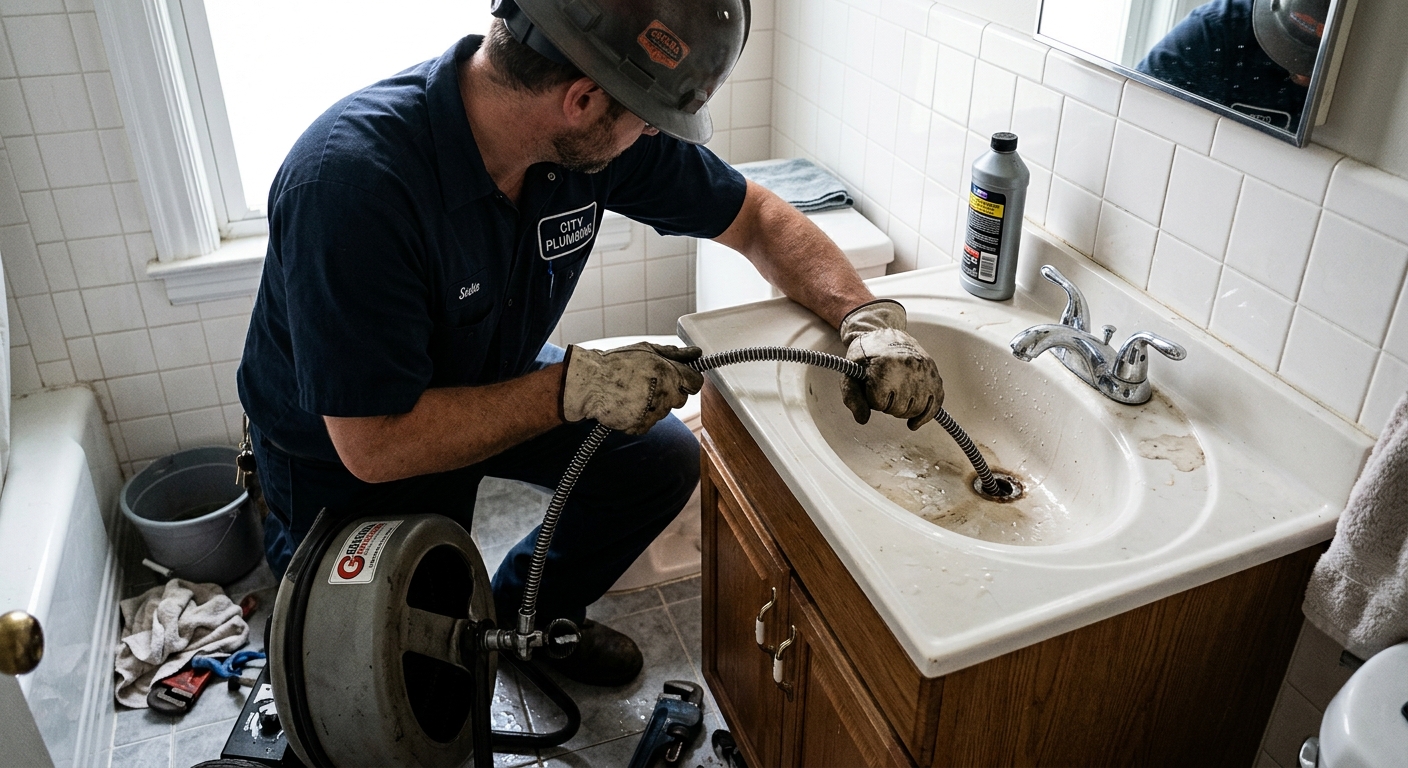
Plumbing costs in Franklin Park — 2026
Franklin Park homeowners face a distinct range of plumbing costs, shaped by the area’s high homeownership rate (91.9%) and the fact that over a third of local homes were built before 1980 (U.S. Census Bureau, ACS 2024). The age of your plumbing system matters: much of the Pittsburgh region was built out between 1900–1950, and those decades left behind a patchwork of galvanized steel and cast-iron pipes nearing the end of their useful life. If you have a burst pipe or major leak, expect to pay more for immediate response—timing is often the largest single factor in the bill. Nearly every type of repair, from a water heater replacement to a main line drain cleaning, will cost more if you call during an emergency, after hours, or on a weekend. Even within a typical home, access difficulty and the kind of pipe material—galvanized, copper, PEX, or cast iron—can swing the total price by hundreds or thousands of dollars.
Here’s what you can expect to pay for common plumbing services in Franklin Park, both when it’s an emergency and when you have the benefit of scheduling in advance:
| Service |
Scope |
Emergency rate |
Standard rate |
| Emergency repair — burst pipe |
locate, open, repair section, restore service |
$650–$1,300 |
$375–$1,300 |
| Water heater replacement (gas, 40–50 gal) |
remove old, install, test, haul away |
$2,100–$3,100 |
$1,300–$3,100 |
| Drain cleaning — main line |
augering or hydro-jet, camera if needed |
$350–$800 |
$200–$500 |
| Sewer line spot repair |
excavate or reline a failed section |
$2,200–$13,000 |
$2,200–$13,000 |
| Whole-house repipe |
replace supply lines throughout, patch and finish |
|
$3,900–$9,400 |
| Water service line replacement |
street to house, excavation and restoration |
|
$6,100–$13,000 |
Estimates for a typical Franklin Park home. Access difficulty and pipe material move these figures more than anything else.
Spot repairs or whole-house repipe?
In Franklin Park and throughout the Pittsburgh area, more and more homeowners are having to choose between spot repairs and a full or partial repipe. If you’ve had two or more leaks in the same material in three years, that’s not just bad luck—it’s a pattern indicating your piping is reaching the end of its service life. Other red flags: house-wide pressure loss (not just at one faucet), brown or rusty water when you first run the tap, visible flaking or rust at exposed joints, and recurring pinhole leaks. These symptoms are especially prevalent in homes with galvanized steel or older copper supply lines, both commonly installed in houses built before 1960.
If you’re tempted to keep patching, do the math. Multiple spot repairs can quickly add up, especially once you factor in wall and ceiling repairs after the pipes are fixed. In homes with plaster rather than modern drywall—common in pre-1950s Franklin Park—restoration costs after plumbing work can rival the plumbing labor itself. Deciding between copper and PEX for a repipe is mainly about budget and preference. Copper is familiar and time-tested; PEX is flexible, easier to install, and less prone to freezing. The big mistake: repiping only half the system, which leaves future leaks waiting in the old sections.
| Situation |
Recommendation |
Cost |
Reasoning |
| One leak, accessible, modern pipe |
Spot repair |
$375–$1,300 |
Good pipes elsewhere suggest isolated issue |
| Two or more leaks in 3 years |
Partial repipe |
$3,900–$6,300 |
Failures are accelerating, replacement more cost-effective |
| Galvanized supply, pressure loss |
Full repipe |
$3,900–$9,400 |
Corrosion is system-wide, can’t be solved piecemeal |
| Polybutylene anywhere in the house |
Full repipe |
$3,900–$9,400 |
Material is failure-prone and often uninsurable |
| Cast iron drain with root intrusion |
Camera, then reline or replace |
$2,200–$13,000 |
Roots mean a breach; scope first, then fix what’s broken |
| Suspected lead service line |
Test, then replace the lateral |
$6,100–$13,000 |
Replace to remove lead hazard, essential for health |
Licensing and permits for plumbing work in Franklin Park
Plumbing in Franklin Park, as in most of Pennsylvania, is licensed and permitted at the municipal or county level—not statewide. This means a plumber licensed in Pittsburgh, for example, may not necessarily be authorized to do plumbing work in Franklin Park or other Allegheny County municipalities. The key question for any homeowner is not simply “are you licensed?” but “are you licensed here?” In Allegheny County, the Health Department administers its own journeyman and master plumber licensing program for Pittsburgh and some nearby municipalities. For the rest of the county, licensing may depend on your specific municipality’s requirements.
Permits are required for significant plumbing changes—adding or altering supply or waste piping systems—while minor fixture replacements like faucets typically do not need a plumbing permit in Allegheny County. Inspection enforcement flows through local municipalities or, if a municipality has opted out, through the PA Department of Labor & Industry. Before hiring a contractor for work over $500, you should check that they maintain a current Home Improvement Contractor (HIC) registration with the Pennsylvania Office of Attorney General (you can verify at hic.attorneygeneral.gov). Also, workers’ compensation coverage is mandatory for Pennsylvania employers and can be checked through the WCAIS system (wcais.pa.gov).
Always insist on proof of both HIC registration and valid workers’ comp before signing any contract, especially on major projects like repiping or water line replacement. This is your best protection if something goes wrong.
Sewer laterals: the pipe you own and can't see
For Franklin Park homeowners, understanding where your responsibility begins and ends with sewer lines is key: you own the lateral that runs from your house out to the main—often including the part under the street. Many expensive surprises start as minor annoyances: a single slow drain, gurgling after a flush, or water backing up at the lowest fixture. When you see these, the issue could be anywhere in your main waste stack or your buried lateral.
Pittsburgh and the surrounding Allegheny County townships use a mix of combined and separated sewers, and outlying homes may still have septic systems (which bring their own troubleshooting headaches such as tank buildup and drainfield failures—requiring regular pumping every 3–5 years). Within the sewer system, the biggest threat to older clay or cast iron pipes is root intrusion—roots find their way into joints, causing slow or recurrent clogs. Bellies (low spots where water and waste collect) and offsets in older pipes also cause chronic backups and can escalate into costly repairs.
Camera inspection should always be your first step before any sewer excavation or repair—never settle for a quote without reviewing the footage yourself. The decision to dig up and replace the line (open-cut replacement) or reline it using trenchless techniques depends on what’s found, but both can be costly and disruptive. For spot repairs, expect to see prices between $2,200–$13,000.
Pipe materials in Franklin Park homes and how they fail
The era your Franklin Park home was built is the strongest predictor of what types of pipes you have, and what issues might be waiting for you. Much of the local housing was constructed between 1900 and 1950, a span that saw wide use of galvanized steel for supply lines and cast iron for drains—both materials now at or beyond their realistic lifespan.
Galvanized steel pipes, in particular, corrode from the inside out. If your water pressure fades throughout the house or you see rusty water on first draw, this is often the cause. These pipes are attracted to a magnet and show a dull gray color; scratch them and you’ll see shiny silver. Copper, introduced widely in the 1950s, is durable but prone to pinholes, especially if your water chemistry is aggressive. Polybutylene, used in the late ‘70s through mid-90s, is problematic and notorious for failure at the fittings—if you see flexible gray-blue piping, that’s a red flag.
PEX has been common since the 2000s and is flexible, plastic, and usually marked with red or blue stripes. Cast iron drain stacks are heavy, black, and joined with lead oakum, while clay tile pipes appear orange-brown and are brittle. PVC and ABS plastics—white and black, respectively—are the newer standards for drains.
Use the scratch and magnet test to help ID your pipes. Matching your home’s era to material will give you a rough estimate of how much useful life remains before a major repipe or replacement is likely required.
| Material |
Typical era |
Failure mode |
Service life |
| Galvanized steel supply |
pre-1960 |
internal corrosion, pressure loss |
40–60 yrs |
| Copper supply |
1950s–present |
pinhole leaks, joint failure |
50–70 yrs |
| Polybutylene supply |
late 1970s–1995 |
fitting failure, sudden bursts |
unreliable |
| PEX supply |
2000s–present |
fitting or UV degradation |
40–50 yrs |
| Cast iron drain |
pre-1975 |
corrosion, cracking, scale |
50–75 yrs |
| Clay tile sewer lateral |
pre-1980 |
root intrusion at joints, offset |
50–60 yrs |
| PVC / ABS drain |
1970s–present |
joint separation, crushing |
50+ yrs |
Service line material and drinking water in Franklin Park
Franklin Park drinking water is supplied primarily by the Pittsburgh Water and Sewer Authority. They have identified and are actively replacing thousands of lead service lines throughout Allegheny County. For every home, there’s a split: the water utility typically owns only the section of pipe up to the curb stop, while the homeowner owns the line from there into the house. In practice, replacement programs often deal only with the utility-owned segment, leaving the homeowner responsible for the remainder. Know that disturbing or partially replacing a lead line can temporarily increase lead levels—total replacement is safest.
To check your own service line, find the pipe as it enters the building. Use a coin or key to gently scratch the pipe. Lead will reveal a shiny silver surface, is soft, and will not attract a magnet. Copper appears bright and reddish. If you have doubts, a licensed plumber or certified tester can verify the material for certain. The Pittsburgh Water and Sewer Authority maintains a published inventory of known or suspected service line materials—consult their records, but also ask directly, as records from the early 20th century can be incomplete or inaccurate.
If you confirm lead or simply want peace of mind, expect replacement costs for the homeowner portion to fall between $6,100–$13,000. It’s worth checking with the utility about the current status of their replacement work and whether any program or cost-share is available to offset your out-of-pocket expense. Never assume these programs are automatic—always ask directly.
Detection methods and what they cost
If you suspect a hidden leak in your Franklin Park home, the first thing to try is the meter test: shut off every tap and appliance, then check your water meter. If the low-flow dial is spinning, you have a leak between the meter and your fixtures—this test costs nothing and gives you an answer in minutes.
If the leak is buried in a wall, underground, or beneath a slab, tools come into play. Acoustic listening devices pick up the sound of pressurized leaks in floors and cavities and are standard for slab leaks. Thermal imaging cameras spot temperature changes caused by leaking hot or cold water in walls. Tracer gas is used when standard methods won’t work; a safe gas is injected and a sensitive detector “sniffs” for the escape route. Each technique targets a different scenario, and most plumbers in Franklin Park charge extra for leak detection using these methods—acoustic and thermal imaging usually run $375–$1,300 if bundled into a repair visit.
Never agree to open walls in search of a leak without first scoping it out; a reputable plumber will always rule out “invisible” sources before moving to demolition, saving you from unnecessary repair costs.
Frequently asked questions — plumbing in Franklin Park
Is a water softener worth it in Franklin Park?
Whether a water softener is worth it in Franklin Park depends on your needs and expectations. Most homes here, supplied by the Pittsburgh Water and Sewer Authority, receive water that’s in the moderately hard range. If you notice calcium buildup on faucets, shower doors, or inside kettles, a softener can help cut down on cleaning and extend the life of appliances. However, not every homeowner feels the difference strongly enough to justify the cost. Whole-house units typically start around $1,300–$3,100 installed, depending on the capacity and plumbing changes needed. If you don’t have significant scale buildup and your family doesn’t mind the feel of “hard” water, you can safely skip this project and save your budget for things that actually need fixing.
What does drain cleaning cost in Franklin Park?
In Franklin Park, professional main line drain cleaning ranges from $200–$500 for routine scheduling to as high as $800 during an emergency or off-hours. Most calls involve snaking or hydro-jetting the main sewer line and may include a camera inspection if repeated blockages occur. The price depends on pipe length, access points, and whether tree roots or heavy buildup are involved. For homeowners in older homes—many built before 1980—a camera inspection (often included when major problems are suspected) is well worth considering, especially if you’ve never had it done. Regular cleaning can prevent big surprises down the road, but if a plumber keeps snaking the same drain every few months, it may be time for a long-term fix instead.
Why do plumbers charge a diagnostic fee?
It’s common for plumbers in Franklin Park to charge a diagnostic or service fee, usually between $375–$1,300 depending on the time and complexity. The fee covers travel, inspection time, and the expertise needed to identify the root cause—much like a co-pay at the doctor. Plumbing problems in older housing stock (a Franklin Park reality) can be complicated: locating a leak behind plaster, diagnosing intermittent sewer backups, or distinguishing between a failing valve and a broken supply line all take time. A thorough diagnosis up front helps homeowners avoid repeat visits, wasted repairs, and higher bills overall. Most reputable plumbers will roll this fee into the cost if you hire them for the repair.
Does insurance cover a burst pipe in Franklin Park?
Homeowners insurance policies in Franklin Park usually cover sudden, accidental damage caused by a burst pipe—for example, water damage to your floors or walls. However, insurance won’t pay if the leak was a result of long-term neglect, slow drips, or frozen pipes that could have been prevented. Most policies will not cover the pipe repair itself (which runs $375–$1,300 for an emergency fix), only the damage to your home and belongings. If you have an incident, document everything with photos and call your insurer right away. Never let a contractor offer to waive your insurance deductible—Pennsylvania’s Home Improvement Consumer Protection Act specifically prohibits this. In any emergency, acting quickly saves both money and hassle.
Can I do my own plumbing work in Franklin Park?
Many minor plumbing repairs in Franklin Park, such as replacing a faucet or tightening a fitting, can be legally done by the homeowner without a permit. But if you need to add or alter supply or waste lines, a permit and professional inspection are often required under the Pennsylvania Uniform Construction Code. While DIY can save on labor costs, remember that improper installation—especially in older homes with outdated pipework—can result in expensive water damage or code violations. For any project over $500 or involving hidden pipes, it often pays to consult a local, properly-registered contractor (verify HIC at hic.attorneygeneral.gov) to stay on the right side of local requirements and protect your home’s value.
How do I tell what my pipes are made of?
In Franklin Park, the best way to identify your pipe materials is a physical inspection at a spot where pipes are visible—typically near the water meter, shutoff, or in the basement. Scratch the pipe gently: galvanized steel is silver-gray and attracts a magnet, copper is reddish and non-magnetic, and lead is very soft, shiny when scratched, and will not attract a magnet at all. Polybutylene is flexible, usually gray, blue, or black, and marked PB. PVC and ABS are plastic, white or black with stamped labeling. If your home was built before 1980, you may have any of these—pipe material often tracks the building era. Always check if you’re planning a major repair or trying to estimate remaining service life; problems with old galvanized or cast iron can quickly escalate to a $3,900–$9,400 repipe.
Which utility supplies water to Franklin Park?
The majority of Franklin Park is served by the Pittsburgh Water and Sewer Authority—the same utility responsible for water quality and service in central Allegheny County. If you have questions about your service line material, water quality concerns, or bills, their office holds the records you’ll need. If you’re worried about possible lead or old supply lines, check their online service line inventory and ask directly about replacement programs. If you ever need to replace your water service line, be prepared for a possible out-of-pocket range of $6,100–$13,000 for the homeowner-owned portion. Always confirm utility details before starting any major plumbing work.
What do I do about a burst pipe right now?
If you’re facing a burst pipe in Franklin Park, act quickly. First, shut off your main water supply—usually found where the pipe enters the basement or near the meter. Electrical panel should be off if there’s flooding near outlets. Move valuables to dry ground. Call an emergency plumber immediately; a same-day visit for active leaks typically runs from $650–$1,300 in Franklin Park. Document the situation for your insurance with photos or video. Until help arrives, you can try to contain the leak with buckets or towels, but avoid entering areas where water contacts electrical outlets. Quick action minimizes not only water damage but also your final bill and repair headache.
What do I do if a pipe is frozen but not burst?
If you suspect a frozen pipe in your Franklin Park home—but see no burst or leak yet—turn off the main supply as a precaution. Gently warm the pipe using a hair dryer, space heater, or wrapped heating pad—never use an open flame. Start near the faucet and work toward the coldest section. Open the faucet to relieve pressure as ice melts, and watch carefully for leaks. Homes in this region are often piped tightly along outside walls, so check basement and crawl spaces. If the pipe thaws without damage, you might avoid an emergency bill. But if you see water, call a plumber; emergency repairs for a burst pipe typically cost $650–$1,300 here. Prevent future freezes by insulating exposed pipes and sealing air leaks near foundations.