What plumbers charge in Lancaster
Lancaster’s plumbing costs are shaped by its distinctive housing stock and older infrastructure. With a city population of 57,970 and nearly nine in ten homes built before 1980 (U.S. Census Bureau, ACS 2024), homeowners see issues that newer suburbs seldom do. The city is known for its pre-1940 row and twin homes—houses where plumbing often means dealing with original galvanized pipe or layers of copper and PEX retrofits. Construction era predicts pipe material, and pipe material predicts what can go wrong—and how expensive the fix will be.
In Lancaster, the same plumbing job can have two prices: one for emergencies and one for scheduled work. Emergency calls—such as a burst pipe or active leak—are the priciest because they require fast response, often after hours, plus diagnostic work in sometimes messy situations. Planned jobs are less, because the crew can schedule time and prep, and you aren’t paying for overtime or urgent trips to the supply house.
| Service |
Scope |
Emergency rate |
Standard rate |
| Emergency repair — burst pipe |
locate, open, repair section, restore service |
$600–$1,150 |
$325–$1,150 |
| Water heater replacement (gas, 40–50 gal) |
remove old, install, test, haul away |
$1,850–$2,700 |
$1,150–$2,700 |
| Drain cleaning — main line |
augering or hydro-jet, camera if needed |
$350–$800 |
$200–$500 |
| Sewer line spot repair |
excavate or reline a failed section |
$1,900–$11,500 |
$1,900–$11,500 |
| Whole-house repipe |
replace supply lines throughout, patch and finish |
— |
$3,400–$8,200 |
| Water service line replacement |
street to house, excavation and restoration |
— |
$5,300–$11,500 |
Estimates for a typical Lancaster home. Access difficulty and pipe material move these figures more than anything else.
Finding a hidden leak in Lancaster
If you suspect a leak in your Lancaster home, start with what you can do for free: the meter test. Shut off every fixture, make sure no toilets are running, then check your water meter. If the small red dial is moving—even slightly—while all water is off, you likely have a leak on the supply side. This step can help you decide if calling a professional is even needed.
If a leak is confirmed but you can’t see where water is escaping, a plumber brings several tools. Acoustic listening, around $325–$800 when included as part of leak repair, can pinpoint the hiss of water escaping under floors or behind walls. Thermal imaging (infrared cameras) helps find leaks in warm-water lines and might add a moderate fee to diagnostics. For difficult jobs—like a slab leak where the supply runs under finished floor—a tracer gas injection and detector may be used, which pushes the cost closer to the higher end of a standard leak search.
Lancaster’s older homes see leaks in wall cavities, above drop ceilings, and under slabs. For irrigation lines running under yards or basements, tracing often involves dowsing rods or electronic locators, depending on what was installed originally. No plumber should start cutting open walls or breaking floors before using every non-invasive method to pinpoint the leak. Jumping to demolition is backwards and often unnecessary in homes where careful tracing saves both money and original plaster.
Emergency rates versus scheduled work in Lancaster
In Lancaster, whether you pay the emergency rate or a standard charge comes down to timing and urgency. The emergency premium covers after-hours or weekend dispatch, the added cost of getting a crew out on short notice, overtime wages for certified techs, and the challenge of troubleshooting fast—sometimes with only partial information or limited daylight.
Here’s what is worth paying the emergency rate for: active flooding or a gushing pipe (where damage mounts by the minute), total loss of water service, sewage backing up into drains, and any kind of gas odor. In these cases, emergency calls—at $600–$1,150 for a burst pipe—are money well spent to limit damage. On the other hand, if you have a slow drip under a sink, a single slow drain, or a running toilet, you can usually wait for business hours and save up to half.
If you discover a leak or burst in Lancaster, shut off water at the main valve—usually near where the line enters your basement or crawlspace. Turn clockwise to stop flow completely. For a fixture leak, close the valve behind the fixture if present. This stops water and buys you time to call for standard service, often dropping your cost from the emergency $600–$1,150 range down to a regular $325–$1,150. Sewage backup or no water? That remains an emergency—call immediately.
Spot repairs or whole-house repipe?
After two or more pipe leaks in three years on the same pipe material, it’s not bad luck—it’s a pattern that calls for more than patchwork. In Lancaster’s big inventory of pre-1940 row and twin homes, original galvanized steel pipes are reaching their limit, and the switch to copper or PEX is common.
Warning signs are clear: low pressure throughout the house (not just at one tap), cloudy or discolored water when you first run a faucet, visible corrosion on the pipes in the basement, or a history of pinhole leaks. For most homeowners, a spot repair makes sense for a single, accessible leak on newer copper or PEX—costing between $325–$1,150. If you have repeated leaks, especially on galvanized or polybutylene, you’re looking at a partial or full repipe.
PEX is popular for whole-house jobs in Lancaster for its flexibility and freeze tolerance, but copper is still requested for durability and resale value. Remember the cost you don’t see: cutting and patching drywall or, in many city homes, repairing plaster or tile after the pipes are replaced. In some cases, especially with original lath and plaster, finish work can rival the plumbing cost.
| Situation |
Recommendation |
Cost |
Reasoning |
| One leak, accessible, modern pipe |
Spot repair |
$325–$1,150 |
Modern materials are reliable; one-off repair is cost-effective. |
| Two or more leaks in 3 years |
Partial repipe |
$3,400–$5,500 |
Multiple failures show pipe fatigue; partial job saves future repairs. |
| Galvanized supply, pressure loss |
Full repipe |
$3,400–$8,200 |
Galvanized pipe rusts from inside; full replacement fixes low flow and water quality. |
| Polybutylene anywhere in the house |
Full repipe |
$3,400–$8,200 |
This material is failure-prone and no longer allowed. |
| Cast iron drain with root intrusion |
Camera, then reline or replace |
$1,900–$11,500 |
Visual confirmation first; root cuts and relining or excavation as needed. |
| Suspected lead service line |
Test, then replace the lateral |
$5,300–$11,500 |
Lead lines must be fully replaced from street to house for health. |
Choosing a water heater in Lancaster
In Lancaster, picking a water heater is about more than just gallons. Most city homes have natural gas, so the choice is often between a gas tank and a tankless system, while some rural parcels might lean electric or heat pump due to utility service.
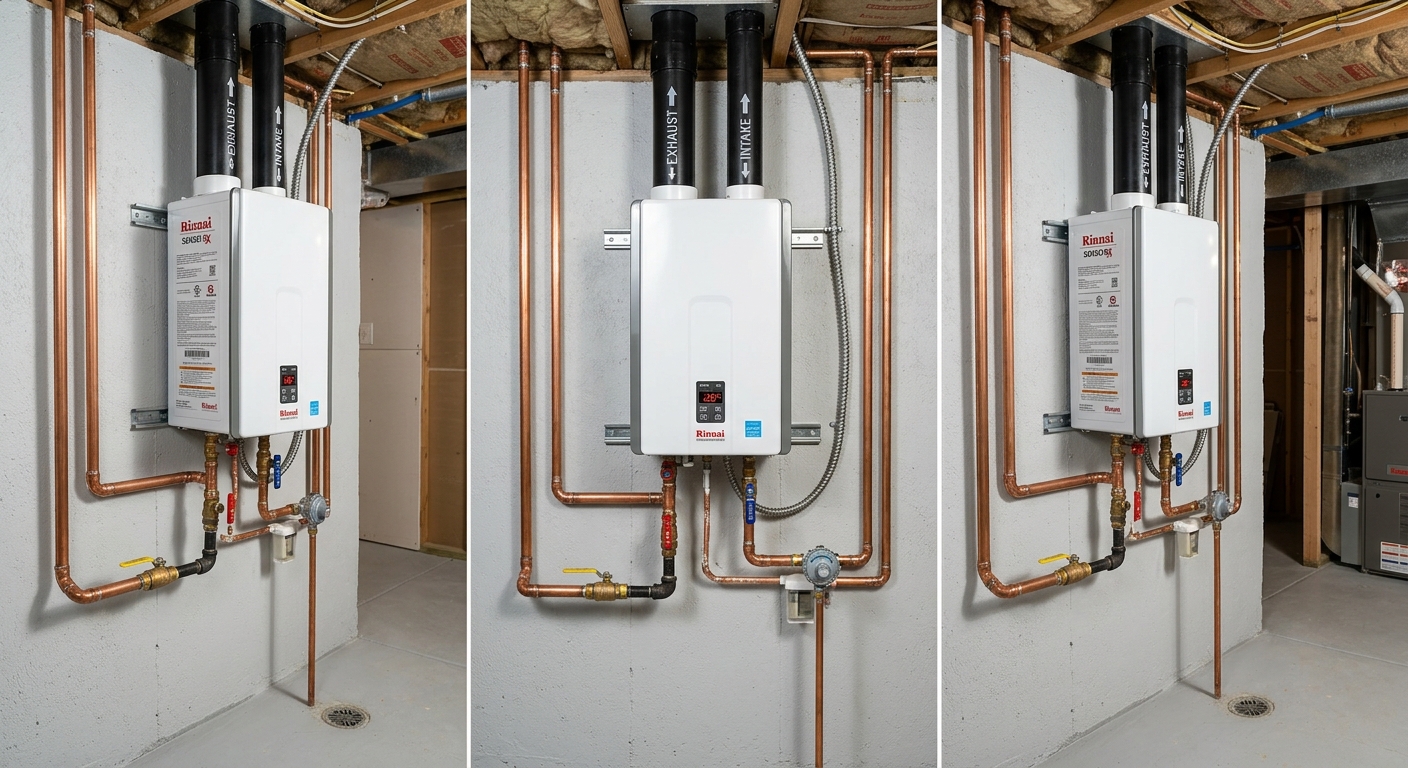
A standard gas tank heater (40–50 gallons) has the lowest installed cost at $1,150–$2,700, but it lasts 8–12 years and slowly loses heat all day. An electric tank runs quieter and is cheaper to buy, but is the most expensive to operate over time. Tankless gas systems run $1,850–$2,700 to install and offer endless hot water, but in older Lancaster city homes, upsizing the gas line or adding proper venting can add surprise costs.
Heat pump water heaters are the cheapest to run but need a warm, open basement and enough space for air flow—they’ll chill and dehumidify the area, which matters if you use your basement for living space. They’re louder, too. Regardless of type, sizing should use the first-hour rating, not just gallons, to guarantee morning showers and laundry don’t run cold. Always install a drip pan and an expansion tank if your home has a pressure regulator. Most failures are in the tank, not the thermostat or valves.
| Type |
Installed cost |
Service life |
Operating cost |
Best when |
| Gas tank, 40–50 gal |
$1,150–$2,700 |
8–12 yrs |
moderate |
Gas available, simple replacement |
| Electric tank, 40–50 gal |
$1,150–$1,850 |
10–15 yrs |
high |
No gas, small household, lower up-front cost |
| Gas tankless |
$1,850–$2,700 |
18–25 yrs |
low-moderate |
Heavy hot water use, space savings, gas capacity available |
| Heat pump water heater |
$1,850–$2,700 |
13–15 yrs |
lowest |
Large basement, electric service, concern for energy bills |
Vetting a plumber in Lancaster County
In Lancaster County, plumbing contractors do not hold a statewide licence. Work is regulated at the municipal level, so a plumber licensed to work in the City of Lancaster must meet that city’s requirements—but may hold no status in nearby townships. For jobs over $500, a Home Improvement Contractor (HIC) registration is required from the Pennsylvania Office of Attorney General. You can verify this at hic.attorneygeneral.gov.
Look for a current insurance certificate with your property named, and confirm workers’ compensation status on wcais.pa.gov. Ask if the crew is company-employed or subcontracted, and clarify how after-hours or emergency billing works before you sign. In our mix of urban and rural homes, a physical office is common but not universal—so proof matters more than address.
- Check HIC registration at hic.attorneygeneral.gov
- Confirm municipal approval for plumbing in your township or city
- Verify general liability insurance and that your property is on the certificate
- Look up workers’ compensation at wcais.pa.gov
- Ensure emergency rates are quoted clearly, not “to be determined”
- Ask for written contracts for jobs over $500
- Clarify if the company uses employees or subcontractors
- Review the cancellation policy (minimum three business days’ right to cancel)
- Demand proof of EPA Lead RRP certification for work on pre-1978 homes
- Never sign off on a repipe or major sewer job without camera footage or a pressure test
- Ask for written warranty details
- See recent references from homes built before 1980
Red flags in Lancaster? The biggest is a major quote based on a quick glance, with no camera inspection. In thinner rural markets, also beware the generalist who works “all trades” but cannot produce municipal documentation or recent local references.
Who is allowed to do plumbing work in Pennsylvania
In Pennsylvania, plumbing is not licensed at the state level—the regulation happens by municipality. That means someone licensed and permitted to work in the City of Lancaster might not be valid in Manheim, Warwick Township, or nearby townships. You must ask not just “are you licensed?” but “are you licensed here?” For most plumbing work over $500, Pennsylvania requires the contractor hold a Home Improvement Contractor (HIC) registration from the Office of Attorney General; check this at hic.attorneygeneral.gov.
Permits are mandatory for plumbing that changes, replaces, or expands any water or drain line—especially in Lancaster city, where any job that alters or adds value to a property calls for a plumbing or building permit. Minor repairs to the same fixture, like changing a faucet or toilet fill valve, usually do not need a separate permit. For enforcement in the city, the Bureau of Building Code Administration handles both permitting and inspections; if you’re in a township, it’s the local code or zoning office.
Whether in Lancaster city or beyond, always get copies of valid business insurance with your property listed and verify workers’ comp at wcais.pa.gov. No statewide registry means you should ask for—and check—every credential, every time you hire a plumber.
Frequently asked questions — plumbing in Lancaster
Should I reline or replace my sewer line?
Relining a sewer line in Lancaster—using cured-in-place pipe (CIPP)—can be cost-effective if the problem is limited to a section and the line is structurally sound enough to hold the liner. It’s often the better route for homes where excavation would mean tearing up restored brick or concrete walks, especially common in Lancaster’s pre-1940 homes. However, if the line is collapsed or full of roots, full replacement is the only guarantee against future backups. Costwise, both approaches can run from $1,900–$11,500 depending on depth and access. Always insist on a camera inspection before deciding. Lining saves disruption and sometimes dollars, but if the old pipe is too far gone, it’s a temporary fix.
What does repiping a house cost in Lancaster?
In Lancaster, full or partial repiping comes up a lot because of the age of the housing stock—88% of homes were built before 1980, and many still have original galvanized pipe. A whole-house repipe, swapping in copper or PEX, ranges from $3,400–$8,200 depending on size and how hard it is to access the lines (old plaster and tight rowhomes usually push the higher end). Partial repipes are less, and a single spot repair can be done for $325–$1,150. Don’t forget to plan for wall, ceiling, and sometimes tile patching, which often rivals the pipe cost itself—especially in city homes with finished basements or vintage plaster walls.
What do I do if sewage is backing up?
If sewage is backing up in your Lancaster home, stop using all plumbing fixtures and call a plumber for emergency service—this is always urgent, with rates typically in the $600–$1,150 band for emergency diagnosis and relief. If you’re on city sewer, the blockage is usually between your house and the street; in rural homes on septic, stoppages may be in the tank or the main line. Do not run water or flush toilets, as this will worsen the problem and risk a full overflow. In some older Lancaster properties, tree roots or collapsed cast iron pipes are common causes. A plumber may recommend a camera inspection (often included) or hydro-jetting, and you should ask for video documentation before approving major repairs.
Should I leave a faucet dripping in cold weather?
In Lancaster’s climate, where winter design temperatures can drop as low as 12°F and freeze-thaw cycles are pronounced, allowing a trickle of water to run overnight in exposed or poorly insulated areas can prevent pipe bursts. This matters most for older homes—many built before 1940—where supply lines were often run along outside walls or over unheated basements. A burst pipe, especially on an emergency call, can run $600–$1,150 to repair. Target the coldest taps (like in a crawlspace or on an outside wall) and keep under-sink cabinet doors open to let warm air circulate. Dripping is always a temporary measure; permanent pipe insulation or rerouting is the better solution.
Am I responsible for the water line under the street?
In Lancaster city and across the county, homeowners are generally responsible for the water line from the curb (or property line) to the house—including the part running under the sidewalk or boulevard, but not under the public street. If you have a lead service line—which is still found in thousands of Lancaster homes—a full replacement runs $5,300–$11,500. The city has an active replacement program but not every line is covered, so check with your utility about any cost sharing. For leaks on your side of the meter, you’ll need to hire and pay a plumber; a break out in the street (on public property) is typically the water bureau’s responsibility.
Are tree roots a common sewer problem in Lancaster?
Yes—especially in Lancaster’s urban neighborhoods and older rowhomes with mature shade trees. Cast iron and clay sewer laterals are prone to root intrusion, and when they clog, you’ll often see slow drains and backups in the lowest fixtures. Clearing roots and scoping the line runs $350–$800 for immediate relief. If the pipe is cracked or collapsed, spot repairs or full relining can get up to $1,900–$11,500. Always get a video inspection before approving any digging or major work—several plumbing companies in Lancaster can provide before-and-after footage so you know the work solved the problem, not just the symptom.
Who inspects plumbing work in Lancaster?
It depends on where you live in Lancaster County. Within Lancaster city, plumbing and building work is inspected by the Bureau of Building Code Administration. If you live in a surrounding township, inspections fall to the township’s code or zoning office. Pennsylvania follows the Uniform Construction Code (UCC), based on the IRC, but each municipality enforces it locally. After a job is complete, the inspector reviews the work before walls are closed—especially important for whole-house repipes, which can range from $3,400–$8,200. Always make sure your contractor schedules an inspection and provides you with a sign-off before making the final payment.
How do I tell what my pipes are made of?
Older Lancaster homes—almost 88% built before 1980—can have a mix of galvanized steel, copper, PEX, and sometimes even cast iron or lead. Visually inspect exposed pipes near the water meter or in the basement: galvanized is dull gray and magnetic; copper is reddish; PEX is white, blue, or red plastic. Lead pipes are soft (a screwdriver will shave them), often have a bulb at the joint, and must be replaced—not repaired. If you’re seeing brown water on first draw or have low pressure throughout the house, original galvanized is likely. Diagnosis by a licensed plumber (running $325–$1,150 for a visit and test) is worth it if you’re unsure—especially before buying or remodeling.
How much does a plumber cost in Lancaster?
Plumbing costs in Lancaster are shaped by your home’s age, pipe materials, and whether the work is urgent. For a standard repair during business hours—such as a small leak or a running toilet—expect to pay $325–$1,150. Emergency work, like a nighttime burst pipe, climbs to $600–$1,150. Larger jobs, including replacing a water heater, can be in the $1,150–$2,700 range. If your home is one of the many pre-1940 row or twin homes, be prepared for access challenges and possible upgrades to copper or PEX, which push costs higher. Always get a written estimate and clarify what’s included—materials, permits, and after-hours surcharges—before the work starts.