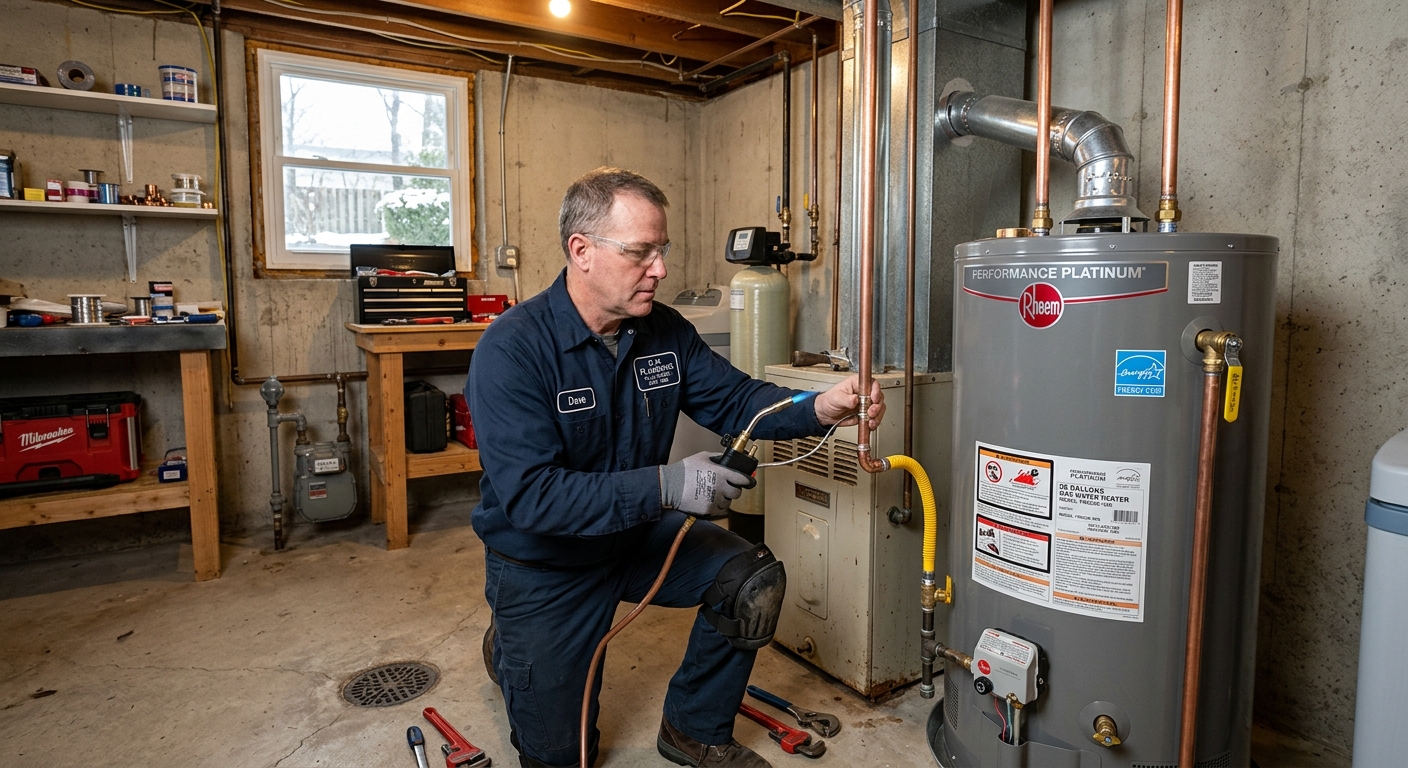
What plumbers charge in Norwood
In Norwood, plumbing costs follow a predictable pattern driven by the neighborhood’s older housing stock. With 88.8% of homes built before 1980 (U.S. Census Bureau, ACS 2024), many properties mirror Upper Darby and Lansdowne, where mid-century rowhouses and twins mean a high chance of galvanized piping, original supply lines, and outdated drains. The era of construction defines what pipe materials you have, and that, in turn, shapes the most likely repairs and their cost.
Norwood’s homeownership rate is 67.7%—most residents are invested in long-term maintenance. You’ll run into two prices for any job: the standard (scheduled) rate, and the emergency rate that covers nights, weekends, or anything involving active water damage. Emergency fees add significant cost, even when the job is the same. In reality, what feels urgent often can safely wait, and knowing the difference can save you hundreds.
Galvanized-to-copper repipes, main drain renewals, and service line upgrades are especially common requests in the dense postwar tracts. Drain cleaning and water heaters are bread-and-butter—and water quality in Norwood drives some of that, especially scale build-up inside fixtures and tanks. Everything from accessibility to the number of finished walls touched will nudge your price within the band.
| Service |
Scope |
Emergency rate |
Standard rate |
| Emergency repair — burst pipe |
locate, open, repair section, restore service |
$600–$1,200 |
$350–$1,200 |
| Water heater replacement (gas, 40–50 gal) |
remove old, install, test, haul away |
$1,900–$2,800 |
$1,200–$2,800 |
| Drain cleaning — main line |
augering or hydro-jet, camera if needed |
$350–$800 |
$200–$500 |
| Sewer line spot repair |
excavate or reline a failed section |
$2,000–$12,000 |
$2,000–$12,000 |
| Whole-house repipe |
replace supply lines throughout, patch and finish |
$3,500–$8,600 |
$3,500–$8,600 |
| Water service line replacement |
street to house, excavation and restoration |
$5,600–$12,000 |
$5,600–$12,000 |
Estimates for a typical Norwood home. Access difficulty and pipe material move these figures more than anything else.
Verifying a Norwood plumber's credentials
Pennsylvania does not license plumbers at the state level—each municipality controls its own rules. In Delaware County, there’s no countywide plumbing license, and Philadelphia’s licensing system does not apply in Norwood. This means the key question isn’t just “are you licensed,” but “are you licensed here?” A plumber licensed in one town might hold no legal credential in the next. Norwood’s code enforcement follows the Pennsylvania Uniform Construction Code (UCC), which is based on the IRC, but permits and inspections are handled by your specific borough or the code office they hire.
For any plumbing contract over $500, the contractor must hold active Home Improvement Contractor (HIC) registration through the Pennsylvania Office of Attorney General. You can verify this at hic.attorneygeneral.gov. For jobs involving employees, valid workers’ compensation coverage is required under state law, and you can check active policies via the state’s WCAIS system at wcais.pa.gov.
Permits are required in many Delaware County municipalities for any new or relocated pipe or fixture. In boroughs similar to Media, minor repairs—such as a faucet cartridge or toilet flapper—typically don’t trigger permits, but new supply lines, water heaters, or drain work do. Always ask to see the permit and inspection pass for permitted work. Require and review a written contract; state protects you through the Home Improvement Consumer Protection Act, which also gives you three business days to cancel.
Hardness, treatment and fixture life in Norwood
Aqua Pennsylvania, Inc. supplies water to most of Norwood, so homeowners are tied to the public utility's quality and mineral content. Public water systems like Aqua publish an annual Consumer Confidence Report, which is free on request and details everything that’s in your water—useful for confirming hardness, treatment methods, and any specific advisories.
In practice, Norwood’s mains supply moderately hard water. Over time, this causes scale build-up in water heaters and fixtures, reducing lifespan and efficiency—especially in older homes with original tanks or supply pipes. It’s common to see water heaters needing replacement sooner than the sticker says when scale is neglected. On the flip side, aggressive water (low in minerals, slightly acidic) is rare here and seldom the culprit behind pinholes in copper.
For most homes, a water softener is more a comfort appliance than a strict necessity—you’ll see less scale and longer faucet life, but the $1,500+ cost rarely pays back directly in Norwood unless you have a long run of visible hard scale or a newer high-efficiency water heater. Whole-house filtration is only worthwhile if you have specific taste or odor complaints; otherwise, a simple under-sink filter at the kitchen tap is fine. Don’t be upsold on equipment you don’t need. If you have a private well, testing annually for bacteria, lead, and nitrate is up to you, since no public report covers these systems.
The point where patching stops making sense
In Norwood’s older rowhouses and twins, two or more pipe leaks on the same supply material within three years is not bad luck—it’s the first warning sign that the whole system is aging out. Other red flags: pressure that drops everywhere in the house, not just at one fixture; brown or rusty water on first draw; visible corrosion on pipe joints; or repeated pinhole leaks, especially in original galvanized. If you’ve had two “spot” repairs and still see issues, a partial or whole-house repipe likely saves money over piecemeal fixes.
When it comes time, PEX and copper are both used in Norwood. PEX is easier to install in tight, finished wall cavities and typically less expensive; copper has a longer track record but can drive up material and labor costs, especially on the full-house jobs. The overlooked cost: drywall and plaster patching when work is finished. In older homes with high-sheen plaster walls, finishing can rival the plumbing labor itself—some rowhouses budget as much for repair as for pipe.
As seen throughout Upper Darby and Lansdowne, this often comes as entire blocks are upgraded from galvanized—one neighbor replaces pipes, everyone else follows within a few years. Polybutylene, if present (uncommon in pre-1980 homes here), and cast iron drains with roots call for decisive action, not patches.
| Situation |
Recommendation |
Cost |
Reasoning |
| One leak, accessible, modern pipe |
Spot repair |
$350–$1,200 |
Cheapest option, justified if the rest of the system is sound |
| Two or more leaks in 3 years |
Partial repipe |
$3,500–$5,800 |
Recurring repairs suggest failing pipe; patching isn’t cost-effective |
| Galvanized supply, pressure loss |
Full repipe |
$3,500–$8,600 |
Old galvanized restricts flow and leaks; replace for reliability |
| Polybutylene anywhere in the house |
Full repipe |
$3,500–$8,600 |
Known defect material; failure risk too high to patch |
| Cast iron drain with root intrusion |
Camera, then reline or replace |
$2,000–$12,000 |
Spot repairs rarely last; address the whole section |
| Suspected lead service line |
Test, then replace the lateral |
$5,600–$12,000 |
Lead is a health risk; full lateral replacement required |
When to call now and when to wait until Monday
If you’re facing a plumbing issue in Norwood, deciding whether it’s an emergency saves real money. An emergency call triggers a premium for after-hours dispatch, overtime labor, and urgent diagnostic work. You’ll pay an extra $200–$600 or more for the same burst pipe fix if the plumber comes at night or on a weekend. The premium covers everything from interrupted schedules to the reality that some repairs can’t be left overnight, especially when active leaks are soaking finished spaces.
But many calls labeled “emergency” by national dispatchers are not. Here’s a triage list to help you decide:
- True emergencies: any active flooding from supply pipes, no water anywhere in the house, sewer or drain backing up into the house, or any gas smell from a water heater. In these cases, delaying risks major property damage or health hazards; emergency rates from $600–$1,200 are justified.
- Can safely wait: a slow drip under a kitchen sink, a single stubborn drain, running toilet, or a fixture shut off at its valve. Schedule these for normal business hours and you’ll pay in the $350–$1,200 range instead of the top end.
To buy time, learn how to shut off your main water valve—usually in the basement near where the water service enters the house. For single fixtures, shutoff valves are under the sink or behind the toilet. Turning off water turns most emergencies into planned work, at planned prices.
Plumbing systems in Norwood homes
Most Norwood homes were built before 1980, mirroring the postwar boom seen in much of Delaware County. In these homes, you’ll often find galvanized steel supply lines—sometimes partially replaced with copper or PEX by now—and cast iron or clay tile drains. The original water service line may be lead, galvanized, or early copper; with many properties, especially in the mid-century tracts, it’s never been replaced.
Galvanized pipes account for much of the ongoing replacement work in Norwood and nearby Upper Darby and Lansdowne. Drains may have root intrusion if original, especially in homes with large street trees. Water heaters in these homes are likely on their second or third replacement, given typical lifespans. Fixture updating tends to follow the pipes, so homes with fresh supply lines often have recent toilets and faucets too.
In the rare newer home (built post-1980), you’ll see more copper or even early PEX for supply, PVC drain lines, and possible risks with builder-grade fixtures and polybutylene in homes from the late 1980s. Even here, first-generation water heaters and dishwashers may be overdue for replacement. New build doesn’t mean foolproof—it just means a different set of problems than the galvanized era.
What a plumbing quote should contain
Every honest Norwood plumbing quote falls into one of two billing models. Flat-rate pricing gives you certainty—the job will cost exactly what’s quoted, no matter how it goes, with the contractor accepting the risk for surprises. Time-and-materials (hourly) can be cheaper for simple jobs but becomes open-ended when scope isn’t fully known. Neither model is inherently good or bad; the problem is a quote that doesn’t say which it is.
You should see line items for the diagnostic or trip fee (and whether it’s waived if you go forward), a description of what will be opened, replaced, and restored, and whether wall or floor repair is included. If permits are required, the quote should specify if the contractor is handling them, and state whether permit fees are included. Labor and material warranties must be written out, with labor (the plumber’s work) clearly separate from manufacturer parts guarantees. Emergency rates, when needed, should be disclosed up front.
| Line item |
What to look for |
Red flag if… |
| Billing model |
flat rate or hourly, stated up front |
unstated |
| Diagnostic fee |
amount, and whether it credits |
vague |
| Scope |
what is opened, repaired and restored |
price with no scope |
| Restoration |
drywall and finish explicitly in or out |
silent |
| Permit |
included and priced |
'not needed' |
| Parts |
brand and model for fixtures |
'standard fixture' |
| Warranty |
labour period stated separately |
parts only |
Frequently asked questions — plumbing in Norwood
How much does a plumber cost in Norwood?
In Norwood, typical plumbing rates depend on whether your job is scheduled or handled as an emergency. For example, an emergency repair for a burst pipe will cost between $600–$1,200, due to overtime labor and after-hours fees. The same repair during business hours usually costs $350–$1,200. Common jobs like replacing a gas water heater (40–50 gallons) run from $1,200–$2,800, with most homeowners paying closer to the midpoint. Always get a written quote before work begins and check if diagnostics, permit fees, and restoration are included to avoid extra charges. Norwood’s older homes can mean more labor, so ask about any unknowns that might increase your final invoice.
Should I leave a faucet dripping in cold weather?
In Norwood, where winters can reach a design temperature of 14 °F, leaving a faucet dripping is sometimes worthwhile if you have older, exposed galvanized or copper pipes in unheated spaces. Keeping just a trickle moving can help prevent expensive freeze breaks, especially in homes built before 1980 with minimal pipe insulation. If you leave for a weekend cold snap, set one faucet on the cold side to drip into the sink, and open cabinet doors under sinks, especially on exterior walls. Compare that to emergency frozen pipe repair, which runs $600–$1,200 after-hours. If your pipes are in conditioned spaces or have been upgraded and insulated, dripping isn’t needed—but for older Norwood homes, it can prevent a very costly call.
How do I verify a plumber's licence and insurance?
Pennsylvania does not license plumbers statewide; licensing is handled by each municipality. In Norwood, make sure your plumber holds a current Home Improvement Contractor (HIC) registration, required for all contracts over $500. You can check this in minutes at hic.attorneygeneral.gov. For jobs with employees, workers’ compensation coverage is mandatory—confirm valid insurance at wcais.pa.gov. Always get written proof and ensure the company name matches the paperwork. Relying on a license from another township or city, like Philadelphia, doesn’t cover you in Norwood. For water heater swaps (typical cost $1,200–$2,800), confirm your plumber is registered and insured before work begins.
What does repiping a house cost in Norwood?
For a whole-house repipe in Norwood—removing and replacing all water supply pipes, plus finish repairs—you’ll typically pay $3,500–$8,600. The price depends on home size, accessibility, whether walls are plaster or drywall, and if the job includes patching any open walls and ceilings. In rowhouses built before 1980, there’s a good chance you’re still running on original galvanized or early copper, so homeowners are often budgeting for this work. Partial repipes, such as targeting one bathroom or the kitchen, fall toward the lower end, but patchwork repairs in older pipes can add up to more in the long run. Always get a scope that clarifies what’s replaced, what’s patched, and what happens to finished surfaces afterward.
Do older Norwood homes have galvanized pipes?
Yes, most Norwood homes built before 1980 likely have some galvanized steel pipes remaining in their supply system—especially if you haven’t replaced all lines since purchase. Galvanized was the norm in rowhouses and twins built during the 1945–1975 boom. These pipes corrode over time, leading to reduced pressure, rusty water, and leaks. Replacement with copper or PEX is common throughout the area, with full-house repipes typically costing $3,500–$8,600. If you notice low water flow or frequent leaks, check any exposed plumbing for gray, threaded steel (galvanized) and consider budgeting for a replacement. Newer homes may have copper or PEX from the start, but partial systems are common in many Norwood properties.
Why do all my drains drain slowly at once?
If you notice every drain in your Norwood home running slowly, the issue is rarely at a single sink or tub—it points to a partial blockage or build-up in the main drain line. In older homes with cast iron or clay tile sewers (typical of pre-1980 construction), slow drainage may be caused by accumulated grease, scale, or even tree roots breaching the original pipes. This is a routine problem in Norwood and surrounding Delaware County. The right first step is a main line cleaning and camera inspection, which usually costs $200–$500 during regular hours and more on emergency calls. Catching and clearing this early can prevent sewage from backing into the house, which quickly moves the bill into thousands. Always request a camera footage review if you suspect main line issues.
Is a water softener worth it in Norwood?
In Norwood, Aqua Pennsylvania delivers water of moderate hardness—not extreme by national standards, but enough to cause scale on fixtures and shorten water heater life if neglected. A water softener improves comfort by preventing scale build-up and making soaps lather better. The equipment and installation typically cost upward of $1,200–$2,800, but in most cases, this doesn’t pay back directly unless you already have significant scaling problems. For many homeowners, spot treatment—like an under-sink filter or annual water heater flush—delivers practically the same results for less. If you notice white build-up on shower heads or fight with soap scum, a softener may be worth it, but don’t install one just on a salesperson’s advice. Review Aqua’s annual water quality report for actual hardness numbers before spending on treatment equipment.
Who pays to replace a lead service line in Norwood?
If your Norwood home is identified on Aqua Pennsylvania’s 2024 inventory as having a potential lead or galvanized water service line, replacement is urgent for health reasons. The cost to replace a service line from the street to the house generally falls in the $5,600–$12,000 range, depending on length and excavation needs. Aqua Pennsylvania and some municipalities run programs to help with these costs, but in most cases, the homeowner is responsible for their portion of the line—from property line to the house. Check with Aqua and your borough for available assistance or cost-share programs. If you suspect lead but haven’t confirmed it, consider a simple water test first—the test cost is minor, but replacement is a major project.
What counts as a plumbing emergency?
In Norwood, a true plumbing emergency includes any situation that risks major and immediate damage to your property or health: a burst pipe spraying water, a sewage backup into the home, a gas odor from your water heater, or no water supply at all. All these require an immediate callout, usually falling in the $600–$1,200 emergency range due to overtime and urgent dispatch. Less urgent: a slow drip under the sink, one slow drain, or a running toilet—these are safe to schedule for business hours. If you’re unsure, shut off water at the main valve (basement or utility room), which will stop most leaks and buy time. If sewage or gas is involved, wait outside and call for help right away. Emergency fees are high, but real emergencies are rare; taking a minute to assess and shut off water can save you hundreds by converting an after-hours emergency into a scheduled repair.