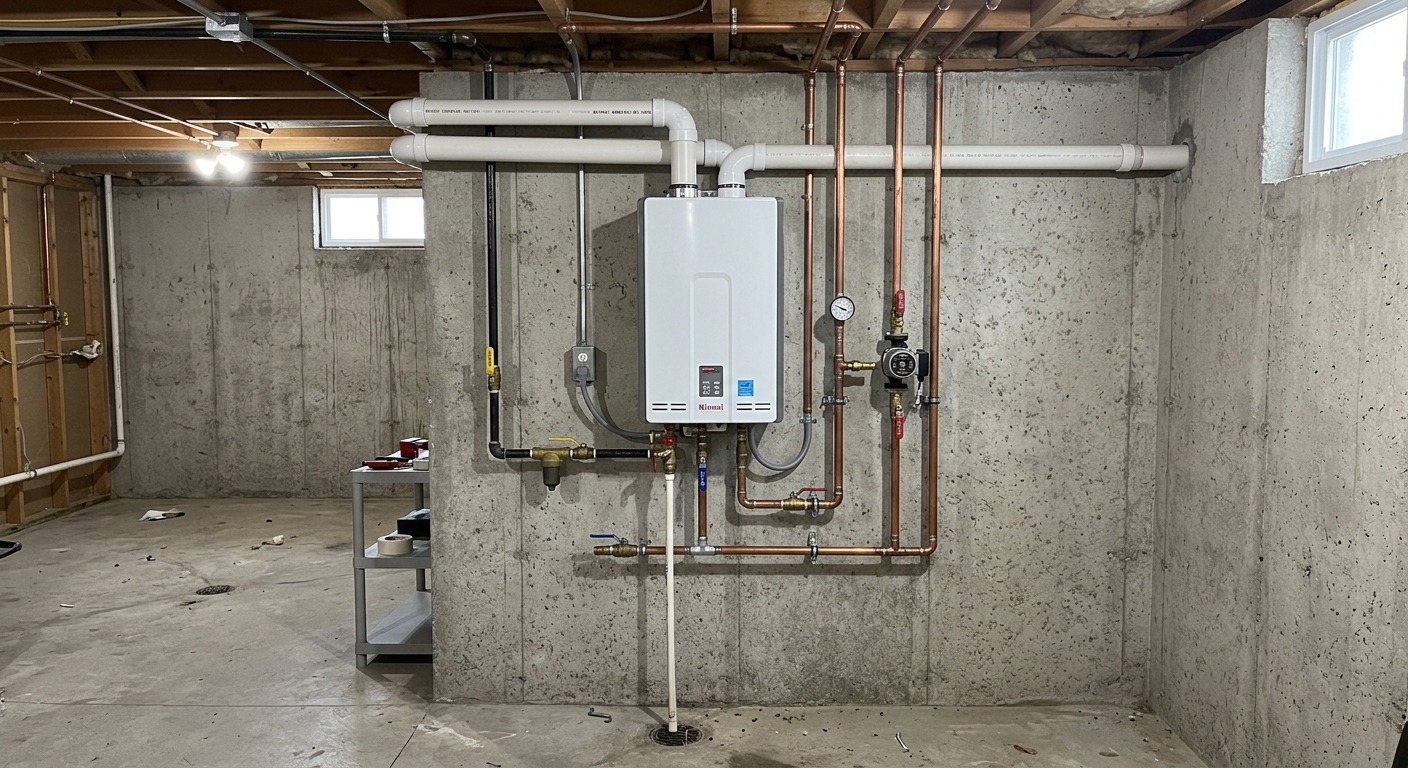
Duquesne plumbing prices by job type — 2026
Duquesne homeowners facing plumbing work in 2026 are dealing with houses that mostly predate 1980—a full 93.2% (U.S. Census Bureau, ACS 2024). That means old pipes like galvanized steel and cast iron are common, which drives the nature and cost of repairs. In this housing market of mostly single-family homes (63.6%), a typical job gets priced based less on national averages and more on access and pipe material—since old galvanized lines or deeply buried sewer laterals are tougher and pricier to work with.
It’s important to know that costs can double if your job is an emergency, especially outside regular hours. Call for a burst main at 2 AM and you’ll pay an “emergency rate;” the same fix during business hours with time to plan comes as a “standard rate.” This applies everywhere from leak repairs to water heater swaps. Here’s what local homeowners can expect:
| Service |
Scope |
Emergency rate |
Standard rate |
| Emergency repair — burst pipe |
locate, open, repair section, restore service |
$550–$1,150 |
$325–$1,150 |
| Water heater replacement (gas, 40–50 gal) |
remove old, install, test, haul away |
$1,800–$2,600 |
$1,150–$2,600 |
| Drain cleaning — main line |
augering or hydro-jet, camera if needed |
$350–$800 |
$200–$500 |
| Sewer line spot repair |
excavate or reline a failed section |
$1,900–$11,500 |
$1,900–$11,500 |
| Whole-house repipe |
replace supply lines throughout, patch and finish |
|
$3,300–$8,000 |
| Water service line replacement |
street to house, excavation and restoration |
|
$5,200–$11,500 |
Estimates for a typical Duquesne home. Access difficulty and pipe material move these figures more than anything else.
Finding a hidden leak in Duquesne
If you suspect a leak in your Duquesne home, try a simple test before calling a plumber: shut off every faucet and appliance, then check your water meter. If the dial or digital readout moves, there’s a supply-side leak somewhere between the meter and your shutoff valves. This quick check costs nothing and can rule out minor drips versus a real hidden problem.
For leaks you can’t see—inside walls, under floors, or beneath a concrete slab—professional plumbers in Duquesne use specialized tools to minimize guesswork and wall cutting. Acoustic listening devices start around $325–$1,150 when bundled with repairs. These devices pick up the sound of water escaping under pressure. Thermal imaging cameras can reveal cold spots caused by moisture, while tracer gas (like nitrogen) and electronic sniffers help in especially tough-to-find cases. Slab leak detection or pinpointing a leak in old galvanized lines often lands in the upper half of the emergency repair price range.
Leaks inside wall cavities or ceilings may show up as stains or bulging paint. For an irrigation line or exterior leak, isolation means sectioning off and analyzing each run, sometimes with pressure tests. Any plumber who wants to tear out drywall before locating the leak is doing it backwards—finding before opening minimizes damage and cost. Slab leaks are a special case: you want someone with the right tools so you aren’t left with unnecessary jackhammering or carpet removal.
Plumbing systems in Duquesne homes
Nearly all Duquesne homes were built before 1980, and with so many single-family houses (U.S. Census Bureau, ACS 2024), that means original piping is usually galvanized steel or copper for supply, and cast iron or clay for drain and sewer. Galvanized water lines are well past their typical service life, often causing low pressure from internal corrosion. Copper supply—common since the 1950s—may still be running strong, but pinhole leaks appear in aging sections, especially with the aggressive water chemistry found in some Allegheny County neighborhoods.
Drains and vent stacks in older homes are most likely cast iron. Under the yard, sewer laterals tend to be clay tile if the house dates back before the 1980s—these joints are magnets for root intrusion. Water service lines may still be lead, especially where the Pittsburgh Water and Sewer Authority (PWSA) hasn’t gotten to a block yet. Water heaters in these homes are often on their second or even third replacement, so you’re not dealing with a one-time investment.
If you see white PVC or gray PEX, it’s been repiped, at least in part. But that’s the exception, not the rule. In Duquesne, the age of the system is one of the best predictors of what kind of trouble you’ll see: chronic leaks, drain backups, or the need for a full repipe. Knowing what’s in your walls—and under your yard—lets you budget wisely.
Dating your plumbing by what it's made of
In Duquesne, the material of your pipes tells the story. Most homes were built when galvanized steel and cast iron were standard. Galvanized steel was the workhorse before copper arrived after World War II. Look for gray, threaded pipes—if a magnet sticks, it’s galvanized. These corrode internally, reduce flow, and typically spring leaks only once the inside is badly restricted.
Copper is reddish and joined by soldering—not threaded—with plastic or brass fittings. Copper resists corrosion, but aggressive water chemistry in Allegheny County can cause pinhole leaks over decades. For supply lines, post-2000 homes often use PEX: flexible, colored plastic tubing with crimped or push-fit fittings. Polybutylene, found in late-1970s through 1995 builds, is dull gray or blue; it’s highly unreliable and uninsurable in many markets due to abrupt fitting failures. If you find plastic with “PB2110” stamped on it, have it checked immediately.
Drains show their age, too. Cast iron lasts up to 75 years, but corrosion inside the pipe or at the joints is typical. Clay tile sewer laterals, common here before 1980, let roots in at the joints; a steel rod will break a piece off, revealing a dull, brittle core. PVC and ABS (white or black plastic) are modern and last the longest when not crushed or poorly glued.
A scratch test—removing insulation and lightly scraping—will often reveal the truth. Galvanized scratches to silver; copper stays red; lead is soft and gray, never threaded. Knowing your material means you can better estimate how much runway you’re buying with a repair—or if it’s time for replacement.
| Material |
Typical era |
Failure mode |
Service life |
| Galvanized steel supply |
pre-1960 |
internal corrosion, pressure loss |
40–60 yrs |
| Copper supply |
1950s–present |
pinhole leaks, joint failure |
50–70 yrs |
| Polybutylene supply |
late 1970s–1995 |
fitting failure, sudden bursts |
unreliable |
| PEX supply |
2000s–present |
fitting or UV degradation |
40–50 yrs |
| Cast iron drain |
pre-1975 |
corrosion, cracking, scale |
50–75 yrs |
| Clay tile sewer lateral |
pre-1980 |
root intrusion at joints, offset |
50–60 yrs |
| PVC / ABS drain |
1970s–present |
joint separation, crushing |
50+ yrs |
Frozen pipes in Duquesne: prevention and thaw
With a frost depth of 36 inches and winter design temperatures dipping to 8 °F, Duquesne sits in classic Western Pennsylvania freeze-thaw country. The burst rarely happens at the frozen spot. Instead, water freezes inside the pipe (commonly in an exterior wall, crawlspace, or unheated attic), forming a plug. If you open a tap and nothing comes out, pressure can build in the section between the freeze and a closed valve—eventually bursting the pipe downstream.
Vulnerable spots in Duquesne homes include pipes in exterior walls, garages, and crawlspaces, as well as outdoor hose bibs and supply lines run through unheated attics—especially in the hilly terrain around town. Prevention beats repair: insulate exposed pipes, apply heat tape where access allows, and in a hard freeze, let faucets trickle slowly to keep water moving. Open cabinet doors under sinks on exterior walls to let warm air circulate. Always shut off and drain outdoor spigots before the first real cold snap—don’t rely on “frost-free” labeling for old connections.
Thawing safely means using a hair dryer, heat lamp, or electric heating pad—never an open flame or torch. Slow, steady warmth is best. If you catch a freeze before it turns into a leak, you’re saving yourself the cost of a burst repair, which ranges from $325–$1,150 for emergency service in Duquesne. In this region, a few hours spent on prevention each fall pays for itself the first time the thermometer dips into single digits.
Verifying a Duquesne plumber's credentials
Plumbing in Pennsylvania is licensed at the municipal—not state—level. This means there’s no one “state license;” in Allegheny County, the Allegheny County Health Department runs its own journeyman and master plumber licensing program. If you hire someone from Pittsburgh, that credential typically covers city jobs, but not necessarily work in Duquesne or another township. Always ask, “Are you licensed for this municipality?” rather than “Are you licensed in PA?”
Major plumbing projects—anything involving a new or altered plumbing system—require an Allegheny County Health Department plumbing permit. Inspections are handled by the county, not the state. Routine fixture swaps (like faucets) don’t usually require permits, but anything involving hidden piping, new drains, or water heaters does. For jobs over $500, your plumber must carry a current Home Improvement Contractor registration from the Pennsylvania Office of Attorney General—verify at hic.attorneygeneral.gov, and get a written contract. You should also verify the contractor’s workers’ compensation insurance using the Pennsylvania Workers’ Compensation Automation and Integration System—check status at wcais.pa.gov.
If your home was built before 1978, federal EPA rules for safe lead paint work apply—search for certified renovators at certifiedrenovatorsearch.epa.gov. With Allegheny County’s mix of contractor backgrounds, don’t assume compliance—ask every time, and check the documentation for yourself.
Lead service lines in Duquesne
Duquesne gets water from the Pittsburgh Water and Sewer Authority (PWSA), which has identified thousands of lead service lines in Allegheny County and is actively replacing them. The water line from the street to your home splits responsibility: the utility owns the line up to the curb shutoff, but you own the lateral from that shutoff into your basement. Utility replacement programs often stop at the property line, leaving the home side for you.
To check your own line, find where the water pipe enters your basement. Use a coin or key to gently scratch it. Lead scratches bright silver and is soft; copper stays reddish; galvanized is dull gray and magnetic. If you discover lead, partial replacements (replacing only part of the line) can briefly increase lead in your water as disturbed minerals are flushed out—full replacement is safest. Don’t assume you’re covered in a mass replacement; check the utility’s published service line inventory or call PWSA directly.
Replacement costs for the home-owned section typically fall between $1,900–$11,500 for a spot sewer or water line repair, and sometimes as much as $5,200–$11,500 for a full water service line replacement. If you suspect lead remains but haven’t been contacted by the utility, ask about cost share or financial aid—PWSA’s approach can shift year to year, and written confirmation is your best protection. Never put off replacement if a test comes back positive for lead; the health risks outweigh the one-time cost.
Frequently asked questions — plumbing in Duquesne
How much does a water heater replacement cost in Duquesne?
A typical gas water heater replacement (40–50 gallon) in Duquesne runs from $1,150–$2,600, with most homeowners paying right around $1,800. That covers removal of the old unit, installation, startup, and hauling away the scrap. Prices here reflect the region’s older homes, narrow basements, and sometimes tricky access, which can push the job into the higher end of the range. If your home already has adequate venting and newer shutoff valves, you’ll likely see savings. Always get a written contract for jobs over $500—Pennsylvania law requires it—and ask what’s included (like city permit fees or expansion tanks) before signing.
What do I do if a pipe is frozen but not burst?
If you find a frozen pipe in your Duquesne home but it hasn’t burst, act fast but cautiously. Open the affected faucet so thawing water can escape as the ice plug melts, reducing pressure. Use a hair dryer, heating pad, or heat lamp—never a torch or open flame, since old wood framing and insulation can catch fire fast. Focus on the section nearest the faucet, working back toward the freeze. If you’re not sure where the freeze is or you see signs of splitting, call a plumber; emergency repairs for a burst pipe can run $550–$1,150, which is far more than the cost of prevention. After a deep freeze, check for leaks as things thaw.
Why do all my drains drain slowly at once?
In Duquesne, if every drain in your house is running slowly, the cause is usually in the main sewer line, not the branch pipes. With so many homes running clay tile or aging cast iron laterals, it’s common for roots to intrude, debris to build up, or a section to settle and develop an obstruction. Sometimes, heavy rainfall in areas with combined sewers can also cause backup. The typical cost for main line drain cleaning—including snaking, possible hydro-jetting, and a camera inspection if needed—runs $200–$500 during normal hours. If clearing the main doesn’t help, a sewer camera inspection can pinpoint the issue. Fixing it before you have a full backup stops bigger problems later.
How much does sewer line repair cost in Duquesne?
Spot repair to a sewer line in Duquesne ranges from $1,900–$11,500, with the most typical bill around $5,200. That reflects excavating or relining a short section (such as where a joint has separated or a root has entered), and factors in the old clay or cast iron common in local homes. Deeper lines, tough access, or a need to dig under sidewalks or driveways will push costs higher. Always ask for a camera inspection and written estimate before authorizing any big dig—the right fix, on the right section, will save you money and headaches long-term.
What do I do if sewage is backing up?
If sewage is backing up into your home, stop running all water and avoid flushing toilets. In Duquesne’s older homes, tree roots or debris often block clay tile or cast iron sewer laterals leading out to the street. Call a plumber right away—emergency main drain clearing will run between $350–$800. Don’t let waste water sit; it can cause health issues and damage flooring or drywall. If you’re in an area on combined sewers, heavy rain can overload public pipes, so monitor the situation after storms as well. Have a professional run a camera after clearing to ensure there’s not a collapsed section causing recurring backups.
Is Duquesne on combined sewers or septic?
In Duquesne and across Allegheny County, most homes connect to public sewer, and the Pittsburgh metro area—including the main part of Duquesne—uses largely combined sewers. On the outskirts or more rural parts of the county, some houses still rely on septic systems, but this is less common. If you’re seeing sewer backups or have questions about your lateral, costs for mainline cleaning run $200–$500, and a camera inspection can confirm your connection type. You can check with your water and sewer provider for absolute clarity on your specific property.
Who inspects plumbing work in Duquesne?
Plumbing work in Duquesne requiring a permit—such as repiping, new water heaters, or moves of major fixtures—is inspected by the Allegheny County Health Department Plumbing Program. This applies to Pittsburgh and most nearby municipalities. Routine fixture swaps rarely need permits. Always check that your plumber is locally licensed, as Pennsylvania licensing is municipal, not statewide. For contracts over $500, verify their Home Improvement Contractor registration (especially if the total climbs into whole-house repiping territory at $3,300–$8,000) and confirm proof of insurance and workers’ compensation.
Is trenchless sewer repair reliable?
Yes, trenchless sewer repair (like pipe bursting or relining) can be very reliable in Duquesne, especially where digging would disrupt landscaping or hardscaping. It’s well-suited to clay tile or cast iron sewer laterals common in older homes, provided the line's alignment and depth aren’t too distorted. Spot repairs start around $1,900–$11,500. Always insist on a camera inspection first to verify the method is appropriate and that you’re correcting the real problem—sometimes a full replacement is cheaper over the long term. Choose a company with local experience, not someone subcontracting the work out.
Does insurance cover a burst pipe in Duquesne?
Most standard homeowner’s policies in Duquesne do cover sudden, accidental water damage from burst supply pipes—like when a freeze causes a split in a wall. What they won’t cover is gradual leaks, flood damage from outside, or the repair of the pipe itself (just the resulting damage). Emergency burst repairs cost between $550–$1,150, and homeowners are also responsible for the deductible—waiving this is specifically prohibited by Pennsylvania law. Always document the damage with photos and keep all receipts for cleanup. Check your policy for exclusions before assuming a claim will be paid out.