Slippery Rock plumbing prices by job type — 2026
In Slippery Rock, plumbing prices swing the most depending on when you call—a burst pipe at midnight gets you a different number than a planned replacement on Wednesday morning. It pays to know which is which. With about 960 owner households and nearly half the homes built before 1980 (U.S. Census Bureau, ACS 2024), older piping materials like galvanized steel or copper are still common in parts of Slippery Rock. Contrast that to neighboring Cranberry Township, where the 1990s–2010s boom means mostly PVC and PEX. That era split shapes costs: replacing a water line buried under a 1996 vinyl-sided split-level is a far different job than tunneling beneath a prewar slab. Gas water heater swaps, spot sewer repairs, and full repipes carry lower labor costs in homes laid out for quick access, while legacy construction brings higher risk for leaks, slow drains, and finishes that cost more to patch afterward.
Emergency calls—including burst pipes—are not just about the fix; you pay for the urgency, possible after-hours dispatch, and the downstream damage they prevent. Standard jobs are scheduled, and the price reflects that lower pressure on the schedule and prep. For every service, access (how much has to be opened up and restored) and what the old pipe is made of move the price band more than anything else.
| Service | Scope | Emergency rate | Standard rate |
|---|
| Emergency repair — burst pipe |
locate, open, repair section, restore service |
$600–$1,150 |
$350–$1,150 |
| Water heater replacement (gas, 40–50 gal) |
remove old, install, test, haul away |
$1,850–$2,700 |
$1,150–$2,700 |
| Drain cleaning — main line |
augering or hydro-jet, camera if needed |
$350–$800 |
$200–$500 |
| Sewer line spot repair |
excavate or reline a failed section |
$1,950–$11,500 |
$1,950–$11,500 |
| Whole-house repipe |
replace supply lines throughout, patch and finish |
|
$3,400–$8,200 |
| Water service line replacement |
street to house, excavation and restoration |
|
$5,300–$11,500 |
Estimates for a typical Slippery Rock home. Access difficulty and pipe material move these figures more than anything else.
Water heater replacement decisions
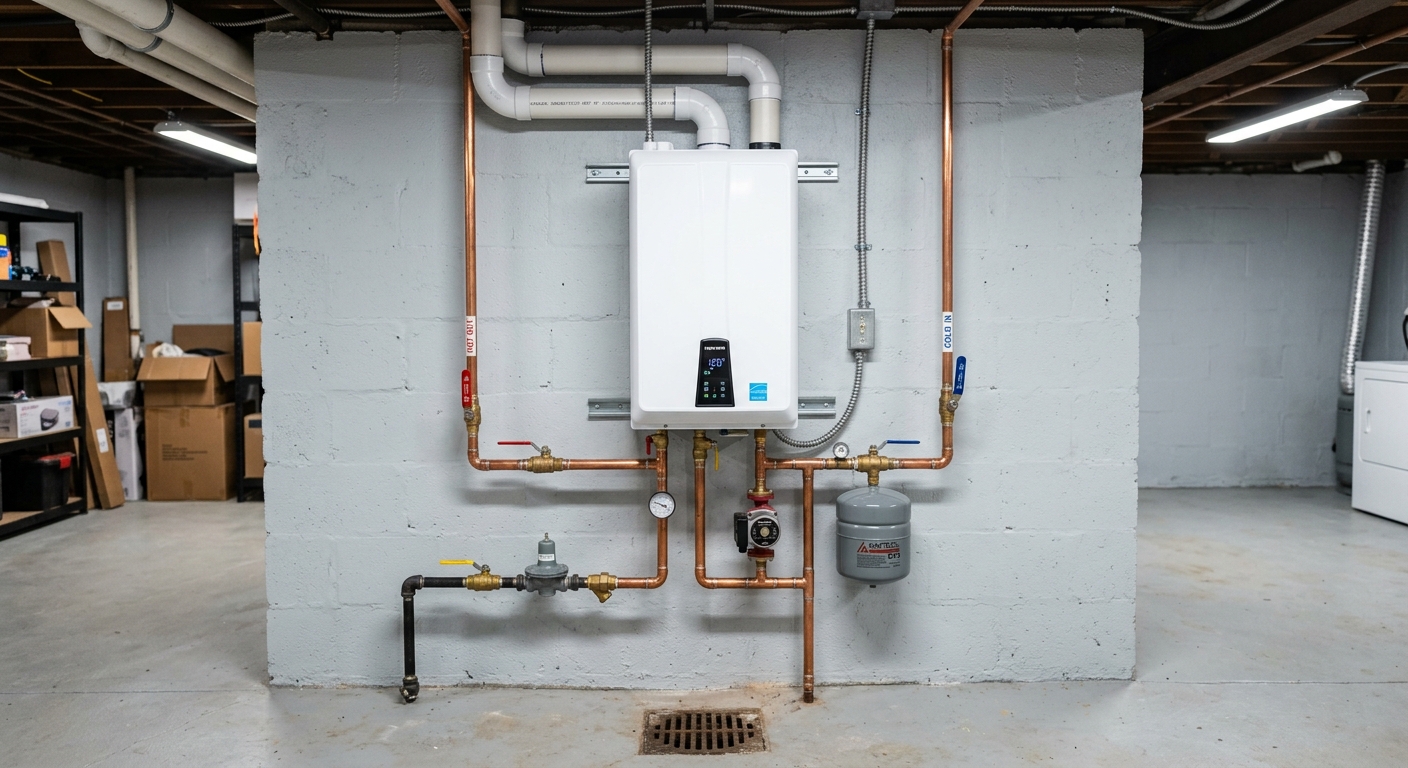
Choosing a water heater in Slippery Rock starts with how your home is set up and what you expect to get back out. Most homes built after 1990, like those in Cranberry Township developments, were plumbed for gas, which means tank and tankless gas models fit right in. Older homes—nearly half of Slippery Rock’s housing was built before 1980—may need more work to upgrade venting or gas supply.
Standard gas and electric tanks are the simplest swaps, with an install cost of $1,150–$2,700 and a typical lifespan of 10–15 years. The big complaint is “standby loss”—they go on reheating water you haven’t used. Tankless gas units grant endless hot water but cost more to install and almost always need a larger gas line and special vent. Don’t just price the heater; ask about the gas work too. Heat pump water heaters run cheapest, but only make sense where you have enough air volume and a space you don’t mind cooling (they dump cold air as a byproduct and make more noise than a tank, so think twice before putting one in a finished basement).
Sizing is about first-hour rating, not just gallons. Expansion tanks and drip pans are code in many municipalities and wise even where not. Nearly always, water heater failure is the tank rusting out, not the controls. That’s why insurance and planned replacement matter more than the “features” list on the box.
| Type | Installed cost | Service life | Operating cost | Best when |
|---|
| Gas tank, 40–50 gal |
$1,150–$2,700 |
8–12 yrs |
moderate |
Existing gas and venting |
| Electric tank, 40–50 gal |
$1,150–$1,850 |
10–15 yrs |
high |
No gas service |
| Gas tankless |
$1,850–$2,700 |
18–25 yrs |
low-moderate |
High demand, large family, space saving |
| Heat pump water heater |
$1,850–$2,700 |
13–15 yrs |
lowest |
Unfinished basement or utility room, electric only |
Comparing plumbing estimates in Slippery Rock
Reading plumbing bids in Slippery Rock, it’s rarely the low bidder who does the shadiest work—it’s the vague bidder. You’ll see two models. Flat rate tells you the whole cost for the listed scope, and builds in the contractor’s risk for parts and labor—they win if it goes quickly; they own the loss if not. Time-and-materials (T&M) charges hourly plus supplies; honest for open-ended situations, but it can add up when access gets tricky or the fix is not obvious at the start. Neither model is a scam, but if you don’t know which you’ve agreed to, you’re in the dark.
Watch for a diagnostic fee and whether it’s deducted from the job if you say yes. Scope needs to spell out what’s being opened, what’s being fixed, and what gets put back—especially floors or drywall. Permits, where required, should be part of the bid; anyone skipping permits is skipping liability. Parts should mean brands and model numbers, not just “standard.” Finally, upfront about after-hours rates and warranty terms means you’re not in for a surprise.
| Line item | What to look for | Red flag if… |
|---|
| Billing model |
flat rate or hourly, stated up front |
unstated |
| Diagnostic fee |
amount, and whether it credits |
vague |
| Scope |
what is opened, repaired and restored |
price with no scope |
| Restoration |
drywall and finish explicitly in or out |
silent |
| Permit |
included and priced |
'not needed' |
| Parts |
brand and model for fixtures |
'standard fixture' |
| Warranty |
labour period stated separately |
parts only |
Sewer line problems in Slippery Rock
If you own your home in Slippery Rock, you’re generally responsible for the sewer line (lateral) from the house out to the public main—sometimes even under the street. That’s where most headaches and arguments start. Symptoms go from subtle—a slow drain in one fixture—to serious, like multiple slow drains at once, gurgling when the washer empties, to the unmistakable disaster of a backup at your lowest toilet or tub.
Before anyone touches a shovel, demand a camera inspection—it's the only way to know if you’re looking at tree roots intruding into a clay tile, a broken pipe, or a sag (belly) holding water. In this region’s older homes, clay and cast iron are still out there, especially outside the newer developments of neighboring Cranberry Township, and roots love to find old pipe seams. Repair options include trenchless relining or open-cut replacement; the decision depends on what the camera shows and how deep and accessible the problem is.
Many outer Butler County townships still use septic. If you’re not tied to public sewer, schedule tank pumping on a 3–5 year rhythm and get a pro to check for drainfield trouble if you see soggy patches in the yard or sluggish drains all over the house.
Never agree to any excavation quote—no matter how urgent—without seeing and getting a copy of the camera footage. It is your proof and your leverage.
The point where patching stops making sense
Slippery Rock homeowners: Two or more supply leaks on the same material in three years means repair money is better spent on a repipe. Don’t let optimism drain your wallet. The red flags are whole-house pressure drop—not just at one sink—rusty or brown water at first draw, visible corrosion, and a string of pinholes along pipes or elbows.
You may get away with a spot repair ($350–$1,150) if you’ve never had issues, the pipe is modern, and access is good. But if it’s galvanized and pressure is slipping, or there’s polybutylene, or you’ve had repeated leaks, it’s time. A full repipe for a typical single-family house lands near $3,400–$8,200 with drywall breaking a tie—original plaster in an older home turns a plumbing job into a restoration job fast.
Cranberry Township’s modern era of multi-bath homes built with PEX and PVC makes their repipes far less intrusive: fewer surprises, quicker to fish new lines with minimal wall opening. Old Slippery Rock or Butler City? Expect more labor, longer finish work, and careful restoration for lath and plaster—budget accordingly.
| Situation | Recommendation | Cost | Reasoning |
|---|
| One leak, accessible, modern pipe |
Spot repair |
$350–$1,150 |
No evidence of systemic failure |
| Two or more leaks in 3 years |
Partial repipe |
$3,400–$5,500 |
Pattern of failure, best to target problem areas |
| Galvanized supply, pressure loss |
Full repipe |
$3,400–$8,200 |
Pipes at end of their life; more leaks inevitable |
| Polybutylene anywhere in the house |
Full repipe |
$3,400–$8,200 |
Known failure-prone material |
| Cast iron drain with root intrusion |
Camera, then reline or replace |
$1,950–$11,500 |
Repair depends on exact break and access |
| Suspected lead service line |
Test, then replace the lateral |
$5,300–$11,500 |
Lead in drinking water, replacement is safest |
Verifying a Slippery Rock plumber's credentials
Pennsylvania does not license plumbers at the state level, except in Philadelphia and Pittsburgh, which have their own exams and registries. For Slippery Rock and the rest of Butler County, plumbing registration is local. One plumber’s license in Butler City does not transfer to Cranberry Township or Slippery Rock Borough. You need to ask every contractor, “Are you registered to work here?”—not just “Are you licensed?”
All jobs over $500 require the plumber to hold a Pennsylvania Home Improvement Contractor (HIC) registration. You can verify this at hic.attorneygeneral.gov. Municipal law decides if your project needs a permit; for example, Cranberry Township mandates permits for any new plumbing or additions to supply or drain lines, inspected by the local building department. In Butler City, replacing a faucet or toilet with no piping change doesn’t need a permit. For every major job, demand proof of workers’ compensation—verified at wcais.pa.gov—and ask for an insurance certificate showing liability coverage. For homes built before 1978, federal EPA Lead Renovation, Repair and Painting (RRP) rules also apply; check for this at certifiedrenovatorsearch.epa.gov.
Don’t accept generic answers—a credible Slippery Rock plumber is clear about permits, registration, and insurance in your municipality.
Frozen pipes in Slippery Rock: prevention and thaw
Southwestern Pennsylvania gets a ground frost depth of 36 inches and winter design lows around 8 °F—no joke for exposed pipes. Most burst pipes in Slippery Rock have nothing to do with the freeze point itself; it’s the trapped ice plug that spikes pressure between the freeze and your next closed faucet. That pressure blows out even new PEX or copper.
The usual danger spots are pipes in exterior walls (especially north-facing), unsealed crawl spaces, garages, hose bibs, and any runs through unheated attic space. Cheapest prevention: wrap every pipe in these zones with insulation. Next, add heat tape to the most exposed stretches. In the worst cold spells, open cabinet doors near outside walls and run a trickle at the furthest faucet—moving water doesn’t freeze as easily. Before November’s first real cold (or sooner), shut off and drain all outside spigots from inside the house to prevent the brass fixture from splitting.
If you find a frozen pipe, do not use an open flame—hair dryers, heat tape, or even a gentle space heater do fine. Focus first on the side nearest the nearest faucet. Know that one pipe burst costs $350–$1,150 or more to fix, plus drywall or flooring. Preventing a freeze is the easiest plumbing dollar you’ll ever save.
Frequently asked questions — plumbing in Slippery Rock
Should I repipe my Slippery Rock home or keep repairing?
The biggest signal that it’s time for a repipe in Slippery Rock—rather than another patch—is a repeat pattern: two or more leaks in the same supply line over three years. With nearly half the homes here built before 1980, there are still a lot of galvanized and older copper pipes, which do not take to long-term patching. If you’ve had falling water pressure throughout the house, rusty water on first draw, and visible corrosion or pinholes, don’t put money into spot fixes. Full or partial repiping usually costs $3,400–$8,200 (and drywall patching may add to that, especially in an older plaster home). If you’re living with modern PEX or copper and just one isolated leak, a spot repair in the $350–$1,150 range may suffice. Know your material, your history, and don’t let wishful thinking cost you more in the long run.
How do I shut off the water to my house?
In Slippery Rock, you’ll typically find your main house shutoff valve where the water line enters—often in the basement, near the front foundation wall. If your home is one of the area's older properties (many built before 1980), the shutoff may be a round wheel or an old lever, and sometimes there’s a second valve at the water meter. Turn the valve clockwise (right) to close. If you ever need to cut water in a hurry—say for a burst pipe—knowing this valve can save you a call-out fee, as emergency repairs in this area start at $350–$1,150. It’s worth testing it before you need it, as old valves sometimes stick. For added peace of mind, label the valve so anyone else in the home can find it fast.
What does drain cleaning cost in Slippery Rock?
Drain cleaning in Slippery Rock covers a range, depending on whether it’s a single fixture or your main sewer line. For a main line blockage, expect to pay $200–$500 for a scheduled call (higher if you call after hours). That covers augering or even hydro-jetting most blockages, and a camera inspection if the problem keeps coming back. If you’re seeing slow drains everywhere or backups in the basement, don’t wait. Tree roots and clay soil in the area cause recurring issues, especially in older homes. For a simple tub or kitchen line, you may pay less—but always ask for a price up front. If a quote comes in over $800 for drain cleaning (main line), be sure you're getting a thorough job, not just a five-minute snake.
Do I need to drain outdoor spigots in Slippery Rock?
Yes, you absolutely should drain and shut off outdoor spigots in Slippery Rock before winter’s first deep freeze. With a regional frost depth of 36 inches and typical lows reaching 8 °F, any water left inside unprotected lines will freeze—and the pipe usually bursts behind the wall, not outside where you can see it. Before November, close the interior shutoff (if you have one), then open the outdoor spigot to let it drain and release pressure. Skipping this step can lead to repairs costing $350–$1,150 (plus any water damage cleanup). If you only have newer frost-proof nozzles, you may be covered, but it’s still smart to disconnect hoses and verify function each year.
Is a sewer line replacement covered by homeowner's insurance?
In Pennsylvania, the norm is that sewer lateral failures—whether from roots or collapse—are not covered by standard homeowner’s insurance in Slippery Rock or anywhere in Butler County. Some policies let you add a sewer and drain endorsement, but it rarely covers the full cost. Out-of-pocket sewer line spot repair lands between $1,950–$11,500, depending on what and where it fails. Before assuming you’re covered, call your agent; for most, this repair is a savings goal or requires outside “line protection” insurance, which some water utilities offer. Always get the policy rider details in writing before trouble hits.
Can I do my own plumbing work in Slippery Rock?
Pennsylvania has no state plumbing license for most places, so homeowners in Slippery Rock can legally do plumbing on their own homes. However, if your municipality requires a permit for certain plumbing work—such as new installations or supply/drain line changes—you must get the permit and have the work inspected. For jobs over $500 paid to any contractor, that person must hold a state HIC registration. If you’re in a neighboring town like Cranberry Township, be aware their code is strict about permits and inspections. Always check with your local municipality before starting, and be ready for close scrutiny on anything involving potable water or waste.
Are tree roots a common sewer problem in Slippery Rock?
Tree root intrusion is common in Slippery Rock, especially in homes with older clay or cast-iron sewer lines (a real concern in areas built pre-1980). Roots get into pipe joints, leading to recurring blockages, slow drains, or worse—main line backups. Clearing out roots usually means annual or semi-annual main line cleaning, which costs between $200–$800 depending on emergency or scheduled work. If roots keep coming back, a camera inspection is mandatory before you consider replacement or a trenchless liner. Pipe condition and depth vary, so always ask to see video proof before any dig is quoted. Modern PVC used in Cranberry Township is less prone to roots, but in older parts of Slippery Rock, root issues are a top reason for sewer calls.
Why do all my drains drain slowly at once?
When every drain in your Slippery Rock home starts running slow, the issue is almost always in your main drain line or at the junction out to the sewer or septic system. This is different from a slow kitchen or bathroom sink, which signals a local clog. Symptoms like bubbling, water backing up into the tub when the washing machine runs, or basement backups mean you need a main line cleaning—often costing $200–$800, depending on timing and camera inspection needs. The problem could be tree roots, a collapsed clay tile, or even a full drainfield in a septic setup outside central town. Don’t wait—with our clay soil and freeze-thaw cycles, what starts as a slow drain becomes a laundry flood fast.
How much does a water heater replacement cost in Slippery Rock?
A straightforward gas or electric tank water heater replacement in Slippery Rock will typically run from $1,150–$2,700, depending on size, access, venting, and whether you’re swapping for tankless or a heat pump unit. Tankless and heat pump models trend to the higher end due to extra installation or electrical work. Nearly half the homes here are older, so add cost if venting or gas supply isn’t up to modern code. Always check that the price includes removal of the old heater, new expansion tanks or pans if needed, permit costs (where required), and haul-away. If you see prices much lower, find out what’s not included—repairs or code upgrades can add up after the job starts.