Plumbing costs in Adams — 2026
Adams, located within Cambria County, has a unique set of plumbing costs rooted in its history and geography. With a high owner-occupancy rate and over 70% of homes built before 1980 (U.S. Census Bureau, ACS 2024), most Adams homes still have water pipes and fixtures dating back to the 1900–1940 mill era. This era’s common use of galvanized pipe means that corrosion and buildup, as well as lead goosenecks, are regular discoveries once plumbing walls are opened. As a result, emergency repairs—like burst pipes—come with both the premium of after-hours service and the uncertainty of what material will be found inside the walls.
Every plumbing job in Adams splits into two different price tracks: an emergency call (typically after hours with water running, flooding, or out completely), and planned work (scheduled during normal business hours, no active leak or urgent failure). That divide can push the same burst pipe repair from the bottom to the very top of the band.
| Service |
Scope |
Emergency rate |
Standard rate |
| Emergency repair — burst pipe |
locate, open, repair section, restore service |
$600–$1,150 |
$350–$1,150 |
| Water heater replacement (gas, 40–50 gal) |
remove old, install, test, haul away |
$1,850–$2,700 |
$1,150–$2,700 |
| Drain cleaning — main line |
augering or hydro-jet, camera if needed |
$350–$800 |
$200–$500 |
| Sewer line spot repair |
excavate or reline a failed section |
$1,950–$11,500 |
$1,950–$11,500 |
| Whole-house repipe |
replace supply lines throughout, patch and finish |
|
$3,400–$8,200 |
| Water service line replacement |
street to house, excavation and restoration |
|
$5,300–$11,500 |
Estimates for a typical Adams home. Access difficulty and pipe material move these figures more than anything else.
Verifying a Adams plumber's credentials
In Pennsylvania, plumbing is regulated at the municipal level—not statewide—which means that a plumber registered in Johnstown may not legally work in Adams Township, and vice versa. The City of Johnstown requires local plumbing contractor registration, while the rest of Cambria County’s boroughs and townships each handle their own plumbing code offices. The practical takeaway: always ask, “Are you registered to work in this municipality?”—not just “Are you licensed in Pennsylvania?” There is no statewide plumbing board or registry.
The Pennsylvania Uniform Construction Code (UCC), based on the International Residential Code, sets the construction standards, but local municipal offices enforce it. In Johnstown, you need a city plumbing permit for any new fixture installation or alteration to existing supply or drainage lines. Routine replacements of faucets or exposed traps, if staying in the same location, usually do not need a permit—but if you’re moving anything or changing lines, check with your township’s or borough’s code office first.
For consumer protection, any plumbing job over $500 requires a written contract under the Home Improvement Consumer Protection Act. All contractors must register with the Pennsylvania Office of Attorney General for work over $500; you can verify this at hic.attorneygeneral.gov. Employers are required to carry workers’ compensation insurance—verify a contractor’s coverage through WCAIS at wcais.pa.gov. Don’t risk hiring anyone for significant work who cannot produce their registration and insurance documents when you ask.
Water quality and what it does to your pipes
Greater Johnstown, which serves much of Adams and surrounding areas, is covered by the Greater Johnstown Water Authority. This means you can request an annual water quality report for your home that lists specifics like hardness, disinfectant byproducts, and the latest lead sampling data. For owners on private wells—common in outlying Cambria County townships—there is no public report, so periodic and comprehensive water testing is up to the homeowner. Tests should cover bacteria, nitrates, pH, and metals at a minimum.
Water hardness isn’t extreme, but scale buildup is routinely found on older copper and steel pipes, as well as in fixtures and water heaters. Inside mill-era houses, it’s not uncommon for sediment in water heaters and reduced flow at faucet aerators to stem from decades of hard water. Scale shortens the life of both water heaters and any valve with rubber or moving parts. Aggressive (acidic) water, while less common here, can cause pitting and pinhole leaks in copper over time.
Whole-house water softeners are sometimes upsold, but the payback in Adams isn’t always there—unless you’re burning through water heaters every 7–8 years, a softener won’t typically save enough in replacement or energy costs to cover its annual maintenance. Point-of-use filters or a basic sediment cartridge on the main line are more often justified. Whole-house filtration systems can work well, but only for specific, tested concerns. Don’t invest in expensive treatment unless water tests or visible symptoms back it up.
Sewer line problems in Adams
In Adams and the rest of Cambria County, homeowners are typically responsible for the sewer lateral—the underground pipe that runs from their house all the way to the main in the street. This means if there’s a blockage or collapse between your foundation and the sewer main, you pay the repair bill, not the city or authority.
Symptoms usually start small: one slow drain or toilet. Next comes multiple slow drains or gurgling noises as pipes struggle to vent. The worst stage is sewage backing up at the lowest fixture (often a basement drain). If you notice a pattern of clogs or backups, plan for a camera inspection before accepting any quote for excavation or replacement. This is the key diagnostic tool that reveals where a line is blocked, whether roots have grown into old clay tile, or if pipe “bellies” (sags that collect waste) and joint offsets have developed in older, shifting ground. Both are routine problems in 100-year-old houses common around Johnstown and Adams Township.
Sewer line repairs may be “open cut” (digging up and replacing the damaged section) or “trenchless” (inserting a new liner through the old pipe). Each has its pros and cons for cost, speed, and landscape impact. In Adams Township and other rural Cambria County areas, many homes aren’t on public sewers, but on individual septic systems. For those, regular tank pumping (every 2–4 years) and monitoring for drainfield failure is essential—a different set of headaches from a clogged lateral, but just as disruptive if missed.
Never accept a sewer excavation quote without seeing the camera footage for yourself. It’s the single most powerful consumer defense in this type of repair.
What urgency costs you
The price you pay for plumbing service in Adams can double if you call after hours or for an active leak. Emergency repairs come with extra costs—dispatch fees for sending crews at night or on weekends, overtime labor, and quick diagnostic work under pressure. This premium is visible in service calls for burst pipes, where a job that might be $350–$1,150 under regular scheduling can run up to $1,150 when water is soaking a finished basement at 8 PM.
Understanding what’s urgent versus what can wait will save you hundreds of dollars. True emergencies include:
- Active water flooding (burst pipe, significant leak)
- No water at all to the house
- Sewage backing up into living spaces
- Gas smell (call the gas company or 911 immediately)
I would not call out an emergency plumber for these—wait for regular hours:
- Slow drip or small leak caught in a bucket
- One slow drain where a backup hasn’t started
- Running toilet (shut off the valve to the tank)
- Water heater isn’t heating but isn’t leaking
To stop a water leak, learn where your main shutoff valve is—usually right after the water meter in the basement. Each fixture (sink, toilet) also has a local shutoff. If you can stop the water and clean up, you just moved from an emergency price band to a planned—often at half the cost. If sewage is backing up, don’t run more water, and call a pro, but insist on camera verification before any excavation.
Service line material and drinking water in Adams
The Greater Johnstown Water Authority, which serves many Adams homes, has reported ongoing lead service line replacements, but has not completed or published a full inventory. The split between what the utility owns (typically from the main to the curb) and what the homeowner owns (from curb into the house) matters: many replacement programs only help on the utility side. Homeowners are responsible for the line running under their yard and driveway.
If your home was built before 1980—very likely in Adams—you may have galvanized or even lead pipe from the street. To check yours, look at the pipe where water enters your basement: scratch it with a coin (lead is soft and shiny underneath; galvanized stays gray), or see if a magnet sticks (it won’t on lead or copper). Even partial replacement can cause lead levels to spike temporarily after disturbance, as old scale flakes off—so always run water to flush before drinking after a pipe job.
The Water Authority may not list individual homes with known lead pipes. Instead, call the utility directly and request their most updated inventory and any cost-sharing programs available. Never assume you’re covered. A full water service line replacement—from street to house—typically costs $5,300–$11,500 in Adams; a partial section will cost less, but be cautious about mixing new copper or PEX with old lead or galvanized. The most expensive scenario is an emergency excavation after a complete line failure.
Tank, tankless or heat pump water heater?
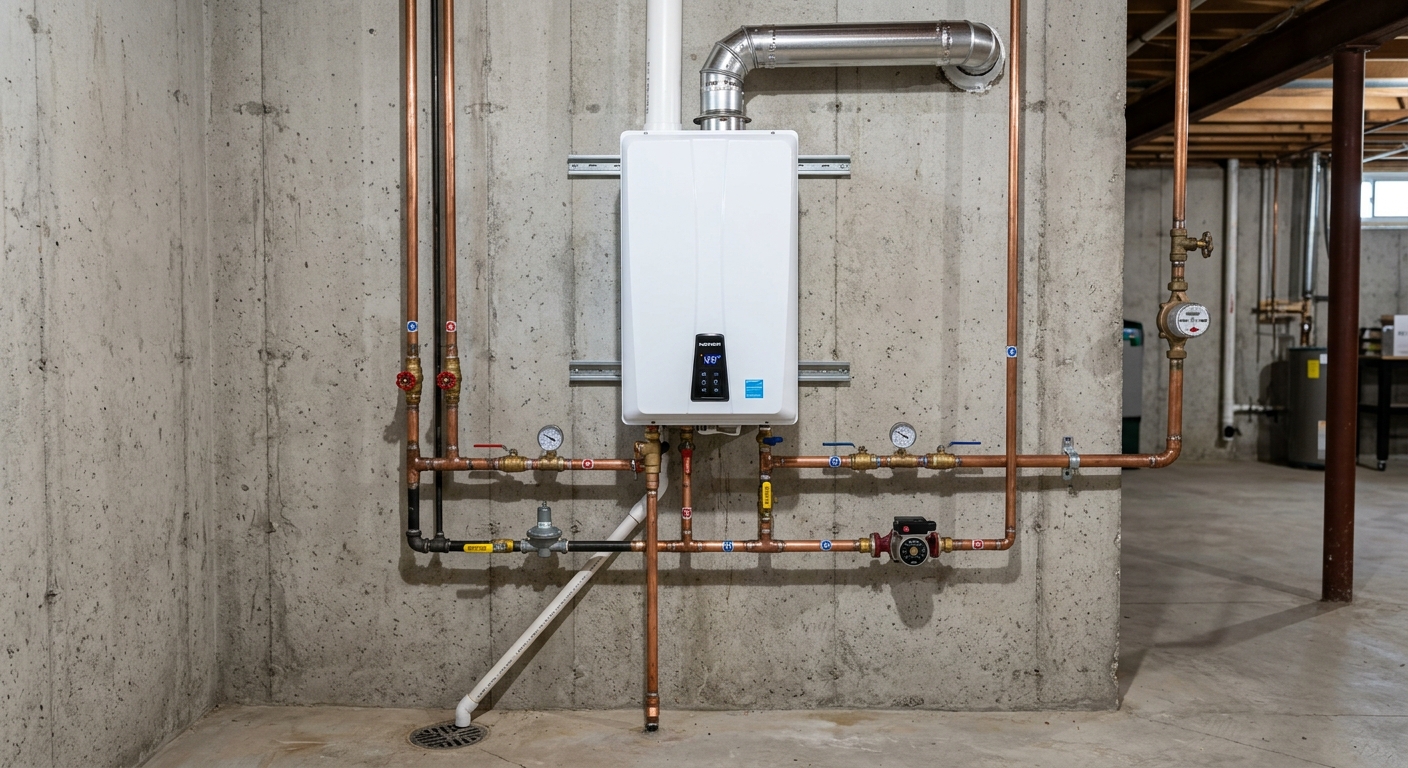
The right water heater for your Adams home depends on your budget, expectations, and basement layout. Tank-type (gas or electric) models are cheapest to install—think $1,150–$2,700—but have shorter lives and wasted energy from standby losses. Gas tankless models provide endless hot water and lower running costs, but most 1900–1940 homes here weren’t piped for high-BTU appliances, so the install may require bigger gas lines and a new vent. That “simple” tankless swap frequently runs toward the top of the price band.
Heat pump water heaters are the most efficient and are gaining traction in Pennsylvania. They use the surrounding air for heating, so they work best in large, unfinished basements. They will cool and dehumidify the room—a plus for a damp stone basement, a minus in a finished space. Be aware: these units make significant noise, so a quiet laundry room or utility closet isn’t ideal. Average annual savings can justify their price, but only if your electric rates are stable, and you don’t mind a few degrees’ chill in the space around the tank.
When sizing, look for the first-hour rating—not just gallons—especially if you have a busy household. In older Adams homes, make sure a new install includes an expansion tank (now code), a metal pan, and a drain. Tank failures are the most common cause for replacement; controls and heating elements rarely go before the tank itself.
| Type |
Installed cost |
Service life |
Operating cost |
Best when |
| Gas tank, 40–50 gal |
$1,150–$2,700 |
8–12 yrs |
moderate |
existing gas, unfinished basement, moderate budgets |
| Electric tank, 40–50 gal |
$1,150–$1,850 |
10–15 yrs |
high |
no gas service, lower up-front cost matters |
| Gas tankless |
$1,850–$2,700 |
18–25 yrs |
low-moderate |
endless hot water wanted, venting and gas size allow |
| Heat pump water heater |
$1,850–$2,700 |
13–15 yrs |
lowest |
large, unfinished space; highest efficiency desired |
Frequently asked questions — plumbing in Adams
What does repiping a house cost in Adams?
Replacing all the water supply pipes—whether switching out galvanized, aging copper, or adding new PEX—usually falls between $3,400–$8,200 for a typical Adams home. The wide range is due to house size, accessibility, and whether finishes like plaster or tile are affected. Because the majority of homes in Adams Township were built before 1980 (U.S. Census Bureau, ACS 2024), original supply lines are frequently at the point of failure after a century of use. Repipe jobs are most often scheduled when leaks start occurring in multiple places. If you’re not having visible leaks and your water pressure is acceptable, you don't need to proactively spend—monitor, but only repipe when reliability becomes a problem.
Should I leave a faucet dripping in cold weather?
In Adams’ long heating season and older homes with pipes in uninsulated crawlspaces or against stone basement walls, it does sometimes make sense to let a faucet drip on the very coldest nights. Pipes can freeze when the temperature drops to 2°F—the local winter design temperature—and running water won’t freeze as easily. However, this is a last resort. First, insulate pipes and seal drafts, especially in basements and rim joists. If you do drip a faucet, the cost in water is typically a few dollars a month—nothing compared to even a minor emergency thaw and repair, which starts around $350–$1,150 for burst pipe repair.
Should I reline or replace my sewer line?
In Adams, older homes almost always have clay or cast iron sewer lines with roots or settlement issues. If a camera inspection reveals only a small area of damage (like a joint offset or one root intrusion), trenchless relining can be less invasive and is usually faster to finish. Total open-cut replacement—digging and replacing the entire run—may run from $1,950–$11,500 depending on access and depth. In most cases, relining is effective if the original pipe is stable and has only isolated defects. If your line is badly collapsed, back-pitched, or broken in several spots, replacement is unavoidable. Don’t decide until you’ve seen the inspection footage yourself.
How hard is the water in Adams?
Adams receives water from the Greater Johnstown Water Authority, which typically reports moderate hardness. Scale buildup is common enough in this area to reduce water heater and fixture life, but not severe enough to make a water softener mandatory for everyone. In most Adams homes, the need for a softener depends on your personal tolerance for scale and how quickly you’re going through appliances. If you’re seeing recurring failures, the investment may pay over time, but I’ve seen plenty of Adams houses where people get by fine without one. Water heaters average 8–12 years here ($1,150–$2,700 to replace).
What does discoloured water on first draw mean?
In Adams, discoloured or rusty water when you first turn on the tap—especially after sitting overnight—usually traces to aging galvanized or iron pipes common in local mill-era housing. It can also occur after street work disrupts sediments in the main. If it clears up quickly, it’s not usually a health risk, but it does signal it’s time to consider pipe replacement or at least a closer camera inspection. If the water stays brown, especially after a recent repair, notify the Greater Johnstown Water Authority. Severe or ongoing discolouration may accelerate the need for a main line or whole-house repipe, which is a $3,400–$8,200 job depending on the home.
Am I responsible for the water line under the street?
In most of Adams and Cambria County, including Johnstown and surrounding boroughs, homeowners are responsible for the water service line from the curb (or property line) right up into the house. The Greater Johnstown Water Authority owns and maintains lines in the street up to the curb stop; from there in, it’s on you for repairs or replacement. If your line fails, a full street-to-house replacement—especially if it means digging up hard surfaces or landscaping—usually costs $5,300–$11,500. You should contact the Water Authority to clarify exactly where their responsibility ends for your address.
Do I need a permit for plumbing work in Adams?
In Adams Township and nearby boroughs, the rules vary by municipality. In the City of Johnstown, any installation of new fixtures or changes to supply or drain lines require a plumbing permit, with inspections by city code officials. Simple replacements of faucets or exposed traps, if in the same location, usually do not need a permit. The rest of Cambria County townships and boroughs run their own code offices—so always check before starting a job. Permit and inspection fees are typically much less than the cost of fixing an unpermitted mistake—especially if a failed inspection leads to costly tear-outs or delays. For substantial jobs over $500, factor in the total cost, since written contracts are required by law ($350–$8,200 depending on the scale of work).
What do I do if sewage is backing up?
Sewage backing up is always an emergency in Adams. First, stop using all water—flushes, laundry, sinks—immediately and keep everyone (including pets) away from affected areas. In homes on the public system, call a plumber prepared for after-hours work, since emergency rates can run $1,950–$11,500 for a main line repair. Before anyone starts digging, a proper camera inspection should be done to locate the blockage and verify if the problem is in your line or out in the main. In rural parts of Cambria County with septic, sudden backup could mean a full tank or a drainfield failure—so call a septic service provider right away. Don’t run more water or try to flush it down—get professional help promptly.
How much does a water heater replacement cost in Adams?
The installed cost of a replacement water heater in Adams depends on fuel type, size, and local access. A typical 40–50 gallon gas tank setup—including removal, new unit, reconnecting, and haul away—will cost $1,150–$2,700. Electric is usually a bit cheaper, while tankless or heat pump water heaters land toward the higher end of $1,850–$2,700. Most of these older homes require some plumbing adjustment, extra labor for new venting or pans, and possibly an expansion tank to meet code. Ask what’s included before you sign—Johnstown’s market tends toward the upper half because of additional travel and the quirks of old houses.