Plumbing costs in Penn — 2026
In Penn, the age and construction era of a home shapes plumbing costs more than any other factor. With a homeownership rate of 74.0% and a quarter of homes built before 1980 (U.S. Census Bureau, ACS 2024), many Penn homeowners face repairs or replacements emerging from the extensive 1960–2000 building wave in Chester County. If your home falls into this category, you are likely dealing with either aging copper or early PEX supply lines, plus PVC or sometimes clay sewer laterals. This matters because older pipes are more prone to failures that cost more to repair—think repeated pinhole leaks in thin-wall copper, or brittle PVC cracking beneath a driveway.
The same job has two very different price tags: an emergency call for a burst pipe or failed water heater will nearly always cost more than a planned repair or replacement. Emergency rates reflect the true cost of after-hours dispatch, immediate parts runs, and jump-the-line scheduling, and Penn’s dense suburban market means you’ll get a tech quickly, but not always cheaply.
| Service |
Scope |
Emergency rate |
Standard rate |
| Emergency repair — burst pipe |
locate, open, repair section, restore service |
$650–$1,300 |
$375–$1,300 |
| Water heater replacement (gas, 40–50 gal) |
remove old, install, test, haul away |
$2,100–$3,100 |
$1,300–$3,100 |
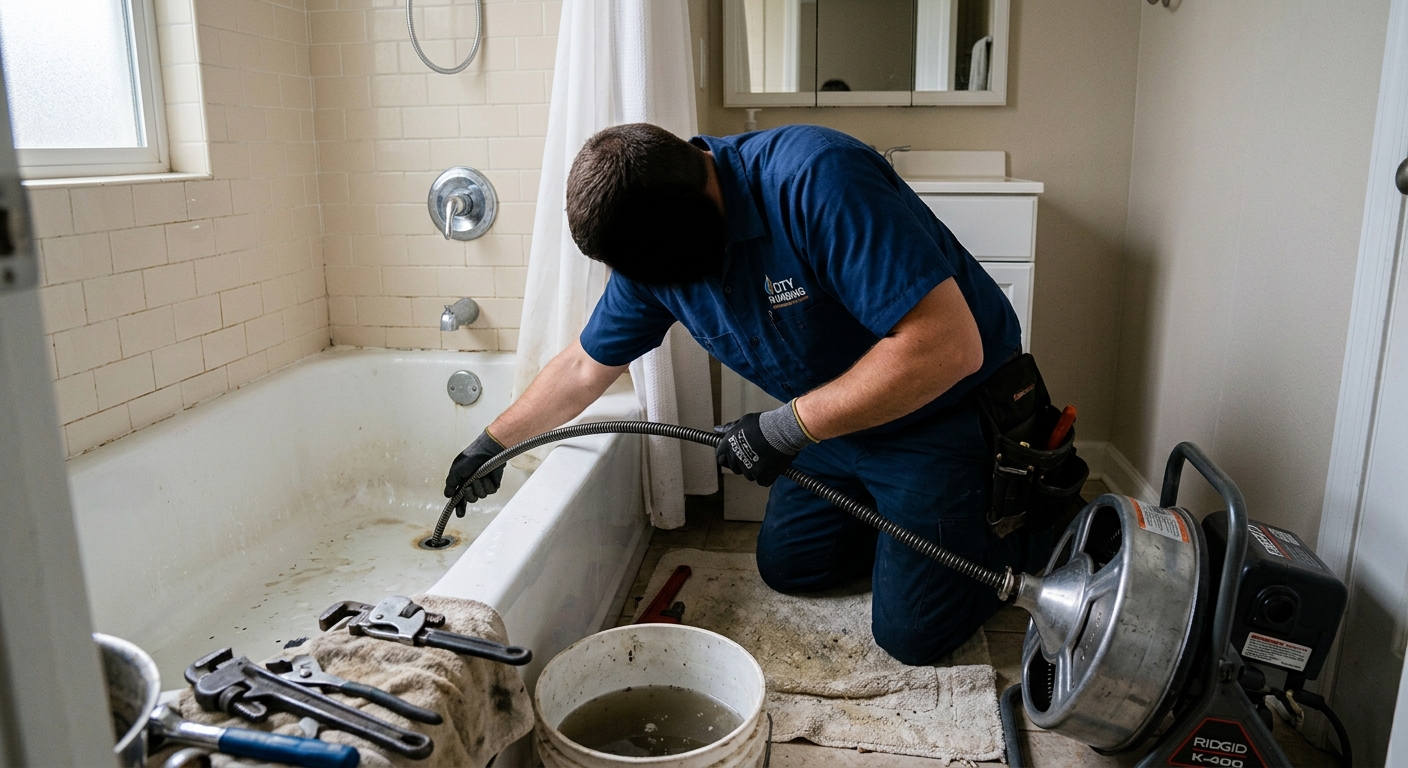
| Drain cleaning — main line |
augering or hydro-jet, camera if needed |
$350–$800 |
$200–$500 |
| Sewer line spot repair |
excavate or reline a failed section |
$2,200–$13,000 |
$2,200–$13,000 |
| Whole-house repipe |
replace supply lines throughout, patch and finish |
|
$3,800–$9,300 |
| Water service line replacement |
street to house, excavation and restoration |
|
$6,000–$13,000 |
Estimates for a typical Penn home. Access difficulty and pipe material move these figures more than anything else.
Verifying a Penn plumber's credentials
In Pennsylvania, including Penn and the rest of Chester County, there is no statewide plumbing license. All plumbing contractor licensing is handled at the municipal level. This means a plumber registered or licensed in Philadelphia or another township may not be authorized to work in Penn or nearby townships. Throughout Chester County, some townships—including Westtown and its neighbors—issue their own plumbing contractor registrations that are separate from Philadelphia or Pittsburgh’s registries. Always ask, “Are you licensed here?” instead of just, “Are you licensed?”
In West Goshen Township, for example, any new or replacement plumbing connected to public water or sewer requires a township plumbing permit. Local code enforcement, such as the West Chester Department of Building, Housing & Codes Enforcement, manages permits and inspections within their jurisdiction. If you live in one of the county’s suburban townships, confirm which municipal office handles plumbing code in your area.
All plumbing contracts over $500 must comply with the Home Improvement Consumer Protection Act. That means you must have a written contract and a three-day right of cancellation. The plumber must be registered as a Home Improvement Contractor (HIC) with the Pennsylvania Office of Attorney General. You can verify HIC registration at hic.attorneygeneral.gov. Workers’ compensation coverage is mandatory for all employers; you can check status via WCAIS (wcais.pa.gov). Don’t sign until you’ve checked both registrations.
Spot repairs or whole-house repipe?
In Penn, when a pipe bursts or springs a leak, the first repair is often straightforward. But if you have two or more leaks in the same type of pipe within three years, you have a systemic problem, not just bad luck. That’s the point where a whole-house or at least partial repipe is usually the smart move.
Common warning signs go beyond obvious leaks: if every fixture sees falling water pressure, or you notice rusty or brown water on first draw, that’s often corrosion inside aging copper or galvanized lines. Visible green or white crust at exposed joints, or repeated pinholes, are clear signals that your supply lines are near failure.
Throughout Chester County, many homes built between 1960 and 2000 are approaching their first major repipe cycle. These homes often have copper that thins from water chemistry or early PEX installations that can show fitting failures. Don’t forget the cost beyond pipe and labor—restoring plaster or drywall can cost half as much as the plumbing, especially in older homes with lath and plaster walls.
PEX is quicker to install and less invasive for retrofits, leading to lower labor costs. But it’s not always appropriate if your home’s supply lines are exposed to sunlight or pests. Copper is longer-lasting but often not worth the upcharge if the rest of your system is already PEX or PVC drain.
| Situation |
Recommendation |
Cost |
Reasoning |
| One leak, accessible, modern pipe |
Spot repair |
$375–$1,300 |
Quick fix, least disruption |
| Two or more leaks in 3 years |
Partial repipe |
$3,800–$6,300 |
Problem will repeat otherwise |
| Galvanized supply, pressure loss |
Full repipe |
$3,800–$9,300 |
Systemic corrosion—can’t patch your way out |
| Polybutylene anywhere in the house |
Full repipe |
$3,800–$9,300 |
Liability—insurance may not cover claims |
| Cast iron drain with root intrusion |
Camera, then reline or replace |
$2,200–$13,000 |
Get proof before digging—spot fix or trenchless may work |
| Suspected lead service line |
Test, then replace the lateral |
$6,000–$13,000 |
Lead risk, removal is solution |
Sewer laterals: the pipe you own and can't see
Most Penn homeowners don’t know that the sewer lateral—the underground pipe running from your house to the public main—is your responsibility the whole way, even under the sidewalk or street. If something goes wrong here, you pay for the diagnosis and the repair, so it pays to know the symptoms.
Symptoms start with one slow drain, then spread to multiple fixtures backing up. Gurgling after flushing or water backing up in a basement drain means the problem is in the main lateral, not just a branch. If the lowest fixture backs up first—usually a basement tub—that’s a classic sign of an obstruction or break downstream.
In Chester County, most boroughs use public sewer while many outlying townships rely on individual septic systems. Municipal sewer lines, especially in older communities, may have brittle PVC, clay, or cast iron laterals—clay is notorious for root intrusion, while PVC can offset or “belly” from settling.
You should always insist on a camera inspection before signing off on any excavation or relining quote. It’s the only way to know what’s actually happening underground. Open-cut replacement is the most direct, but trenchless relining or “pipe bursting” is often less disruptive if site conditions allow. Never accept a sewer quote in Penn without seeing the footage first.
If you’re on a private septic, separate issues entirely—slow drains may mean the tank needs pumping (typically every 3–5 years) or worse, a failed drainfield.
Finding a hidden leak in Penn
The first tool every Penn homeowner has for leak detection is free: shut off every faucet and appliance, then watch your water meter. If the meter keeps spinning, you have a leak on the supply side. A sudden jump in your Aqua Pennsylvania bill can be the first sign.
Professional leak detection usually starts around $375–$1,300 depending on methods and house size. Acoustic listening devices are used for pinpointing leaks behind walls or under slabs. Thermal imaging can highlight cold spots from water loss in hidden spaces. In rare cases—like a slab leak—plumbers may use tracer gas, injecting a safe gas into the lines and using a sensitive “sniffer” to find the escape point.
Irrigation line leaks are trickier, usually requiring isolation and careful meter testing by zone. A slab leak will often cause a warm spot on the floor, discolored baseboards, or even mold or musty odors in carpets. If a plumber wants to start opening walls or floors before locating the leak, get a second opinion—proper detection comes before demolition in Penn.
Penn's housing stock and its plumbing
With 64.8% single-family homes and only 20.5% built before 1980, Penn’s housing is mostly the product of Chester County’s 1960–2000 suburb boom (U.S. Census Bureau, ACS 2024). What this means for plumbing is mostly copper supply lines, some early PEX in the last two decades, and builder-grade PVC drains that are reaching their first heavy repairs.
For sewer, expect mostly PVC laterals if your home is from the 1980s onward, with some lingering clay tile—and with that, potential root intrusion if you’re on a wooded lot. The odds of a lead service line are very low, with Aqua Pennsylvania reporting less than 1% remaining in Chester County in 2024, but always worth verifying if your house predates 1980.
Most water heaters in these homes are on their first or second replacement. If you’ve got the original still running past year fifteen, you’re on borrowed time—budget $1,300–$3,100 for a gas replacement. While newer construction doesn’t mean “maintenance-free,” original builder fixtures and pipes from this era are now overdue for their first major update.
What a plumbing quote should contain
Every Penn homeowner should make sure they understand what they’re agreeing to before any plumber touches a wrench. Plumbers in Chester County typically use one of two billing models. “Flat rate” means you get one price for the job, regardless of time. This gives you price certainty, but the contractor builds in margin for unexpected work. “Time and materials” pricing means you pay for labor by the hour and parts as used—sometimes cheaper for simple repairs, but wide open if the job uncovers extra work.
A professional quote should clearly state whether there’s a diagnostic fee and if it credits toward work performed. Expect clear definition of the scope: what gets opened, fixed, and restored (plaster, drywall, finish). The quote should note if permits are included—or explain why they’re not needed—and name actual fixture models, not just “standard.” Labor warranty and after-hours rates should be spelled out, not buried in fine print. Silent or vague quotes are a red flag in Penn.
| Line item |
What to look for |
Red flag if… |
| Billing model |
flat rate or hourly, stated up front |
unstated |
| Diagnostic fee |
amount, and whether it credits |
vague |
| Scope |
what is opened, repaired and restored |
price with no scope |
| Restoration |
drywall and finish explicitly in or out |
silent |
| Permit |
included and priced |
'not needed' |
| Parts |
brand and model for fixtures |
'standard fixture' |
| Warranty |
labour period stated separately |
parts only |
Frequently asked questions — plumbing in Penn
Why do plumbers charge a diagnostic fee?
Plumbers in Penn charge a diagnostic fee because finding the true source of a plumbing problem often takes time, skill, and sometimes specialized equipment. Whether it’s pinpointing a hidden leak or scoping out a backed-up sewer line, the first hour might be in investigation rather than turning a wrench. This fee typically covers travel, time, and use of tools—plus it weeds out “shopping calls” from people not ready to commit. In many cases, reputable Chester County plumbers will credit this diagnostic charge against approved work, so if you go ahead with a repair priced at $375–$1,300, the fee is deducted. Always ask if the diagnostic fee is creditable and insist it’s stated on your contract so there’s no surprise on the invoice afterward.
What do I do if sewage is backing up?
If sewage is backing up anywhere in your Penn home, stop using all water fixtures immediately—every flush or load of laundry makes the situation worse. Check if it’s only one fixture; if all drains are slow or backing up at the lowest point (like a basement), you have a main sewer blockage. Call a plumber who offers camera inspections—don’t settle for someone willing to start digging or snaking blind. In Penn, main sewer line cleaning or emergency spot repair will typically fall in the $350–$800 (drain clean) to $2,200–$13,000 (spot repair) range. Don’t delay; sewer backups pose health hazards and can cause expensive property damage if not stopped quickly.
Who owns the sewer lateral, me or the city?
In Penn and throughout Chester County, the homeowner is responsible for the entire length of the sewer lateral from your house to the main line—often including the portion that runs under sidewalks or the street. The city or utility typically owns only the main line, not the lateral serving your property. That means any repair or replacement, from minor root cleaning ($350–$800) to a full lateral replacement ($6,000–$13,000), is your expense. Always insist on a video inspection before committing to repairs so you know exactly what’s needed. This ownership rule surprises many new homeowners, but it’s standard for this region.
What does repiping a house cost in Penn?
For most homes in Penn, a whole-house repipe—replacing the aging copper or PEX with new PEX or copper throughout—usually lands between $3,800–$9,300. The range depends on your home’s size, the number of bathrooms, and how accessible the old pipe is. The cost includes labor, piping, and a basic patch of walls and ceilings, but does not always cover fine plaster or custom paint finishes. Expect old 1960–2000 houses to need this work sooner due to the end-of-life for builder-installed piping. Always get multiple quotes and ensure the scope includes wall restoration if that matters to your resale value or personal comfort.
Can I do my own plumbing work in Penn?
In Penn, you can legally do some of your own plumbing work because Pennsylvania does not require a statewide plumbing license. However, municipal rules still apply—especially in towns like West Goshen, where a permit is needed for new or replacement plumbing connected to the public water or sewer system. DIY repairs can save money on a basic fixture swap, but if the job costs more than $500 or involves the main lines, you risk failing a code inspection, or worse, causing water damage not covered by insurance. For serious leaks or repipes, it’s usually safer to pay a professional—expect $375–$1,300 for a small repair.
Is a tankless water heater worth it in Penn?
In Penn, switching to a tankless water heater is tempting because you’ll never “run out” of hot water, and the units can last longer than traditional tanks. But the up-front install cost is higher—more than a standard replacement, which runs $1,300–$3,100 for a standard 40–50 gallon gas water heater. Tankless systems may also require new venting, gas lines, or electrical work, adding to cost. You’ll see the most benefit if your household uses hot water at several hours apart, or if you value space savings. For most Penn homes, a quality tank unit remains the more budget-friendly choice until your usage pattern really demands the upgrade.
Which utility supplies water to Penn?
In Penn, the main water providers are Aqua Pennsylvania’s southeast division and, in parts of the area, the West Chester Area Municipal Authority. Aqua Pennsylvania handles water for most Chester County suburbs, and they maintain a record of your service material—important for tracking any remaining lead lines, which are now under 1% for this county. If you need to coordinate a water service line replacement (budget $6,000–$13,000), you’ll work directly with Aqua or your municipal authority for shutoff and inspection approvals.
Should I leave a faucet dripping in cold weather?
In Penn, winters are cold enough (14°F design temperature and 30-inch frost depth) that leaving a slow drip during the coldest nights can prevent a frozen pipe—especially if your home has pipes running through unheated spaces like garages or exterior walls. This is especially true for older homes and for those that have had previous freeze-ups. While it costs a little extra on your Aqua Pennsylvania bill, it’s far cheaper than paying $375–$1,300 for an emergency burst pipe repair. If you’re away for an extended winter trip, consider shutting off and draining the supply instead.
Why do all my drains drain slowly at once?
In Penn, when every drain in the house is slow at the same time, the problem is almost never at just one sink or tub. It almost always means there’s a blockage in the main house drain or the sewer lateral leading out to the street or septic tank, especially in neighborhoods built with aging PVC or clay tile. Clearing a main line clog using augering or hydro-jet work typically runs $200–$500 during standard hours. If backups persist after cleaning, you may need a camera inspection to check for pipe belly, offset, or severe root intrusion—common for older houses in Chester County’s suburban sprawl.