Plumbing costs in Crafton — 2026
Crafton’s housing is among the oldest in Allegheny County, with nearly all homes built before 1980 and about half as single-family houses (U.S. Census Bureau, ACS 2024). That construction era means most original piping was galvanized steel or cast iron, both of which are well past their prime. The result is a steady workload for plumbers replacing sections, whole systems, or handling emergency fixes as pipes finally give way.
It’s important to know: the same job comes in two prices, depending on whether it’s an emergency call. Lateral leaks, failed water heaters, or sewer backups after 5 p.m. or on weekends bring premiums for after-hours work, immediate response, and overtime labor. The prices below reflect the difference. For the majority of jobs, the largest factor is the era and material of your piping—access to the failed section in a 1920s basement is different than in new construction, affecting cost and complexity sharply.
The most common high-ticket repairs in Crafton tie back to aging lines: frozen or burst supply pipes, persistent clogs, and degrading sewer laterals, especially under the street. Here’s what you can expect to budget for typical work in a house like yours:
| Service |
Scope |
Emergency rate |
Standard rate |
| Emergency repair — burst pipe |
locate, open, repair section, restore service |
$600–$1,150 |
$350–$1,150 |
| Water heater replacement (gas, 40–50 gal) |
remove old, install, test, haul away |
$1,850–$2,700 |
$1,150–$2,700 |
| Drain cleaning — main line |
augering or hydro-jet, camera if needed |
$350–$800 |
$200–$500 |
| Sewer line spot repair |
excavate or reline a failed section |
$1,950–$11,500 |
$1,950–$11,500 |
| Whole-house repipe |
replace supply lines throughout, patch and finish |
— |
$3,400–$8,300 |
| Water service line replacement |
street to house, excavation and restoration |
— |
$5,300–$11,500 |
Estimates for a typical Crafton home. Access difficulty and pipe material move these figures more than anything else.
Sewer line problems in Crafton
In Crafton and throughout Allegheny County, the homeowner usually owns the sewer lateral from the house all the way to the main under the street. That means if your line fails, your responsibility typically includes even those sections buried deep under the sidewalk or road.
The early warning signs of a sewer line issue begin as one slow drain, escalating to multiple slow drains, odd gurgling sounds from toilets, and finally backup at the lowest plumbing fixture (often a basement floor drain). If you detect more than one drain acting up or unusual noises, it’s time to act before raw sewage becomes a cleanup nightmare.
The first and most sensible step is a camera inspection. A reputable plumber will feed a scope through the main cleanout and show you the footage—never accept a quote for sewer excavation without seeing exactly what and where the problem is. In older Crafton homes, sewer laterals were often run in clay tile. These are notorious for root intrusion at the joints, as well as developing low spots (“bellies”) and offsets where the ground has moved. Cast iron, common in pre-1975 homes, develops corrosion and eventual cracking.
Repair options depend on the findings. In some cases, trenchless relining works well and saves landscaping, but this is less effective if your line is collapsed or offset. Open-cut excavation is more invasive but sometimes required. For Crafton, where the terrain is hilly and sewers are often deep, cost reflects not just the footage but how much concrete, street, or yard must be restored.
On the outskirts of Allegheny County there are still septic systems in some townships. If your home is on septic, slowdowns can signal a full tank (typically pumped every 2–3 years) or a failed drainfield—totally different problems than a city sewer block.
The bottom line: never agree to a sewer dig without reviewing the camera footage that proves a repair or replacement is actually necessary.
Galvanized, copper, PEX, cast iron
The bones of a Crafton house tell the story of Pittsburgh’s building booms. Much of the local stock dates 1900–1950, a time when galvanized steel was king for supply lines, and cast iron or clay tile ran the drains and sewer. These materials had their day—now, many are at the end of their service life, especially where Pittsburgh’s water chemistry and freeze-thaw cycles have taken a toll.
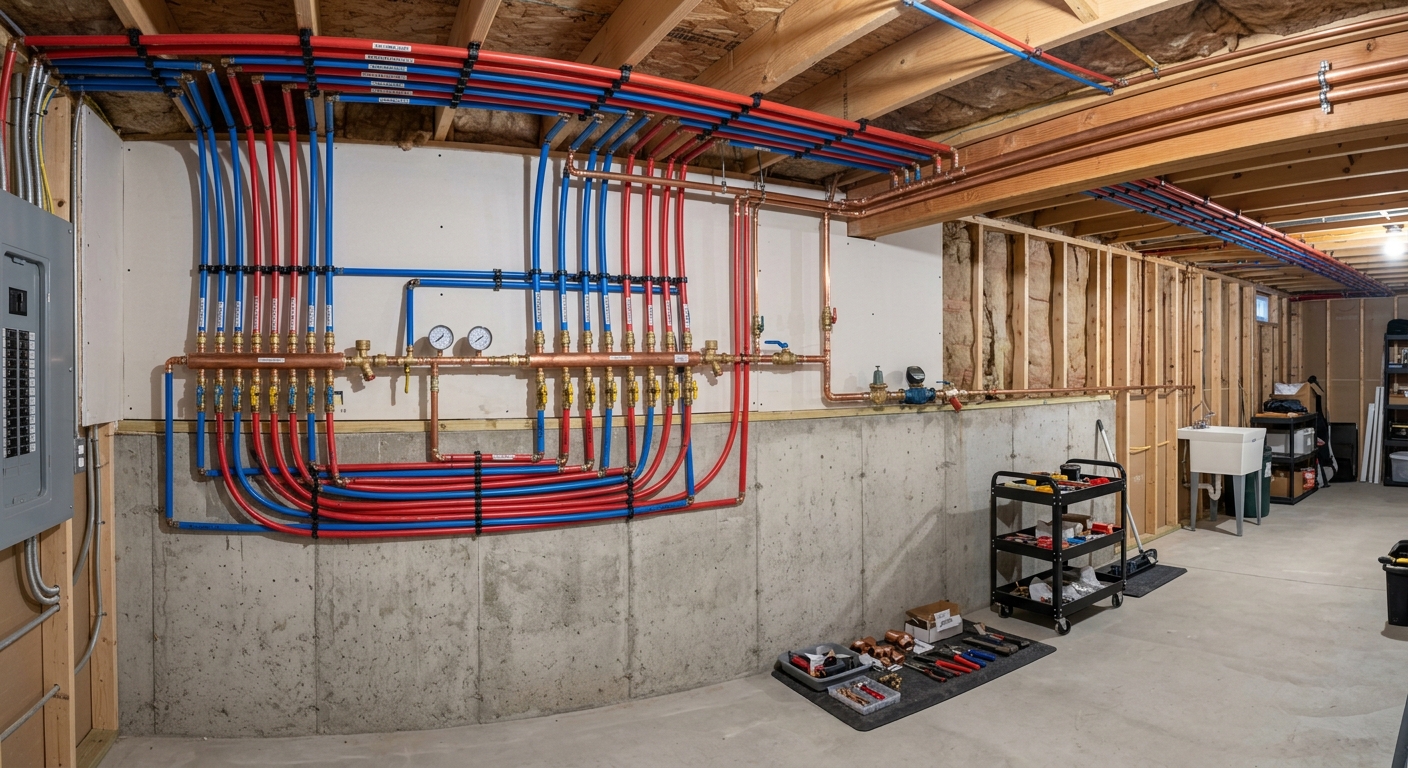
You can often identify what pipes you have at home with a simple scratch and magnet test. Galvanized steel is silver-gray, magnetic, and threaded; scratch it and you see a shiny silver beneath. Copper is a reddish-gold color, non-magnetic, and joined by soldered joints. PEX is flexible, plastic, usually blue or red for hot/cold, and connects by crimped rings. Cast iron drainpipes are black and ring like a bell if you tap them. Polybutylene, thankfully rare now, is gray, flexible, and joined by distinctive metal or plastic fittings.
Materials age differently. Galvanized steel builds up mineral corrosion inside, slowly closing off flow before it ever leaks—most see 40 to 60 years. Copper lasts a bit longer but can develop pinhole leaks if your water is aggressive, while PEX is today’s standard for repipes. Cast iron drains start leaking at joints and cracking at 50–75 years, while clay tile sewer laterals usually fail at joints, letting in roots or shifting out of place.
If your home was built before 1960 and the piping is original, its time is probably up. Newer homes may have copper, PEX, or PVC drains—a reason repairs are cheaper and further between. Here’s how each typical material stacks up:
| Material |
Typical era |
Failure mode |
Service life |
| Galvanized steel supply |
pre-1960 |
internal corrosion, pressure loss |
40–60 yrs |
| Copper supply |
1950s–present |
pinhole leaks, joint failure |
50–70 yrs |
| Polybutylene supply |
late 1970s–1995 |
fitting failure, sudden bursts |
unreliable |
| PEX supply |
2000s–present |
fitting or UV degradation |
40–50 yrs |
| Cast iron drain |
pre-1975 |
corrosion, cracking, scale |
50–75 yrs |
| Clay tile sewer lateral |
pre-1980 |
root intrusion at joints, offset |
50–60 yrs |
| PVC / ABS drain |
1970s–present |
joint separation, crushing |
50+ yrs |
Choosing a plumbing contractor
In Crafton, plumbing is licensed and permitted municipally within Allegheny County, so always confirm your contractor holds a valid credential for the actual town or city where the job will happen. Statewide licensing doesn’t exist for plumbers—contractors need Home Improvement Contractor (HIC) registration (check hic.attorneygeneral.gov) for contracts above $500, but plumbing licenses come from the county or city. Don’t just ask "are you licensed"—ask "are you licensed here, this township or city?"
Always request a certificate of insurance that covers liability on your property, not just somewhere else. Workers’ compensation is also mandatory for employers in Pennsylvania—verify coverage at WCAIS (wcais.pa.gov). Ask if the company uses in-house staff or hires out to subcontractors; the latter scenario can complicate warranty and accountability. For emergency work, make sure you understand how after-hours pricing is disclosed and what’s included in diagnostic fees.
- Check HIC registration at hic.attorneygeneral.gov
- If in Pittsburgh or nearby township, ask if licensed with the Allegheny County Health Department
- Get a certificate of insurance naming your property—do not accept a generic
- Verify workers’ compensation status at WCAIS
- Request references from recent jobs in Crafton or Allegheny County
- Ask if all workers sent are direct employees or if any are subcontractors
- Find out if the owner is local—many Pittsburgh market competitors are not
- Insist on clear after-hours rates, dispatch, and diagnostic fee disclosures
- Refuse any quote for replacing drains or supply lines without seeing proof—camera for drains, pressure test for supplies
- Demand a written contract if the work exceeds $500 (required by law)
- Be suspicious of “per-foot” pricing without specifying footage and restoration included
- Do not work with any plumber unwilling to show municipal credentials on request
In a contractor-dense Pittsburgh market, the most glaring red flag: a bid for a major repipe or sewer job with zero test results or camera footage shown. Walk away—if they can’t justify the job, they shouldn’t get your money.
Service line material and drinking water in Crafton
Crafton’s water is provided by Pittsburgh Water and Sewer Authority, which is actively replacing thousands of lead service lines in Allegheny County. The line from the water main to your house is split—one part is owned by the utility; the other, typically from the curb into your foundation, is yours alone. Most replacements to date have covered only the public-side portion; many Crafton homeowners still have legacy lead, galvanized, or copper for their portion.
To check your service line, locate where the water enters in the basement. Carefully scratch the pipe with a coin or screwdriver and use a magnet—lead is dull silver, easy to nick, and non-magnetic; galvanized is silver but magnetic; copper is red or gold and non-magnetic. If you suspect lead, do not disturb the pipe further—instead, contact a licensed plumber for inspection.
Partial replacements—where only the utility or only the homeowner’s length is upgraded—can temporarily worsen lead levels because old scale breaks loose. That’s why Pittsburgh Water and Sewer Authority’s website maintains a service line inventory; check your address for replacement status and next steps. If Crafton has not announced a cost-share or full coverage program, you must contact the utility for the latest eligibility, do not assume one exists.
If you must replace your side, expect a price comparable to water service line replacement: $5,300–$11,500, often determined by lawn, sidewalk, or street restoration. Full home repiping (all plumbing lines, not just service) comes in at $3,400–$8,300.
No matter what, always follow up with your water utility to get a written record of what’s been replaced and any funding options—don’t guess based on neighbors or rumors.
Licensing and permits for plumbing work in Crafton
For plumbing in Crafton, licensing is strictly a municipal matter—there is no statewide plumbing license in Pennsylvania. Instead, within Allegheny County, the Allegheny County Health Department runs its own journeyman and master plumber licensing program for Pittsburgh and many surrounding municipalities. The practical effect: a plumber may be licensed for work in the city but hold no credential in Crafton or another township, even if it’s the next street over. The right question is always, “Are you licensed in this specific municipality?”
Permits in Pittsburgh and surrounding municipalities are required for all new plumbing systems and most alterations—think water heaters, whole-house repiping, new bath or kitchen additions, or sewer line work. For small fixture swaps like replacing a faucet, no plumbing permit is usually needed. Health department inspectors check permitted jobs for code compliance (based on the Pennsylvania Uniform Construction Code, tied to the IRC). For work outside these municipalities, confirm whether the local government opts in or out of state enforcement—the Pennsylvania Department of Labor & Industry steps in for those that opt out.
Every plumbing job over $500 must come with a written contract (required by the Home Improvement Consumer Protection Act). Verify contractor registration at hic.attorneygeneral.gov and workers’ compensation via WCAIS (wcais.pa.gov). Checking the insurance certificate—specifically naming your property—protects your home if something goes wrong on site.
When to call now and when to wait until Monday
In Crafton, plumbing emergencies cost more—sometimes several hundred dollars more—because of after-hours dispatch, rapid response, overtime, and the premium for getting someone decent out to your door at midnight or on a Sunday. The difference between emergency and standard repair for something like a burst pipe ranges from $600–$1,150 after hours to $350–$1,150 during regular hours. The labor cost, trip charge, and the need to triage “blind” (without time to plan or order parts) all drive the price up.
Help yourself by knowing when you must call and when you can book for business hours. Emergencies to call for right now:
- Active flooding or spraying water—shutoff needed ASAP
- No water anywhere in the house, not weather-related
- Sewage backing up or flooding at a floor drain
- The smell of gas, especially near a water heater or boiler
Can usually wait until business hours:
- One slow (but flowing) drain
- Dripping faucet or exposed pipe, no active flood
- Running toilet, but no risk to others systems
- Low water pressure (unless it drops to nothing suddenly)
Here’s the best tool in your kit: the main water shutoff on your line. This is often just after the pipe enters your foundation (in older Crafton homes, a threaded or lever valve). Shut it clockwise to isolate the whole house; smaller valves under sinks or toilets can cut flow to a single fixture. Knowing how to do this keeps a minor leak from becoming an expensive after-hours crisis, and lets you schedule repairs within business hours at normal rates.
Frequently asked questions — plumbing in Crafton
What does discoloured water on first draw mean?
Discoloured water in Crafton—yellow, orange, or brown—at the first faucet draw is almost always sediment or rust shaken loose from older iron or galvanized pipes. Nearly every home here predates 1980, which means many still have some original lines prone to interior rust buildup. If it clears after running the tap for a minute, it’s typically not harmful, but it is a warning that your plumbing may be corroding. If the water stays colored, or you notice particles, call the Pittsburgh Water and Sewer Authority to check for utility work in the area. For persistent issues tied to your own lines, whole-house repiping in Crafton typically costs $3,400–$8,300—but unless you have leaks or severe pressure loss, you can schedule at your convenience and don’t need to panic.
Am I responsible for the water line under the street?
In Crafton and most of Allegheny County, you are responsible for the section of water service line that runs from your foundation to the utility’s shutoff near the curb, which may include a section beneath the sidewalk or even the street. The Pittsburgh Water and Sewer Authority handles the “public side” only—from the main to their shutoff or curb box; anything past that is your problem if it fails or develops a leak. Homeowner replacement of the service line, including excavation and restoration, runs $5,300–$11,500. Always confirm your side of the property line with both the utility and your contractor—they can show you exactly where your obligation ends.
Should I reline or replace my sewer line?
In Crafton’s older homes, whether to reline or replace a sewer lateral depends on the problem’s location and severity. Spot relining can save you the cost and mess of excavation if the line is generally straight and structurally solid, but has roots or cracks. However, if there’s a collapsed section or major offset—common in clay or cast iron—digging and full replacement may be your only option. Prices for sewer line spot repair here usually fall in the $1,950–$11,500 range, with deeper, harder-to-access lines costing more. You should never agree to any fix (relining or replacement) until you’ve seen camera footage that clearly identifies what and where the issue is on your own property.
Why do plumbers charge a diagnostic fee?
Plumbers in Crafton usually charge a diagnostic fee because travel, skilled labor, and sometimes specialized tools (like sewer cameras or pressure gauges) are all costs they incur before the repair even starts. The highly variable housing here—nearly all built pre-1980—means every job is an unknown. A main line camera inspection, for instance, often justifies a drain cleaning or spot repair costing $350–$1,150 to solve a clog, yet the diagnostic fee makes sure the professional can afford to show up, identify the issue, and provide a fixed scope of work. If you hire them for the repair, many will credit the diagnostic fee toward the final bill. Just ask for this policy up front.
Do I need to drain outdoor spigots in Crafton?
Yes, you should always drain and shut off outdoor spigots in Crafton every fall. The region’s code calls out a frost depth of 36 inches and a winter design temperature of 8°F, so any pipes or hose bibs exposed to freezing air are at real risk of splitting or bursting. If a spigot freezes and bursts, you could be on the hook for an emergency repair costing $600–$1,150 if it leaks inside the wall. Always shut off the interior valve (if present) and drain the exterior line at the start of the cold season—it takes five minutes, saves hundreds of dollars, and is well worth the effort for any home here.
Who inspects plumbing work in Crafton?
In Crafton, plumbing work that requires a permit is inspected by the Allegheny County Health Department Plumbing Program when the job is in Pittsburgh or nearby municipalities participating in the county system. If work is done in townships outside this program, the municipality or, in rare cases, the Pennsylvania Department of Labor & Industry (for opt-out municipalities) handles permits and inspections. Always confirm with your contractor and local office before you begin, especially for a high-value repair or upgrade such as a water heater replacement (typically $1,150–$2,700). Each jurisdiction has its own process—don’t assume a permit pulled in Pittsburgh covers work in Crafton.
How hard is the water in Crafton?
Crafton receives water from the Pittsburgh Water and Sewer Authority, which sources mainly from rivers. The general water hardness is moderate, not extreme—most residents don’t need a softener, but mineral buildup does occur over years in old galvanized pipes, which nearly every home here started with. The upshot is reduced flow and eventually discolored water as interior pipe scale flakes off, a reason why many Crafton homeowners now replace sections or whole runs with PEX or copper (typical repipe cost: $3,400–$8,300). If you’re seeing scale on fixtures or short water heater life, a basic inline sediment filter can extend your system’s lifespan.
What do I do about a burst pipe right now?
If you have an active leak or burst pipe in Crafton, immediately shut off the main water valve—usually located just inside where the water line enters your basement. Turn it clockwise until it stops. Then open a couple faucets downstairs to relieve any built-up pressure. Take photos of the affected area for insurance and call a licensed plumber with local credentials for Allegheny County. The cost to repair a burst pipe emergency typically runs $600–$1,150 if it happens after hours or on a weekend, higher if any walls or finished floors need major restoration. If you’re able to contain the leak, you can sometimes save hundreds by waiting to schedule work during normal business hours.
How much does sewer line repair cost in Crafton?
In Crafton, the cost for sewer line repair varies widely based on how far the damage runs, how deep the lateral lies, and what stands above (lawn, sidewalk, street). A spot repair—excavating and replacing a failed section—typically costs $1,950–$11,500. Full line replacement can reach the upper band, especially if the repair crosses pavement or requires traffic control. Most plumbers now offer camera inspections to scope the problem before quoting a solution—never accept a dig/no-dig estimate without seeing the actual footage of your sewer. Homes here with original clay or cast iron lines are the most frequent candidates for major repairs.