Plumbing costs in Bloomsburg — 2026
Plumbing costs in Bloomsburg swing by hundreds depending on whether your call is an after-hours emergency or a scheduled repair. In a county where most homes—over 79%—were built before 1980 (U.S. Census Bureau, ACS 2024), the odds are your pipes aren’t modern PEX. The typical Bloomsburg or Berwick house, built between 1900 and 1940, still has original galvanized steel or even cast iron in the walls or out under your yard. That means more calls for full or partial repiping as internal pipe corrosion or root-choked sewer lines finally give way. Material and access matter most: it takes more labor (and makes more mess) to cut into plaster or dig through dense clay than plywood and sand.
Costs for the same repair jump if you call in a panic—most local plumbers add a travel fee or bump their billable rate for anything after-hours, which is common here in rural Columbia County. Even so, some repairs (like a leaking water heater with an active flood) can't wait. Budget and urgency both push your options.
| Service |
Scope |
Emergency rate |
Standard rate |
| Emergency repair — burst pipe |
locate, open, repair section, restore service |
$550–$1,050 |
$300–$1,050 |
| Water heater replacement (gas, 40–50 gal) |
remove old, install, test, haul away |
$1,650–$2,500 |
$1,050–$2,500 |
| Drain cleaning — main line |
augering or hydro-jet, camera if needed |
$350–$800 |
$200–$500 |
| Sewer line spot repair |
excavate or reline a failed section |
$1,750–$10,500 |
$1,750–$10,500 |
| Whole-house repipe |
replace supply lines throughout, patch and finish |
|
$3,100–$7,500 |
| Water service line replacement |
street to house, excavation and restoration |
|
$4,800–$10,500 |
Estimates for a typical Bloomsburg home. Access difficulty and pipe material move these figures more than anything else.
Winter pipe failures in north-central Pennsylvania
Bloomsburg winters are no joke—climate data puts our frost depth at 36 inches and it’s not rare to see the mercury plunge to 2 °F for days (ground snow load: 40 psf). Those underground figures matter because not every pipe is buried deep enough to meet code, especially in older homes or unheated outbuildings. In practice, a pipe usually bursts not where it freezes, but between the ice plug and a closed faucet. As ice forms, it expands and pushes trapped water toward that closed valve, building enough pressure to split the copper or burst a section of PEX or galvanized steel.
The most common freeze points? Pipes in exterior walls, crawlspaces lacking insulation, unheated garages, attic lines for second floors, and hose bibb supply lines. Old Bloomsburg houses, especially those built pre-1940, often have pipes run with little protection in places that chill fast when the wind howls off the river. It pays to insulate pipes, wrap heat tape where you can, leave cabinet doors open to let warm air flow on bitter nights, and trickle faucets when the forecast heads to single digits. Always shut off and drain outdoor spigots before the first hard freeze—never rely on “frost-free” alone in our climate.
If a pipe does freeze, thaw it slowly with a hair dryer, heat gun, or warm towels—never a torch. Open flame is the fast route to a house fire. If the pipe bursts, figure an emergency repair landing somewhere between $550–$1,050.
Sewer laterals: the pipe you own and can't see
Homeowners in Bloomsburg, Berwick, and across Columbia County are responsible for the sewer lateral—the buried pipe running from your house out to the main, sometimes running under the street. Many discover this only when a backup happens and the repair bill lands in your lap. Public sewer is the rule in Bloomsburg and Berwick, with separated sanitary lines, but nearby rural townships rely on septic systems—a different animal entirely.
Symptoms of sewer trouble start with a single slow-moving drain, progress to several at once, then gurgling, and finally sewage backing up at the lowest drain in the house. The only proper way to diagnose a sewer lateral issue is with a camera—especially in neighborhoods built 1900–1940, where the line is likely clay tile vulnerable to root intrusion or offset joints. If a plumber quotes you excavation without showing you camera footage of the problem, walk away.
Older lines often fail from roots finding joints in clay tile, “bellies” where the pipe sags, or offsets from shifting deep frost. Repairs may be spot fixes, relining, or full trench replacements—open-cut if roots are rampant or pipe is collapsed, trenchless if you catch the problem early. If you’re on a septic, most root issues are in the pipe to the tank—plus regular pumping is essential for a healthy drainfield. In Bloomsburg, budget $1,750–$10,500 for a localized sewer repair, but insist on camera proof before you spend a nickel on excavation or replacement.
Licensing and permits for plumbing work in Bloomsburg
Pennsylvania doesn’t issue a statewide plumbing license—instead, licensing is handled by municipalities. That means a plumber licensed in Philadelphia or Pittsburgh doesn’t hold any credential in Bloomsburg or the rest of Columbia County unless they’ve registered locally. The right question to ask is: “Are you licensed here, and have you pulled this permit before?”
In Bloomsburg, the Town Code Enforcement Office handles plumbing permits. You’ll need a permit for installing or replacing water or sewer piping beyond fixture swaps; simpler fixes like swapping out faucets generally don’t require one. Surrounding townships each use their own officials, so be clear about where the property sits before hiring. Inspections are local, not state run. For contracts over $500, the plumber must be registered with the Pennsylvania Office of Attorney General as a Home Improvement Contractor; you can look up registration at hic.attorneygeneral.gov. Always check that your plumber carries valid workers' compensation—verification runs through the WCAIS system (wcais.pa.gov). There is no state-level plumbing board, registry, or license to check beyond these channels.
Pipe materials in Bloomsburg homes and how they fail
If your house in Bloomsburg or Berwick was built before 1940, you likely still have galvanized steel supply lines or cast iron drains—materials that have more than earned their keep but are past their service life. Galvanized steel corrodes from the inside, closing off flow from mineral buildup long before outright leaks. Copper, the norm since the 1950s, is more durable but can spring pinhole leaks from aggressive water. Polybutylene, mostly found in very late 70s to early 90s builds, is tough to insure and notorious for sudden failures at crimped joints. PEX—plastic, flexible, installed with cinch or crimp rings—is current practice for supply lines.
For drains, cast iron was universal until the mid-1970s: check for a black, magnet-attracting pipe that sounds solid. Your main sewer lateral, if you’ve never replaced it, is probably unglazed clay tile if the house pre-dates the 1980s—root intrusion at joints is a dead giveaway when you see the camera footage. PVC and ABS plastic started replacing both cast iron and clay tile drains from the 70s onward. To identify your supply: scratch an exposed pipe—shiny silver is galvanized, copper is red-gold, PEX is blue/red/white smooth plastic, polybutylene is dull gray-blue. Magnet sticks = steel.
Service life knits to the building era: galvanized and cast iron are failing now, copper falls next, PVC/PEX rides well into this century. If you’re planning a major renovation or keep patching leaks, a whole-house repipe can run between $3,100–$7,500 but ends the cycle for decades.
| Material |
Typical era |
Failure mode |
Service life |
| Galvanized steel supply |
pre-1960 |
internal corrosion, pressure loss |
40–60 yrs |
| Copper supply |
1950s–present |
pinhole leaks, joint failure |
50–70 yrs |
| Polybutylene supply |
late 1970s–1995 |
fitting failure, sudden bursts |
unreliable |
| PEX supply |
2000s–present |
fitting or UV degradation |
40–50 yrs |
| Cast iron drain |
pre-1975 |
corrosion, cracking, scale |
50–75 yrs |
| Clay tile sewer lateral |
pre-1980 |
root intrusion at joints, offset |
50–60 yrs |
| PVC / ABS drain |
1970s–present |
joint separation, crushing |
50+ yrs |
Tank, tankless or heat pump water heater?
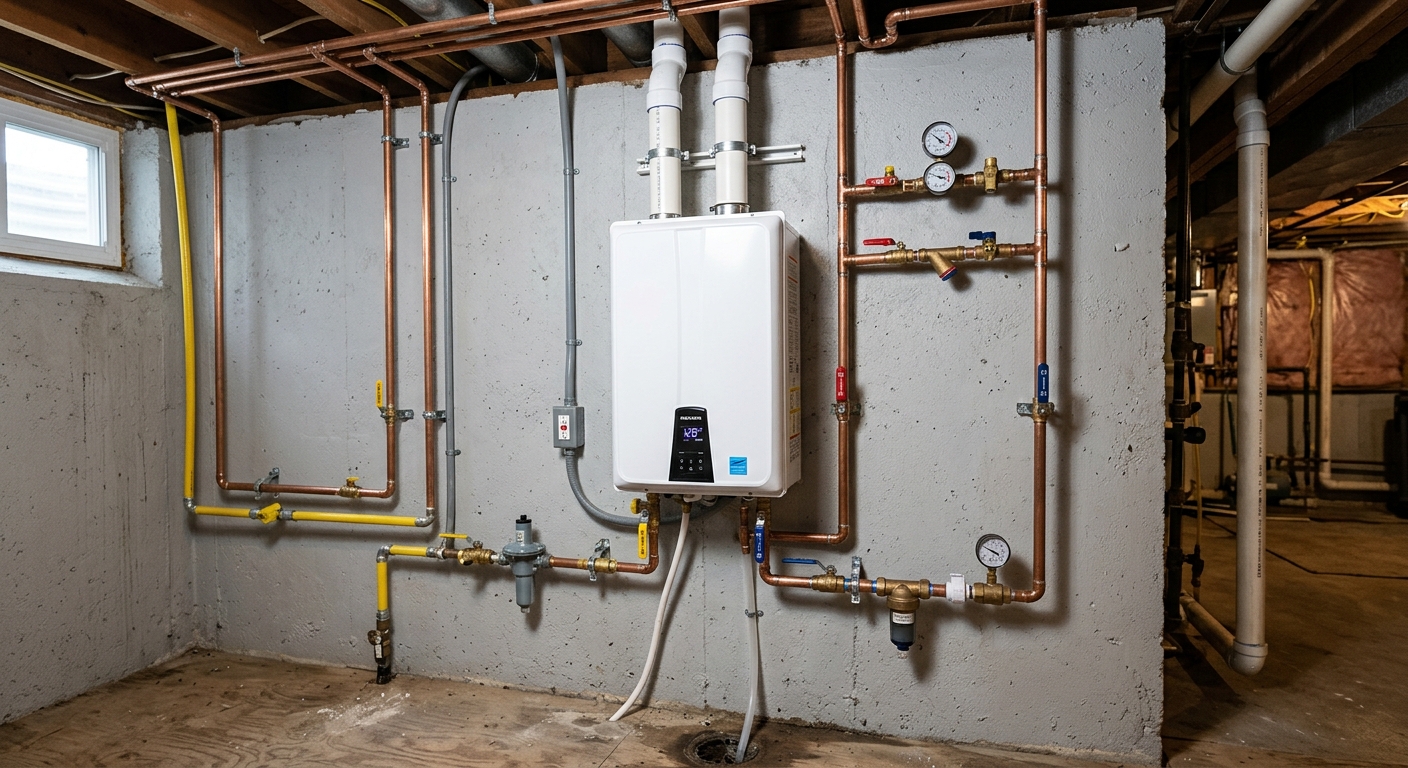
For Bloomsburg homeowners eyeing a water heater swap, here’s how the options break down. Tank-style—gas or electric—are the baseline: cheapest up front, but expect 8–15 years of life and pay to keep all that water hot around the clock. Tankless delivers endless hot water and the best space savings, with lifespans pushing 18–25 years, but costs more to install (and many local gas lines or vents are undersized, adding hidden expense). Heat pump water heaters cost the most up front but run on a fraction of the electricity. They need plenty of warm air—no closets or cold garages in our climate—and can chill finished basements with their cold exhaust and fan noise. Installation in cold or cramped areas usually isn’t worth it.
No matter what you choose, go by first-hour rating (how much hot water it delivers fully warmed up, not tank size), and always add a thermal expansion tank if you’re on the Bloomsburg Municipal Authority or Berwick Borough Water supply, as these closed systems need pressure relief. Most failures occur when the tank rusts out and springs a leak—not in the controls or burners. Factor in the cost of a drain pan and a floor drain where possible.
| Type |
Installed cost |
Service life |
Operating cost |
Best when |
| Gas tank, 40–50 gal |
$1,050–$2,500 |
8–12 yrs |
moderate |
Existing gas line and vent, lowest up-front spend |
| Electric tank, 40–50 gal |
$1,050–$1,650 |
10–15 yrs |
high |
No gas available, simple swap, low install |
| Gas tankless |
$1,650–$2,500 |
18–25 yrs |
low-moderate |
Space is tight, high demand, existing gas service sized right |
| Heat pump water heater |
$1,650–$2,500 |
13–15 yrs |
lowest |
Plenty of warm ambient air, energy savings matter most |
Bloomsburg's housing stock and its plumbing
Bloomsburg’s homes tell their plumbing story by their age. Nearly 80% pre-date 1980, and in Berwick that number is just as high. In practical terms, homes built between 1900 and 1940—common along our streets—typically keep vintage galvanized steel supply lines and cast iron drains, unless remodeled. These older pipes corrode and narrow, causing pressure drops and leaks, while clay tile sewer laterals outside are prime targets for root intrusion. The odds are highest that if your house is older, someone has snaked or patched the drains multiple times instead of full replacement.
Public water supply via the Bloomsburg Municipal Authority or Berwick Borough Water Department means your supply line could be original lead, galvanized, or copper—though lead service lines are mostly partial replacements so far. If your water heater looks older than your youngest child, it’s probably on its second or third cycling, since most only last about a decade. In newer homes—fewer here, but some exist—expect builder-grade copper, PVC drains, and maybe polybutylene or PEX for supply, with fixtures approaching their first full replacement window. Whatever the vintage, Columbia County’s buried pipes freeze, shift, and eventually fail—knowing what’s in your walls helps you budget and plan ahead.
Frequently asked questions — plumbing in Bloomsburg
How much does a water heater replacement cost in Bloomsburg?
Water heater replacement costs in Bloomsburg generally fall between $1,050–$2,500 for a standard gas or electric tank unit. The bulk of the price comes from labor, hauling away the old tank, and any adjustments to supply lines or venting in older homes—many of which were built before 1980. If you need a tankless or a heat pump water heater, expect installation toward the higher end. Emergency replacements (especially if you’re dealing with an active leak on a weekend) can run a few hundred more. Always ask if the quote covers everything, including disposal and necessary code upgrades. With most water heaters in local housing lasting 8–15 years, it pays to check for signs of rust or slow recovery time before your tank fails.
Is my water line lead?
In Bloomsburg and Berwick, some water service lines—especially in homes built pre-1940—may still be lead or partially replaced with copper or galvanized. Berwick Borough has started inventorying and replacing lead lines, but it’s not complete. If you see a silvery pipe where it enters your basement, try the scratch test: if it shines like a nickel and is soft, it could be lead. The only way to know for sure is to have it inspected. If replacement is needed, figure a cost between $4,800–$10,500 for full water service line replacement from street to house. Even partial replacements are worth considering given the health risks, especially if your house predates 1980.
Who owns the sewer lateral, me or the city?
In Bloomsburg and Berwick, you own the sewer lateral from your house all the way to the main, even if the main is across the street. Most people find this out the hard way when a backup occurs or roots pierce the clay line. The municipality maintains the main; everything from your home to that main—including under the street—is your responsibility. If there’s a blockage or collapse, you pay for both the fix and any excavation. Spot repairs usually cost $1,750–$10,500 depending on the length and surface above the pipe. Always insist on a camera inspection before approving excavation or relining, especially in older Columbia County homes.
How deep do water lines need to be buried in Bloomsburg?
By Pennsylvania Uniform Construction Code, and due to our northern climate, water supply lines in Bloomsburg must be buried below the local frost depth—36 inches minimum. That’s to ensure lines don’t freeze when the average winter design temperature bottoms out at 2 °F. In practice, older homes sometimes have shallower mains, especially near foundations or in crawlspaces. If a buried outdoor pipe freezes and bursts in winter, repairs can range from $550–$1,050 just for the immediate leak, with trenching and restoration adding more if a line needs replacing. Always confirm new lines are set below frost to avoid repeat freeze damage.
Repair or replace a leaking water heater?
In Bloomsburg, if your water heater is leaking from the tank itself (not just a valve or fitting), replacement is your only real option—tanks can’t be patched. If the water heater’s less than 10 years old and the leak is from a valve or drain, a repair may be possible and cost-effective. Remember, most water heaters here last 8–15 years given our hard water and older plumbing. Replacing the tank costs between $1,050–$2,500 and can be completed in a few hours, while ongoing repairs to an old tank cost more in callbacks than a new unit. Always check that the plumber installs a pan and tests all connections to prevent future issues.
Do older Bloomsburg homes have galvanized pipes?
Yes, many Bloomsburg homes—especially those built 1900 to 1940—still have galvanized steel supply lines unless they’ve been replaced. Galvanized pipes corrode from the inside out, leading to low water pressure and rusty water before they leak. These pipes have a service life of about 40–60 years, and most are at or past due for replacement now. Full replacement with PEX or copper runs from $3,100–$7,500 in typical local houses, depending on access and finish work. If you notice “sand” in your faucet aerators or low pressure, you probably still have galvanized lines in your walls or basement.
Why do plumbers charge a diagnostic fee?
In Bloomsburg and the surrounding rural townships, travel time is a real expense for plumbers—thin demand and the wide area mean specialists have to cover more ground per call. Diagnostic fees offset this and often cover the basic troubleshooting time, whether you proceed with repairs or not. For something like main drain cleaning, you might see a combined fee of $200–$500, with some deducted from the final bill if you approve additional work. Given local housing’s age and unpredictable access, diagnostics help your plumber find the actual failure point before recommending a major repair—saving you money on unnecessary work.
Should I wait until business hours to call?
If water is actively flooding, a sewer is backing up into the house, or the main supply line is leaking, don’t wait—delays cause water damage that costs thousands. But for drips, slow drains, or lack of hot water, waiting until regular business hours will usually save you on the emergency call-out fee, which can tack on $200 or more to repairs (for example, an emergency burst pipe repair runs $550–$1,050). In outlying townships, surcharges are especially common. If you can safely shut off water locally or catch dripping in a bucket, document it and schedule prompt—but non-emergency—service for regular rates.
How do I verify a plumber's licence and insurance?
In Pennsylvania, there is no statewide plumbing license; municipal registration rules apply. In Bloomsburg, always ask if your plumber has pulled permits with the Town Code Enforcement Office before. For jobs over $500, the contractor must carry a valid Home Improvement Contractor (HIC) registration—that can be checked at hic.attorneygeneral.gov. To confirm they’re insured and covered by workers’ compensation, ask for their policy and verify directly at wcais.pa.gov. A properly registered and insured plumber protects you from liability and ensures contract coverage under the PA Home Improvement Consumer Protection Act. This matters even more in older homes, where insurance claims may get messy if coverage is missing or expired.