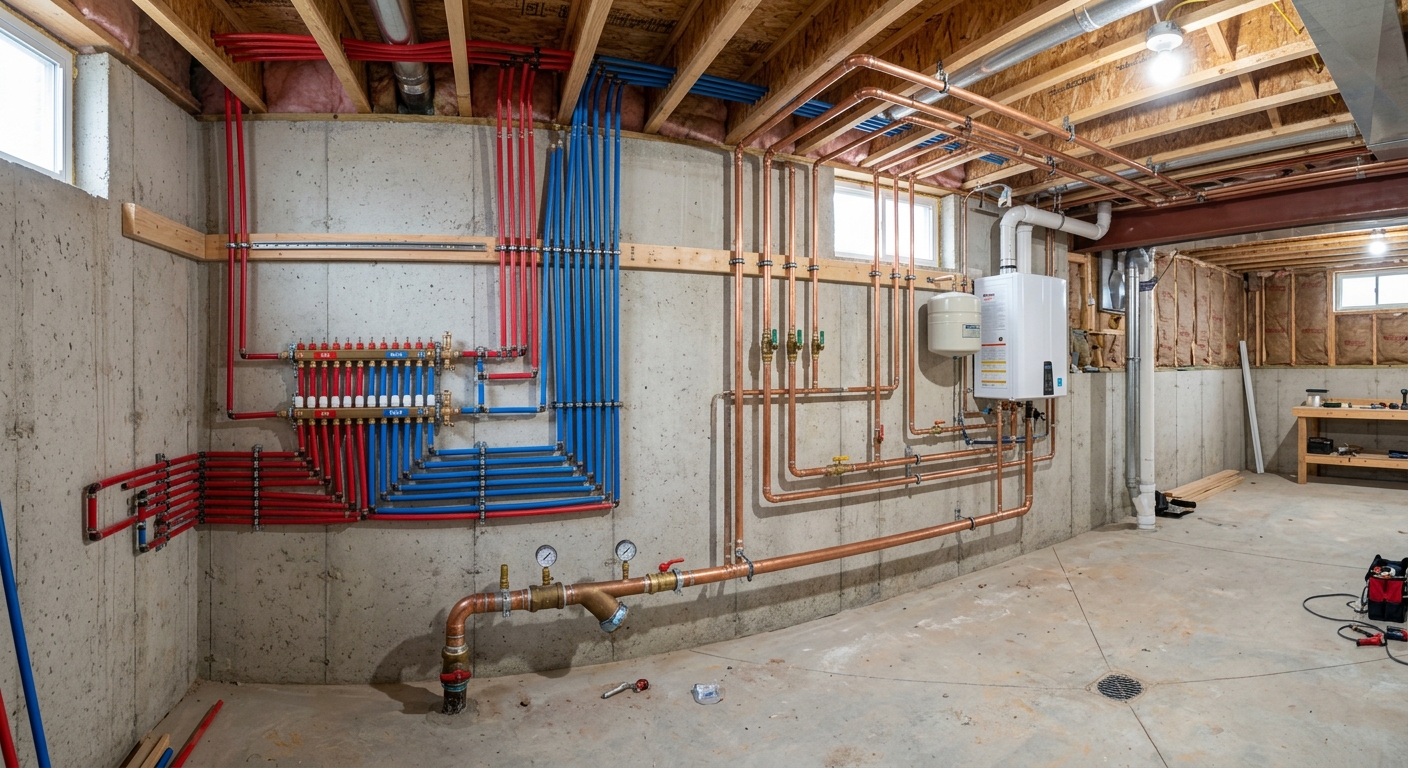
Plumbing costs in Upper Saucon — 2026
Upper Saucon’s plumbing costs line up with the realities of post‑1950 suburban tract homes, many with legacy copper and galvanized lines now reaching the end of their lifespan. The area’s homeownership rate is 90.0% and nearly half of homes were built before 1980 (U.S. Census Bureau, ACS 2024), which means repairs and upgrades aren’t rare events—especially as copper-to-PEX repipe and fixture modernization work are common in South Whitehall and Upper Macungie. With plumbing, construction era often predicts the pipe material, and pipe material is what determines what fails—and how much a fix will cost.
One cost number doesn’t fit every job because the same work carries a much steeper price if it’s an emergency. Emergency response means after-hours work, a trip charge, overtime labor, and everything being handled under pressure. Planned, daytime work can be scheduled, sometimes grouped with other repairs, and you avoid the upper end of local rates.
The table gives a local view of what to expect for the most common jobs. After-hours and burst pipe emergencies demand a premium, but even planned work can vary if access is tough or the original installation is buried or concealed behind finished basement ceilings or thick plaster.
| Service |
Scope |
Emergency rate |
Standard rate |
| Emergency repair — burst pipe |
locate, open, repair section, restore service |
$700–$1,350 |
$400–$1,350 |
| Water heater replacement (gas, 40–50 gal) |
remove old, install, test, haul away |
$2,200–$3,200 |
$1,350–$3,200 |
| Drain cleaning — main line |
augering or hydro-jet, camera if needed |
$350–$800 |
$200–$500 |
| Sewer line spot repair |
excavate or reline a failed section |
$2,300–$13,500 |
$2,300–$13,500 |
| Whole-house repipe |
replace supply lines throughout, patch and finish |
|
$4,000–$9,700 |
| Water service line replacement |
street to house, excavation and restoration |
|
$6,300–$13,500 |
Estimates for a typical Upper Saucon home. Access difficulty and pipe material move these figures more than anything else.
Spot repairs or whole-house repipe?
In a typical Upper Saucon home, especially those built during the 1960s–80s postwar boom, the question comes up: is this one-off, or are we facing a system failure? The honest answer—two or more leaks on the same pipe material within three years is a pattern, not bad luck. Don’t spend good money chasing leaks in material that's at the end of its life.
Watch for these signals: pressure dropping everywhere, not just at one fixture; rusty or green water when you first open a tap; visible blue-green corrosion on copper joints; or having to patch pinholes repeatedly. All point to a system problem, and patching one part only buys you time before the next issue.
Comparing copper and PEX: PEX is flexible, resists freeze damage, and goes in fast—savings that really add up in homes with finished basements or lots of elbows. Copper is still fine for repairs, but in homes with original 1960s copper that is now pitted or thinning, continuing with spot repairs is rarely money well spent. And remember the honest cost: after the pipes, it’s the drywall or plaster patching that piles on expense. In Upper Saucon’s older homes, especially those with plaster, wall repairs often cost as much as the repipe labor.
In South Whitehall and Upper Macungie especially, copper-to-PEX upgrades are so common because the neighborhoods were built all at once, with the same pipe—meaning failures show up at the same time, and the right answer is usually a partial or whole-house repipe, not another patch.
| Situation |
Recommendation |
Cost |
Reasoning |
| One leak, accessible, modern pipe |
Spot repair |
$400–$1,350 |
Local fix is practical and cost-effective |
| Two or more leaks in 3 years |
Partial repipe |
$4,000–$6,500 |
Recurring failure, bigger repair pays off |
| Galvanized supply, pressure loss |
Full repipe |
$4,000–$9,700 |
Galvanized pipes close up, water flow drops |
| Polybutylene anywhere in the house |
Full repipe |
$4,000–$9,700 |
Polybutylene fails suddenly and catastrophically |
| Cast iron drain with root intrusion |
Camera, then reline or replace |
$2,300–$13,500 |
Root failure means the line is compromised throughout |
| Suspected lead service line |
Test, then replace the lateral |
$6,300–$13,500 |
Lead is the one material where replacement is always the answer |
Water quality and what it does to your pipes
Upper Saucon gets its water primarily via the Lehigh County Authority, and that means you can (and should) request the latest annual water quality report—they’re required to publish it. Hard water, which leaves spots and shortens water heater life, is common; so is the kind of slightly acidic water that promotes pinholes in copper over time. Both issues matter more in older homes with legacy copper or when you’re considering a new water heater.
Investing in a softener? In Upper Saucon, most homes run a mid-level water hardness—enough to scale up a tank fast, but not the kind of hard water that makes a salt system pay itself back inside three years. Only consider a softener if you are burning through water heaters prematurely. Whole-house filtration is worth looking into only for taste, odor, or visible sediment; otherwise, a point-of-use filter (like one on your kitchen sink) is usually enough and doesn’t chew up pressure or require pricey maintenance.
If you’re on a private well (still common in the outer Lehigh County townships), only you are responsible for testing—and no annual report will show up in your mailbox. Private wells can carry minerals, bacteria, or other contaminants, and a certified lab test every year or two is the only sure protection, especially if you have kids or elderly family.
Skip “oversold” treatment systems promising miracle solutions—if there’s not a real water test making the case, it’s not worth hundreds or thousands out of pocket.
Emergency rates versus scheduled work in Upper Saucon
In Upper Saucon, the cost split between emergency and scheduled plumbing work is sharp—the same repair can cost hundreds more if it can’t wait for regular hours. What makes up this higher price? You’re paying for a plumber to drop what they’re doing and arrive at your house after hours, often with a trip charge and overtime labor. Diagnosis and repair are done on the clock and under pressure, especially when water is causing active damage.
But not every leak is an emergency. Here’s a clear triage list:
- Emergencies (call now): active flooding, water pouring from ceilings or through floors, no water at all, sewage backup into drains or tubs, or a gas smell near a water heater or furnace.
- Wait for business hours: a slow drip, a single slow drain that’s not backing up, a running toilet, noisy pipes, or a trickle under a sink you can catch in a bowl.
To give you a decision point: an emergency burst pipe repair might run $700–$1,350, while a scheduled fix for the same pipe during business hours could be as little as $400. If you can safely turn off your water at the main shutoff (usually by your water meter in the basement or a crawlspace), you’ve bought yourself time—and often significant savings—by waiting for daytime rates. Every plumbing fixture (toilet, sink, washing machine) also has a local shutoff, and closing it stops a localized leak from becoming an emergency. If you don’t know where either shutoff is, now is the time to find out. That single skill is the biggest money-saver in plumbing.
Finding a hidden leak in Upper Saucon
If you suspect a water leak in your Upper Saucon home, the simplest first test is free: shut off every fixture, fill nothing, and look at your water meter. If the dial is spinning, you’ve got a leak on your supply lines. It may be behind a wall or even below your slab, but this tells you if water is escaping somewhere.
After that, pros have tools. Most leak detection starts with acoustic listening devices ($200–$600 as a standalone service), picking up the sound of escaping water behind walls or floors. Thermal imaging comes next ($400–$800 including some plumbing labor): a camera “sees” temperature shifts from chilled or hot leaking pipes. For concrete slab leaks or truly hidden lines, tracer gas can be pumped through the line and sniffed out ($800–$1,500 when used by slab repair pros).
Typical situations: slab leaks are common in mid-century homes with copper under the floor. Hidden wall leaks tend to appear as mystery stains or swelling on drywall. Irrigation lines or buried exterior pipes sometimes require both acoustic and tracer detection. No plumber should start tearing open ceilings or walls before localizing a leak. Anyone doing so is guessing at your expense.
Who is allowed to do plumbing work in Pennsylvania
Pennsylvania does not issue a statewide plumbing license. Instead, plumbing is governed at the municipal level; in Lehigh County, the City of Allentown Building Office oversees local trade licensing and permitting. Practically, this means a plumber licensed in one township may hold no valid credential in the next—so what matters is not whether someone is “licensed,” but whether they’re licensed here in Upper Saucon or your specific municipality. Always ask.
Permitting is similarly local. In Allentown and surrounding Lehigh County municipalities, work like a water heater replacement, repipe, or anything that alters piping inside or outside your house generally requires a permit and a follow-up inspection. Very minor repairs—like replacing a faucet or repairing an internal fixture—usually don’t trigger permitting, but anything more should be checked with your local office or the City of Allentown Building Office.
For jobs over $500, the Home Improvement Contractor (HIC) registration is mandatory and can be verified at hic.attorneygeneral.gov. Written contracts are required by law over $500, with a three business-day right to cancel. Workers’ compensation coverage is also compulsory for all employers in the trade. Verify coverage using the official Workers' Compensation Automation and Integration System (WCAIS) at wcais.pa.gov, and ask any contractor for proof of insurance directly naming your property.
How to find a good plumber in Upper Saucon
Finding the right plumber in Upper Saucon is step-by-step, and worth the effort. Start by verifying they’re registered as a Home Improvement Contractor (HIC) through the state (hic.attorneygeneral.gov). Then, because plumbing is municipally licensed here, confirm they hold a valid trade license for your exact municipality. Don’t just assume—being licensed in Allentown does not cover a job in Upper Saucon or Lower Macungie.
Check for proof of current insurance specifically naming your property as insured, and confirm their workers’ comp status through WCAIS (wcais.pa.gov)—don’t just take a verbal assurance. Ask whether they use full-time employees or sub out work. For emergencies, know if the dispatch charges and after-hours pricing are disclosed in writing up front; in Lehigh County’s busy market, you want solid communication before anyone starts cutting pipe.
- Check HIC registration at hic.attorneygeneral.gov
- Confirm municipal plumbing trade license (not just any PA town)
- Obtain general liability insurance certificate naming your address
- Verify workers’ compensation on wcais.pa.gov
- Ask about full-time staff versus subcontractors
- Get written estimate and contract for any job over $500
- Require upfront disclosure of after-hours or emergency rates
- Get camera footage for any drain or sewer replacement recommendation
- Request a pressure test with any full or partial repipe proposal
- Ask for contactable local references
- Review written warranty terms, including exclusions
- Verify required permits before job start
Red flags: Anyone who won’t provide a license, says “permits aren’t needed,” or pushes whole-house repipes or sewer replacements without camera proof or a pressure drop is taking advantage of a saturated market. In Lehigh County, competition is high; you do not need to tolerate a rushed or second-rate job.
Frequently asked questions — plumbing in Upper Saucon
What does drain cleaning cost in Upper Saucon?
Drain cleaning in Upper Saucon generally runs $200–$500 for scheduled main line service and $350–$800 if it’s an after-hours or emergency call. The price covers augering or hydro-jetting out the main line, usually including a camera inspection for clogs that are stubborn or where roots are suspected. Cost varies mostly with access—older homes with finished basements or multiple tight bends in the main drain may run higher. In most cases, regular preventive cleaning saves you money compared to waiting for a backup at night when emergency rates kick in. Always ask up front if the quoted price includes both clearing the clog and a camera look, as in some older Upper Saucon homes, recurring issues only get fixed when you see what’s inside the pipe.
Who owns the sewer lateral, me or the city?
In Upper Saucon and most of Lehigh County, the homeowner owns the entire sewer lateral—from just outside your home, right out to where it meets the public main under the street. The city or the Lehigh County Authority is responsible only for the public main. That means if you’re looking at a blockage or a spot repair, the full cost—including excavation and restoration, often between $2,300–$13,500—is yours as the homeowner. The only exception is if the municipality is actively participating in a lead or sewer line replacement program, but that’s sporadic and never guaranteed. Always check if you have root damage or a collapse, and get camera documentation to justify any major repair.
How do I find a hidden water leak?
Start by turning off all water fixtures and watching your meter—if the dial still moves, water is escaping somewhere on your supply side. For Upper Saucon homeowners, this meter test is free and reliable, especially in homes built before 1980 with older copper or galvanized lines. If you confirm a leak, professional detection uses acoustic listening (to “hear” the leak through floors and walls), thermal imaging, or even tracer gas for trickier slab leaks. Professional leak detection services locally fall in the $200–$800 range, depending on complexity. The key: Don’t let anyone open walls without using these non-invasive methods first. You’ll avoid unnecessary drywall damage and expense by insisting on a proper locate before any patching or replacement work starts.
Repair or replace a leaking water heater?
In Upper Saucon, the answer depends on age and where the leak is coming from. If your gas water heater is under 8 years old and the leak is at a valve, fitting, or drain, it’s usually worth repairing. But once you see water pooling from the bottom or see rust near the tank seam, replacement is almost always more cost-effective—especially since hard water shortens tank life in this area. A standard 40–50 gallon gas water heater replacement in this market costs $1,350–$3,200, as of 2026. If your unit is out of warranty or over 10 years old, replacement now prevents an emergency later, which can double labor costs. Scheduled replacements also ensure inspectors sign off and permits are in place, required in most Lehigh County municipalities.
How much does sewer line repair cost in Upper Saucon?
Sewer line spot repair in Upper Saucon typically runs $2,300–$13,500, with the big range reflecting how much of your lateral needs replacing and how deep it’s buried. Most jobs need excavation and sometimes restoration of hardscape or landscaping. If you’re only relining a section, expect the lower end; if the line is collapsed, tree roots have breached it, or you’re in a home with deep set lines, it can climb to the top of the range. Always insist on a camera inspection, both before (to justify replacement) and after (to verify the repair), so you don’t overpay for an unnecessary full replacement.
What do I do about a burst pipe right now?
If a pipe bursts in your Upper Saucon home, shut off your water immediately at the main valve—usually near your meter in the basement or lowest level. This single step will prevent flooding and buy you time to call a plumber under less pressure. Once water is off, open a faucet to drain lines and relieve pressure, and move valuables out of affected areas. Emergency burst pipe repair locally costs $700–$1,350; you can save by acting fast and knowing your shutoff location. Make sure to document the damage for insurance and, unless there’s widespread freezing and local plumbers are booked out, try scheduling repairs for normal hours to avoid the highest rates.
Do older Upper Saucon homes have galvanized pipes?
Nearly half the homes in Upper Saucon were built before 1980, and many still have original galvanized supply lines or drain lines—especially houses in neighborhoods that saw tract builds in the 1950s through early 1970s. Galvanized supply pipes close up with scale and can fail with leaks or low water pressure over time. When you start seeing frequent leaks or pressure drops, a full repipe runs between $4,000–$9,700. Because failures tend to happen in clusters as the pipes age, spot repairs don’t make sense once a pattern appears. A camera inspection (for drains) or pressure test is the best way to decide when it's time to upgrade everything.
Do I need a permit for plumbing work in Upper Saucon?
In most parts of Upper Saucon and Lehigh County, any plumbing work that alters piping—like a water heater replacement, repipe, or installing new fixtures—requires a building permit. Very minor fixture repairs inside a dwelling, such as faucet repairs, don’t generally need one. For larger jobs, the City of Allentown Building Office or your municipality’s UCC office will issue the permit, and an inspector must sign off on the work before it's closed in. Skipping permits can make future home sales harder and can void insurance if a claim is tied to unpermitted work. Permitted, inspected plumbing work on a water heater runs $1,350–$3,200 in Upper Saucon. Make sure your contractor handles the paperwork, not you.
What do I do if a pipe is frozen but not burst?
If you discover a frozen pipe in your Upper Saucon home but there’s no leak yet, turn off the main water supply as a precaution—especially if your house is one of the nearly 50% built before 1980, when pipe insulation standards were inconsistent. Then, safely thaw the pipe by warming the affected area with a space heater or hairdryer (never a torch). Keep a faucet open to relieve pressure and watch for water flow. Call a local plumber if you can’t locate the freeze or if you suspect a split. Keep in mind, emergency freeze break repairs range from $700–$1,350, so investing in prevention and not forcing the thaw can save major hassle and expense. Afterward, insulate vulnerable lines to protect against another freeze.