South Heidelberg plumbing prices by job type — 2026
South Heidelberg, with a homeownership rate of 91.0% and 41.2% of homes built before 1980 (U.S. Census Bureau, ACS 2024), sees classic Berks County plumbing issues: leaking galvanized supply lines and failing cast-iron drains, especially in houses dating to the mid-century housing wave. In this market, plumbing costs depend not just on what needs fixing but when—emergency calls, such as for a burst pipe after work hours or a flooded basement on a winter weekend, nearly always cost more than planned or scheduled work. This emergency premium comes from rapid response, overtime labor, and the need to diagnose under pressure. The difference is often several hundred dollars for the exact same repair if you have the luxury of waiting.
Restoration costs are shaped by pipe material and how easy it is to reach. The same repair on an accessible copper line in a finished basement usually costs less than breaking into original plaster or tiled walls typical of older South Heidelberg homes, where patching can be half the total bill. Below is what to expect, both in urgent and standard situations, for the area’s most common plumbing jobs:
| Service |
Scope |
Emergency rate |
Standard rate |
| Emergency repair — burst pipe |
locate, open, repair section, restore service |
$600–$1,250 |
$375–$1,250 |
| Water heater replacement (gas, 40–50 gal) |
remove old, install, test, haul away |
$2,000–$2,900 |
$1,250–$2,900 |
| Drain cleaning — main line |
augering or hydro-jet, camera if needed |
$350–$800 |
$200–$500 |
| Sewer line spot repair |
excavate or reline a failed section |
$2,100–$12,500 |
$2,100–$12,500 |
| Whole-house repipe |
replace supply lines throughout, patch and finish |
|
$3,600–$8,800 |
| Water service line replacement |
street to house, excavation and restoration |
|
$5,700–$12,500 |
Estimates for a typical South Heidelberg home. Access difficulty and pipe material move these figures more than anything else.
Verifying a South Heidelberg plumber's credentials
Pennsylvania does not have a statewide plumbing license. In Berks County, licensing is handled at the municipal level—not at the state—so a plumber licensed for work in Reading may not have credentials recognized in South Heidelberg or another township. The upshot for homeowners is: do not stop at "Are you licensed?" Instead, ask your plumber directly, "Are you licensed to pull permits and work here in South Heidelberg?" In Reading, a local plumbing trade license and registration are required for any job needing a plumbing permit.
Permitting rules depend on where the property sits. In Reading, most plumbing work beyond a direct fixture swap—such as moving water lines or drains, or replacing a section of buried piping—requires a permit and inspection by your local code enforcement office. Simple like-for-like fixture swaps inside an existing bathroom typically do not require a permit in surrounding townships. After work is done, the municipality or a third-party enforcement agency will inspect the job to ensure it meets the Pennsylvania Uniform Construction Code (UCC), which is based on the International Residential Code.
To verify a contractor, request their Home Improvement Contractor (HIC) registration number and check its standing at hic.attorneygeneral.gov; state law requires a written contract for jobs over $500. For insurance, ask for a copy of their certificate of workers’ compensation and confirm through the WCAIS system (wcais.pa.gov). Responsible homeowners check these before work begins.
The point where patching stops making sense
In South Heidelberg, if your pipes have sprung two or more leaks within three years, you’re not unlucky—you have aging infrastructure that needs real attention. Repeated leaks, especially in the original galvanized supply lines or cast iron drains that are typical of homes built between 1940 and 1970, mean spot repairs quickly become money pits. Watch for a drop in water pressure throughout the house (not just at one faucet), brown or rust-stained water when you first turn on a tap, visible corrosion or “zinc blooms” where pipes meet, or repeat pinholes that signal the inside of the pipe is failing.
You’ll face a choice between copper and PEX for replacement. Copper is long-lived and resists UV damage but costs more, especially with current commodity prices. PEX is flexible, faster to install, and gentle on old plaster finishes, but it’s not code-approved for every application. Partial repipes sometimes make sense—like replacing just the worst sections—but in homes with failing galvanized, the honest answer is usually to repipe the entire system so you’re not chasing new leaks every year. Remember, in homes finished with plaster, drywall and paint repairs after the plumbing is done can often match the plumbing cost itself.
| Situation |
Recommendation |
Cost |
Reasoning |
| One leak, accessible, modern pipe |
Spot repair |
$375–$1,250 |
Material is sound, isolated problem, minimal patching. |
| Two or more leaks in 3 years |
Partial repipe |
$3,600–$5,900 |
Pattern signals aging pipe, more leaks likely to follow. |
| Galvanized supply, pressure loss |
Full repipe |
$3,600–$8,800 |
Corrosion constricts pipes; pressure won’t recover otherwise. |
| Polybutylene anywhere in the house |
Full repipe |
$3,600–$8,800 |
Material is failure-prone; insurers often require replacement. |
| Cast iron drain with root intrusion |
Camera, then reline or replace |
$2,100–$12,500 |
Roots signal breach; cleaning alone won’t cure the issue. |
| Suspected lead service line |
Test, then replace the lateral |
$5,700–$12,500 |
Lead is a health hazard. Replacement is the safe route. |
South Heidelberg's housing stock and its plumbing
In South Heidelberg, just over four in ten homes were built before 1980. In both Reading and the surrounding Berks County townships, the dominant housing wave from the 1940s to 1970s translates directly to plumbing materials still in service. Supply piping in these homes tends to be galvanized steel or, in better builds, copper. Drains are often cast iron, while buried sewer laterals are most likely clay tile or sometimes even Orangeburg. It’s not uncommon for a house from this era to experience the second or even third water heater replacement, and to need upgrades such as modern shutoff valves or new hose bibbs for exterior use.
Where homes are newer—late-1980s through early 2000s—the trend shifts to builder-grade copper or polybutylene, with plastic (PVC, ABS) drains. Polybutylene is notorious for failure in homes from the 1980s and early 1990s, so if that’s you, repiping is often “when” not “if.” Water heaters in these houses tend to be on their first or second life, but many are past the ten-year mark. Even in “modern” subdivisions, faucet cartridges and cheap builder fixtures can start to fail in predictable waves, and supply lines for toilets and sinks reach the end of their dependable span right around year 15–20. So, while newer homes dodge the worst of corrosion, there’s always a clock ticking on something.
Emergency rates versus scheduled work in South Heidelberg
In South Heidelberg, the difference between an emergency and a scheduled plumbing call is hundreds of dollars—and peace of mind. Emergency rates are higher for good reasons: you’re paying for after-hours dispatch (nights, weekends, holidays), a trip charge just to roll a truck now, overtime rates for the plumber, and the reality that diagnosis has to happen under time pressure, sometimes with little or no access to parts. For example, a burst pipe fix called in at 7 p.m. after a cold snap might run $600–$1,250, where the exact same repair done the next morning would likely fall at $375–$1,250.
Be clear about what counts as an emergency. These absolutely qualify: water flooding the house (shut it off—see below), no water at all, sewage backing up into drains, or any gas smell. If you’ve got a slow drip under a sink, a single clogged tub, or a running toilet, those can all wait—save yourself the surcharge and call during standard hours. Running appliances or fixtures when a drain is slow or you suspect a partial clog can turn a manageable problem into an expensive mess, so it’s smart to hold off until help arrives.
Every homeowner in South Heidelberg should know how to shut off the main water valve—usually where the water line enters the basement, often marked with a red or blue handle. For sinks and toilets, local shutoffs are right where the supply line meets the wall. Turn clockwise to close, and after shutting the main, open the lowest faucet in the house to drain water out of the lines. These steps convert many “emergencies” into standard service calls—and save real money.
Choosing a water heater in South Heidelberg
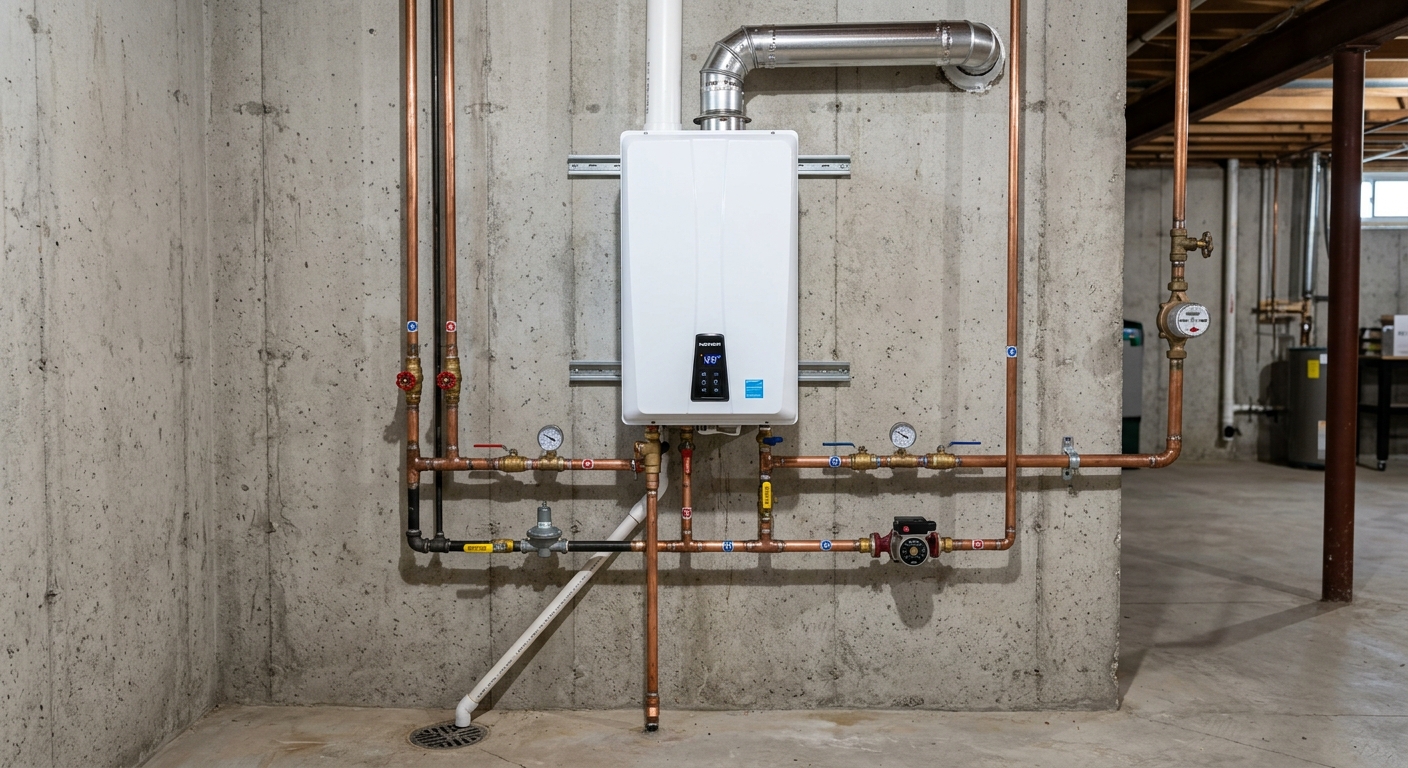
When it’s time for a new water heater in South Heidelberg, your main options are tank, tankless, or heat pump units. The honest breakdown: a standard gas or electric tank is cheapest up front and easiest to install, but with a service life of 8–15 years, you’ll be replacing it more often. Tankless heaters promise endless hot water and longer life, but the higher price tag includes possible gas line upgrades and new venting—investments that catch many homeowners off-guard. Heat pump water heaters cost a bit more to put in, but they sip electricity—saving money long term—if you can give them enough air and a spot where the extra noise and cooling effect don’t matter, such as an unfinished basement. In finished spaces, the noise and mild cooling can be real drawbacks.
Sizing should be based on the first-hour rating, not just tank size; that’s how much hot water you actually get when everyone’s showering and starting the laundry at once. All new installations in this area should include a thermal expansion tank (especially with pressure regulators) and a drip pan with drain if it’s above a finished floor. Most failures happen when the tank rusts through, not the controls—so replacement is rarely avoidable at end of life.
| Type |
Installed cost |
Service life |
Operating cost |
Best when |
| Gas tank, 40–50 gal |
$1,250–$2,900 |
8–12 yrs |
moderate |
Most homes on gas, quick payback, small families. |
| Electric tank, 40–50 gal |
$1,250–$2,000 |
10–15 yrs |
high |
No gas available, easier install, lower repair cost. |
| Gas tankless |
$2,000–$2,900 |
18–25 yrs |
low-moderate |
Big families, endless hot water, accepts higher upfront cost. |
| Heat pump water heater |
$2,000–$2,900 |
13–15 yrs |
lowest |
Electric only, basement install, wants lowest utilities. |
Hardness, treatment and fixture life in South Heidelberg
South Heidelberg is served in part by the Reading Area Water Authority, which issues an annual water quality report by law—you can request it directly for a summary of hardness and any known issues. Hard water—marked by white scale on fixtures and cloudy spots on glassware—shortens the life of water heaters and can gum up faucet aerators. Over the long haul, scale builds up in heating elements and inside tanks, shifting electric and gas bills up and slowly choking off water flow at fixtures.
Softening systems can improve appliance longevity, but they do cost to maintain, and for most homes here, payback is stretched if water heater and fixture replacement cycles are already every 8–12 years. For those with copper plumbing, aggressively soft water can actually increase pinhole leaks over time—so don’t rush into a water softener just because of one appliance or batch of spots on shower doors. Whole-house filtration is usually only cost-effective if you have sediment or specific taste/odor issues; point-of-use filters (at kitchen sinks) solve most drinking water complaints without breaking the bank. If your home depends on a private well (still common in outlying Berks townships), none of this replaces independent testing—well water isn’t monitored by any utility, so test yearly for bacteria, nitrates, and hardness.
Don’t let anyone convince you to install “miracle” treatment units without a real report and honest assessment of your particular water chemistry.
Frequently asked questions — plumbing in South Heidelberg
Is trenchless sewer repair reliable?
Trenchless sewer repair, such as pipe lining or pipe bursting, is generally reliable for homes in South Heidelberg—especially where digging up mature landscaping or concrete driveways is a big concern. The key is a clean, correctly sized existing line: trenchless works best when the old sewer pipe (often clay tile in Berks County’s older homes) has a clear path and root intrusion can be managed. For a typical spot repair, expect costs in the $2,100–$12,500 band, with the price climbing for longer or deeper sections. Always insist on a camera inspection before and after—if the line is collapsed, offset, or completely blocked, open-cut replacement may be your only choice. For the large mid-century stock in South Heidelberg, a seasoned local plumber can usually tell right away if trenchless will work.
What counts as a plumbing emergency?
In South Heidelberg, a true plumbing emergency is any situation that causes active flooding, loss of all running water, sewage backing up into the house, or the smell of gas near water heaters or piping. These conditions mean damage is underway or health is at risk. Burst pipes during freeze-thaw cycles or a sudden sewer backup merit an immediate call—these repairs typically cost between $600–$1,250 for urgent response. By contrast, a slow drip, one clogged sink, or a running toilet isn’t critical and can safely wait until business hours for service. Knowing the main shutoff location in your home and using it in a crisis can convert many emergencies into standard repairs, saving both stress and cost.
Who inspects plumbing work in South Heidelberg?
Plumbing inspection in South Heidelberg depends on your exact location. While Reading properties are checked by the City of Reading Codes Services Division, other parts of Berks County—including South Heidelberg—use their own township code offices or sometimes third-party enforcement agencies. Inspection is required for most plumbing work beyond swapping a faucet or showerhead, such as new water heater installs or repiping. Inspectors ensure the job meets the Pennsylvania Uniform Construction Code, based on the IRC. Before you hire a plumber, confirm they’re registered to pull permits in your specific jurisdiction—not just “licensed in Pennsylvania.” Serious plumbers expect this question. The permit and inspection cost is built into most job prices, such as a water heater replacement in the $1,250–$2,900 range.
Is my water line lead?
In Reading and some older South Heidelberg areas, thousands of properties still have lead service lines, especially in pre-1980 housing (which makes up 41.2% of the area’s stock). If your home’s main water line is thick, dull silver, bends like soft metal, and is easily scratched with a coin, there’s a good chance it’s lead. The only way to be sure is to have it tested by a pro or ask the Reading Area Water Authority if your address is on their lead inventory. If confirmed, full water line replacement runs $5,700–$12,500, but that is the honest fix—no filter or partial patch makes a lead service line safe long-term.
How much does a plumber cost in South Heidelberg?
Plumbing costs in South Heidelberg depend on the job, urgency, and access. Emergency repairs, such as for a burst pipe, land in the $600–$1,250 range, while scheduled work like a drain cleaning or water heater swap is usually much less—and you’ll often save several hundred dollars just by waiting until morning. More extensive jobs, like a whole-house repipe or water service line replacement, can run into the low five figures depending on home size and access. Always ask for a written estimate and verify HIC registration before work starts.
Should I leave a faucet dripping in cold weather?
In older South Heidelberg homes—especially those with supply lines routed through uninsulated crawlspaces or exterior walls—leaving a trickle of water running on frigid nights can prevent pipes from freezing and bursting. That’s a small, temporary cost compared to a winter emergency repair at $600–$1,250. However, if your plumbing is modern and well insulated, it’s better to seal up drafts and insulate lines directly. Faucet dripping is a last resort, not a substitute for fixing real insulation gaps. Too much water wastage isn’t ideal, but one slow drip is cheap insurance in our winter.
Who owns the sewer lateral, me or the city?
In South Heidelberg and most of Berks County, the homeowner owns the “lateral”—the section of pipe running from your house to the municipal sewer main, usually under your yard or driveway. The city or township maintains only the main line in the street. If your sewer lateral backs up, leaks, or collapses, it’s your responsibility to repair it. Spot repairs or replacement usually run $2,100–$12,500, depending on depth, length, and landscaping. Sewer insurance for laterals is worth considering for older homes with clay or cast iron pipe.
How hard is the water in South Heidelberg?
Water in South Heidelberg, supplied in part by the Reading Area Water Authority, is moderately hard—enough to cause scaling in water heaters and on fixtures over a decade or two. The authority’s annual water quality report, available on request, gives precise numbers for hardness in grains per gallon. Hardness reduces soap’s effectiveness and leaves crusty deposits on faucet aerators and around showerheads. If you see scale inside your kettle or on dishes, your water heater and appliances are seeing it too. You may consider a softener if you notice significant buildup, but for many, just periodic cleaning and the odd repair is a cheaper route than a system install in the $1,250–$2,000 range.
What does drain cleaning cost in South Heidelberg?
In South Heidelberg, routine main line drain cleaning—using a mechanical auger or, in more stubborn cases, hydro-jetting—generally costs $200–$500 for a scheduled visit. If you’re facing a true emergency, like water or sewage backing up across multiple fixtures, the after-hours rate jumps to $350–$800. Sometimes a camera inspection is needed to spot blockages or root intrusion, which is common in older homes with original cast-iron or clay drains. Unclogging a single sink or tub is often cheaper, but main lines come with higher rates due to equipment and the risk of bigger issues lurking below. Always ask if camera inspection is included and get a fixed price before the truck rolls.