What plumbers charge in Economy
In Economy, plumbing costs swing widely depending on whether you need help right now or have the luxury to book ahead. With a homeowner occupancy rate of 93.0% and most houses built before 1980 (U.S. Census Bureau, ACS 2024), Economy's housing reflects Beaver County's postwar boom, meaning many households face the same aging galvanized steel supply lines and slab-on-grade foundations. That construction era is more than trivia: old pipes drive up the odds of an emergency — and set the tone for repair difficulty and cost.
An emergency call costs more. Dispatching a plumber after hours, on weekends or right in the middle of a flood pulls premium pricing. The exact job—everything from cutting out a broken copper elbow behind your dishwasher to replacing an entire water heater—runs two price tags: one for emergencies, and one for scheduled work. Expect the emergency fork in the road for active leaks, backed-up sewers, and no hot water situations.
Below are the typical prices for Economy, factoring in Beaver County’s common home layouts and plumbing era.
| Service |
Scope |
Emergency rate |
Standard rate |
| Emergency repair — burst pipe |
locate, open, repair section, restore service |
$600–$1,250 |
$350–$1,250 |
| Water heater replacement (gas, 40–50 gal) |
remove old, install, test, haul away |
$1,950–$2,900 |
$1,250–$2,900 |
| Drain cleaning — main line |
augering or hydro-jet, camera if needed |
$350–$800 |
$200–$500 |
| Sewer line spot repair |
excavate or reline a failed section |
$2,100–$12,500 |
$2,100–$12,500 |
| Whole-house repipe |
replace supply lines throughout, patch and finish |
— |
$3,600–$8,800 |
| Water service line replacement |
street to house, excavation and restoration |
— |
$5,700–$12,500 |
Estimates for a typical Economy home. Access difficulty and pipe material move these figures more than anything else.
Galvanized, copper, PEX, cast iron
Most houses in Economy, like the rest of Beaver County, were built during the 1945–1970 boom and still sport original plumbing—or a patchwork of updates. Galvanized steel, the common supply line pre-1960, looks grayish with threaded joints and attracts a magnet. If you scratch it and see silver metal, it’s galvanized. These pipes corrode inside, narrowing with mineral scale and rust until pressure drops or a pinhole leak appears—expect a 40–60 year useful life.
Copper has been the norm since the 1950s. It has a rosy color, won’t take a magnet, and usually joins with soldered fittings. While it’s durable, aggressive water chemistry can pit the walls, resulting in pinhole leaks after 50–70 years. Polybutylene, a gray plastic from the late 1970s–1995, was a cheap update but failed at fittings—if you spot flexible gray pipe with plastic or metal crimp rings, that’s it, and insurers avoid it in most markets.
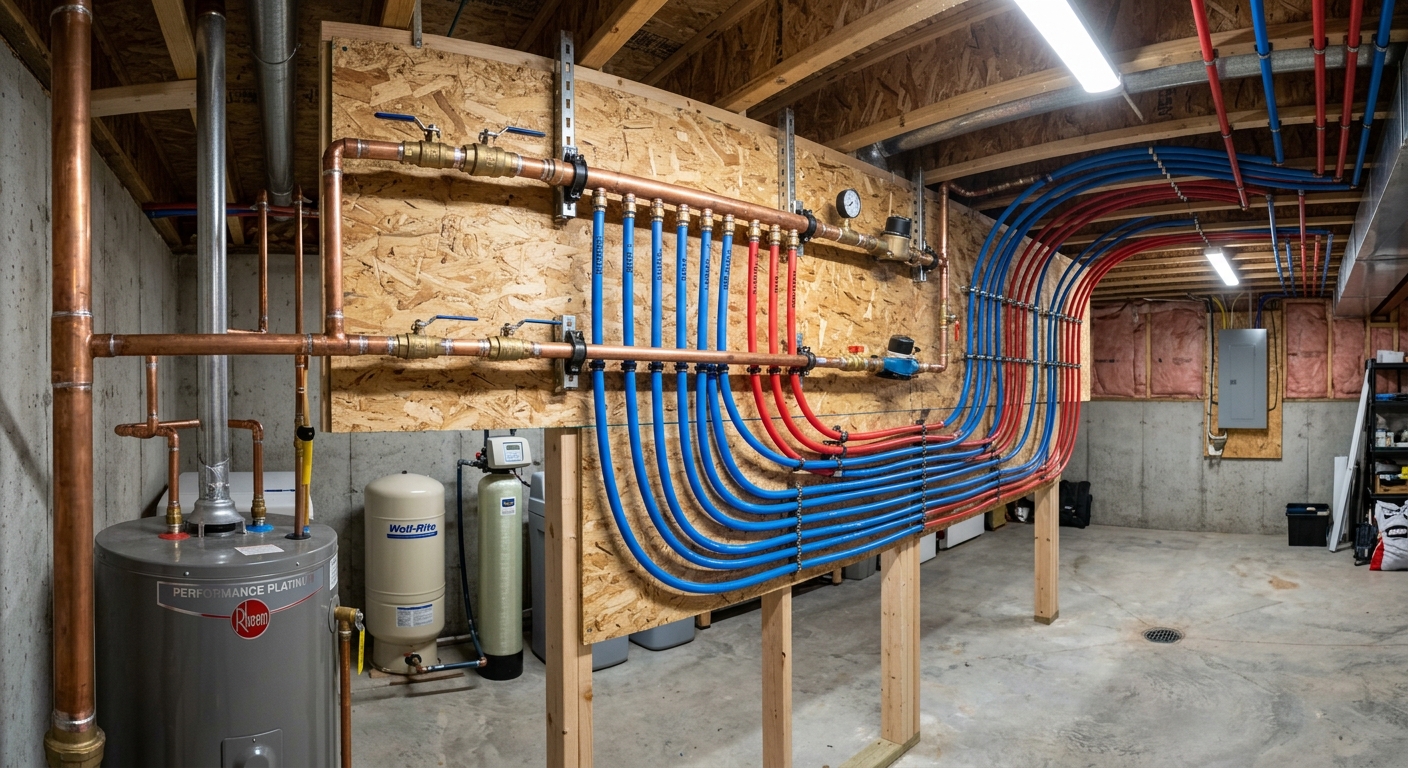
PEX, flexible plastic in red, blue or white, is current standard. It resists corrosion but can degrade under UV light at fittings—expect 40–50 years. For drains, cast iron (pre-1975) is heavy, dark, and may be joined with lead or rubber couplings. These crack or corrode out at 50–75 years. Economy homes may also have clay tile sewer pipes—look for orangey-brown ceramic pipe, especially at clean-outs. Clay pipe joints are magnets for tree roots, usually failing at 50–60 years.
| Material |
Typical era |
Failure mode |
Service life |
| Galvanized steel supply |
pre-1960 |
internal corrosion, pressure loss |
40–60 yrs |
| Copper supply |
1950s–present |
pinhole leaks, joint failure |
50–70 yrs |
| Polybutylene supply |
late 1970s–1995 |
fitting failure, sudden bursts |
unreliable |
| PEX supply |
2000s–present |
fitting or UV degradation |
40–50 yrs |
| Cast iron drain |
pre-1975 |
corrosion, cracking, scale |
50–75 yrs |
| Clay tile sewer lateral |
pre-1980 |
root intrusion at joints, offset |
50–60 yrs |
| PVC / ABS drain |
1970s–present |
joint separation, crushing |
50+ yrs |
Water quality and what it does to your pipes
Most homes in Economy get water from Beaver Falls Municipal Authority, which serves multiple Beaver County municipalities. Public systems like this are required to issue an annual water quality report (Consumer Confidence Report); you can request a copy directly from the provider if you don’t see one in your bill.
Hard water is common in southwestern Pennsylvania—minerals in the water will build scale inside water heaters and faucets, shortening their life and lowering flow. If you notice white build-up on fixtures, that's scale from minerals settling out of the water. These deposits can force water heater replacements closer to the $1,250–$2,900 window. On the other hand, if your water is too soft or mildly acidic, it can eat away at copper pipes over decades, causing pinhole leaks and the need for section replacements or a whole-house repipe.
Softeners can help, but in Economy’s price and utility context, a softener doesn’t always pay back unless your appliances are suffering or your water is extremely hard—watch for rapid build-up. Don’t buy a whole-house system for taste, odor, or hardness unless you’ve tested and truly need one. Point-of-use filters (like at a kitchen sink) are cheaper and often more practical. Always grab the water report before making any investment.
Homes on private wells, more common in northern Beaver County’s rural townships, need to handle testing on their own—no public report means there’s no shortcut for annual or biennial water quality checks by a certified lab.
Verifying a Economy plumber's credentials
Plumbing licensing in Pennsylvania is local, not statewide. While some might assume there is a state plumbing board, the real authority is the local municipality. That means a plumber who is perfectly licensed in one Beaver County town may have no credential at all in the next. For Economy homeowners, don’t just ask “are you licensed?”—always press for “are you licensed here?”
Each municipality in Beaver County—including Economy—runs its own permitting office. In some places, like Aliquippa, any new or replacement water or sewer service line connection requires a plumbing permit and inspection. Beaver Falls is slightly different: if you’re just swapping an interior fixture for a like-for-like replacement, you usually don’t need a city permit.
No matter where you are in Beaver County, you should verify a plumber’s Home Improvement Contractor (HIC) registration for jobs over $500; check at hic.attorneygeneral.gov. For any company sending a crew onto your property, you can verify their workers’ compensation coverage using WCAIS (wcais.pa.gov). Pennsylvania also requires a written contract for home improvement work over $500, and homeowners have a three business-day right to cancel that contract as part of consumer protections.
How to find a good plumber in Economy
Start your search by checking that the plumber is Home Improvement Contractor (HIC) registered for contracts over $500—look them up at hic.attorneygeneral.gov. But licensing is municipal in Pennsylvania, so you’ll also want to confirm the company is properly authorized specifically in Economy. Ask directly: are you licensed to pull plumbing permits here?
Always request a certificate of insurance that names your address. Then check that the company carries proper workers' compensation coverage through the WCAIS system (wcais.pa.gov). Find out if the company uses its own, background-checked crew, or subs work out to a patchwork of third parties. Emergency dispatch rates should always be clear up front—ideally in writing.
- Verify HIC registration at hic.attorneygeneral.gov
- Confirm municipal licensure in Economy for plumbing
- Request certificate of insurance naming your property
- Check workers' comp status via WCAIS
- Ask if all on-site crew are company employees
- Get emergency, night, and weekend pricing in writing
- Ask for references on similar Economy projects
- Look for experience with postwar, slab-on-grade homes
- Require camera footage for any sewer repair quote
- Require a pressure test before agreeing to a repipe
- Review contract terms and cancellation rights
In Beaver County’s moderate suburban market, beware any pushy sales for expensive replacements. The biggest warning sign? A company pushing a whole-house repipe or sewer dig with no camera footage, no pressure test, and no clear, written diagnosis.
When to call now and when to wait until Monday
If you’re staring at water shooting from a pipe under the sink at 11 p.m., the premium for an emergency callout in Economy is absolutely real. You pay for after-hours dispatch, the higher hourly rate for overtime labor, and a fast-moving diagnosis done under pressure, often with partial restoration (not full finish work) the same night. The price fork is clear: an emergency burst pipe repair might cost $600–$1,250 tonight, while the same job scheduled could fall to $350–$1,250.
So what is a true plumbing emergency in Economy? Here’s a triage list. Call now (even if it’s the weekend) for:
- Active flooding (pipe or fitting burst pouring out water)
- No water service at all
- Sewage backing up in floor drains, tubs, or toilets
- Gas smell near a water heater or appliance—leave the house and call emergency services
Issues that can usually wait:
- A slow drip from a fixture or a pipe joint you can catch in a bucket
- One slow or clogged drain with others working fine
- A single running toilet
- Low hot water—but not a flood or gas issue
If you’re in doubt, shut off the water at the main shutoff—usually located where the service line enters the basement or crawlspace—or at the fixture valve under the sink or toilet. Knowing how to do this converts many weekend emergencies into plain old service calls that can wait for a regular rate.
Camera inspection, relining and replacement
For Economy homeowners, here’s a key ownership fact: in most Beaver County municipalities, you, not the water company, own the sewer lateral all the way from your house to the street main. That means you’re responsible for leaks, roots, collapses and repairs—including any dig into your yard (or under a driveway).
Symptoms of potential lateral trouble, in increasing order of urgency: one slow drain (localized clog), multiple slow drains or toilets gurgling (possible main blockage), and backup in lowest-level fixtures (main line or lateral—serious). Before anyone quotes you a trench or relining job, insist on a camera inspection. This is the only way to pinpoint root intrusion (typical in clay tile pipes, common before 1980 in Beaver County), show bellies or offsets, or verify a collapse. Any sewer repair—especially costing $2,100–$12,500—expects a video, and if you don’t get it, walk away.
Options for busted laterals? Spot dig and repair if you have a clear, localized issue. If roots permeate every joint or the line has collapsed in multiple places, open-cut replacement or trenchless relining may be better on a postwar property with mature trees and tight access.
Outside core towns with combined sewers, many Beaver County homes rely on septic. Here, main worries are overdue tank pumping (every 3–5 years), saturated drainfields, and line blockages—an entirely different repair than a street lateral and not handled by the same utility.
Frequently asked questions — plumbing in Economy
What do I do about a burst pipe right now?
If a pipe suddenly bursts in your Economy home, your first move is to stop the water. Find your main shutoff—often in the basement or wherever the water line enters the house—and turn it clockwise to close. This will stop further flooding and prevent more damage. Next, call a plumber and be clear that you’ve turned the water off, since this often moves the problem from an emergency to a next-available scheduled call, possibly saving you money. Emergency repairs in Economy usually cost between $600–$1,250 if you call after hours, but shutting off the main and waiting for a scheduled visit can save you a few hundred dollars. Document any damage for your insurance and mop up as best you can until help arrives.
Is trenchless sewer repair reliable?
In Economy, trenchless sewer methods like pipe relining and pipe bursting are increasingly common, especially with mature landscaping or tight driveways in postwar homes. When done properly, a trenchless repair can last as long as open-cut replacement—many manufacturers warrant liners for over 40 years. Costs average $2,100–$12,500 depending on length and depth. The key is having a video inspection to confirm that your existing line is a good candidate—solid clay tile or cast iron with isolated cracks or joint offsets does well, but a fully collapsed or misaligned line may still require excavation. Pick a plumber with successful trenchless jobs in similar Economy homes, and always get the video before you approve any repair.
How do I tell what my pipes are made of?
The easiest way for an Economy homeowner to identify supply pipe is to look for an exposed section in the basement or under a sink. Galvanized steel is silver-gray and magnetic; scratch it and you’ll see a metallic color. Copper is reddish-brown and non-magnetic, with soldered brass-colored joints. PEX is flexible, smooth red/blue/white plastic with crimped brass or plastic fittings. Cast iron drains are heavy, dark, and may have leaded joints. If your home was built during Beaver County’s 1945–1970 boom, expect galvanized steel or copper supply lines and possibly cast iron or clay drains. Knowing your material helps budget for repairs—a whole-house repipe in Economy runs $3,600–$8,800.
Who inspects plumbing work in Economy?
In Economy, plumbing inspections are governed by local municipal officials—not by a statewide plumbing board. If your job requires a permit, the municipality’s own permitting office will inspect the work and sign off for code compliance. For jobs like new or replacement water/sewer service line connections, expect an inspection. Always verify that your plumber is authorized in Economy specifically, and keep in mind that a Home Improvement Contractor registration is not a plumbing license. Permit and inspection fees are usually wrapped into the overall project cost—typical emergency repair rates in Economy range from $600–$1,250.
How deep do water lines need to be buried in Economy?
In southwestern Pennsylvania (which Economy is part of), frost depth is 36 inches per code, so water service lines must be buried at least that deep to prevent freezing. Local code mandates stem from the Pennsylvania Uniform Construction Code, based on the IRC. If you need a new water line—say, to replace galvanized or lead—excavation below this depth is necessary, which partly explains the cost: a water service line replacement in Economy falls between $5,700–$12,500. Don’t let anyone quote you a shallow line, even for a short run, as it puts you at high risk for winter freeze-ups.
Why do plumbers charge a diagnostic fee?
In Economy, a diagnostic fee is charged to cover time, travel, and expertise involved in locating and identifying the cause of a plumbing problem. Most plumbing systems in town—including many with slab-on-grade foundations and finished basements—are not straightforward to inspect. A plumber might need to remove access panels or run a camera into a line, which justifies the fee. In emergency settings, this forms part of the higher callout price (for example, $600–$1,250 for a burst pipe repair). Always ask if the fee will be credited toward your repair if you approve the job, and make sure the scope is clear in advance.
How much does a water heater replacement cost in Economy?
For a standard gas 40–50 gallon water heater replacement in Economy, the total cost—including removal, install, testing, and haul-away—generally falls between $1,250–$2,900. Emergency replacements on weekends or holidays skew toward the upper end ($1,950–$2,900), while most planned replacements can be done near the middle of the range. The condition of your supply lines, access to the equipment, and the age of surrounding plumbing (especially galvanized connections) all influence price. Always get a complete, itemized quote and check if permits and inspections are included.
Who pays to replace a lead service line in Economy?
In Beaver County, including Economy, homeowners usually own the water service line from the house to the street, and are responsible for its replacement—including if it’s an old lead line. Some municipalities (like Aliquippa) offer replacement programs, but in most cases the homeowner absorbs the cost, which typically ranges between $5,700–$12,500. It’s worth checking with the Beaver Falls Municipal Authority to find out if any assistance or incentives exist—public programs may periodically help defray part of the bill, but don’t expect it as the norm.
Which utility supplies water to Economy?
Most homes in Economy are served by the Beaver Falls Municipal Authority, which also covers several surrounding communities in Beaver County. If you receive a bill from them, you’re on municipal water and can request their annual water quality report to check for issues like hardness, chlorine, or lead content. Infrastructure repairs to the water main are the utility’s job, but the service line from the curb to your Economy home is yours to maintain or replace. If you ever need a full line replacement, expect to pay between $5,700–$12,500.