Plumbing costs in Allegheny — 2026
In Allegheny, part of Blair County’s moderate secondary market, plumbing costs hinge on the age of your home and whether you’re facing an emergency. With a population of 6,600 and over half of residences built before 1980 (U.S. Census Bureau, ACS 2024), many homes in Altoona and surrounding townships still have original galvanized piping. This construction-era detail shapes what fails, how urgently, and what you’ll pay.
The same repair—say, fixing a burst pipe—will run two very different prices depending on whether a plumber has to respond after hours or in the middle of a snowstorm. Emergency rates factor in travel distances (common in rural Blair County), after-hours labor, and the urgency of repair. Scheduled jobs, on the other hand, are less costly and easier to budget for.
Allegheny’s high share of homes built from 1900–1950 means aging pipes, outdated water heaters, and higher odds of water line and sewer failures. Original materials are now well past their service life in most homes, so issues like poor pressure, leaks, and severe clogs are routine calls. Unsurprisingly, the most expensive jobs—like a full main line sewer repair or water service replacement—track directly with difficult access or having to dig through decades-old yards and sidewalks.
| Service |
Scope |
Emergency rate |
Standard rate |
| Emergency repair — burst pipe |
locate, open, repair section, restore service |
$550–$1,100 |
$325–$1,100 |
| Water heater replacement (gas, 40–50 gal) |
remove old, install, test, haul away |
$1,700–$2,500 |
$1,100–$2,500 |
| Drain cleaning — main line |
augering or hydro-jet, camera if needed |
$350–$800 |
$200–$500 |
| Sewer line spot repair |
excavate or reline a failed section |
$1,800–$11,000 |
$1,800–$11,000 |
| Whole-house repipe |
replace supply lines throughout, patch and finish |
— |
$3,100–$7,600 |
| Water service line replacement |
street to house, excavation and restoration |
— |
$4,900–$11,000 |
Estimates for a typical Allegheny home. Access difficulty and pipe material move these figures more than anything else.
Frozen pipes in Allegheny: prevention and thaw
Allegheny’s winters are harsh, with a frost depth requirement of 36 inches and winter design temps regularly dropping to 2 °F. Combine these conditions with the highest snow loads in Pennsylvania and you have a recipe for frozen pipes each season, especially in homes from the 1900–1950 housing wave.
Most pipe bursts don’t happen at the spot where the ice forms. Instead, as water freezes and creates a blockage, pressure builds between the ice plug and a closed valve—like a faucet—that’s downstream. Eventually, the pipe splits where it can’t handle that pressure. Vulnerable spots in Allegheny homes include supply pipes in exterior walls, unheated crawlspaces, attached garages without adequate insulation, hose bibs, and occasionally unconditioned attics—even in older two-story houses.
Prevention is far cheaper than a call to fix a burst—especially when repair can run $550–$1,100 during an emergency:
- Insulate all exposed supply pipes in unheated spaces.
- Apply heat tape where insulation alone won’t do.
- During extreme cold snaps, let a trickle run from faucets on exterior walls.
- Open cabinet doors under sinks to let warmer air circulate around pipes.
- Shut off and drain outdoor spigots before the first hard freeze.
If a pipe does freeze, thaw it using a hair dryer or a space heater—but never use an open flame or torch, which is not only a fire hazard but also banned by all modern building codes. If you can’t locate the frozen area or see bulging, call a pro before water starts pouring in your basement.
Emergency rates versus scheduled work in Allegheny
The difference between emergency and standard plumbing rates in Allegheny is black-and-white. For a burst pipe, you’re looking at a bill from $550–$1,100 on emergency terms compared to $325–$1,100 if you can wait for regular hours. That extra cost covers more than just labor. Emergency jobs in Blair County almost always mean dispatching a plumber after hours or even through snow, with an added trip charge, overtime rates, and the pressure to diagnose and fix on the spot—no chance to line up parts or schedule another trade if flooring or drywall needs to come up.
Here’s the triage:
- True emergencies: Active flooding (water pouring from a ceiling or wall), no water at all (main shutoff defect or burst supply), sewage backing up inside, and any gas smell—these absolutely require a same-day response.
- Can wait: Slow drips, a single slow drain, a toilet that won’t stop running, or a problem that’s contained with a bucket overnight. In these cases, waiting for business hours can save you hundreds.
Every Allegheny homeowner should know how to shut off water at the main (usually a single wheel or lever near where the line enters your basement, often in a pit or near the heater) and at individual fixture stops under each sink or toilet. That knowledge alone can turn an emergency—charging an emergency trip rate—into an ordinary job you can schedule for the next working day.
What construction era means for your pipes
In Allegheny, more than half the homes were built before 1980, and that era is everything when it comes to plumbing. Houses built in the 1900–1950 wave typically have galvanized steel supply lines—these rust internally, eventually closing up and causing low pressure at every tap. Sewer laterals from this era are often clay tile, which are prone to intrusion by roots and breakage by ground movement. Service lines to the street in older homes could be lead, galvanized, or early copper, each carrying its own issues. If your water heater is original to the house, you’re likely on a third or even fourth replacement by now.
Houses built closer to 1970–1980s may have copper supply lines and cast iron or PVC drains. Newer homes on the edge of town often used builder-grade fixtures, and some may have polybutylene pipe if they were built in the brief window before it fell out of use. In those suburbs, the issues shift to the first replacement cycle for water heaters and the slow wear-out of plastic drains and valves—not catastrophic failure, but growing pains as the house matures.
Most problems—leaks, pressure loss, sewer backups—map back to what’s inside the walls, which is dictated by construction era. That’s why knowing your house’s age and history is essential before approving any major plumbing job.
When to repipe a Allegheny home
If you have two or more leaks in the same line within three years, on the same original pipe material, it’s time to stop patching. That’s not “unlucky”—it’s the end of life for that system. Common signals are falling pressure across the whole house instead of just one fixture, rusty or brown water on first draw, visible corrosion at union or elbow joints, or repeated pinhole leaks that recur despite repairs.
Most original Altoona homes from the 1900–1950 boom (over half the current stock) still have galvanized lines inside, and these are overdue for full replacement. Partial repipes—just the worst run—make sense in newer homes or where most of the plumbing has modernized, but in a house with widespread original pipe, going piecemeal becomes more expensive over a few years.
PEX is now standard for repipes thanks to lower cost, quicker install, and freeze resistance, but some owners prefer copper for resale or allergy reasons. Remember, repipe costs in Allegheny always include not just materials and labor, but the sometimes considerable expense of drywall or plaster patching and repainting afterward. In houses with thick plaster walls and lath, this finish work can cost as much as the plumbing itself.
| Situation |
Recommendation |
Cost |
Reasoning |
| One leak, accessible, modern pipe |
Spot repair |
$325–$1,100 |
Cheapest, no pattern of failure, minimal disturbance |
| Two or more leaks in 3 years |
Partial repipe |
$3,100–$5,100 |
Failing material, economics favor repiping over patching |
| Galvanized supply, pressure loss |
Full repipe |
$3,100–$7,600 |
Galvanized pipes are at end of service life |
| Polybutylene anywhere in the house |
Full repipe |
$3,100–$7,600 |
Prone to sudden failure; insurance may require replacement |
| Cast iron drain with root intrusion |
Camera, then reline or replace |
$1,800–$11,000 |
Root intrusion signals failure in drain material, spot repairs may not hold |
| Suspected lead service line |
Test, then replace the lateral |
$4,900–$11,000 |
Health mandate, long-term solution |
Licensing and permits for plumbing work in Allegheny
Pennsylvania does not issue a statewide plumbing license. Instead, plumbing is licensed municipally. In Blair County, for example, the City of Altoona requires its own contractor license for commercial plumbing work—and a plumber licensed elsewhere may have no credential in Altoona or another township. For a homeowner in Allegheny, the real question is whether your contractor carries the proper local license for your town or borough, not just for the state, and whether they’ll pull the correct permit if required.
For residential work in Altoona and nearby municipalities, permits are generally only required for significant installations or alterations—like a water heater replacement that involves changing pipework—while simple fixture swaps can be done without a separate plumbing permit. The City of Altoona Codes & Inspections Office enforces these rules and will inspect any work that falls under their jurisdiction.
Homeowners should verify HIC registration for contracts over $500 using the Pennsylvania Office of Attorney General’s online tool. Always check that the contractor carries up-to-date workers’ compensation insurance, which you can confirm through WCAIS. For pre-1978 homes, ensure the plumber follows EPA Lead RRP requirements if any walls or pipes with lead paint will be disturbed.
Choosing a water heater in Allegheny
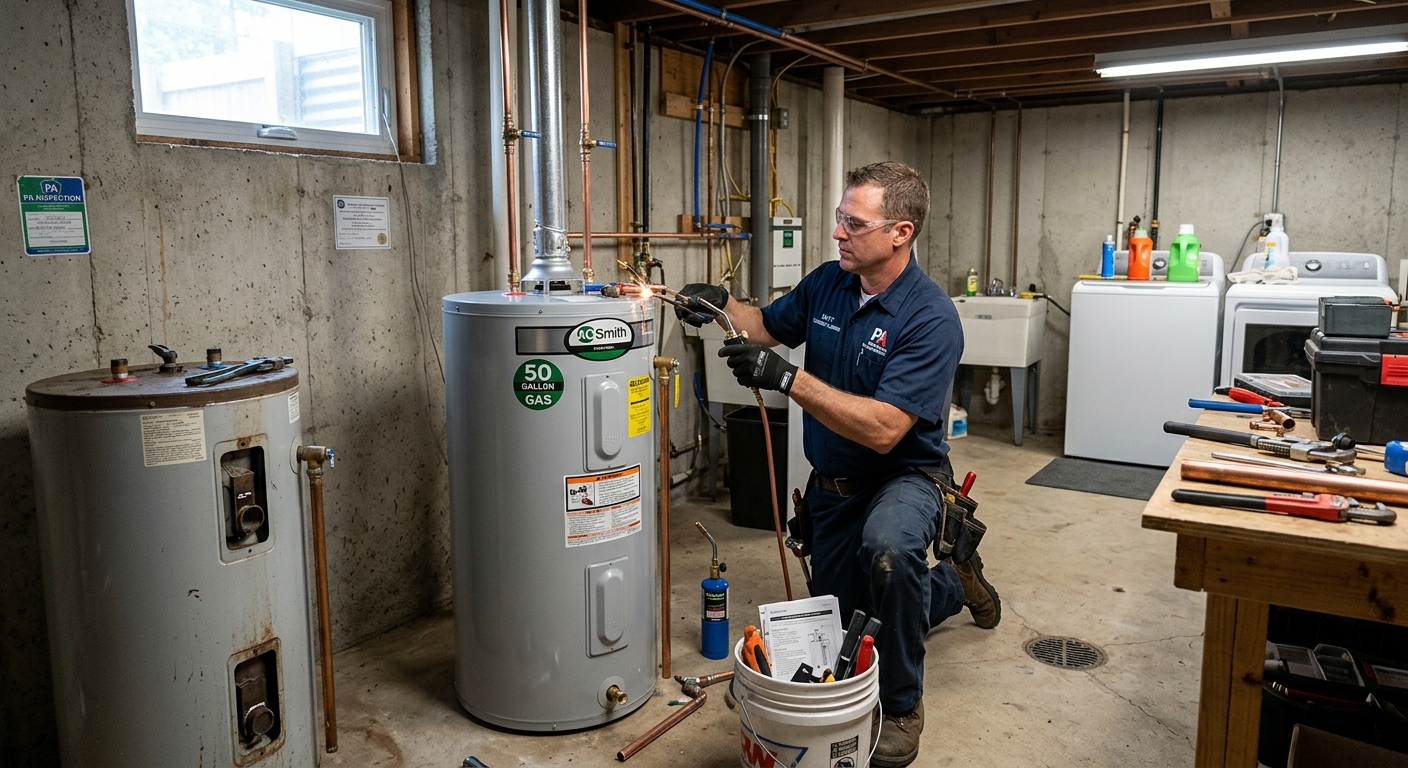
When replacing a water heater in Allegheny, your options are gas tank, electric tank, gas tankless, or heat pump. Each has trade-offs that matter in older homes or unheated basements common in Blair County.
A gas tank heater is the most common and usually the cheapest to install, though its lifespan is shorter (8–12 years) and you’ll pay for standby losses—heat wasted when hot water sits unused. Electric tank heaters are slightly longer lasting but cost more to run in Pennsylvania’s higher electric rate environment. Tankless gas models deliver endless hot water, but installation almost always needs bigger gas pipes and a new vent, which can unexpectedly add several hundred dollars. They last nearly twice as long as tanks but often only make financial sense in homes with multiple showers or large families.
Heat pump water heaters now see more installs where there’s enough space and a warm location (they draw air heat, so they lower the temperature in the installation room and can be loud if placed near living areas). They have the lowest running cost, but putting one in a cold, damp Allegheny basement is a poor match unless the room is heated year-round.
No matter the heater, size for your household’s first-hour hot water demand, not just tank volume. Modern jobs require an expansion tank, drip pan, and a drain if you’re installing over finished space. Most failures are tank leaks, not failed controls, making regular inspection of the base and connections worthwhile to catch leaks early before they flood your basement or utility room.
| Type |
Installed cost |
Service life |
Operating cost |
Best when |
| Gas tank, 40–50 gal |
$1,100–$2,500 |
8–12 yrs |
moderate |
Gas available, typical family, moderate usage |
| Electric tank, 40–50 gal |
$1,100–$1,700 |
10–15 yrs |
high |
No gas service; small homes with light usage |
| Gas tankless |
$1,700–$2,500 |
18–25 yrs |
low-moderate |
Big family; high demand; willing to upgrade gas line |
| Heat pump water heater |
$1,700–$2,500 |
13–15 yrs |
lowest |
Large, warm space; high electric rates; no gas |
Frequently asked questions — plumbing in Allegheny
Repair or replace a leaking water heater?
If your water heater in Allegheny is leaking from the tank itself—especially after 8–12 years for a gas tank model—replacement is almost always the right call. Fixing a failed tank is almost never practical, and patch jobs don’t hold under daily expansion and contraction. However, if the leak comes from a supply connection or valve—or if your heater is less than 5 years old and otherwise runs fine—a repair could make sense, often for less than $325–$1,100. Given the age and mineral content of Altoona water, most tanks here don’t last past their expected service life. Be aware that newer heaters are more efficient, and catching a replacement early can avoid basement water damage.
Why do all my drains drain slowly at once?
If every drain in your Allegheny home is slow, the most common cause is a blockage in the main sewer line, not a single fixture trap. Blair County’s housing stock—especially the homes built through 1980—often relies on old cast iron, clay tile, or early plastic, all of which are susceptible to scale buildup, low points, and especially tree root intrusion. Main line drain cleaning runs $200–$500 during business hours and usually includes a camera inspection. Don’t use chemical drain products, as they tend to cause more harm in old pipes and are rarely effective on a full-house clog. Call a professional with augering or hydro-jetting equipment.
Do I need a permit for plumbing work in Allegheny?
In Allegheny (Blair County), permits for plumbing depend on the scope of work. Minor fixture swaps on existing lines can be done without a separate plumbing permit in Altoona and most local municipalities, but replacing anything that alters the system—like a water heater with pipe changes or a full repipe—needs a permit and inspection. For commercial work, Altoona has its own contractor licensing. Always ensure your contractor is HIC registered for jobs over $500, has current workers’ comp (verifiable through WCAIS), and obtains the correct municipal permit before starting. This protects you legally and ensures the job passes inspection.
How deep do water lines need to be buried in Allegheny?
Water lines in Allegheny and throughout Blair County need to be buried at least 36 inches deep. That’s the frost depth, meant to keep pipes below the level where soil freezes in a typical winter with temperatures down to 2 °F. Shallower lines are much more likely to freeze and burst, which leads to expensive emergency repairs in the $550–$1,100 range if not deeper. Always ask your plumber to follow local code and verify depth if you’re replacing or repairing your service line.
What do I do about a burst pipe right now?
If a pipe bursts in your Allegheny home, immediately turn off the main water valve—usually located where your water line enters the basement or utility area. Then open the lowest faucet in your house (often a basement laundry tub) to drain remaining water and reduce pressure. Only after water is off should you call a plumber for an emergency repair, which will cost between $550–$1,100 if it can’t wait for regular business hours. If the break is near electrical lines or panels, do not enter standing water. Shut off the main breaker and stay safe until the area is dry. Prevention with pipe insulation costs a fraction of an emergency trip.
How much does sewer line repair cost in Allegheny?
Spot repairs to a damaged or root-blocked sewer line in Allegheny usually cost from $1,800–$11,000, depending on depth, location, and whether the fix is excavation or trenchless lining. The wide cost range reflects how much work it takes to access old pipes, especially in yards or under driveways. Most jobs start with a camera inspection (often included in main line cleaning), and full replacements can run even higher if the line is collapsed or beyond relining. If you suspect a main break—like sewage backing up indoors—address it quickly to prevent further property damage.
Are tree roots a common sewer problem in Allegheny?
Yes, tree root intrusion is a routine issue in Allegheny homes, especially in the neighborhoods and townships with clay tile or cast iron sewer laterals from the 1900–1950 construction boom. Roots seek out small gaps and can completely block a main line, causing slow drains or backups. Clearing roots with professional hydro-jetting or augering runs $200–$500, but severe cases may need a spot repair or relining, which can climb to $1,800–$11,000. Consider preventative annual cleanout if you live near mature trees and your house is pre-1980.
Who pays to replace a lead service line in Allegheny?
In Allegheny, as elsewhere in Blair County, the cost to replace a lead service line from the home to the street almost always falls to the homeowner. The Altoona Water Authority has an active inventory program, but full countywide replacement is not yet complete, so older homes may still have lead. Replacement costs typically run $4,900–$11,000. Grants and financing may sometimes be available, but don’t count on coverage unless a specific replacement initiative is announced. Testing and confirming the line material is always the first step—especially in houses built before 1950.
How much does a plumber cost in Allegheny?
For standard service calls during business hours, you’ll pay between $325–$1,100 for common repairs like a burst pipe, or $200–$500 for main drain cleaning. Emergency repairs—nights, weekends, or when water is actively flooding—cost more due to overtime and travel, pushing jobs into the $550–$1,100 range for labor alone. Larger jobs like water heater replacement or a partial repipe fall between $1,100–$5,100. Always ask for written estimates, and check the contractor’s HIC registration and workers’ comp, which all legitimate Blair County plumbers must supply on request.