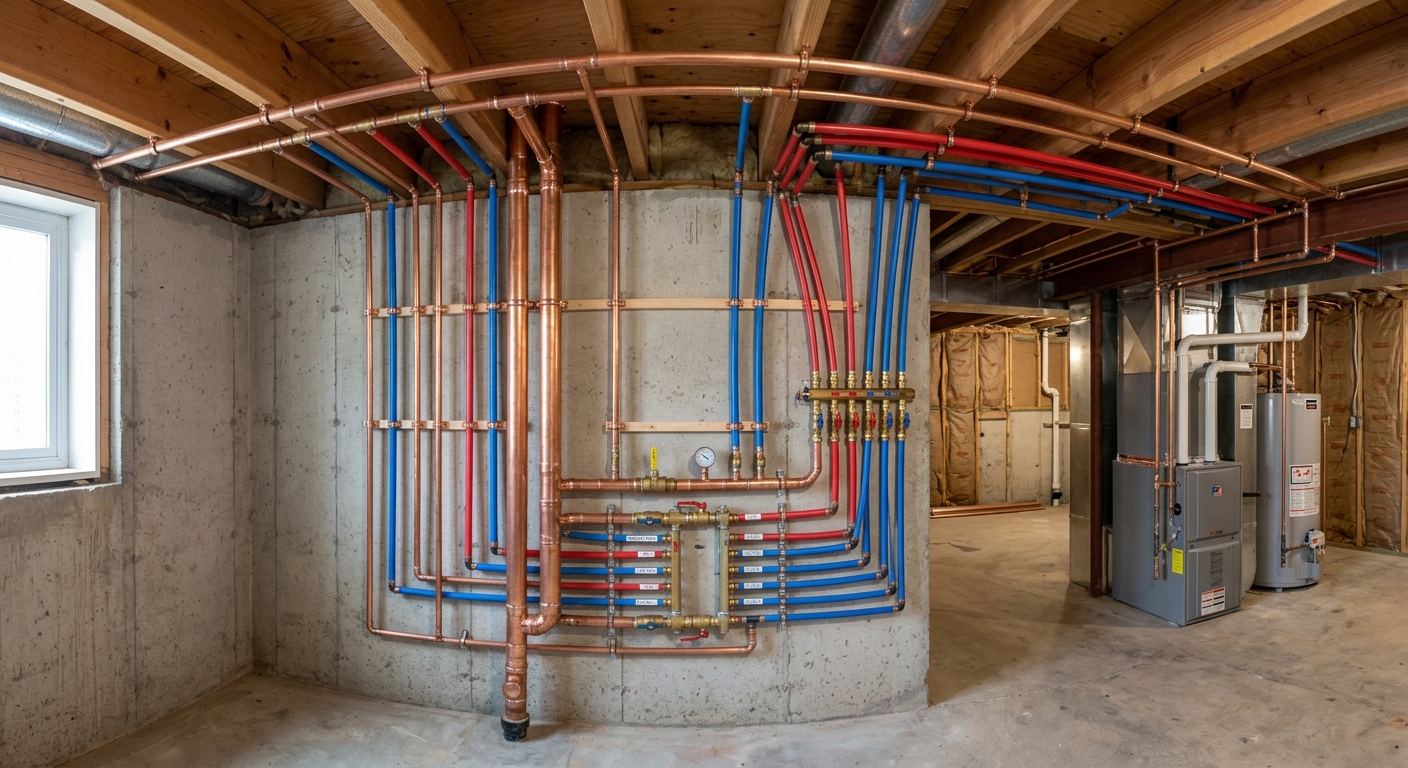
Washington plumbing prices by job type — 2026
In Washington, Lehigh County, plumbing costs swing by hundreds—or even thousands—depending on whether you’re in an emergency or calling for planned work. Home repairs here often come down to the era of your house: over half of homes in Washington were built before 1980 (U.S. Census Bureau, ACS 2024), and most are single-family (82.6%). This means you’ll see a lot of post‑1950 suburban tract housing, especially in South Whitehall and Upper Macungie, where copper-to-PEX repipes and fixture upgrades are routine. The kind of pipe running through your walls—copper, galvanized, PEX—will decide both what goes wrong (think pinhole leaks or corroded joints) and what fixing it costs.
The same job can bear two very different price tags, driven mainly by whether it’s an emergency call. Plumbers in Lehigh County, and especially the packed Allentown–Bethlehem–Easton market, price urgent responses higher to cover overtime, after-hours dispatch, and immediate parts runs. If you can wait for a normal slot, you’ll pay less—sometimes much less.
| Service |
Scope |
Emergency rate |
Standard rate |
| Emergency repair — burst pipe |
locate, open, repair section, restore service |
$600–$1,250 |
$350–$1,250 |
| Water heater replacement (gas, 40–50 gal) |
remove old, install, test, haul away |
$1,950–$2,900 |
$1,250–$2,900 |
| Drain cleaning — main line |
augering or hydro-jet, camera if needed |
$350–$800 |
$200–$500 |
| Sewer line spot repair |
excavate or reline a failed section |
$2,100–$12,500 |
$2,100–$12,500 |
| Whole-house repipe |
replace supply lines throughout, patch and finish |
$3,900–$9,500 |
$3,600–$8,700 |
| Water service line replacement |
street to house, excavation and restoration |
$6,900–$12,500 |
$5,700–$12,500 |
Estimates for a typical Washington home. Access difficulty and pipe material move these figures more than anything else.
Licensing and permits for plumbing work in Washington
Plumbing work in Washington—like all of Lehigh County—falls under the Pennsylvania Uniform Construction Code (UCC), but there is no statewide plumbing license. Instead, trade licensing is handled municipally. In Allentown, the City of Allentown Building Office manages plumbing trade licenses and countywide permitting. That matters: a plumber licensed in Allentown might not be recognized in Whitehall Township or any other municipality. Always confirm they hold the right trade license for your specific town—the question isn’t “Are you licensed?” but “Are you licensed here?”
Permits are typically required for plumbing alterations, including water heater replacements. In Lehigh County, most municipalities follow the UCC and almost always require a building permit for significant changes, while very minor like-for-like fixture repairs inside your home can usually be done without one. Inspections are performed by your municipality’s code office or a third-party UCC office.
For protection, check that your contractor is registered under Pennsylvania’s Home Improvement Contractor (HIC) system—mandatory for contracts over $500, and you can verify at hic.attorneygeneral.gov. All employers must provide workers' compensation; you can confirm coverage using WCAIS at wcais.pa.gov. If your home was built before 1978, work disturbing paint falls under the federal EPA Lead RRP Rule—look up certified renovators at certifiedrenovatorsearch.epa.gov.
For Washington homeowners, always verify licensing, registration, and insurance before signing a contract. Every municipality can enforce the rules differently, so don’t leave it to chance.
The leak you can hear but can't see
If you suspect a hidden leak in your Washington home, start by shutting off every faucet, toilet, and water-using appliance. Then check your water meter—if the small triangle or dial keeps moving, you’ve got a supply-side leak somewhere. This simple test costs nothing and narrows the problem dramatically.
Professional leak detection covers several methods. Acoustic listening uses ultra-sensitive microphones to hear water escaping behind walls or under slabs—expect to pay $350–$800 if bundled with emergency service. Thermal imaging picks up cold spots where water runs behind finished surfaces, while tracer gas (injecting a safe, detectable gas into the line) is reserved for the trickiest cases—these approaches can quickly pinpoint leaks that are invisible but still doing damage.
Slab leaks—where a line runs under a finished concrete floor—are serious but not rare in postwar homes here. Wall cavity leaks usually turn up as a faint musty smell or bubbling paint, and irrigation or exterior line leaks may only show as soft ground. In every case, a good plumber isolates and locates before cutting or opening any surface. If someone reaches for a demo saw on the first visit, you’re paying them to guess.
Local pros in Washington use combinations of these tools to target the source with minimal disturbance and can usually turn the job from “major headache” to “fixed in one visit” if you catch it early.
Is your water line lead? How to find out
Washington, served by the Lehigh County Authority under the City of Allentown concession, is among the areas where an active lead service line inventory and replacement program is underway. That matters, because your water service line can be part lead (and part copper or plastic) in older homes—particularly those built before 1980. The water line split matters: the utility-owned portion usually runs from the street to your property line, while the homeowner’s “lateral” goes from the curb into your house. Utility replacement programs, if offered, often cover only the utility’s half.
To find out what material you have, check where your water line enters the house, typically in the basement. Use a key or coin to scratch the pipe: lead is dull silver and soft, while copper is reddish, and plastic is white or blue/black. A magnet will not stick to lead or copper, but will stick to galvanized steel. This scratch-and-magnet test is reliable for the section you can see, but hidden portions may still differ.
Allentown’s Lehigh County Authority does not publish a detailed count of lead lines per home—you need to contact them directly to see if they’ve identified your service or to ask about replacement cost-sharing. The price to fully replace both portions (street to house) is typically $5,700–$12,500. Partial replacements can temporarily increase lead in your water because disturbed scale exposes new leaded surfaces—another reason full replacement is safest when possible.
Bottom line: don’t assume; ask the utility about your address. If you’re responsible for your section, get a written quote so you’re comparing the $5,700–$12,500 homeowner portion—not what the city may cover.
How to find a good plumber in Washington
Washington sits in a dense, highly competitive plumbing market—so as a homeowner, you have leverage. Start by verifying your plumber’s credentials. For jobs over $500, plumbers must register as Home Improvement Contractors (HIC) with the Pennsylvania Office of Attorney General; check their registration at hic.attorneygeneral.gov. But licensing here is municipal—meaning the plumber must also hold a valid trade license with the City of Allentown Building Office (if working in Allentown) or whatever municipality governs your address. Always ask, “Are you licensed to work in my township?”
Require a current insurance certificate naming your property. Pennsylvania mandates workers’ compensation for all employers; verify coverage at wcais.pa.gov. For homes built before 1978, make sure your plumber is certified under the EPA Lead RRP Rule (certifiedrenovatorsearch.epa.gov).
Ask if the company uses its own employees or subs out the work. Confirm emergency pricing and dispatch fees in advance—Washington’s saturated market (Allentown–Bethlehem–Easton) means plenty of honest competition, but also the odd operator who cuts corners. Be wary if you’re quoted a full repipe or sewer replacement without any camera footage or pressure test as proof.
- Verify HIC registration at hic.attorneygeneral.gov
- Confirm local trade license in your specific municipality
- Check workers’ compensation coverage at wcais.pa.gov
- Get a written insurance certificate naming your address
- Confirm EPA Lead RRP certification for pre-1978 homes
- Ask if labor is in-house or subcontracted
- Insist on emergency pricing disclosures before dispatch
- Request camera footage or pressure test for buried lines
- Ask for a detailed written scope, not just a quote total
- Get warranty details spelled out—in writing
- Check online reviews in Washington and Lehigh County, not just region-wide
- Ask for permit copies on permit-triggering jobs
Red flags: high-pressure sales, full-system jobs with no inspection proof, vague or missing paperwork, or any bid that undercuts the local norm ($3,600–$8,700 for a repipe) by half. If they won’t provide documentation, move on.
What a plumbing quote should contain
Plumbing quotes in Washington use either a flat rate or time-and-materials model. Flat rate quotes give you a fixed cost—good for bigger or defined jobs. You pay a premium to shift the risk to the contractor. Time-and-materials (T&M) rates may save money on straightforward work, but costs can balloon if things get complicated. Neither approach is a scam, but you need to know which you’re agreeing to; surprises happen when that detail is missing.
Most pros charge a diagnostic fee just to show up—ask if it credits toward the final bill. Pay close attention to what the quote includes: a real quote spells out what areas will be opened, what gets put back together, and if drywall or floor finishing is part of the deal. Permits and their fees should appear as a line. You want to see the brand and model of fixtures, separate warranty periods for labor and parts, and clear mention of after-hours rates if that’s in play.
| Line item |
What to look for |
Red flag if… |
| Billing model |
flat rate or hourly, stated up front |
unstated |
| Diagnostic fee |
amount, and whether it credits |
vague |
| Scope |
what is opened, repaired and restored |
price with no scope |
| Restoration |
drywall and finish explicitly in or out |
silent |
| Permit |
included and priced |
'not needed' |
| Parts |
brand and model for fixtures |
'standard fixture' |
| Warranty |
labour period stated separately |
parts only |
A full, detailed quote helps keep both sides honest and avoids disputes down the line. When in doubt, ask for every promise in writing.
Emergency rates versus scheduled work in Washington
In Washington, plumbing jobs split in two categories: true emergencies (where waiting risks damage or health) and jobs that can hold until the next business morning. The difference shows up sharply in your bill. Emergency plumbing rates include an after-hours or weekend dispatch fee, a trip charge, overtime labor rates, and the premium for dropping everything to get you running again. Diagnosis is often done hastily, which sometimes means more exploratory work and extra costs.
Here’s the real triage: A true emergency means active flooding, a complete loss of water, sewage backing up into your home, or any gas smell—these can’t wait and may even require a 911 call alongside the plumber. On the other hand, a slow leak, one slow drain, a running toilet, or a single fixture dripping are all situations that can safely wait for regular hours, saving you hundreds.
How much is on the line? Using the emergency burst pipe repair rates, you could pay $600–$1,250 for an after-hours call—compared to $350–$1,250 if you can wait until business hours. That difference multiplies across other job types and is sometimes more than just dollars: an unscheduled water heater replacement or repipe fetches a similar premium.
Every Washington homeowner should know where the water main shutoff is—usually found near where the line enters the basement. Practice turning it off, as well as shutoffs at individual fixtures (toilets, sinks). Shutting the water down buys you time and turns most “emergencies” into manageable, scheduled repairs. If you’re not sure where your main shutoff is, ask your plumber the next time they’re out for any reason—it’s worth knowing.
Frequently asked questions — plumbing in Washington
Is Washington on combined sewers or septic?
Most of Washington, PA, is served by separated sanitary and storm sewers if you’re within Allentown’s boundaries. That means household wastewater and storm runoff go through two different systems, reducing the risk of backups during heavy rain. In parts of outer Lehigh County—including some townships around Washington—individual septic systems are still widespread. If you’re new to the area or unsure, check with your municipality or the Lehigh County Authority. The type of system impacts what kind of emergency response you need: clearing a sewer main in this area costs $350–$800 for emergency service. Know your system—you don’t want to pay for the wrong kind of fix.
How do I tell what my pipes are made of?
Homes in Washington vary—over half were built before 1980, so you’ll find copper, galvanized steel, or even older materials. The easiest test: scratch the pipe with a coin. Copper pipes are reddish, lead is dull gray and soft, and galvanized steel is gray and a magnet will stick to it. Plastic doesn’t scrape and looks white or black. Knowing your pipe type is important, especially for insurance and for repiping quotes. Full repipes in Washington typically run from $3,600–$8,700 depending on access and material.
Is a tankless water heater worth it in Washington?
In Washington and wider Lehigh County, the answer depends on your hot water usage and interest in energy savings. Tankless heaters cost more up front but save on standby heat loss. However, installation is more complex due to the winter design temperature (4 °F), which affects sizing and can push installation into the higher end of the cost spectrum. Expect a tankless install here to exceed the standard water heater replacement rate of $1,250–$2,900. In older homes, rerouting lines and addressing venting code may make the switch less cost effective. Consider your hot water habits before deciding.
What does repiping a house cost in Washington?
If your Washington home needs a full repipe—often triggered by leaks in old copper or galvanized lines—typical cost ranges from $3,600–$8,700. Post‑1950 tract houses, especially in South Whitehall and Upper Macungie, are prime candidates for copper-to-PEX conversions, which can be less invasive and sometimes cheaper to install. The main factors that move the price are the house layout, whether finished areas need patching, and how much pipe is behind hard-to-access walls or slabs.
Should I wait until business hours to call?
When possible, yes—Washington plumbing rates drop substantially during normal hours. True emergencies (flooding, sewage backup, no water at all) justify the premium emergency rate of $600–$1,250 for a burst pipe fix. Slow leaks, one toilet or sink clog, or a running faucet can hold until the next workday, potentially saving you several hundred dollars. Before calling, shut off the water at the main or at the affected fixture. That one move often converts an emergency call into a scheduled, more affordable repair.
Do I need a permit for plumbing work in Washington?
In Washington, which falls under Lehigh County rules, most plumbing alterations and water heater replacements require a building permit. This is enforced either by your municipality or by a third-party UCC office. Minor like-for-like repairs—such as swapping out a faucet or showerhead—typically don’t need a permit. Don’t skip this step: unpermitted work can affect insurance and resale. Permit fees add to your cost but are often rolled into a flat job price—ask if your quote (usually $1,250–$2,900 for heater replacement) includes the permit.
Who pays to replace a lead service line in Washington?
Responsibility for lead service line replacement in Washington is split: the Lehigh County Authority owns the portion from the street to your curb, and you own the line from curb into your house. Local programs may cover part of the replacement, but details aren’t always published—call your water utility to confirm what’s possible. As the homeowner, you’ll typically pay for your half: full replacement from street to house is between $5,700–$12,500. Partial replacements can actually make lead exposure worse in the short run, so push for complete replacement if possible.
How much does a water heater replacement cost in Washington?
For a standard 40–50 gallon gas water heater replacement in Washington, the all-in average lands between $1,250–$2,900. This covers removal, installation, and hauling away the old unit. Permits may be extra or included—ask for this line by line in your quote. Prices are higher for emergency calls, venting or code changes, or upgrades to tankless systems. Older homes may require minor plumbing updates, which can nudge costs upwards.
How deep do water lines need to be buried in Washington?
In Washington and the rest of Lehigh County, frost depth rules the burial depth for water lines—typically a minimum of 36 inches deep, due to the local climate with a winter design temperature of 4 °F and significant freezing risk. Shallow lines risk burst pipes and high repair costs, so this isn’t a corner worth cutting. Excavation and restoration for water service line replacement falls in the $5,700–$12,500 range. Ensure any contractor follows the code—they’ll know these depths from routine local permitting requirements.