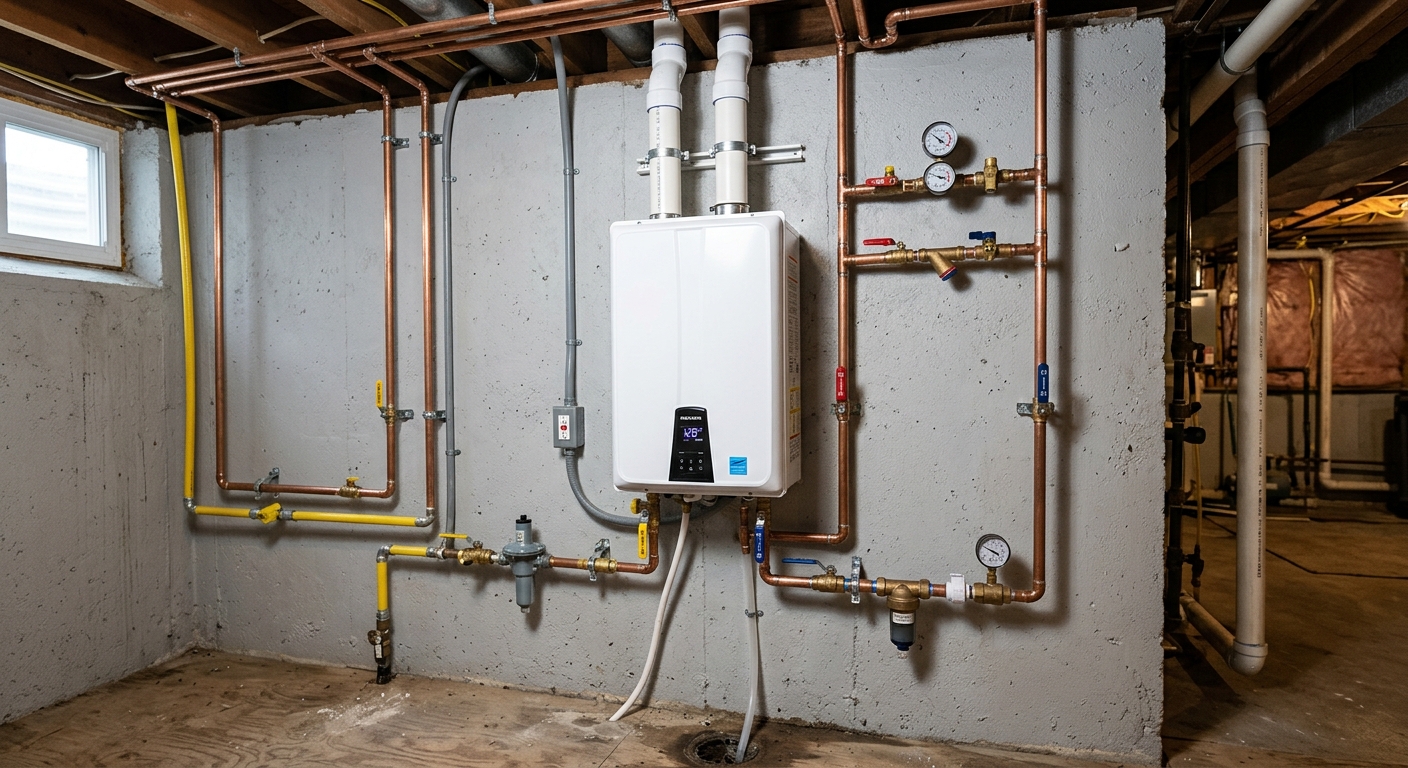
Plumbing costs in Forest Hills — 2026
Forest Hills homeowners, especially those living in older homes (88.0% built before 1980, U.S. Census Bureau, ACS 2024), face plumbing realities tied deeply to the era their house was built. Much of Pittsburgh’s housing stock dates 1900–1950, so many local houses still rely on aging galvanized and cast-iron pipes. This means higher odds of leaks, corrosion, and pressure problems as these materials naturally reach the end of their service life.
Two factors drive what you’ll pay for any repair or replacement in Forest Hills: whether it’s an emergency, and what kind of pipes are in your home. An emergency call—burst pipes, active leaks—costs more for the same repair than a scheduled job, reflecting the need for immediate response and after-hours work. For example, fixing a burst pipe on a winter weekend will cost more than a weekday appointment to fix a slow leak. This distinction matters; homeowners here are mostly in single-family homes (72.1%) and often shoulder the full repair cost without the buffer of a landlord or association.
Below are typical price bands for the most common plumbing jobs in Forest Hills. Costs run higher when access is tight—think plaster walls or finished basements. Old pipe materials can also raise the bill, especially if upgrades or code compliance become inevitable during the work.
| Service |
Scope |
Emergency rate |
Standard rate |
| Emergency repair — burst pipe |
locate, open, repair section, restore service |
$600–$1,200 |
$350–$1,200 |
| Water heater replacement (gas, 40–50 gal) |
remove old, install, test, haul away |
$1,900–$2,800 |
$1,200–$2,800 |
| Drain cleaning — main line |
augering or hydro-jet, camera if needed |
$350–$800 |
$200–$500 |
| Sewer line spot repair |
excavate or reline a failed section |
$2,000–$12,000 |
$2,000–$12,000 |
| Whole-house repipe |
replace supply lines throughout, patch and finish |
$3,500–$8,600 |
$3,500–$8,600 |
| Water service line replacement |
street to house, excavation and restoration |
$5,500–$12,000 |
$5,500–$12,000 |
Estimates for a typical Forest Hills home. Access difficulty and pipe material move these figures more than anything else.
Who is allowed to do plumbing work in Pennsylvania
In Pennsylvania, plumbing isn’t licensed at the state level—it’s handled by each municipality. That means a plumber licensed in Pittsburgh, for example, may have no legal standing to work on a plumbing system just outside city limits in Forest Hills. The practical reality for homeowners in Forest Hills is this: Don’t just ask, "Are you licensed?"—ask, "Are you licensed and permitted to work here?" In most of Allegheny County, including Pittsburgh and nearby municipalities, the Allegheny County Health Department runs its own journeyman and master plumber licensing program. If your plumber isn’t listed with their program and your job requires a permit, you’re risking a failed inspection or a red-tagged job.
Permits are required for installing or altering plumbing systems in Pittsburgh and most surrounding municipalities per the Allegheny County Health Department. Widespread practice allows minor fixture replacements like faucets to proceed without a permit, but anything involving new piping or fixture relocation needs inspection. Always ask if your project requires a permit and, if so, that the contractor will pull it. Home Improvement Contractor (HIC) registration, overseen by the Pennsylvania Office of Attorney General, is mandatory for any contract over $500—you can verify this registration at hic.attorneygeneral.gov. For jobs with employees, verify workers’ compensation through WCAIS at wcais.pa.gov, ensuring the coverage lists your property and not just the contractor’s office. These checks are your best protection if something goes wrong during your plumbing work.
Water quality and what it does to your pipes
Most homes in Forest Hills are served by the Pittsburgh Water and Sewer Authority, which is required to publish an annual water quality report. If you’re curious about what’s in your water, request this report directly from the utility. Hardness (the balance of calcium and magnesium dissolved in the water) in this region can vary, but scale buildup from moderately hard water is a common reason for shortened water heater and fixture life in older Forest Hills homes. If you see white crusts on faucet aerators or heating elements, that’s scale—no mystery.
Very soft water is rare here, but aggressive (slightly acidic) water can lead to pinhole leaks in copper pipe over decades. Softener systems sold for "performance" often don’t pencil out economically—unless you’re seeing rapid tank failure or soap scum makes you miserable, your money may be better spent on routine appliance maintenance.
Whole-house filtration makes sense only when testing confirms a problem—like elevated chlorine or sediment. Point-of-use (under-sink) filters are usually enough for taste, coffee, or odor complaints. If your home was built before 1978, be aware of the federal EPA Lead RRP Rule; don’t trust any filtration device to “remove lead” unless independently certified.
I see a lot of money wasted on redundant systems sold door-to-door. If your water quality report is good and you’re not having pipe or appliance problems, you don’t need to add treatment gear just to keep up with your neighbors.
Spot repairs or whole-house repipe?
Patching pipes makes sense in certain situations, but there’s a real threshold where spending more on repairs is throwing good money after bad. If you’ve had two or more leaks in three years (especially on the same type of pipe), that’s a pattern—not just bad luck. Falling pressure at every fixture, brown or rusty water on first draw, corrosion you can see on joints, or repeated pinhole leaks mean the pipe wall is giving up. This is especially familiar in Forest Hills and throughout Allegheny County, where much of the housing stock dates back to the early-to-mid 1900s and still uses galvanized or cast iron piping.
A spot repair on an accessible, modern pipe is usually the best course—quick, effective, and priced best. But with older galvanized supply lines, pressure loss and leaks almost always mean the whole system is closing in on end-of-life. PEX is now the standard for repipe jobs: it's flexible, durable, and fast to install. Copper is still the premium option, but adds cost. Don’t forget the real wildcard: patching and repainting drywall or plaster after the plumbing is done. In homes with old plaster walls—very common in this region—those patch costs can match or outpace the plumbing work itself, especially after a whole-house upgrade.
| Situation |
Recommendation |
Cost |
Reasoning |
| One leak, accessible, modern pipe |
Spot repair |
$350–$1,200 |
Low risk of future trouble, effective fix |
| Two or more leaks in 3 years |
Partial repipe |
$3,500–$5,800 |
Pattern of failure; proactive replacement saves on future calls |
| Galvanized supply, pressure loss |
Full repipe |
$3,500–$8,600 |
Old material at end-of-life, reliably solves pressure and leak issues |
| Polybutylene anywhere in the house |
Full repipe |
$3,500–$8,600 |
Material has unpredictable failures, often excluded from insurance |
| Cast iron drain with root intrusion |
Camera, then reline or replace |
$2,000–$12,000 |
Confirm with camera, targeted repair or full section upgrade as needed |
| Suspected lead service line |
Test, then replace the lateral |
$5,500–$12,000 |
Lead is a health risk and should be permanently removed |
How to find a good plumber in Forest Hills
Always start by confirming your plumber is licensed for work in Forest Hills itself—not just "the Pittsburgh area." Since plumbing licenses in Allegheny County are municipal, someone approved for Pittsburgh jobs may not be legal in the next township. Ask directly about Allegheny County Health Department registration. For anything over $500, Pennsylvania law also requires Home Improvement Contractor (HIC) registration; you can verify that at hic.attorneygeneral.gov. Make sure the insurance policy they show specifically covers your address, not just their office.
Workers’ compensation is mandatory for all employers—double-check status using WCAIS at wcais.pa.gov before anyone starts work. Ask who will actually be on-site; a reputable company will send in-house crews, not unknown sub-contractors. For emergency repairs, get the after-hours fee structure quoted in writing, not just a verbal promise. And never sign off on a major repipe or sewer estimate without camera footage or a pressure test that shows real need—too many bad actors in a saturated Pittsburgh metro market.
- Confirm Allegheny County Health Department plumbing license for jobs requiring permits
- Check HIC registration at hic.attorneygeneral.gov
- Verify insurance with your address as the named property
- Check workers’ compensation via wcais.pa.gov
- Get written, detailed estimates covering labor, materials, and finish work
- Request camera evidence before agreeing to sewer or main line replacement
- Ask who will perform the work (in-house crew vs. subcontractors)
- Agree on emergency rates before booking after-hours work
- Ask about permit requirements and whether the contractor handles applications
- Check references from recent local jobs—not just one town over
- Demand a written contract for work over $500
- Review payment, deposit, and cancellation terms under the Home Improvement Consumer Protection Act
Red flags: pushy “one call closes,” high-pressure upsells, lack of a camera on sewer or drain diagnosis, or quoting $5,800 for a repipe without physically inspecting all exposed piping—these are all warning signs in the dense, competitive local market.
Freeze risk and what to do about it
Forest Hills faces winter lows down to 8 °F and a required 36-inch frost depth, typical of southwestern Pennsylvania’s freeze-thaw cycles. Most pipe bursts don’t happen at the frozen spot—instead, the pipe splits downstream where pressure from expanding ice has nowhere to go, often between the plug and the closed faucet. This is why a frozen kitchen pipe might lead to a ruptured section hidden behind a wall, not just in the crawlspace.
Vulnerable zones include pipes on exterior walls, uninsulated crawlspaces, garages with piping, outdoor hose bibbs, and (in some older homes) pipes in unconditioned attics. Insulation is the cheapest and most effective prevention. Heat tape can be used on particularly at-risk runs, but must be installed to manufacturer specs. If a deep freeze is forecast, let a trickle run from one faucet—moving water is far less likely to freeze. Opening cabinet doors under sinks on outside walls lets indoor warmth protect pipes. And always shut off and drain outdoor spigots well before the season’s first hard freeze.
If pipes do freeze, use a hair dryer (slow and steady), space heater (attended only), or gentle wrap with warm towels. Never use an open flame or torch—beyond the fire hazard, it’s illegal and can ruin the pipe. If prevention fails and you’re dealing with an actual burst, the cost to get a plumber out ranges from $600–$1,200 for an emergency repair. Insulating or upgrading exposed pipes now will pay for itself if it prevents even one leak.
Dating your plumbing by what it's made of
In Forest Hills, the age of your home almost always predicts the piping you’ll find. Much of Pittsburgh’s housing stock dates to 1900–1950, so most homes still have some combination of galvanized steel supply pipes and cast iron drains—both now nearing or beyond their design life. Galvanized steel is gray, dull, magnetic, with threaded joints and often visible rust where cut or scratched. These pipes corrode from the inside, slowly reducing water pressure and eventually leaking.
Copper pipes (usually installed from the 1950s on) are reddish-brown, non-magnetic, and joined with soldered fittings. Copper generally lasts well, but Pittsburgh water can produce pinhole leaks, especially in older lines. Polybutylene pipes, found in some 1980s and 1990s homes, are light gray or blue, plastic, and joined with crimped or clamped fittings. These are notorious for sudden failures, often at joints, and are no longer insurable in some markets.
PEX pipes (in use since the 2000s) are brightly colored—usually red and blue—and flexible, joined by mechanical crimp rings. They are resistant to freeze damage and are current best practice for repiping. On the drain side, cast iron (pre-1975) is thick, black, heavy, magnetic, often joined with lead-and-oakum seals; clay tile (often orange, pre-1980) runs between house and street and can be seen at cleanouts. Clay and cast iron both fail from inside—corrosion, roots, or cracking. PVC/ABS (white or black plastic, post-1970s) is generally trouble-free when joints hold.
Use the scratch test: gray/magnetic (galvanized), orange/fragile (clay), red/copper (copper). If the exposed supply line entering your basement is gray, threads at joints, and water pressure is low, you’re likely due for a repipe.
| Material |
Typical era |
Failure mode |
Service life |
| Galvanized steel supply |
pre-1960 |
internal corrosion, pressure loss |
40–60 yrs |
| Copper supply |
1950s–present |
pinhole leaks, joint failure |
50–70 yrs |
| Polybutylene supply |
late 1970s–1995 |
fitting failure, sudden bursts |
unreliable |
| PEX supply |
2000s–present |
fitting or UV degradation |
40–50 yrs |
| Cast iron drain |
pre-1975 |
corrosion, cracking, scale |
50–75 yrs |
| Clay tile sewer lateral |
pre-1980 |
root intrusion at joints, offset |
50–60 yrs |
| PVC / ABS drain |
1970s–present |
joint separation, crushing |
50+ yrs |
Frequently asked questions — plumbing in Forest Hills
How do I verify a plumber's licence and insurance?
In Forest Hills, don’t just take their word. First, for plumbing licenses and permits, ask the contractor specifically about their Allegheny County Health Department license—this is the authority if your job requires a permit. For any job over $500, verify their Home Improvement Contractor (HIC) registration at hic.attorneygeneral.gov. Insurance is your safety net: ask to see their liability insurance certificate and check it lists your specific address, not just their office. Workers' comp status is public—use the WCAIS portal (wcais.pa.gov) to confirm coverage. These checks are crucial. If an unlicensed or uninsured worker is injured at your house, you could be on the hook. For emergency repairs that can't wait, expect to pay around $600–$1,200 for a burst pipe repair, but a reputable contractor will always supply documentation you can check while they’re en route. No credentials, no job.
Are tree roots a common sewer problem in Forest Hills?
Yes, tree roots are a frequent cause of sewer issues in Forest Hills due to the age and type of pipes underground. Many homes here—especially those built before 1980—still have clay tile or older cast iron sewer laterals. These materials develop small gaps at the joints as they age, and roots easily exploit those weak spots. If you have frequent backups or slow main drains, a root intrusion is one of the top suspects. Clearing roots is never a permanent fix; the only long-term solution is to reline or replace that section of pipe. For these repairs in Forest Hills, you’re looking at a ballpark range of $2,000–$12,000, driven by how much pipe is affected and the difficulty of access. Always ask for a camera inspection before spending money on any major sewer work.
Am I responsible for the water line under the street?
In Forest Hills and across Allegheny County, the homeowner’s responsibility typically starts at the property line. That said, when your water service line runs from the street to your house, you are responsible for the entire length, including the section under the public sidewalk or right-of-way. Replacing a failed or lead service line is a major project—digging may require permits from the local utility and even coordination with the Pittsburgh Water and Sewer Authority. For a full replacement, budget in the range of $5,500–$12,000. Confirm with the utility about the handoff point, but expect to carry the cost for any leak detected between the curb and your basement wall.
How much does sewer line repair cost in Forest Hills?
Sewer line repairs in Forest Hills reflect our local soil (clay and shale), pipe depth, and the age of our infrastructure. Most homes were built before 1980, so clay tile or cast iron is common, which means roots and settling are frequent culprits. Spot repairs or relines typically cost between $2,000–$12,000. The price varies depending on how deep the pipe is, how many feet of pipe need repair, and whether excavation must disturb sidewalks or driveways. Always request video footage of the problem before you agree to major work—many reliable contractors can show you the issue in real time while you watch.
Why do all my drains drain slowly at once?
When every drain in your Forest Hills house slows down at the same time, it almost always points to a clog or restriction in the main drain line—not just an issue with one fixture’s trap. Tree roots invading clay sewer laterals, settled cast iron clogged with rust scale, or the build-up of grease and debris over decades—all are common causes in this area due to older pipe materials. A main line auger or hydro-jet cleaning with camera inspection typically costs $200–$500 if scheduled, and may go higher if you need after-hours emergency response. Avoid repeated use of chemical drain cleaners—they're usually a short-term fix and can damage old pipes.
What do I do about a burst pipe right now?
If you find a burst pipe in your Forest Hills home, immediately shut off your main water valve. Most are near where the water line enters your basement. Open the lowest faucet to drain out any pressure. Do not use any open flame to thaw nearby pipes—use a hair dryer (not too close) or call a professional right away. Expect a typical emergency repair to run $600–$1,200 for a burst pipe if it happens after-hours or during a deep freeze. Remove valuables and dry any standing water to minimize damage. Take photos in case you need to file a homeowners' insurance claim. Don’t wait—insurance companies may deny coverage if neglect is found.
How do I prevent frozen pipes in Forest Hills?
With our winter design temp of 8 °F and frequent freeze-thaw cycles, prevention is critical in Forest Hills. Insulate any pipes near exterior walls, in crawlspaces, or in garages. Before cold snaps, let a thin trickle run from a faucet and open sink cabinet doors to let heat in. Always shut off and drain outdoor spigots before the first hard freeze of the season. If you’ve had repeated freezes, consider adding heat tape rated for water pipes, installed professionally. The cost to fix a burst is far greater—anywhere from $600–$1,200 for a simple emergency repair. Spending $50–$200 on good insulation and prep is money very well spent.
What does repiping a house cost in Forest Hills?
Repiping a Forest Hills home—especially one with original galvanized or failing copper lines—typically costs between $3,500–$8,600. This depends on the size of your house, how much drywall or plaster needs to be opened, and whether you choose premium copper or PEX. Remember, older houses (and 88.0% of homes here were built before 1980) often have difficult-to-access pipes hidden behind original finishes. The finish work—patching, painting, and restoring walls—can sometimes match the cost of the plumbing itself. A whole-house repipe is rarely urgent unless you’re seeing active leaks and severe pressure drops. Talk to more than one licensed local plumber for detailed, written bids.
Repair or replace a leaking water heater?
In Forest Hills, if your water heater is more than 12 years old and leaking from the tank, replacement almost always pays off—average lifespan is about a decade in our water conditions. Small leaks at the fittings or relief valve can sometimes be repaired for much less, but leaks at the bottom or rust coming out of taps signal the end. New gas water heater installation for a typical 40–50 gallon tank runs $1,200–$2,800, including removal and haul-away of the old unit. Factor in age and efficiency—newer models are a lot more robust against local water conditions and often come with better warranties. If the unit is under 8 years old and the leak is at a connection, a repair in the $350–$1,200 range is fair.